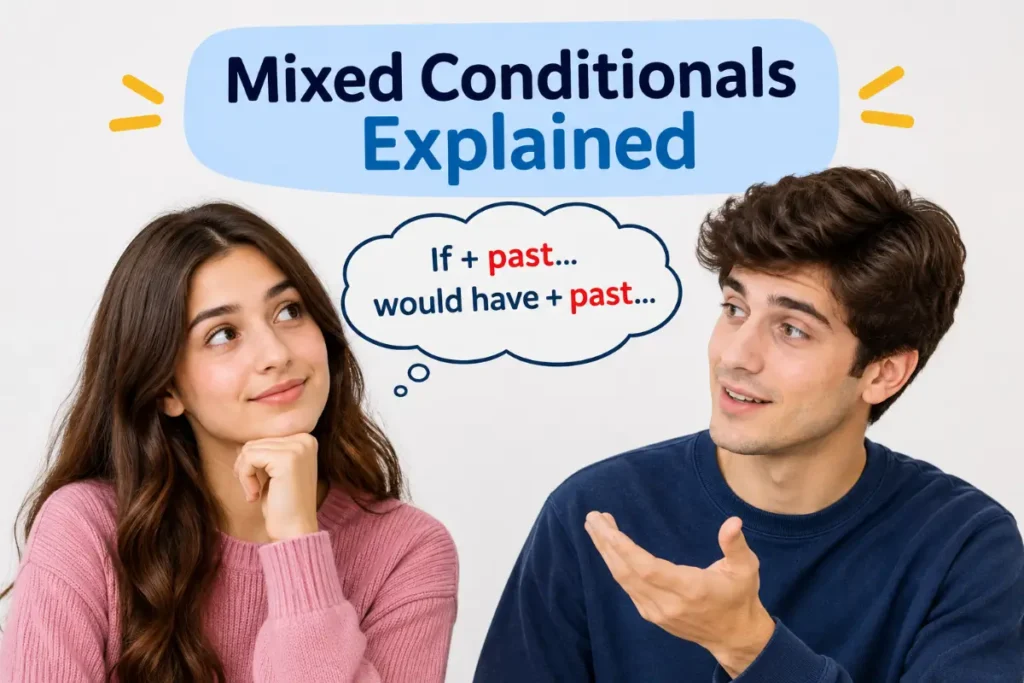
Mixed conditionals explained in one sentence: they are “if” sentences where the time of the condition and the time of the result don’t match. In an ordinary conditional, both halves sit in the same time frame. In a mixed conditional, one half points to the past and the other points to the present, or the other way around.
You already use the idea in everyday speech. “If I had taken that job, I’d be rich now” connects a decision made years ago to a situation that exists today. This guide breaks the structure down into two clear types, shows how to choose between them, compares mixed sentences with third conditionals side by side, and covers the modals, negatives, and writing contexts where mixed conditionals shine. It ends with 20 practice items and answers.
You may also find Past Participle Examples: 50 Easy Examples to Master Grammar (2026) helpful if you want to explore this topic further.
Why They’re Called “Mixed”
The standard conditionals each stay in one time frame. The second conditional imagines an unreal present or future (If I knew, I would tell you). The third imagines an unreal past (If I had known, I would have told you). A mixed conditional borrows one half from each.
The British Council’s LearnEnglish page on third and mixed conditionals explains that the key difference is the time of the result: if the result happens in the past, you have a third conditional, and if the result is true in the present, you have a mixed one. That single observation is the foundation for everything that follows.
The Two-Question Test
Whenever you aren’t sure which structure to use, ask two questions about the imagined situation.
- When is the condition? Is it a specific past event, or a general present quality?
- When is the result? Does it belong to the past, or does it still matter now?
| Condition | Result | Type |
|---|---|---|
| Past event | Past result | Third conditional |
| Past event | Present result | Mixed type 1 |
| Present quality | Past result | Mixed type 2 |
| Present quality | Present or future result | Second conditional |
Writing out your two answers before choosing verb forms prevents most mistakes.
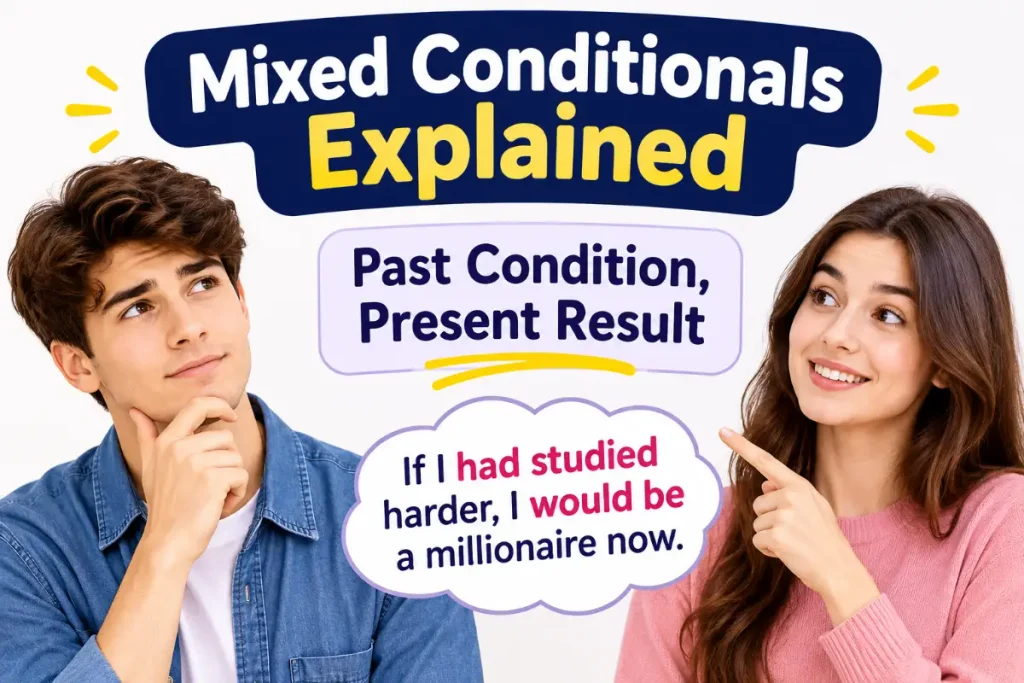
Type 1: Past Condition, Present Result
If + past perfect, would + base verb
The “if” part names something that didn’t happen in the past. The result describes how things would be different now.
- If I had studied medicine, I would be a doctor now.
- If she had caught the flight, she would be here already.
- If we had saved more, we would own a house today.
- If he had taken his doctor’s advice, he wouldn’t be in pain now.
- If the company had adopted cloud software in 2015, it wouldn’t be struggling with outdated systems today.
Look at the pattern: a single decision or event in the past (“studied,” “caught,” “saved,” “took,” “adopted”) shapes a state that exists at this moment (“am,” “is here,” “own,” “is in pain,” “is struggling”). Words like now, today, still, already, and these days often appear in the result clause.
This type is the one most people reach for when reflecting on life choices. It’s reflective rather than regretful: it simply connects the past decision to the present reality.
Type 2: Present Condition, Past Result
If + past simple, would have + past participle
The “if” part describes a present or general quality that isn’t actually true. The result is something that did or didn’t happen in the past because of that quality.
- If I weren’t afraid of flying, I would have taken the job in Tokyo.
- If he were more patient, he wouldn’t have quit so quickly.
- If they weren’t so busy, they would have come to the wedding.
- If she spoke Spanish, she would have gotten the position in Madrid.
- If I had a better memory, I wouldn’t have missed the deadline.
Here, the condition is an ongoing trait or situation (afraid, impatient, busy, unable to speak Spanish, forgetful). Those qualities are true now and were true back then, which is why they can explain a past outcome.
Why Type 2 Usually Involves States, Not Events
Notice the verbs in the “if” clauses of type 2: were afraid, were patient, were busy, spoke, had. They describe lasting states, abilities, or characteristics. That’s because a single past event normally belongs in the past perfect, which would give you a third conditional. The simple past in the “if” clause signals a general, continuing quality rather than a one-time event.
Compare:
- If I had been afraid of flying (on that day), I wouldn’t have boarded the plane. (third conditional, a specific moment)
- If I weren’t afraid of flying (as a general trait), I would have taken the job. (mixed type 2, an ongoing quality)
Time Markers That Help You Choose
| Word or Phrase | Usually Signals |
|---|---|
| now, today, these days, still, already | present result (mixed type 1) |
| nowadays, currently, at the moment | present result (mixed type 1) |
| last year, yesterday, back then, at the time | past result (third or mixed type 2) |
| in general, by nature (as a trait) | present quality (mixed type 2) |
These aren’t foolproof, but they provide quick clues about which half of the sentence belongs to which time.
Third Conditional vs. Mixed Conditional: Same Condition, Different Meaning
The best way to feel the difference is to hold the “if” clause constant and change only the result.
- Third: If I had studied medicine, I would have worked in a hospital. (result in the past)
- Mixed: If I had studied medicine, I would be working in a hospital now. (result in the present)
Both sentences share the same imagined past event. Only the time of the consequence changes, and that single change moves you from one structure to the other. For a full look at the all-past pattern, see our guide on third conditional examples.
Modals, Negatives, and Continuous Forms
Mixed conditionals aren’t limited to “would.”
Could and might express possibility rather than certainty:
- If I had studied harder, I could be at a better school now.
- If she were more organized, she might have finished sooner.
Negatives work in either clause:
- If I hadn’t moved here, I wouldn’t know my husband today.
- If he weren’t so careless, he wouldn’t have lost the file.
Continuous forms emphasize an ongoing situation in the result:
- If I had taken the job, I would be living in Berlin right now.
- If they had listened, we wouldn’t be arguing about this today.
For more about how “could,” “might,” and “would” differ in meaning, see our modal verbs list.
Results That Reach Into the Future
Present-result mixed conditionals can also stretch toward the near future when the consequence is still unfolding.
- If I had gone to bed earlier, I wouldn’t be so tired tomorrow.
- If we had invested last year, we would be earning interest this year.
The result clause still depends on a past event, but its effect continues beyond the present moment.
Word Order, Commas, and “Were”
As with other conditionals, the clauses can swap places, and a comma follows an opening “if” clause: If I had studied medicine, I would be a doctor now. / I would be a doctor now if I had studied medicine. Our guide to when to use a comma after an introductory phrase explains the comma rule in detail.
In type 2, formal English prefers were for “be” with every subject: If I were braver rather than If I was braver. That’s the subjunctive at work, which we cover in our guide to subjunctive mood examples.
Mixed Conditionals in Real Writing
Personal reflection and storytelling. Memoir writers and interviewees use mixed conditionals to connect past decisions with present lives: If my family hadn’t emigrated, I wouldn’t be speaking English right now.
Business analysis. Managers review strategy this way: If we had invested in marketing last year, we would have more customers today. The sentence links a past choice with a measurable present outcome.
Health and lifestyle. If I had quit smoking earlier, my lungs would be healthier now. Here, the present consequence is the point of the sentence.
Persuasive writing. Mixed conditionals can warn readers about ongoing consequences: If the city had planned for growth ten years ago, residents wouldn’t be stuck in traffic every morning.
In each case, the structure packs a lot of meaning into one sentence by linking cause (past) to effect (present).
How to Build a Mixed Conditional From Real Facts
Starting from what actually happened is the easiest way to produce a correct mixed sentence. Follow four steps.
- Write the real fact about the past and the real fact about the present. I didn’t learn to code, and I don’t work in tech now.
- Pick the cause and the effect. Cause: not learning to code (past). Effect: not working in tech (present).
- Reverse both and match the tenses. The cause is a past event, so use the past perfect: If I had learned to code… The effect is a present state, so use “would” plus the base verb: …I would work in tech now.
- Add a time word if it helps. If I had learned to code, I would be working in tech right now.
Here’s the same method for type 2. Real facts: I’m not confident in meetings, so I didn’t speak up yesterday. The cause is a present trait (not confident), and the effect is a past event (didn’t speak up). Reverse and match: If I were more confident in meetings, I would have spoken up yesterday.
Whenever you doubt your sentence, go back to the real facts and check that the verb forms mirror them: a past event takes the past perfect, a present quality takes the simple past, a present result takes “would,” and a past result takes “would have.”
For another useful perspective, check out Use Used To vs Would: 7 Easy Rules (2026 Guide).

“I Wish” and “If Only” With Mixed Conditionals
Mixed conditionals have close relatives in wish sentences. These express regret about the same kinds of connections.
- I wish I had learned to code. I would be working in tech now. (regret about a past event with present effects)
- If only I were more confident. I would have spoken up yesterday. (regret about a present quality with past effects)
“Wish” and “if only” follow the same unreality logic as the “if” clauses: the past perfect for a past event, the simple past (or were) for a present state. You can often convert a mixed conditional into a wish by moving the imagined condition into a wish clause. That makes “wish” sentences a handy way to check whether your tenses are right.
Quick Reference
| Type | Condition | Result | Example |
|---|---|---|---|
| Mixed 1 | past perfect | would + base | If I had gone, I’d know her now. |
| Mixed 2 | past simple | would have + participle | If I were braver, I’d have asked. |
| Third | past perfect | would have + participle | If I had gone, I’d have met her. |
| Second | past simple | would + base | If I knew, I’d tell you. |
Common Mistakes People Make
Mistake 1: Using the wrong tense in the result. If I had more time, I would have finished. This mixes unintended forms. For a general present quality, If I had more time (in general), I would have finished can work as type 2, but check that the “if” clause truly describes an ongoing state.
Mistake 2: Putting “would” in the “if” clause. If I would have studied, I would be a doctor. Use If I had studied.
Mistake 3: Using the simple past for a one-time past event. If I was born in Spain, I would speak Spanish now. A single past event needs the past perfect: If I had been born in Spain.
Mistake 4: Forgetting the base verb in type 1. I would speaking Spanish now. Correct: I would speak Spanish now.
Mistake 5: Treating every mixed sentence as an error. Mixed conditionals are correct whenever the times genuinely differ.
Mistake 6: Using “was” instead of “were” in formal type 2. Casual speech accepts “was,” but careful writing prefers If I were braver.
Mistake 7: Mixing up the two types. Check whether the condition or the result is the past half. If the condition is past, you need past perfect; if the result is past, you need “would have.”
Practice Exercise
Complete each sentence or identify the type. Answers follow.
- If I ___ (study) medicine, I ___ (be) a doctor now.
- If she ___ (not miss) the flight, she ___ (be) here now.
- If I ___ (be) braver, I ___ (ask) her out last year.
- If we ___ (leave) earlier, we ___ (not be) late now.
- If he ___ (not be) so shy, he ___ (make) friends at school.
- If they ___ (save) money, they ___ (own) a house today.
- If I ___ (not be) afraid of heights, I ___ (climb) the tower yesterday.
- If you ___ (listen) to me, you ___ (not have) this problem now.
- If she ___ (speak) French, she ___ (get) the Paris job last year.
- If I ___ (win) the lottery, I ___ (be) rich today.
- Identify: If I had studied, I would have passed.
- Identify: If I had studied, I would be at university now.
- Identify: If I were taller, I would have joined the team.
- Fix: If I had been born in Spain, I would speaking Spanish now.
- “If he ___ the instructions, he wouldn’t be confused now.” (read / had read)
- “If she ___ more patient, she wouldn’t have quit.” (is / were)
- “If I hadn’t moved here, I ___ my husband today.” (wouldn’t know / wouldn’t have known)
- “If they weren’t so busy, they ___ to the wedding last week.” (would have come / would come)
- “If the company had invested in training, it ___ stronger today.” (would be / would have been)
- Rewrite as mixed: I didn’t take the job, so I’m not rich now.
Answer Key
- had studied / would be
- hadn’t missed / would be
- were / would have asked
- had left / wouldn’t be
- weren’t / would have made
- had saved / would own
- weren’t / would have climbed
- had listened / wouldn’t have
- spoke / would have gotten
- had won / would be
- third conditional
- mixed (past → present)
- mixed (present → past)
- If I had been born in Spain, I would speak Spanish now.
- had read
- were
- wouldn’t know
- would have come
- would be
- If I had taken the job, I would be rich now.
Frequently Asked Questions
How is a mixed conditional different from a third conditional?
The third conditional keeps both the condition and the result in the past. A mixed conditional has one past half and one present half. The difference is the time of the result: past for third, present for mixed type 1.
Can I use “was” instead of “were” in mixed type 2?
In casual speech, yes. In careful writing, “were” is the standard form for unreal conditions with every subject.
Are there only two kinds of mixed conditionals?
Grammar books usually describe these two main types, because they cover the most common patterns. Speakers also combine other time frames in natural speech, such as a past condition with a future-leaning result, but those still follow the same logic.
Do I need time words to make a mixed conditional clear?
They help but aren’t required. Words like “now,” “today,” and “still” signal a present result, while “last year” or “yesterday” signal a past one. The verb forms carry most of the meaning on their own.
What’s the fastest way to choose the right pattern?
Decide when the condition and the result each occur, then match the verb forms: past perfect for a past event, past simple for a present quality, “would + base” for a present result, and “would have + participle” for a past result.
Is a mixed conditional the same as a “wish” sentence?
They’re related but different. “I wish I had studied medicine” expresses regret directly. A mixed conditional links an imagined cause to an imagined effect. You can often turn one into the other: I wish I had studied medicine; I’d be a doctor now.
Before moving on, you may also want to read Modal Verbs List: What Each One Means and When to Use It for more helpful grammar tips.
Wrapping Up
If you remember one habit from mixed conditionals explained here, make it the two-question test: when is the condition, and when is the result? A past event with a present result uses “if + past perfect, would + base verb.” A present quality with a past result uses “if + past simple, would have + past participle.” The rest is practice and choosing the right modal.
Pay attention to the real-life moments when you naturally connect past choices to present situations, because those are the moments mixed conditionals were made for. Used well, they let you explain cause and effect across time in a single, compact sentence.