These subjunctive mood examples show how English quietly changes its verbs when we talk about wishes, hypotheticals, and demands instead of plain facts. If you’ve ever wondered why “If I were you” sounds right and “If I was you” sounds slightly off, you’ve already bumped into the subjunctive without knowing its name.
The good news is that the subjunctive shows up in only a handful of patterns. Learn those patterns, and you’ll know exactly when to reach for “were,” when to use the bare verb, and when a regular “was” is perfectly fine.
You may also find Reported Speech Tense Changes: The Complete Backshift Guide (2026) helpful if you want to explore this topic further.
What the Subjunctive Actually Is
Most of the time, English uses the indicative mood, which states facts: It is sunny. She was late. The subjunctive mood is used when something is imagined, wished for, doubted, or demanded. It signals “this isn’t necessarily real.” Two forms do most of the work:
- The past subjunctive, which in practice means using were with every subject (including I, he, she, and it).
- The present subjunctive, which means using the bare base verb, even with he, she, and it.
Pattern 1: Wishes and “As If” With “Were”
When you wish for something contrary to reality, the verb “be” becomes were.
- I wish I were taller.
- She wishes it were Friday.
- If only he were here.
- He talks as if he were the boss.
In each case, the situation isn’t true: you’re not taller, it isn’t Friday, he isn’t here, and he isn’t the boss. That “not true” feeling is the signal that you need the subjunctive.
Pattern 2: Unreal Conditionals With “If I Were”
The most famous subjunctive example is the “if” clause describing something unlikely or impossible.
- If I were you, I’d apologize.
- If she were president, she would change the law.
- If it were up to me, we’d leave now.
Compare that with a real possibility, where the indicative “was” is correct: If he was late yesterday, he probably missed the opening. Here you genuinely don’t know whether he was late, so you’re not imagining anything. Merriam-Webster points out the subjunctive isn’t always strictly followed, even by great writers: F. Scott Fitzgerald sometimes wrote “I wish I was” where strict rules call for “were.” So “was” in casual unreal sentences isn’t a disaster, but “were” remains the standard choice in careful writing.
Pattern 3: Demands, Suggestions, and Requirements (The Mandative Subjunctive)
After verbs like demand, insist, suggest, recommend, request, require, and propose, and after adjectives like essential, vital, important, and necessary, English uses the bare verb in the “that” clause.
- She insists that he arrive on time. (not “arrives”)
- I suggest that she take the earlier train.
- It is essential that every student be present. (not “is”)
- The rules require that each applicant submit a form.
Notice the verb doesn’t change for third-person singular: he arrive, she take, student be. That oddly “wrong-looking” form is the whole point.
Pattern 4: Frozen Expressions
Some subjunctive forms survive in set phrases that never changed:
- Long live the queen!
- Be that as it may, we’ll proceed.
- Come what may, we’ll stay together.
- If need be, I can drive.
- So be it.
- God bless you.
You don’t need to analyze these. Just recognize them as fossils of an older, more widespread subjunctive.
Subjunctive vs. Conditional: Not the Same Thing
People often mix up the subjunctive mood with the conditional sentence structure. They overlap, but they aren’t identical. A conditional describes “if X, then Y.” The subjunctive is the verb form that shows up inside certain conditionals (and wishes and demands) to mark unreality. For the full conditional patterns, see our guides on third conditional examples and mixed conditionals explained.
20 Subjunctive Mood Examples in Everyday English
The subjunctive mood might sound like a complicated grammar term, but you probably use it more often than you realize. It appears in everyday conversations when you express wishes, give advice, make suggestions, or imagine situations that aren’t real. Once you recognize these patterns, identifying the subjunctive becomes much easier.
Here are 20 subjunctive mood examples that show how it works in different situations:
| Example Sentence | What It Expresses |
|---|---|
| I wish I were on vacation. | An unreal wish |
| If I were rich, I’d buy a beach house. | An imaginary situation |
| She wishes she were more confident. | A personal wish |
| If he were here, he’d know what to do. | An unreal condition |
| I suggest that she apply for the job. | A recommendation |
| The doctor recommended that he rest. | Advice |
| My parents insist that I be home by ten. | A demand |
| It’s important that everyone arrive early. | A requirement |
| The teacher requested that each student bring a notebook. | A request |
| We demand that the company take action. | A strong demand |
| If only I were better at math. | An unreal wish |
| He acts as if he were the owner. | An imaginary comparison |
| I wish it were warmer outside. | A wish about the present |
| The manager requires that every employee attend the meeting. | A requirement |
| It’s essential that she be informed immediately. | Necessity |
| Long live the king! | A traditional expression |
| Come what may, I’ll support you. | A fixed expression |
| Be that as it may, we must continue. | A fixed expression |
| I propose that we start earlier. | A suggestion |
| The committee insists that the report be completed today. | A formal requirement |
Look closely at the verbs in these sentences. You’ll notice forms such as were, be, apply, rest, and arrive. They don’t always follow the usual subject-verb agreement rules because the subjunctive has its own patterns.
For example, “She applies for the job” is correct in a regular statement, but “I suggest that she apply for the job” uses the base verb because it follows a recommendation.
That’s the key to recognizing the subjunctive: pay attention to what the speaker is expressing, not just the subject of the sentence.
Present Subjunctive vs. Past Subjunctive: What’s the Difference?
English has two main subjunctive forms: the present subjunctive and the past subjunctive. Their names can be a little misleading because the past subjunctive doesn’t necessarily describe something that happened in the past. Both forms help express ideas that go beyond straightforward facts, but they appear in different sentence patterns.
Present Subjunctive
The present subjunctive uses the base form of the verb, even when the subject is he, she, or it. You’ll usually find it after words that express suggestions, demands, requests, recommendations, or requirements.
For example:
- I recommend that he take a short break.
- She insists that everyone be present.
- It’s important that the application include all required documents.
- The coach suggested that we practice every day.
- They demanded that the company refund their money.
Notice that the verbs don’t take an -s ending with singular subjects. In ordinary statements, you’d say “he takes a break,” but in the subjunctive construction, you say “I recommend that he take a break.”
Past Subjunctive
The past subjunctive is most commonly seen with the verb be, which changes to were regardless of the subject. It’s used to talk about imaginary situations, unreal conditions, and wishes that don’t match reality.
For example:
- If I were famous, I’d use my platform to help others.
- I wish she were here.
- If he were more careful, he wouldn’t make these mistakes.
- She talks as if she were the manager.
- If the weather were better, we’d go hiking.
In these examples, were doesn’t indicate past time. Instead, it shows that the speaker is imagining a different situation.
Here’s a quick comparison:
| Feature | Present Subjunctive | Past Subjunctive |
|---|---|---|
| Main verb form | Base form of the verb | Were (with the verb be) |
| Common use | Demands, suggestions, and requirements | Wishes and unreal situations |
| Example | I suggest that he go. | If he were here, he’d help. |
| Another example | It’s vital that she be ready. | I wish she were ready. |
The easiest way to remember the difference is to look at the purpose of the sentence. If someone is requesting, suggesting, or demanding something, the present subjunctive may be needed. If someone is imagining a situation that isn’t real, were is often the correct choice.
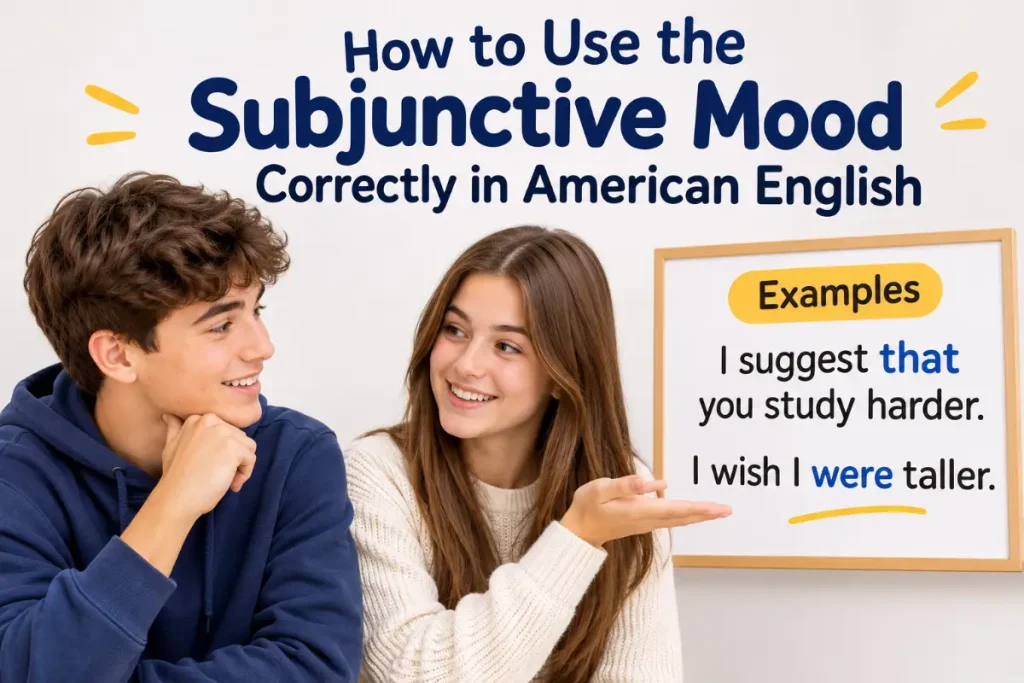
How to Use the Subjunctive Mood Correctly in American English
The subjunctive mood is still an important part of American English, especially in formal writing, academic work, professional communication, and everyday expressions such as “If I were you.”
You don’t need to memorize dozens of complicated grammar rules to use it correctly. Focus on these three situations, and you’ll be able to recognize most common subjunctive constructions.
1. Use “Were” for Unreal or Imaginary Situations
When you talk about something that isn’t true or imagine a different reality, use were in careful standard English, even with singular subjects such as I, he, and she.
For example:
- If I were in your position, I’d accept the offer.
- I wish it were easier.
- If she were the manager, things might be different.
In casual American conversation, you may also hear “If I was in your position” or “I wish it was easier.” These forms are common in everyday speech, but were remains the traditional choice in formal writing when expressing an unreal situation.
2. Use the Base Verb After Suggestions and Demands
When a sentence expresses a demand, recommendation, request, or requirement, the verb in the following that clause often stays in its base form.
For example:
- The supervisor requested that he finish the report.
- I recommend that she see a specialist.
- They insisted that the meeting begin on time.
- It’s essential that every employee follow the safety rules.
A common mistake is adding -s to the verb when the subject is singular. Remember, the subjunctive doesn’t follow the usual third-person singular pattern.
3. Don’t Use the Subjunctive for Every “If” or “That” Clause
For another useful perspective, check out Future Perfect Tense Examples: 25 Simple Sentences + Rules (2026).
Seeing the words if or that doesn’t automatically mean you need the subjunctive. The meaning of the sentence determines which verb form works.
Compare these examples:
| Indicative Mood | Subjunctive Mood |
|---|---|
| If I was rude, I apologize. | If I were you, I’d apologize. |
| She knows that he is ready. | She suggests that he be ready. |
| If he was absent yesterday, I didn’t notice. | I wish he were here today. |
The indicative mood describes facts, beliefs, and real possibilities. The subjunctive expresses wishes, hypothetical situations, recommendations, and demands.
Once you understand this difference, choosing between was and were, or arrives and arrive, becomes much easier. These small verb changes can make a noticeable difference in the accuracy of your writing.
Quick Reference
| Situation | Subjunctive Form | Example |
|---|---|---|
| Wish | were | I wish I were rich. |
| Unreal “if” | were | If I were you… |
| Demand/suggestion | base verb | I insist that he leave. |
| “Essential” adjectives | base verb | It’s vital that she be told. |
| Frozen phrase | fixed | Long live the king. |
| Real possibility | indicative (was) | If he was late, he got in trouble. |
Common Mistakes People Make
Mistake 1: If I was you, I’d go. Careful writing prefers If I were you.
Mistake 2: She demanded that he leaves. Use the bare verb: that he leave.
Mistake 3: It is important that he is on time. The subjunctive version is that he be on time.
Mistake 4: Using “were” for real possibilities: If he were late yesterday, he missed it wrongly implies you’re imagining. Use was when it could really be true.
Mistake 5: Writing I wish I would be taller. The wish pattern uses were: I wish I were taller.
Practice Exercise
Choose the correct form. Answers follow.
- If I ___ (was/were) you, I’d apologize.
- I wish she ___ (was/were) here.
- The manager insists that he ___ (arrives/arrive) on time.
- It is essential that every student ___ (is/be) present.
- If he ___ (was/were) late yesterday, he probably missed the intro. (real possibility)
- She suggested that we ___ (take/takes) the early train.
- ___ (Was/Were) I rich, I’d travel the world.
- He talks as if he ___ (knows/knew) everything.
- I demand that she ___ (apologizes/apologize).
- Long ___ (live/lives) the queen!
- If it ___ (was/were) up to me, I’d cancel the event.
- The doctor recommended that he ___ (rests/rest) for a week.
- I wish I ___ (had/have) more time.
- If only it ___ (is/were) Friday.
- Be that as it ___ (may/might), we’re moving forward.
- It’s vital that the report ___ (be/is) finished today.
- If I ___ (were/am) taller, I’d play basketball.
- The rules require that each applicant ___ (submits/submit) a form.
- Come what ___ (may/will), we’ll stay together.
- She acts as though she ___ (is/were) the boss.
Answer Key
- were
- were
- arrive
- be
- was
- take
- Were
- knew
- apologize
- live
- were
- rest
- had
- were
- may
- be
- were
- submit
- may
- were
Frequently Asked Questions
Is “if I was” always wrong?
Not always. It’s perfectly correct for real possibilities (“If I was rude, I’m sorry”). For imagined or impossible situations, “if I were” is the standard form, though “was” turns up in casual speech and even in published writing.
Why does the subjunctive use “he be” instead of “he is”?
The present subjunctive uses the plain base form of the verb for every subject. “He be” and “she take” look odd, but that’s the pattern for demands and suggestions in formal English.
Is the subjunctive dying out in English?
It has shrunk over the centuries, but it’s still alive in “if I were,” “I wish it were,” and mandative sentences like “I insist that she go,” especially in formal and American English.
Do British and American English treat the subjunctive differently?
Slightly. American English keeps the mandative subjunctive (“I suggest that he go”) more consistently, while British English more often uses “should” (“I suggest that he should go”) or the indicative.
What’s the fastest way to catch subjunctive errors before publishing?
Look for wishes, “as if” clauses, unreal “if” clauses, and “that” clauses after words like insist, suggest, or essential, then check that you used “were” or the bare verb.
Before moving on, you may also want to read Common List of Irregular Verbs (2026 Guide) for more helpful grammar tips.
Wrapping Up
Once you’ve seen enough subjunctive mood examples, the pattern is easy to spot: any time you’re wishing, imagining something unreal, or demanding that something happen, the verb steps back to “were” or the bare form. Real facts and genuine possibilities stay in the ordinary indicative.
Don’t worry about memorizing grammar terminology. Just train your ear for the signals (wish, if only, as if, insist, suggest, essential) and choose “were” or the base verb whenever they appear. Your writing will sound more polished, and you’ll be in good company with careful writers everywhere. To see how these forms combine with modal verbs, check our modal verbs list.