These present perfect continuous tense examples show how English talks about activities that started in the past and are still connected to the present moment. If you’ve ever said “I’ve been waiting for an hour” or “It’s been raining all day,” you’ve used this tense without thinking twice about it.
The tricky part isn’t saying it. It’s knowing when to choose it over the simpler present perfect (“I’ve waited”). This guide walks through the form, the three main uses, and the stative-verb exception that catches almost everyone.
You may also find Use Have Been vs Had Been: 7 Easy Rules (2026 Guide) helpful if you want to explore this topic further.
Quick Answer
The present perfect continuous tense describes an action that started in the past and is still happening or has recently stopped with a result visible in the present. Its structure is has/have + been + verb-ing.
Examples:
- I have been working for three hours.
- She has been studying since morning.
- They have been playing soccer all afternoon.
- He has been feeling tired lately.
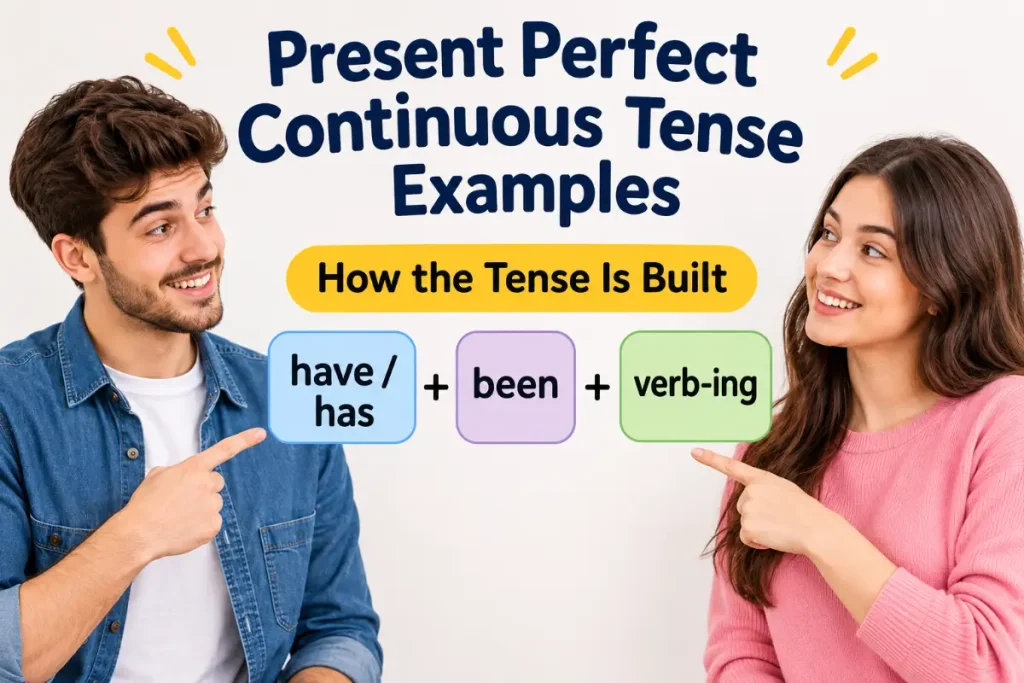
How the Tense Is Built
The structure is have/has + been + verb-ing.
- I have been working.
- She has been studying.
- They have not been sleeping well. (negative: haven’t been)
- Have you been waiting long? (question)
Contractions are everywhere in speech and informal writing: I’ve been, she’s been, they’ve been, haven’t been, hasn’t been.
Use 1: An Action Still in Progress, With “For” or “Since”
The most common use is an activity that began in the past and continues now. Time expressions like for, since, how long, and all day often come along.
- I’ve been learning Spanish for two years.
- She’s been working here since 2019.
- How long have you been waiting?
- It’s been raining all morning.
The British Council’s LearnEnglish grammar page notes that “for,” “since,” and “how long” often appear with this tense when talking about ongoing single or repeated actions.
Use 2: Recent Activity With Visible Results
Sometimes the activity has just stopped, but you can see the evidence.
- You’re out of breath. Have you been running?
- Her eyes are red. She’s been crying.
- The kitchen smells great. Someone’s been baking.
You don’t need “for” or “since” here. The present evidence is what links the past activity to now.
Use 3: Repeated or Temporary Activity Lately
The tense also describes repeated actions over a recent period, or situations that feel temporary.
- I’ve been drinking more water lately.
- He’s been coming to the gym every morning this month.
- We’ve been staying with friends while our house is repaired.
Present Perfect Continuous vs. Present Perfect Simple
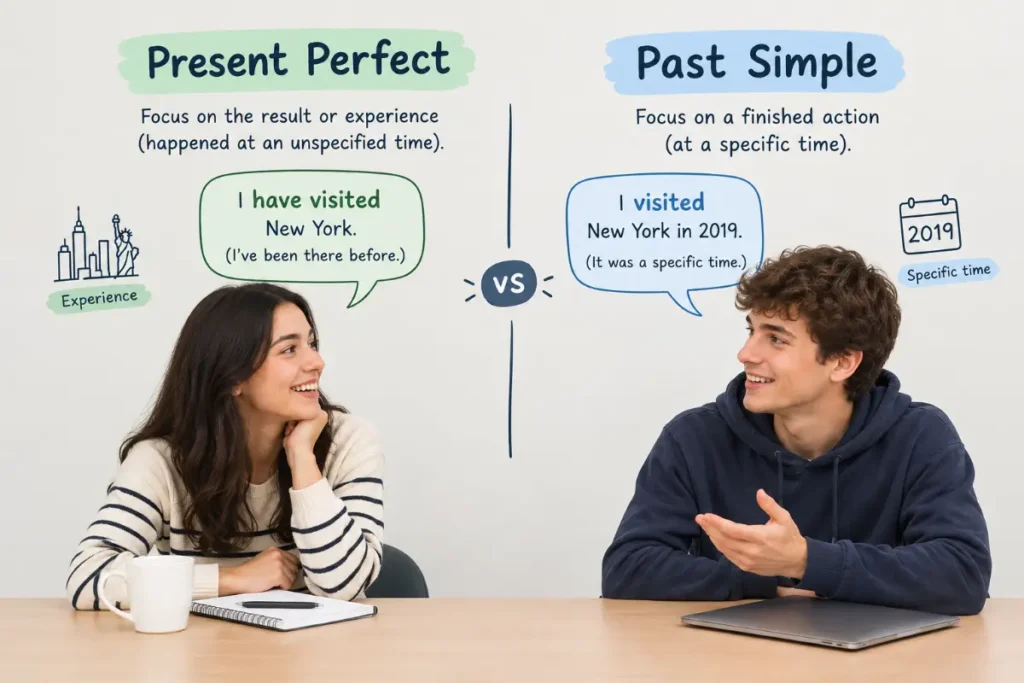
Both tenses connect the past to the present, but they focus on different things. The usual rule: the simple form focuses on the result or amount; the continuous form focuses on the activity or duration.
- I’ve written three emails. (result and number)
- I’ve been writing emails all morning. (the activity)
- She has painted the room. (finished, done)
- She has been painting the room. (in progress, or the activity itself is the point)
If you can answer “how many?” or “how much?”, the simple form is usually the better choice. If you’re highlighting how long or the ongoing process, choose the continuous.
The Stative Verb Exception
Verbs that describe states rather than actions (know, like, love, hate, believe, own, want, belong, understand) rarely appear in the continuous form. Use the simple form instead.
- I have known him for ten years. (not have been knowing)
- She has owned the shop since 2015.
- We have wanted this for ages.
30 Present Perfect Continuous Tense Examples in Everyday English
Present perfect continuous tense becomes easier to understand when you see how people use it in everyday conversations. These examples show how the tense describes ongoing activities, recent actions, and repeated situations connected to the present.
| Example | What It Shows |
|---|---|
| I have been working on my project all morning. | Ongoing activity |
| She has been studying for her final exams. | Ongoing activity |
| They have been waiting for the bus since 8 a.m. | Starting point |
| We have been living in this neighborhood for five years. | Duration |
| He has been learning to drive lately. | Recent activity |
| It has been raining since yesterday. | Ongoing situation |
| My parents have been traveling around Europe. | Ongoing activity |
| The baby has been sleeping for three hours. | Duration |
| I have been reading this novel all week. | Ongoing activity |
| She has been practicing the piano every evening. | Repeated activity |
| You have been working too hard recently. | Recent activity |
| The students have been preparing for the competition. | Ongoing activity |
| He has been fixing his car since this morning. | Duration |
| We have been discussing the new project all day. | Ongoing activity |
| My brother has been playing video games lately. | Repeated activity |
| The neighbors have been making noise all night. | Ongoing situation |
| I have been trying to contact you for hours. | Duration |
| She has been exercising regularly this month. | Repeated activity |
| They have been building their new house since January. | Ongoing activity |
| The company has been hiring new employees recently. | Recent activity |
| Why have you been avoiding my calls? | Repeated behavior |
| Someone has been using my computer. | Recent activity |
| Her eyes are swollen because she has been crying. | Visible result |
| You look exhausted. Have you been running? | Visible result |
| The kitchen smells wonderful. Mom has been cooking. | Visible result |
| He has been working from home this week. | Temporary situation |
| We have been staying at a hotel while our house is renovated. | Temporary situation |
| How long have they been waiting outside? | Asking about duration |
| I haven’t been sleeping well lately. | Recent situation |
| Has she been taking English lessons recently? | Asking about recent activity |
Notice how each sentence connects an earlier activity to the present. Some describe actions that are still happening, while others explain a recent activity through its visible results.
Present Perfect Continuous Tense Examples in Positive, Negative, and Question Forms
The present perfect continuous tense follows the same basic structure in positive, negative, and question sentences. However, the position of have or has changes depending on the sentence type.
Understanding these three forms will help you use the tense naturally in everyday speaking and writing.
Positive Sentences
Use subject + have/has + been + verb-ing to make positive statements.
- I have been working on my English.
- She has been cooking dinner for an hour.
- They have been playing soccer since noon.
- He has been studying for his exams.
- We have been waiting for our friends.
Use has with he, she, and it, and have with I, you, we, and they.
Negative Sentences
To make a negative sentence, place not after have or has.
Structure: Subject + have/has + not + been + verb-ing.
- I have not been feeling well lately.
- She has not been attending her classes regularly.
- They have not been working on the assignment.
- He hasn’t been sleeping properly.
- We haven’t been watching television recently.
In everyday English, contractions such as haven’t and hasn’t are more common than their full forms.

Interrogative Sentences
For questions, move have or has before the subject.
Structure: Have/Has + subject + been + verb-ing?
- Have you been waiting long?
- Has she been working here for five years?
- Have they been practicing for the match?
- Has he been learning English recently?
- Have we been making too much noise?
For questions that ask about duration or details, add a question word at the beginning:
- How long have you been studying English?
- What has she been doing all morning?
- Why have they been arguing?
- Where have you been staying lately?
Remember: The word been must appear between have/has and the verb ending in -ing. Leaving it out is one of the most common mistakes learners make.
Present Perfect Continuous Tense Examples With For, Since, Lately, and Recently
Time expressions make present perfect continuous sentences more specific. They help explain how long an activity has continued, when it started, or whether it has been happening during a recent period.
Here are the most common time expressions used with this tense.
Examples With “For”
Use for when you want to mention the duration of an activity. It answers the question “How long?”
- I have been working here for six months.
- She has been learning French for two years.
- They have been waiting for the doctor for an hour.
- We have been living in this apartment for a decade.
- He has been practicing basketball for three hours.
Examples With “Since”
Use since when you want to identify the starting point of an activity.
- I have been studying since 7 a.m.
- She has been working here since 2022.
- They have been living in Chicago since last summer.
- We have been waiting since Monday.
- He has been playing the guitar since childhood.
Examples With “Lately”
Lately refers to a recent period. It often describes activities or habits that have happened repeatedly or continued over time.
- I have been drinking more water lately.
- She has been feeling tired lately.
- They have been spending more time together lately.
- He has been exercising regularly lately.
- We have been discussing our future plans lately.
Examples With “Recently”
Recently also refers to a period close to the present. It can describe recent activities, changes, or temporary situations.
- I have been working overtime recently.
- She has been taking online classes recently.
- They have been visiting their grandparents recently.
- He has been looking for a new job recently.
- We have been spending less money recently.
Quick tip: Remember the difference between for and since. Use for with a period of time, such as “for three hours,” and since with a starting point, such as “since Monday.” Both can help connect a past activity to the present.
Quick Reference
| Use | Pattern | Example |
|---|---|---|
| Ongoing action | have/has been + -ing + for/since | I’ve been waiting since noon. |
| Visible recent result | have/has been + -ing | You look tired. Have you been working? |
| Repeated lately | have/has been + -ing | He’s been jogging lately. |
| Result or number | present perfect simple | I’ve read three chapters. |
| Stative verb | present perfect simple | I’ve known her for years. |
Common Mistakes People Make
Mistake 1: I am waiting here since 9. Use the present perfect continuous: I’ve been waiting here since 9.
Mistake 2: She has been knowing him for years. “Know” is stative: She has known him for years.
Mistake 3: I’ve been writing three emails. A specific number points to the simple form: I’ve written three emails.
Mistake 4: We’ve been living here since five years. “For” goes with a length of time: for five years. “Since” goes with a starting point: since 2020.
For another useful perspective, check out Zero Conditional Sentences Examples: 2026 Grammar Guide.
Mistake 5: Forgetting “been”: She has working all day. The correct form is has been working.
Practice Exercise
Write the correct form, or choose the better option. Answers follow.
- I ___ (wait) for an hour.
- She ___ (study) since 8 a.m.
- How long ___ you ___ (live) here?
- They ___ not ___ (sleep) well lately.
- The kids are muddy. They ___ (play) outside.
- He ___ (work) here for ten years.
- It ___ (rain) all day.
- ___ you ___ (cry)? Your eyes are red.
- We ___ (talk) about this since lunch.
- She ___ (learn) piano since she was six.
- I ___ (not feel) well recently.
- What ___ he ___ (do) all morning?
- They ___ (build) the bridge for two years.
- The baby ___ (cry) for ten minutes.
- I ___ (read) this book all week.
- He ___ (practice) guitar since breakfast.
- We ___ (look) for you everywhere!
- “I ___ this house since 2018.” (have owned / have been owning)
- “She ___ three emails this morning.” (has written / has been writing)
- “He ___ the same song all day.” (has played / has been playing)
Answer Key
- have been waiting
- has been studying
- have / been living
- have / been sleeping (haven’t been sleeping)
- have been playing
- has been working
- has been raining
- Have / been crying
- have been talking
- has been learning
- haven’t been feeling
- has / been doing
- have been building
- has been crying
- have been reading
- has been practicing
- have been looking
- have owned
- has written
- has been playing
Frequently Asked Questions
Does the present perfect continuous mean the action is still happening?
Often, but not always. It can describe something that’s still going on or something that just stopped with visible results. Context tells you which.
Can I use “always” with the present perfect continuous?
It’s unusual. Speakers generally avoid “always” with this tense and use other forms or time expressions like “all day” or “lately.”
What’s the difference between “for” and “since” here?
“For” introduces a length of time (for two hours, for three years). “Since” introduces a starting point (since Monday, since 2020).
Can I use the continuous form with stative verbs like “know” or “love”?
Almost never. Stative verbs take the simple form: “I’ve known him for years,” not “I’ve been knowing him.”
What’s the fastest way to check my sentence?
Ask whether you’re focusing on the activity or duration (continuous) or on a result or number (simple), and confirm you have “have/has been + -ing.”
Before moving on, you may also want to read Mixed Conditionals Explained: 2026 Guide for more helpful grammar tips.
Wrapping Up
After working through these present perfect continuous tense examples, the core idea should feel straightforward: the tense links an ongoing or very recent activity to the present moment, usually with “for,” “since,” or visible evidence. Pick it when the activity or duration is the point, and switch to the simple form when you care about the result or count.
To see how the same idea shifts back in time, read our guide to past perfect continuous tense rules, and for the “have been” versus “had been” decision in general, see how to use have been vs had been. If you’d like to keep tenses consistent across a whole sentence, our sequence of tenses rules page covers that next step.