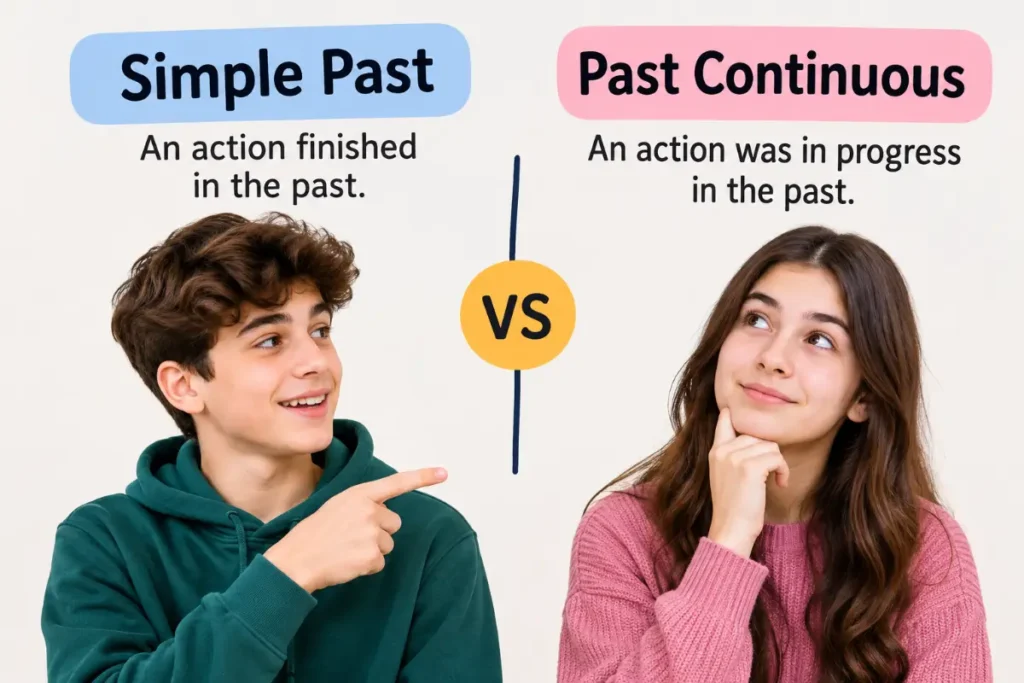
The choice between simple past vs past continuous comes down to how you picture the action. The simple past treats it as a finished event: “I cooked dinner.” The past continuous treats it as something in progress at a moment in the past: “I was cooking dinner when the phone rang.” One is a completed fact, and the other is a scene you’re standing inside.
Most of the time, the two tenses work together. A longer action in progress sets the scene, and a shorter one interrupts it. This guide covers that interruption pattern, the background-versus-event contrast that makes stories vivid, the verbs that never take the continuous, and the small differences in meaning that change a sentence from “finished” to “unfinished.”
You may also find When to Use Past Perfect Tense Practical Guide (2026) helpful if you want to explore this topic further.
The Core Contrast
| Simple Past | Past Continuous | |
|---|---|---|
| Form | verb + -ed, or an irregular past form | was/were + verb + -ing |
| Picture | a finished event | an action in progress at a past moment |
| Question it answers | What happened? | What was going on? |
| Example | She wrote a letter. | She was writing a letter. |
The Athabasca University Write Site describes the past progressive as an action that was happening when another action took place, and lists while and when as the typical time clues. That pairing, a continuous action plus an interrupting simple past one, is the pattern to learn first.

How the Past Continuous Is Formed
The form is was or were plus the main verb with -ing.
- I was working. / He was working. / It was working.
- You were working. / We were working. / They were working.
The negative is wasn’t or weren’t, and questions invert the subject: Were you sleeping? What was she doing? Short answers repeat the auxiliary: Yes, I was. No, they weren’t. The spelling rules for the -ing form, such as run → running and make → making, are the same ones covered in our guide to present continuous tense rules.
Pattern 1: The Interrupted Action
This is the pattern the two tenses were made for. A longer action is in progress (past continuous) when a shorter event cuts in (simple past).
- I was cooking dinner when the phone rang.
- She was taking a shower when the doorbell rang.
- They were playing tennis when it started to rain.
- What were you doing when the earthquake happened?
The continuous action began before the interruption and was still going when it arrived. The simple past marks the moment of interruption, a single point in time.
When vs. While
When usually introduces the shorter interrupting event, and while introduces the longer action in progress.
- I was cooking when the phone rang.
- While I was cooking, the phone rang.
Both sentences say the same thing. The order of the clauses changes, but the tenses stay the same.
Pattern 2: Two Actions at the Same Time
When two longer actions happen at the same moment, both take the past continuous, usually joined by while.
- While I was studying, my brother was playing video games.
- She was singing while he was playing guitar.
This gives a picture of two parallel activities. A sentence with both actions in the simple past, like “She sang while he played guitar,” is also correct, but it treats the actions as completed rather than ongoing.
Pattern 3: Setting the Scene
The past continuous works as the background in a story, with the simple past carrying the main events forward.
- The sun was shining and the birds were singing when I left the house.
- It was raining heavily when we arrived at the station.
- Everyone was dancing when the music suddenly stopped.
This is why the two tenses often appear together in fiction and anecdotes. The continuous paints the scene, and the simple past moves the plot.
Pattern 4: A Sequence of Finished Events
When events happen one after another, each one is complete, so the simple past is the right choice. The continuous would be wrong here.
- She woke up, brushed her teeth, and left for work.
- He opened the door, looked inside, and screamed.
- Incorrect: She was waking up, was brushing her teeth, and was leaving for work.
A chain of past continuous verbs makes it sound as though everything happened at once, which isn’t what a sequence means.
Pattern 5: Completed vs. Unfinished
Sometimes the two tenses differ in whether the action was finished.
| Simple Past | Past Continuous |
|---|---|
| She painted the room. (she finished) | She was painting the room. (in progress; we don’t know if she finished) |
| I wrote a letter. (completed) | I was writing a letter. (at that moment, not necessarily completed) |
| He read the book. (the whole book) | He was reading the book. (he was in the middle of it) |
This is a useful distinction in storytelling and in reports, where you might want to emphasize that something was still in progress at a key moment.

Pattern 6: Polite Softening
The past continuous can make a request or question sound more polite and less direct. This use looks like a past tense but actually refers to the present.
- I was wondering if you could help me.
- We were hoping you’d join us.
- I was thinking we could meet on Friday.
Compare the blunter “I wonder if you can help me.” The past continuous adds distance and politeness.
Pattern 7: Repeated Annoying Past Habits
Just like the present continuous, the past continuous with always or constantly can describe a repeated action that annoyed the speaker.
- He was always losing his keys.
- She was constantly complaining about the weather.
The simple past, “He always lost his keys,” states the habit neutrally. The continuous adds a tone of annoyance.
Verbs That Don’t Take the Past Continuous
Stative verbs, those describing states rather than actions, usually stay in the simple past, just as they do in the present.
- Incorrect: I was knowing the answer.
- Correct: I knew the answer.
- Incorrect: She was owning a car in 2015.
- Correct: She owned a car in 2015.
The same list applies: know, understand, believe, want, need, like, love, own, belong, seem. Our guide to present continuous tense rules lists these verbs and the ones with both meanings.
Simple Past vs. Past Perfect: A Quick Note
The past perfect, covered in our guide to when to use past perfect tense, shows an action finished before another past event. The past continuous shows an action in progress at a past moment. They answer different questions: “What had already happened?” versus “What was going on?”
- When I arrived, the guests had left. (finished before I came)
- When I arrived, the guests were leaving. (in the middle of leaving)
Simple Past vs. Past Continuous Examples in Everyday English
Understanding grammar rules is easier when you see how people use them in everyday conversations. The simple past and past continuous often appear in stories, daily routines, and descriptions of past experiences. The difference is whether you’re reporting a completed event or describing something that was happening at a particular moment.
Compare these examples:
| Simple Past | Past Continuous |
|---|---|
| I watched a movie last night. | I was watching a movie at 9 p.m. |
| She cleaned her room yesterday. | She was cleaning her room when I arrived. |
| They played basketball after school. | They were playing basketball when it started raining. |
| He worked late last Friday. | He was working when his manager called. |
| We drove to Chicago last weekend. | We were driving to Chicago when the storm began. |
| My mother cooked dinner. | My mother was cooking dinner when I got home. |
| The baby cried last night. | The baby was crying when we entered the room. |
| I read that book last summer. | I was reading that book when you called. |
Notice that the simple past reports what happened, while the past continuous places the listener inside an activity that was already in progress.
Simple Past and Past Continuous in Questions
You can also use both tenses to ask about past events, but the question structure changes depending on what you want to know.
| Simple Past Question | Past Continuous Question |
|---|---|
| What did you eat? | What were you eating? |
| Where did she go? | Where was she going? |
| Did they watch the game? | Were they watching the game? |
| Did he work yesterday? | Was he working at 6 p.m.? |
| When did you leave? | What were you doing when I left? |
Use the simple past when asking about a completed action or event. Use the past continuous when asking about an activity that was in progress at a particular time.
Simple Past vs. Past Continuous: Signal Words and Time Expressions
Certain words and time expressions can help you decide whether to use the simple past or past continuous. However, these clues don’t automatically determine the tense. You still need to consider whether the action was completed or in progress.
Common Signal Words for the Simple Past
The simple past frequently appears with expressions that identify a finished time or completed event.
Common examples include:
- Yesterday: I visited my grandparents yesterday.
- Last night: She watched a documentary last night.
- Last week: We moved into our new apartment last week.
- Two days ago: He called me two days ago.
- In 2020: They moved to Texas in 2020.
- When: I finished my homework when my brother arrived.
These expressions help establish when a completed action happened.
Common Signal Words for the Past Continuous
The past continuous often appears with expressions that identify an ongoing activity or a specific moment in the past.
Common examples include:
- While: While I was studying, my sister was listening to music.
- At that moment: I was talking to my teacher at that moment.
- At 8 p.m. yesterday: We were having dinner at 8 p.m. yesterday.
- All evening: She was working all evening.
- This time yesterday: This time yesterday, I was flying to New York.
- When: I was sleeping when the alarm went off.
When and While: Which Tense Should You Use?
Both when and while can appear with the simple past and past continuous, but they often introduce different types of actions.
| Word | Common Pattern | Example |
|---|---|---|
| When | Past continuous + simple past | I was sleeping when you called. |
| While | Past continuous + simple past | While I was sleeping, you called. |
| While | Past continuous + past continuous | While I was cooking, he was cleaning. |
| When | Simple past + simple past | When she arrived, we started dinner. |
Remember that these are common patterns, not unbreakable rules. The meaning and relationship between the actions determine which tense fits best.
Simple Past vs. Past Continuous: How to Choose the Right Tense
Sometimes both tenses are grammatically possible, but they communicate slightly different meanings. The easiest way to choose the right one is to consider what you want your reader or listener to understand.
Use the following questions to make your decision.
1. Is the action a completed event?
Choose the simple past when you’re reporting something that happened and was completed.
- I finished my assignment.
- She bought a new laptop.
- They visited their relatives.
2. Was the action in progress at a specific past moment?
Choose the past continuous when you want to show that an activity was happening at a particular time.
- I was finishing my assignment at midnight.
- She was shopping when I called.
- They were visiting their relatives when the storm started.
3. Did a shorter action interrupt a longer activity?
Use the past continuous for the ongoing activity and the simple past for the interruption.
- I was taking a nap when the doorbell rang.
- He was driving when his phone buzzed.
- We were eating when the electricity went out.
4. Were two activities happening simultaneously?
Use the past continuous for both activities when you want to emphasize that they were happening at the same time.
- I was writing an email while my colleague was preparing the presentation.
- The children were playing while their parents were talking.
5. Are you describing a series of completed actions?
Use the simple past to show events happening one after another.
- She got dressed, ate breakfast, and left for work.
- He picked up his bag, locked the door, and walked away.
A Simple Decision Table
| Your Intended Meaning | Correct Tense |
|---|---|
| A finished action | Simple past |
| An action in progress at a past moment | Past continuous |
| A shorter action interrupting a longer one | Both tenses |
| Two simultaneous ongoing activities | Past continuous |
| A sequence of completed events | Simple past |
| A temporary past activity | Past continuous |
The key is to focus on the meaning rather than memorizing signal words. Once you understand whether an action was completed or still in progress, choosing between the two tenses becomes much easier.
Quick Reference Table
| Situation | Tenses | Example |
|---|---|---|
| Interrupted action | continuous + simple past | I was cooking when she called. |
| Two simultaneous actions | continuous + continuous | While I studied, he was playing. |
| Background to a story | continuous + simple past | It was raining when we arrived. |
| Sequence of events | simple past only | She woke up and left. |
| In progress / unfinished | past continuous | She was painting the room. |
| Completed | simple past | She painted the room. |
| Polite request | past continuous | I was wondering if you could help. |
| Stative verbs | simple past only | I knew the answer. |
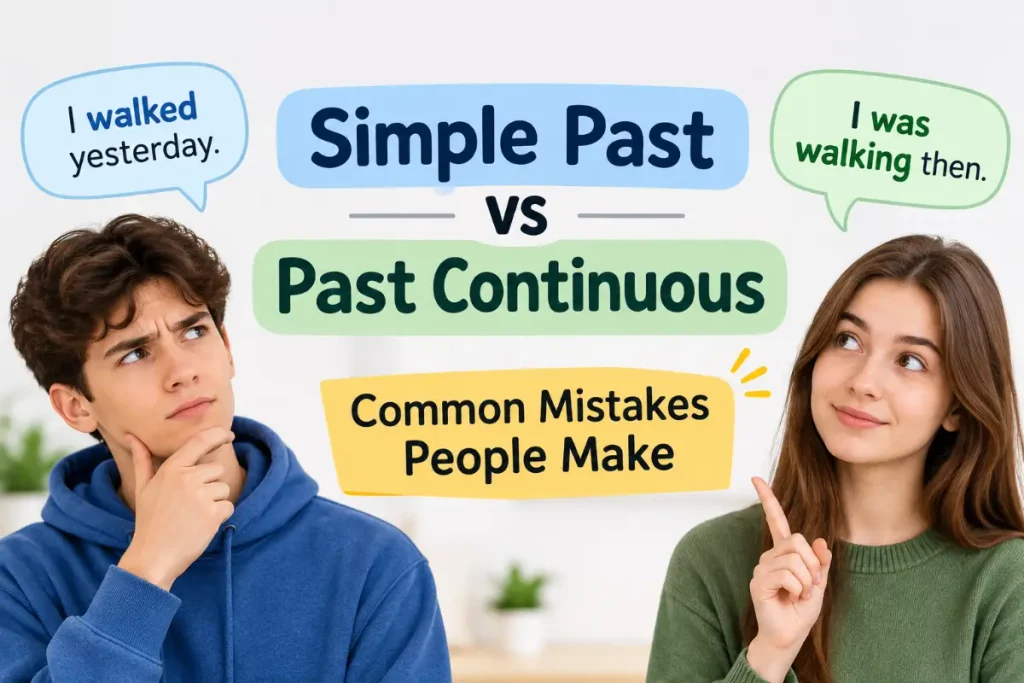
Common Mistakes People Make
Mistake 1: Using the simple past for both parts of an interruption, as in “I cooked when the phone rang,” which suggests you cooked at the moment it rang rather than being in the middle of cooking.
Mistake 2: Using the continuous for a sequence of finished events, as in “She was waking up and was brushing her teeth.”
Mistake 3: Using the continuous with stative verbs, such as “I was knowing” or “she was owning.”
For another useful perspective, check out Past Participle Examples: 50 Easy Examples to Master Grammar (2026).
Mistake 4: Using was/were with the simple past form, as in “I was cooked” or “they were played,” instead of the -ing form.
Mistake 5: Using the continuous for the interrupting event, as in “I cooked when the phone was ringing,” which reverses the roles.
Mistake 6: Confusing was and were: I/he/she/it was, but you/we/they were.
Practice Exercise
Choose the correct form, fix the error, or complete the sentence. Answers are listed right after, so try each one before checking.
- I (cooked/was cooking) dinner when the phone rang.
- While she (read/was reading), the lights went out.
- Yesterday, I (walked/was walking) to school.
- She (took/was taking) a shower when the doorbell rang.
- He (opened/was opening) the door and (walked/was walking) in.
- At 8 p.m. last night, we (watched/were watching) a movie.
- They (played/were playing) tennis when it started to rain.
- I (knew/was knowing) the answer.
- She finished her novel and (sent/was sending) it to a publisher.
- What (did you do/were you doing) when the earthquake happened?
- The sun (shone/was shining) and the birds (sang/were singing) when I left the house.
- Fix: I was waking up, was brushing my teeth, and was leaving.
- Fix: While I was cooking, the phone was ringing.
- Fix: She was owning a car in 2015.
- Choose: I (wondered/was wondering) if you could help me. (polite)
- Choose: He (always lost/was always losing) his keys, which annoyed us.
- Which sentence shows the call interrupted the cooking? (a) I cooked when she called. (b) I was cooking when she called.
- Complete: While I (study), my brother (play) video games.
- Complete: She (cry) when I (enter) the room.
- Complete: They (not/listen) when the teacher (give) instructions.
Answer Key
- was cooking
- was reading
- walked (a single finished event)
- was taking
- opened; walked (a sequence of finished events)
- were watching (in progress at 8 p.m.)
- were playing
- knew (stative verb)
- sent (a completed event in a sequence)
- were you doing
- was shining; were singing
- I woke up, brushed my teeth, and left.
- While I was cooking, the phone rang.
- She owned a car in 2015.
- was wondering
- was always losing
- (b)
- was studying; was playing
- was crying; entered
- weren’t listening; gave (or was giving)
Frequently Asked Questions
What’s the main difference between the simple past and the past continuous?
The simple past describes a completed action, while the past continuous describes an action that was in progress at a past moment. The first answers “What happened?” and the second answers “What was going on?”
Can I use both tenses in the same sentence?
Yes, and it’s the most common pattern. The past continuous gives the longer background action, and the simple past gives the shorter event that interrupts it: “I was cooking when the phone rang.”
Should I use “when” or “while”?
While typically introduces the longer action in progress, and when typically introduces the shorter interrupting event. Both sentences “While I was cooking, the phone rang” and “I was cooking when the phone rang” mean the same thing.
Why can’t I say “I was knowing”?
Know is a stative verb, describing a state rather than an action in progress. Stative verbs stay in the simple past: “I knew.”
What’s the fastest way to choose between them?
Ask whether the action was a finished event or something in progress at a particular moment. If you picture it as a snapshot of something ongoing, use the past continuous. If you picture it as a completed event, use the simple past.
Before moving on, you may also want to read Common List of Irregular Verbs (2026 Guide) for more helpful grammar tips.
The Short Version
The choice between simple past vs past continuous is a choice about perspective. The simple past reports finished events and keeps a story moving, and the past continuous describes what was going on around them. When the two meet, the continuous action is the longer one, and the simple past is the interruption.
Keep three habits in mind: use the simple past for a sequence of finished actions, avoid the continuous with stative verbs, and watch the when/while pattern. With those in place, the two tenses fit together naturally, giving your writing both momentum and atmosphere.