Not sure when to use a period, comma, or nothing at all with abbreviations? How to Punctuate Abbreviations doesn’t have to be complicated. Learn the simple rules for punctuating common abbreviations, acronyms, titles, and shortened words without making your writing look cluttered or inconsistent.
Learning punctuation correctly means accepting one thing upfront: this is one of the more genuinely inconsistent corners of English punctuation. Merriam-Webster states this plainly — “the styling of abbreviations is inconsistent and arbitrary and includes many possible variations.” That said, there are real patterns worth knowing, and once you understand them, most everyday abbreviations stop being a guessing game.
You may also find Use an Em Dash: 7 Smart Ways to Use It Correctly (2026) helpful if you want to explore this topic further.
The Quick Answer
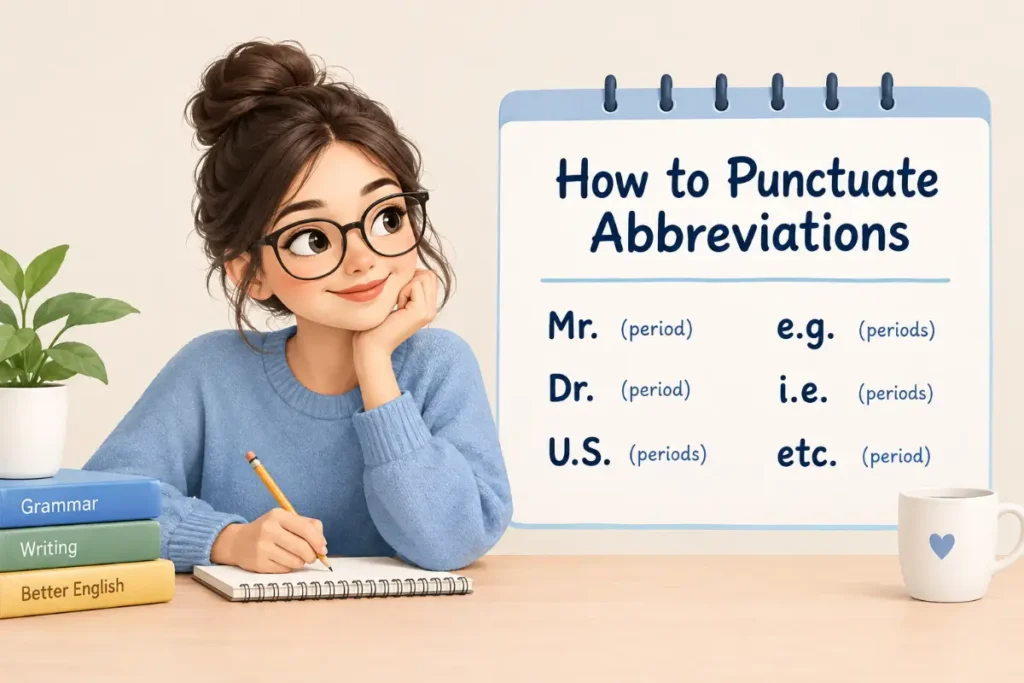
- Titles before a name generally take a period: Mr., Mrs., Dr., Gov., Sen.
- Acronyms pronounced as words generally skip periods: NASA, LASER, NATO
- Initialisms pronounced letter by letter often skip periods too, especially with three or more letters: FBI, CEO, DVD
- Short (two-letter) abbreviations, especially under AP style, often keep periods: U.S., U.K., U.N.
- Lowercase Latin abbreviations keep periods: e.g., i.e., etc.
- Never use two periods in a row when an abbreviation ends a sentence — one period does double duty.
Rule 1: Titles Before Names Take a Period
Common courtesy and professional titles used directly before someone’s name are abbreviated with a period.
- Mr. Alvarez, Mrs. Chen, Ms. Patel, Dr. Kim
- Gov. Whitmer, Sen. Booker, Rep. Ocasio-Cortez
- Gen. Martinez, Lt. Col. Reyes
This is a widely consistent rule across AP, Chicago, and most American style guides — these specific titles are punctuated the same way virtually everywhere in American English.
Rule 2: Acronyms and Initialisms Generally Skip Periods
Merriam-Webster draws a useful distinction here: acronyms — abbreviations formed from initial letters and “usually do not include periods” — cover terms like PR (public relations), CEO (chief executive officer), and BTW (by the way). This applies whether the acronym is pronounced as a word (NASA, LASER) or letter by letter (FBI, CEO, DVD).
- She works at the FBI.
- He was named CEO last year.
- NASA announced a new mission.
This is the modern, dominant convention — older writing sometimes shows periods in these abbreviations (F.B.I., C.E.O.), but current style guides, including AP, Chicago, and APA, have largely moved away from that older punctuated style for longer acronyms and initialisms.
Rule 3: Short Two-Letter Abbreviations Are the Genuine Exception
This is one of the more specifically inconsistent areas, and it’s worth knowing the reasoning behind it. Even though most acronyms skip periods today, AP style specifically keeps periods in two-letter abbreviations: U.S., U.K., U.N., B.A., B.C. The stated reasoning is that a two-letter abbreviation without periods could occasionally be mistaken for an unrelated word or feel visually too abrupt, so the periods are retained as a small clarity measure. Notably, AP style makes exceptions even within this rule — “EU” and “GI,” for instance, do not take periods despite also being short.
Other style guides, including Chicago and APA, have moved toward dropping periods even from these short abbreviations (US, UK), so which convention you follow genuinely depends on which style guide governs your specific piece of writing.
Rule 4: Lowercase Latin Abbreviations Keep Their Periods
Common Latin-derived abbreviations that are typically written in lowercase retain periods, and this is one of the more consistently applied rules across nearly every style guide.
- e.g. (for example)
- i.e. (that is)
- etc. (and so on)
- a.m. / p.m.
- vs. (versus, though some legal contexts write “v.” without a following period)
Rule 5: Academic Degrees and Suffixes
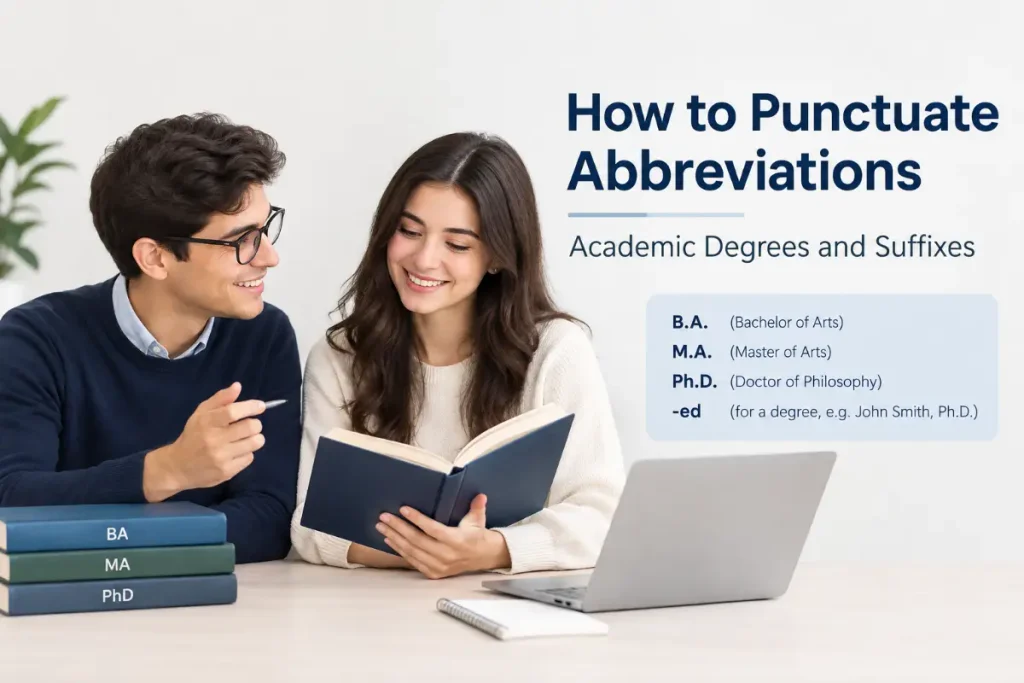
Academic degrees following a person’s name typically take periods and are set off with commas.
- Sarah Lin, Ph.D., presented her research.
- James Torres, M.D., joined the panel.
Name suffixes like Jr. and Sr. also take a period, though they are not typically set off with a comma in current AP style, while some other style guides still prefer the comma: Martin Luther King Jr. (AP style) versus Martin Luther King, Jr. (older or alternate convention). Whichever convention you choose, staying consistent throughout a single document matters more than which specific option you pick.
Rule 6: Never Double Up Periods at the End of a Sentence
This is one of the cleanest, most universally agreed-upon rules for how to punctuate abbreviations, and it’s worth memorizing as an absolute: if a sentence ends with an abbreviation that already has a period, you don’t add a second period for the sentence itself.
- He is a vice president at Apple Inc. (correct — one period serves double duty)
- He is a vice president at Apple Inc.. (incorrect — never double the period)
This rule holds even inside quotations: Laura said, “We will continue this tomorrow at 8:00 a.m.” — no extra period is added after the closing quotation mark, even though the sentence and the abbreviation both technically “end” at that point. Note that this exception applies specifically to periods; if the sentence is a question or exclamation, the question mark or exclamation point is still added after the abbreviation’s period, since those marks serve a different grammatical function.
The Fastest Way to Check Yourself
Step 1: Is this a courtesy or professional title directly before a name? Use a period.
Step 2: Is this a longer acronym or initialism (three or more letters)? Skip the period, following the now-dominant modern convention.
Step 3: Is this a short, two-letter abbreviation, and are you following AP style specifically? Keep the period.
Step 4: Is this a lowercase Latin abbreviation? Keep the period.
Step 5: Does the abbreviation fall at the very end of a sentence? Use only one period, never two.
How to Punctuate Abbreviations: Quick Reference
| Type | Periods? | Example |
|---|---|---|
| Title before a name | Yes | Dr. Kim, Sen. Booker |
| Long acronym/initialism (3+ letters) | Generally no | FBI, NASA, CEO |
| Short two-letter abbreviation (AP style) | Yes | U.S., U.K. |
| Short two-letter abbreviation (Chicago/APA) | Often no | US, UK |
| Lowercase Latin abbreviation | Yes | e.g., i.e., etc. |
| Academic degree after name | Yes | Maria Lopez, Ph.D. |
| Sentence-ending abbreviation | One period only, never two | …at 8 p.m. |
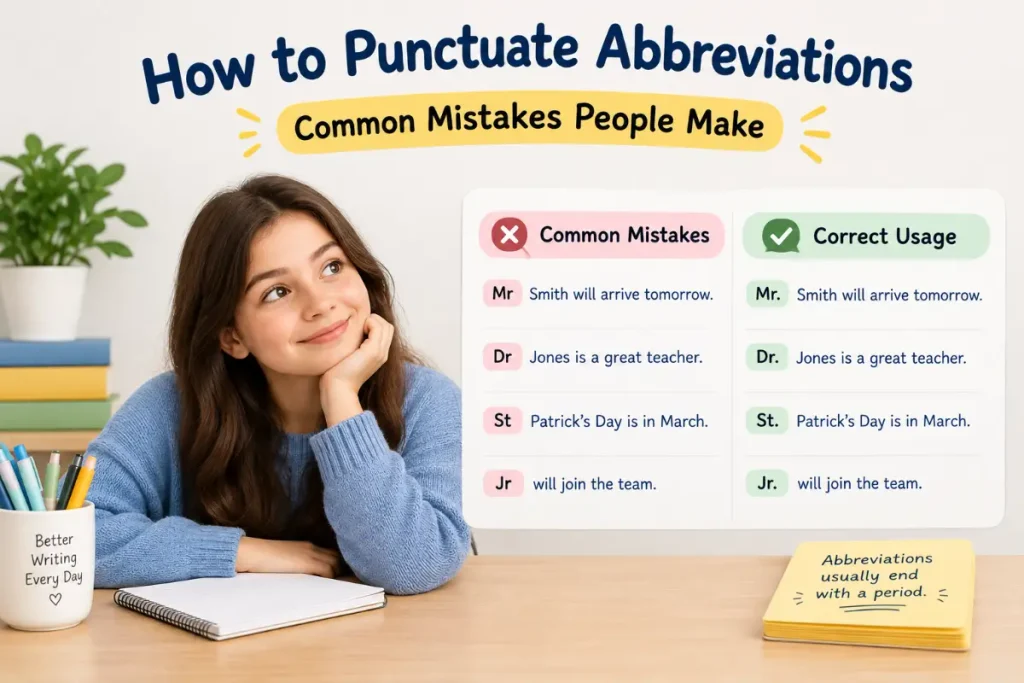
Common Mistakes People Make
Mistake 1: “She works at the F.B.I.” Under modern style conventions, this should be “the FBI” — most current style guides have dropped periods from this and similar longer initialisms.
Mistake 2: “The meeting starts at 8:00 a.m..” This doubles up the period incorrectly — one period does the job of both ending the abbreviation and the sentence: “The meeting starts at 8:00 a.m.”
Mistake 3: “The report covered the US economy” under AP style specifically. AP style calls for periods here: “the U.S. economy” — though this would be correct without periods under Chicago or APA conventions, which is exactly why knowing your governing style guide matters.
For another useful perspective, check out Colon vs Semicolon: The Ultimate Usage Guide for 2026.
Mistake 4: “He has a Ph.D, and she has an M.A.” Missing a period: “Ph.D.” needs the final period just like the initial ones, so it should read “Ph.D.”
Mistake 5: Inconsistent style within the same document. Writing “U.S.” in one paragraph and “US” in another, without a specific style reason for the switch, looks unpolished — pick one convention and apply it consistently throughout.
More Examples to Lock It In
- Dr. Chen, Ph.D., spoke about U.S. trade policy at the NATO summit.
- The CEO announced the merger at 9 a.m., just before the SEC filing deadline.
- Gov. Lee met with representatives from the FBI and the U.N. this week.
- The package includes various items, e.g., cables, adapters, and a manual.
- Martin Luther King Jr. delivered the speech in 1963.
Frequently Asked Questions
Why do some abbreviations keep periods while others don’t?
Historically, most abbreviations included periods, but modern style has moved toward dropping them for longer acronyms and initialisms, largely for visual simplicity. Shorter abbreviations, titles, and Latin-derived terms have generally kept their periods, though the exact line varies somewhat by style guide.
Does AP style always require periods in two-letter abbreviations?
Mostly, yes — U.S., U.K., U.N., B.A., and B.C. all keep periods under AP style, though AP itself carves out specific exceptions like EU and GI, which don’t take periods despite also being short.
Is it wrong to write “Mr” without a period, as is common in British English?
Not wrong, exactly — this reflects a genuine difference between American and British punctuation conventions. British style traditionally omits the period from titles like Mr and Dr when the abbreviation ends in the same letter as the full word, while American English retains the period regardless.
How do I know whether an abbreviation has “become its own word” and no longer needs to be treated as an abbreviation?
Check whether it’s listed as a standalone entry in a standard dictionary — terms like “laser,” “scuba,” and “radar” started as acronyms but are now treated as ordinary lowercase words in their own right, no longer requiring capital letters or periods at all.
What’s the fastest way to catch abbreviation punctuation errors before publishing something?
Identify which category each abbreviation falls into (title, long acronym, short two-letter form, Latin term, or academic degree), apply the corresponding rule, and double-check that no sentence ends with two periods stacked together.
Practice Exercise
Decide whether each abbreviation needs periods, following standard AP style. Write the correctly punctuated abbreviation in each sentence before checking the answer key.
- Dr Alvarez will see you now.
- She used to work for the CIA.
- The meeting begins at 9 am.
- He earned his PhD last spring.
- The US economy grew steadily this quarter.
- Please bring pens, notebooks, etc.
- Gov Lee announced the new policy.
- The country joined NATO in 1949.
- The package weighs 10 lb.
- We arrived at 7:30 pm.
- She met with Sen Harris yesterday.
- He has a BA in English.
- The report was prepared by the FBI.
- The appointment is scheduled for 10 a.m.
- They contacted the company’s CEO.
- Rep Martinez introduced the bill.
- The office is located 5 mi from downtown.
- She received her M.A. in history.
- Bring your ID, passport, etc.
- The U.S. team arrived yesterday.
Answer Key
- Dr. — period needed for the title before a name.
- CIA — no periods; it’s a standard initialism.
- 9 a.m. — periods used with lowercase time abbreviations.
- Ph.D. — periods used in the academic degree abbreviation.
- U.S. — periods used under AP style.
- etc. — period needed because etc. is a Latin abbreviation.
- Gov. — period needed for the title before a name.
- NATO — no periods; it’s a commonly used acronym.
- lb. — period needed for the abbreviated unit.
- p.m. — periods used with lowercase time abbreviations.
- Sen. — period needed for the abbreviated title before a name.
- B.A. — periods used in the degree abbreviation.
- FBI — no periods; standard initialism.
- a.m. — periods are required.
- CEO — no periods; standard initialism.
- Rep. — period needed for the title before a name.
- mi. — period needed for the abbreviated unit.
- M.A. — periods used in the degree abbreviation.
- etc. — period needed at the end of the abbreviation.
- U.S. — periods used under AP style.
If you can consistently identify titles, time abbreviations, academic degrees, units, initialisms, and Latin abbreviations, you’ve got the main patterns behind how to punctuate abbreviations.
Before moving on, you may also want to read Comma Before And Rule: 5 Easy Rules You Need to Know (2026) for more helpful grammar tips.
The Bottom Line
Mastering how to punctuate abbreviations means recognizing which category an abbreviation falls into — titles and Latin terms generally keep periods, longer acronyms and initialisms generally skip them, and short two-letter abbreviations depend on which style guide you’re following. The one truly universal rule: never stack two periods together at the end of a sentence. Given how much genuine inconsistency exists across style guides, picking one convention and applying it consistently throughout your writing matters just as much as memorizing every individual case.
For more on capitalization conventions that often intersect with abbreviated titles, see our guide on when to capitalize job titles — and if apostrophes in pluralized abbreviations (like “CEOs” versus “CEO’s”) still feel uncertain, our apostrophe rules for plurals guide covers that exact case.