Ever wondered how to punctuate an interrupted sentence without making your dialogue look awkward or confusing? Whether a speaker gets cut off, pauses mid-thought, or gets interrupted by another action, the right punctuation keeps the meaning clear while making your writing feel natural.
Knowing punctuation interrupted sentence actually means knowing which of four distinct types of interruption you’re dealing with, since each one calls for a different punctuation mark. Merriam-Webster confirms the em dash’s role in marking “an abrupt change in thought or sudden interruption” — but that’s only one piece of the puzzle. A sentence can be interrupted by another speaker, by the speaker’s own hesitation, by a sudden action, or by an inserted thought — and mixing up which mark belongs to which type is one of the more common small errors in narrative writing.
You may also find Punctuate Abbreviations: The 2026 Easy Guide helpful if you want to explore this topic further.
The Quick Answer
- Cut off by another speaker or external event (sudden, sharp): em dash
- “I was just about to—” “Don’t,” he said.
- Trailing off, hesitating, or fading out (soft, gradual): ellipsis
- “I just think that… maybe we should wait.”
- Interrupted by an action beat mid-sentence: em dashes around the action, or a period if the action stands as its own sentence
- “I need you to—” she paused, glancing at the door “—listen carefully.”
- Interrupted by an inserted thought or aside: parentheses or em dashes, depending on emphasis
- He was, as far as anyone could tell, completely unaware of the situation.
Type 1: Cut Off by Another Speaker — Use an Em Dash
This is the sharpest, most sudden kind of interruption, and it’s the classic use case people usually mean when they ask how to punctuate an interrupted sentence in dialogue. One character starts speaking, and another cuts them off mid-thought.
- “I really think we should—” “No,” she said flatly. “We’re not doing that.”
- “Can you just listen for a—” “I’ve heard enough.”
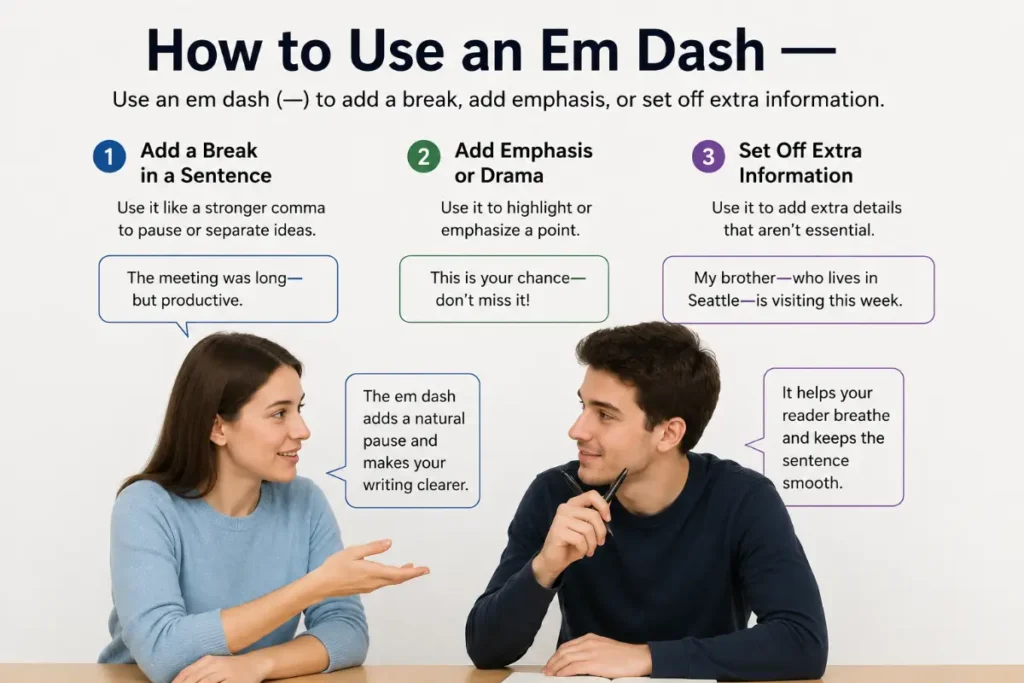
Notice the em dash appears right at the point of interruption, with no closing punctuation after it — the sentence is deliberately left incomplete. For the complete range of jobs an em dash can perform beyond this specific one, see our full em dash guide.
Type 2: Trailing Off or Hesitating — Use an Ellipsis
This is a softer, more gradual kind of interruption — not caused by someone else cutting the speaker off, but by the speaker’s own hesitation, uncertainty, or a thought that fades rather than stops abruptly.
- “I just think that… I don’t know, maybe I’m wrong.”
- “If only I had…” She never finished the sentence.
The difference in feel between this and the em dash matters: an ellipsis signals the speaker is still choosing, still searching for words, or deliberately letting a thought go unfinished — while an em dash signals something outside the speaker’s control cut them off. For more on this specific distinction and the ellipsis’s other uses, see our guide to using an ellipsis correctly.
Type 3: Interrupted by an Action Beat
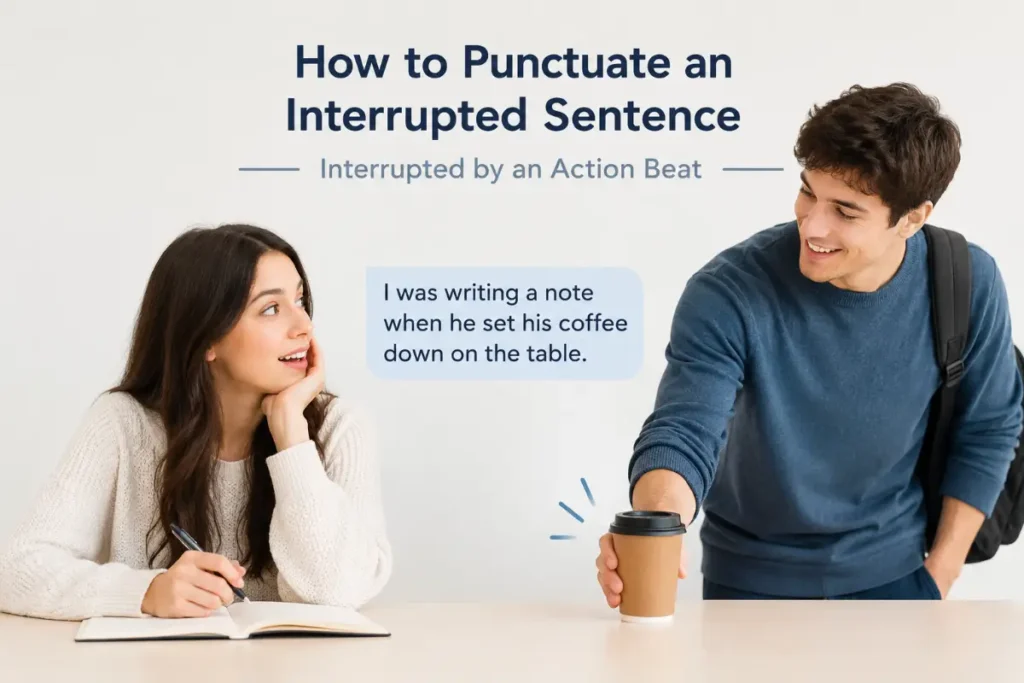
When a physical action interrupts a line of dialogue mid-sentence — the speaker pauses to do something before continuing the same thought — em dashes bracket the action on both sides.
- “I need you to—” she paused, glancing nervously at the door, “—listen very carefully.”
Notice both dashes are needed here: one where the dialogue breaks off, and one where it resumes, with the action beat sitting between them. This is different from an action that simply follows a complete line of dialogue, which is punctuated as its own separate sentence with a period:
- “I need you to listen very carefully.” She glanced nervously at the door.
Type 4: Interrupted by an Inserted Thought or Aside
This type of interruption happens in narration rather than dialogue — a sentence pauses briefly to insert a clarifying thought, aside, or qualifier before continuing its original path.
Using parentheses (quieter, more of an aside):
- The plan, though nobody said so directly, was already falling apart.
Using em dashes (more emphasis on the inserted content):
- The plan — though nobody said so directly — was already falling apart.
For the full breakdown of when parentheses work better than a comma or em dash for this kind of insertion, see our guide to using parentheses in a sentence.
The Fastest Way to Check Yourself
Step 1: Is the sentence being cut off suddenly by someone or something external? Use an em dash, with no closing punctuation.
Step 2: Is the speaker hesitating or trailing off on their own? Use an ellipsis.
Step 3: Is an action interrupting dialogue mid-sentence, with the dialogue resuming afterward? Bracket the action with em dashes on both sides.
Step 4: Is a narrative sentence pausing to insert a brief aside or qualifier? Use parentheses for a quiet aside, or em dashes for more emphasis.
How to Punctuate an Interrupted Sentence: Quick Reference
| Type of Interruption | Mark | Example |
|---|---|---|
| Cut off by another speaker | Em dash, no closing punctuation | “Wait, I just—” “No.” |
| Trailing off or hesitating | Ellipsis | “I don’t know, maybe…” |
| Action interrupts dialogue | Em dashes on both sides | “I need—” she paused “—more time.” |
| Inserted thought in narration | Parentheses or em dashes | He was, admittedly, wrong. |
Common Mistakes People Make
Mistake 1: Using an ellipsis where a sharp cutoff actually occurred. “I was going to say…” “Don’t bother.” reads as a soft fade when the scene calls for a sudden interruption; an em dash better captures that abruptness: “I was going to say—” “Don’t bother.”
Mistake 2: Adding closing punctuation after an em dash used for interruption. “I really think we should—.” is incorrect — once the em dash marks the cutoff, no period or comma follows it, since the sentence is intentionally left unfinished.
Mistake 3: Using only one em dash for an action that interrupts and then resumes dialogue. “I need you to—” she paused “listen carefully” is missing the second dash; both sides of the interrupting action need their own dash: “I need you to—” she paused “—listen carefully.”
For another useful perspective, check out Use Quotation Marks Correctly: The Complete Guide (2026).
Mistake 4: Confusing a trailing ellipsis with an omission ellipsis. The ellipsis used to show hesitation in dialogue is a different job from the ellipsis used to show cut material from a quotation — mixing these functions up in formal writing (using a trailing ellipsis in an academic quote, for instance) can look like an accidental omission rather than an intentional stylistic pause.
Mistake 5: Overusing interruptions of any kind. Interrupted sentences are a powerful device precisely because they’re not the default — a page where every other line of dialogue is cut off loses its dramatic impact and can start to feel more chaotic than intentional.
More Examples to Lock It In
- “I promise, I would never—” “Stop,” she said. “I don’t want to hear it.”
- “Maybe if I had just tried harder…” He stared at the floor, unable to continue.
- “You need to check—” he gestured toward the door “—before anyone sees you.”
- The decision, whatever its merits, had already been made.
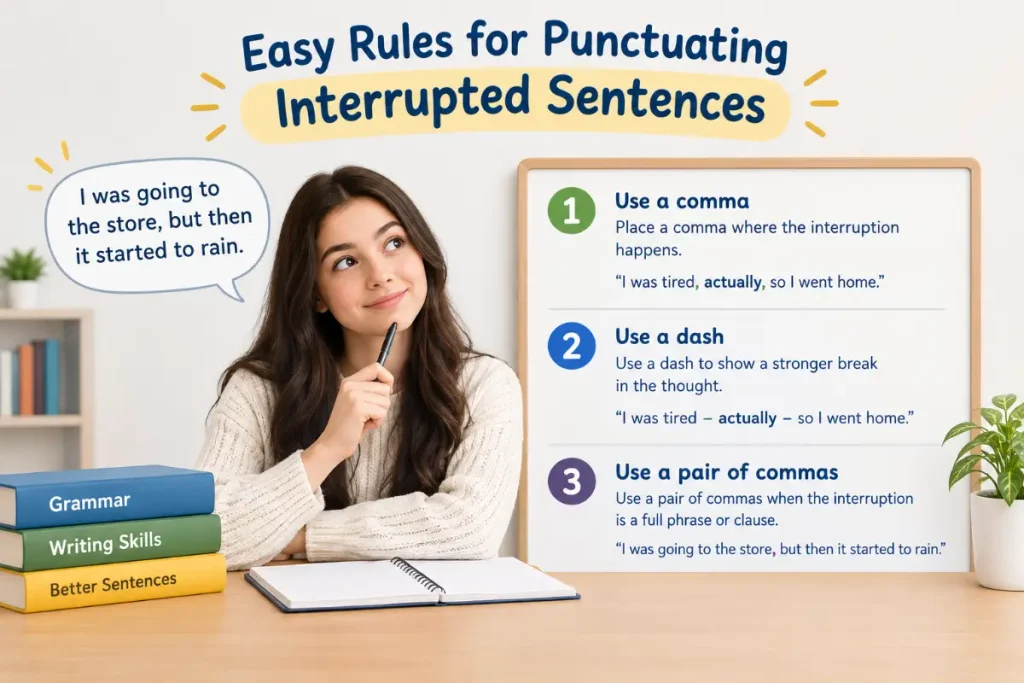
7 Easy Rules for Punctuating Interrupted Sentences
1. Match the Punctuation to the Type of Break
First, identify what is actually happening in the sentence. A sudden cutoff, a fading thought, a physical action, and an inserted aside don’t communicate the same thing, so they shouldn’t all use the same punctuation.
- Em dash: signals a sudden or abrupt break.
- Ellipsis: shows hesitation, trailing off, or a thought that fades.
- Parentheses: set off quieter, secondary information.
- Em dashes: can give an inserted phrase stronger emphasis.
The reason for the interruption should determine the punctuation you choose.
2. Place the Punctuation Where the Interruption Occurs
The punctuation should appear exactly where the sentence breaks, rather than being added at the end.
For example:
- I thought we could—
- If only I had known…
- She was about to leave when—
This placement helps readers understand exactly when the thought, speech, or action changes direction.
3. Don’t Add a Period After an Interruption Em Dash
When an em dash shows that dialogue has been abruptly cut off, don’t add a period, comma, or other closing punctuation directly after it.
- Correct: I wanted to tell you—
- Incorrect: I wanted to tell you—.
The em dash already communicates that the sentence stops suddenly, so another punctuation mark isn’t necessary.
4. Keep Each Speaker’s Interruption Easy to Follow
When one character cuts another person off, make the change in speaker obvious. A new line for each speaker is usually the clearest approach, especially when the conversation becomes fast-paced.
- Speaker A begins a thought and stops with an em dash.
- Speaker B immediately responds or interrupts.
- Speaker A can continue afterward if the conversation calls for it.
Clear speaker changes prevent punctuation from making an already chaotic conversation harder to understand.
5. Separate Completed Actions From True Interruptions
Not every action occurring alongside dialogue needs to interrupt the sentence. If the speaker has already completed the thought, let the action begin as a separate sentence.
- I need to leave now. She grabbed her coat.
- We should talk about this later. He looked toward the door.
Use interruption punctuation when the action genuinely breaks into the middle of an ongoing sentence.
6. Don’t Use an Ellipsis Simply Because a Sentence Is Incomplete
An unfinished sentence doesn’t automatically require an ellipsis. Consider why the sentence remains unfinished.
- Sudden cutoff: use an em dash.
- Hesitation or fading thought: use an ellipsis.
- Deliberately unfinished statement: choose the mark that best reflects the intended tone.
Compare the difference:
- I was just about to— → abrupt interruption
- I was just about to… → trailing or hesitant thought
The punctuation changes the reader’s sense of what happened.
7. Use Interruption Punctuation Consistently
Once you’ve established how interruptions work in a piece of writing, stick with the same pattern throughout. Inconsistent punctuation can make readers wonder whether two similar situations are supposed to mean different things.
Before publishing, check that:
- Sudden cutoffs use em dashes consistently.
- Trailing thoughts use ellipses consistently.
- Mid-sentence action interruptions are punctuated the same way.
- Parenthetical asides follow the same style throughout the piece.
- You aren’t adding interruption marks simply for dramatic effect.
Good punctuation should support the scene without becoming more noticeable than the writing itself.
Frequently Asked Questions
Can an em dash and an ellipsis ever be used in the same sentence?
Yes — a sentence might trail off with an ellipsis and then be cut short entirely by another speaker’s interruption marked with an em dash, especially in dialogue-heavy scenes where a character hesitates before being cut off completely.
Do these rules for how to punctuate an interrupted sentence apply outside of fiction?
The em dash and parentheses rules apply broadly across formal and informal writing. The ellipsis-for-hesitation and em-dash-for-dialogue-interruption uses are specific to narrative and creative writing; formal and academic writing rarely needs to represent interrupted speech at all.
Is it ever correct to interrupt a sentence with just a comma?
Only for a mild, non-disruptive insertion — like a brief appositive or qualifier (“The plan, frankly, made no sense”) — not for a genuine sharp interruption or hesitation, which need the stronger marks covered in this guide.
How do I show a sentence interrupted by internal narration rather than dialogue?
This typically uses em dashes or parentheses within the narrative prose itself, depending on how much emphasis the inserted thought deserves — the same logic that governs inserted asides generally.
What’s the fastest way to catch interruption-related punctuation errors before publishing something?
Identify which of the four types of interruption is actually happening in each case — external cutoff, self-hesitation, action mid-dialogue, or narrative aside — and make sure the mark you’ve chosen matches that specific type rather than defaulting to whichever mark feels familiar.
Practice Exercise
Decide which mark best fits each interrupted sentence: em dash or ellipsis. Answers are listed right after — try each one before checking.
- “I just wanted to say___” “Save it,” she snapped.
- “Maybe we should just___” he trailed off, unsure.
- “Don’t you dare___” “Or what?” he interrupted.
- “I keep wondering if___” She shook her head, unable to finish.
- “Wait, before you go___” “I have to leave,” she said quickly.
Answer Key
- em dash
- ellipsis
- em dash
- ellipsis
- em dash
If you got four or more correct, the sharp-cutoff-versus-soft-fade distinction has already become clear.
Interrupted Sentences in Different Writing Contexts
- In fiction and screenwriting, all four types of interruption appear regularly, since realistic dialogue naturally includes hesitation, cutoffs, and characters talking over one another — screenplay format in particular relies heavily on the em dash to show characters interrupting each other in fast-paced exchanges.
- In journalism, interrupted quotations are handled more conservatively — reporters typically either complete a source’s thought through paraphrase or use an ellipsis to show where a quote was trimmed, rather than representing a genuine mid-sentence interruption as it happened in real time.
- In academic and business writing, interrupted sentences are rare by design, since formal writing favors complete, uninterrupted thoughts — when a brief aside is needed, parentheses or a measured em dash insertion is far more common than any dialogue-style cutoff.
- In everyday personal writing, like texts or emails, ellipses for trailing thoughts are extremely common, while the sharper em-dash cutoff is less frequently needed outside of transcribed or quoted conversation.
Before moving on, you may also want to read Oxford Comma Examples: 21 Ways to Use It Correctly (2026) for more helpful grammar tips.
The Bottom Line
Learning how to punctuate an interrupted sentence comes down to correctly identifying which of four situations you’re facing: a sharp external cutoff (em dash), a soft internal hesitation (ellipsis), an action breaking up ongoing dialogue (em dashes on both sides), or an inserted aside in narration (parentheses or em dashes). Match the mark to the type of interruption, and this stops being a guessing game.