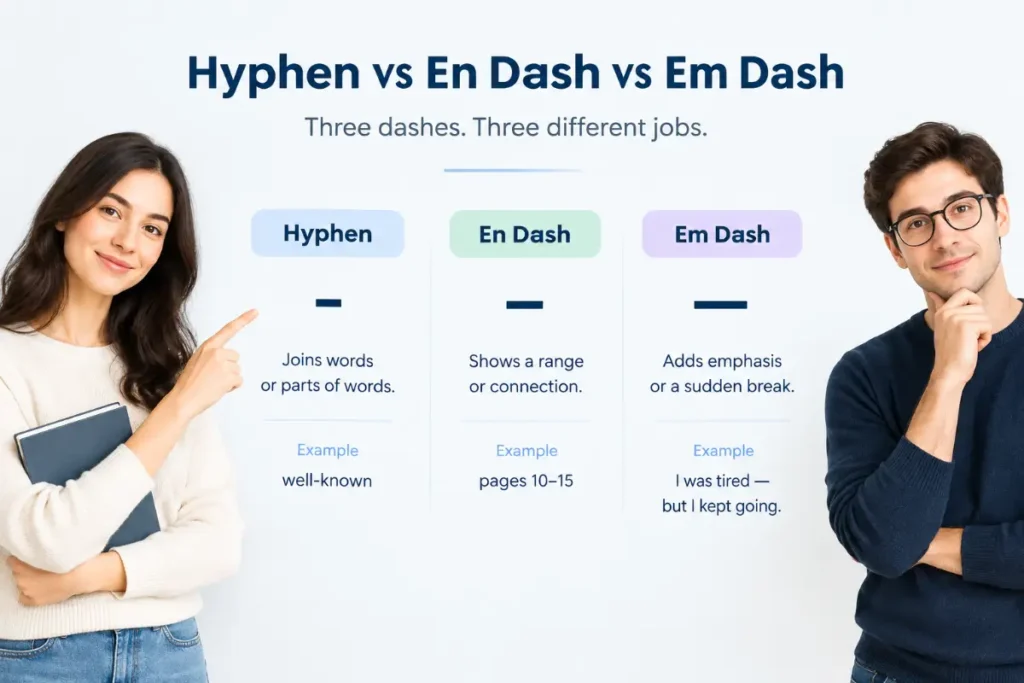
Confused about Hyphen vs En Dash vs Em Dash? These three punctuation marks may look similar, but each has a different job. Once you know where and when to use them, your writing becomes clearer, smoother, and more polished.
We’ve already covered how to use an em dash in full depth. This guide answers a different, more visual question: how do you tell these three similar-looking marks apart at a glance, and which one do you actually reach for in each situation? Merriam-Webster lays out the distinction clearly — three marks, three different widths, three different jobs.
You may also find Punctuate an Interrupted Sentence: 7 Easy Rules (2026) helpful if you want to explore this topic further.
The Quick Answer
- Hyphen (-) — shortest — joins words or parts of words
- well-known author, self-esteem, 24-hour service
- En dash (–) — medium length, roughly the width of a capital N — shows ranges or connections between values
- pages 10–15, the 2020–2021 season
- Em dash (—) — longest, roughly the width of a capital M — sets off information, marks breaks, or replaces a comma/colon/parentheses
- The results — though preliminary — were promising.
The test: are you joining two words into one? Use a hyphen. Are you showing a range between two values? Use an en dash. Are you setting off extra information or marking a dramatic pause? Use an em dash.
Visual Comparison: Seeing the Length Difference
Lined up together, the length difference becomes obvious:
- Hyphen: –
- En dash: –
- Em dash: —
The names themselves tell you the size: “en” and “em” refer to typesetting units roughly matching the width of the capital letters N and M in a given typeface — an em dash is about twice as wide as an en dash, and both are noticeably longer than a plain hyphen.
Hyphen: Joining Words and Word Parts
The hyphen is the shortest of the three, and its job is connecting — joining two or more words into a single compound term, or splitting a word across a line break.
Examples:
- She’s a well-known photographer.
- He gave a much-needed apology.
- This is a state-of-the-art facility.
- The five-year-old loved the zoo.
- We need a re-evaluation of the plan.
Hyphens are also used with certain prefixes and suffixes to avoid confusion or awkward letter combinations: re-elect (avoiding “reelect”), self-aware, ex-husband. Note that hyphenation conventions for prefixes vary by style guide and by whether the resulting word could be misread without the hyphen — this is one of the more genuinely inconsistent areas across different references.
En Dash: Showing Ranges and Connections
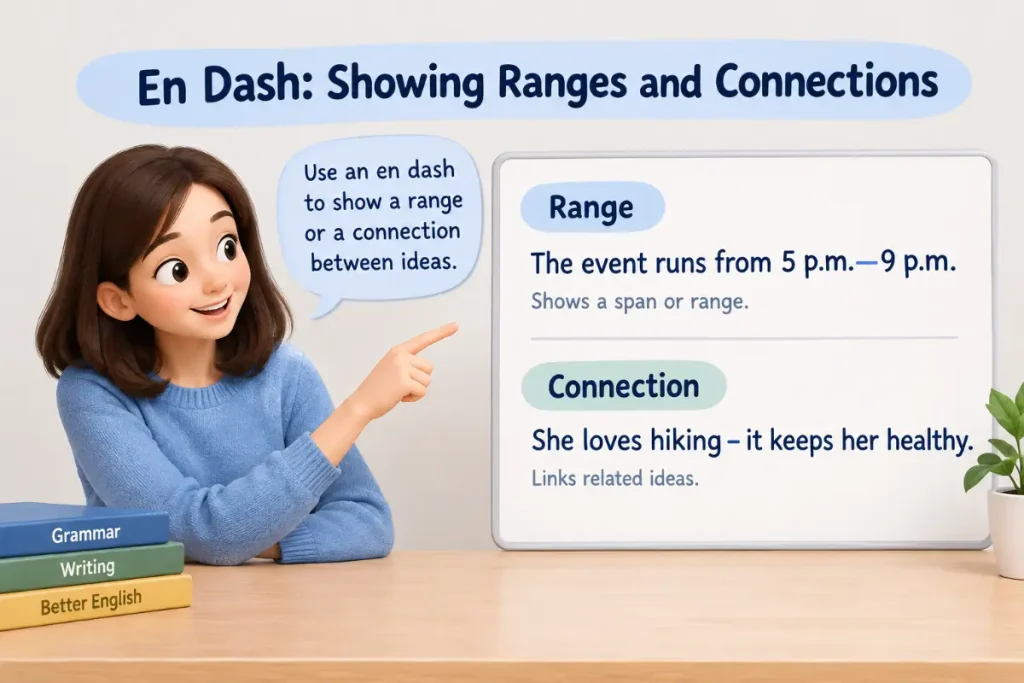
The en dash is used primarily to indicate a range between two values — numbers, dates, or times — functioning essentially as a stand-in for the word “to” or “through.”
Examples:
- Please read pages 45–52 before class.
- The store is open Monday–Friday, 9 a.m.–5 p.m.
- The 2019–2020 fiscal year showed strong growth.
- Add 2–3 tablespoons of olive oil.
The en dash is also used to connect two words or names that retain their own individual identity within a compound, rather than truly merging into one term — for example, describing a route or a score: the New York–London flight, a 3–1 victory. This is a subtler use most casual writers rarely need, but it’s the technically correct choice in these specific cases according to most style guides, including Chicago Manual of Style.
Em Dash: Setting Off Information and Marking Breaks
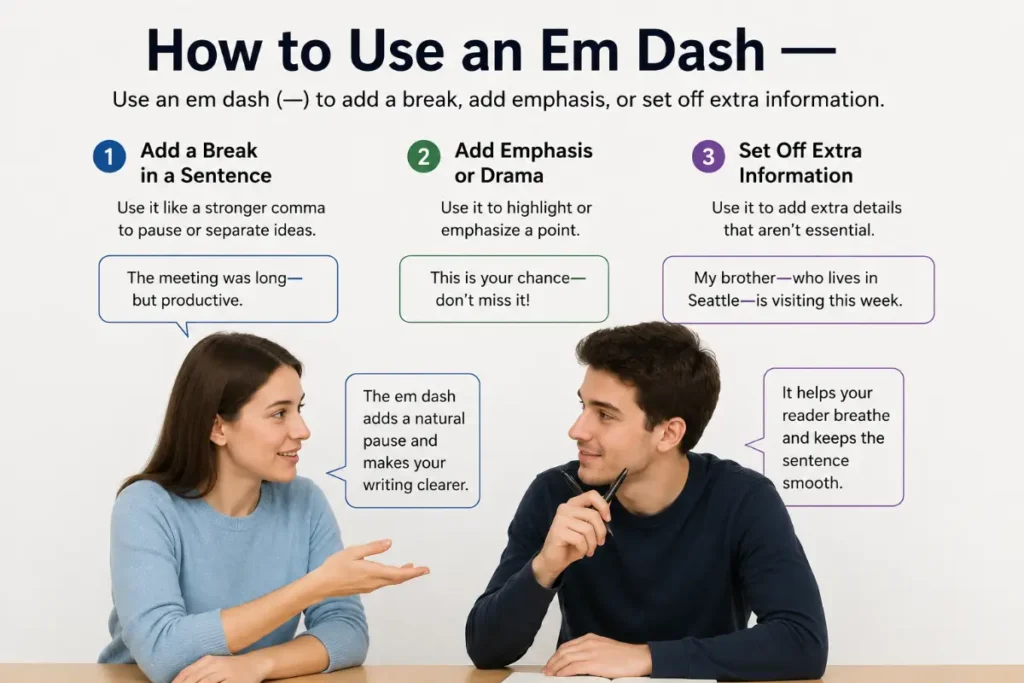
The em dash is the longest and most versatile of the three, capable of standing in for a comma, colon, semicolon, or set of parentheses — and it’s the only one of the three that can mark an abrupt break in a sentence or interrupted speech.
Examples:
- The museum’s newest exhibit — a collection of ancient pottery — draws crowds every weekend.
- She had one rule — never negotiate on price.
- He was about to leave — actually, he’d already left.
- “I was going to say—” she started, before he cut her off.
For the complete breakdown of every job the em dash can do, including the four distinct uses and the spacing conventions around it, see our full em dash guide.
Why These Three Get Confused So Often
Part of the confusion is purely visual — on many keyboards, there’s no dedicated en dash or em dash key, so people default to typing a single hyphen for all three jobs, or let autocorrect handle the conversion without understanding what’s actually happening. Word processors typically convert two consecutive hyphens (–) into an em dash automatically, which is convenient but can obscure the fact that a completely different, longer mark has just been substituted in.
The other source of confusion is that all three marks technically function as a kind of “connector” in a sentence, even though the specific job each one performs — joining words, showing a range, or setting off a clause — is genuinely distinct.
The Fastest Way to Check Yourself
Step 1: Are you joining two or more words into a single compound term? Use a hyphen.
Step 2: Are you showing a range between two numbers, dates, or times? Use an en dash.
Step 3: Are you setting off extra information, marking an abrupt shift, or replacing a comma, colon, or parentheses? Use an em dash.
Step 4: If you’re genuinely unsure and don’t have easy access to an en dash on your keyboard, a hyphen is the more forgivable substitute in casual writing — though in professional or published work, using the correct mark matters more.
This same “check the specific job before reaching for a mark” habit is exactly what resolves confusion around colon vs semicolon too — different marks, same underlying discipline of matching the tool to the task rather than defaulting to whichever one feels most familiar.
Hyphen vs. En Dash vs. Em Dash: Quick Reference
| Hyphen (-) | En Dash (–) | Em Dash (—) | |
|---|---|---|---|
| Length | Shortest | Medium | Longest |
| Named after | — | Capital “N” width | Capital “M” width |
| Main job | Joins words | Shows ranges | Sets off info, marks breaks |
| Example | well-known | pages 10–15 | The results — surprising — held up. |
| Spacing | None | None | Style-dependent (spaced or unspaced) |
| Keyboard shortcut | Standard hyphen key | Varies by OS | Varies by OS, or auto-converted |
Common Mistakes People Make
Mistake 1: “The event runs from 9am – 5pm.” A hyphen is being used where an en dash belongs — this should be “9am–5pm,” using the medium-length dash designed specifically for ranges.
Mistake 2: “Well – known chef” with spaces around a hyphen. Hyphens joining compound words never take spaces around them: “well-known chef,” not “well – known chef.”
For another useful perspective, check out Use an Ellipsis Correctly: 20 Simple Examples (2026).
Mistake 3: Using a hyphen for an em dash’s job. “The trip was amazing – we’d go back in a heartbeat” technically should use an em dash: “The trip was amazing — we’d go back in a heartbeat,” since a hyphen isn’t designed to set off a full clause like this.
Mistake 4: Using an em dash for a simple number range. “Pages 10—15” (with a full em dash) is longer and visually heavier than what a number range calls for; “pages 10–15” with the shorter en dash is the more precise, correct choice.
Mistake 5: Inconsistent dash length within the same document. Mixing hyphens, en dashes, and em dashes inconsistently for the same type of job (for example, using a hyphen for one date range and an en dash for another) looks unpolished in professional and published writing.
More Examples to Lock It In
- The well-researched report — spanning pages 12–45 — covered the 2020–2023 period in detail.
- She’s a well-known expert in twentieth-century art — a field she’s studied for over fifteen years.
- The flight from New York–Chicago was delayed; passengers waited 2–3 hours before boarding.
- His five-year plan — ambitious by any measure — aimed to double revenue by 2025–2026.
Frequently Asked Questions
How do I actually type an en dash or em dash on my keyboard?
On a Mac, Option+Hyphen produces an en dash, and Shift+Option+Hyphen produces an em dash. On Windows, Alt+0150 (numeric keypad) produces an en dash, and Alt+0151 produces an em dash. Most word processors, including Word and Google Docs, will also auto-convert typed hyphens into the appropriate dash based on context and spacing.
Is it ever acceptable to just use a hyphen for everything?
In casual writing — texts, emails, social media — using a plain hyphen in place of an en or em dash is common and rarely causes real confusion. In professional, published, or formal writing, using the technically correct mark for each job is expected and reflects more careful attention to detail.
Why does the em dash sometimes have spaces around it and sometimes not?
This is a genuine style choice rather than a fixed rule — Chicago Manual of Style generally recommends no spaces (word—word), while many newspapers and other style guides use a single space on each side (word — word). Either is acceptable as long as it’s applied consistently throughout the same document.
Does the en dash have any uses beyond number ranges?
Yes, though less commonly needed — it’s also used to connect two words that retain their separate identity within a compound term, such as describing a relationship or connection between two named things (“the Lincoln–Douglas debates,” “a 3–1 score”), a subtler use most casual writing rarely calls for.
What’s the fastest way to catch dash errors before publishing something?
Check every dash-like mark in your document: is it joining two words into a compound (hyphen), showing a range between values (en dash), or setting off a clause or marking a break (em dash)? Confirm consistent spacing conventions for em dashes throughout, and make sure ranges use the en dash rather than a plain hyphen.
Practice Exercise
Decide whether each blank needs a hyphen, en dash, or em dash. Answers are listed right after — try each one before checking.
- The store hours are 9 a.m.___5 p.m.
- She’s a well___respected journalist.
- The proposal___though risky___was approved.
- Please review pages 20___30 before the meeting.
- He’s a twenty___five___year___old graduate student.
- The 2021___2022 season was their best yet.
- “I was about to say___” he paused mid-sentence.
- We need a state___of___the___art solution.
- The flight route is Chicago___Denver.
- Her one goal___winning___never wavered.
Answer Key
- en dash
- hyphen
- em dash (x2)
- en dash
- hyphen (x3, for the compound “twenty-five-year-old”)
- en dash
- em dash
- hyphen (x3)
- en dash
- em dash
If you got eight or more correct, the length-and-job distinction has already become instinct. For any you missed, ask: joining words (hyphen), showing a range (en dash), or setting off information or marking a break (em dash)?
These Three Marks in Different Writing Contexts
- In academic and scientific writing, en dashes for number ranges and dates are expected and consistently enforced by journals and style guides — a citation reading “pp. 45-52” with a plain hyphen instead of an en dash is a small but noticeable formatting inconsistency to careful editors.
- In journalism, AP style actually skips the en dash entirely, using hyphens for ranges instead in most contexts — a genuine exception to the three-mark system that’s worth knowing if you write for news publications specifically, since it diverges from Chicago Manual of Style convention.
- In web and digital publishing, dash usage varies widely depending on the content management system and font rendering, and many casual blogs and websites default to plain hyphens throughout simply because en and em dashes aren’t always easy to insert consistently across different editing tools.
- In book publishing and literary writing, all three marks are used with their full range of distinct functions, since print typesetting has long supported precise dash-width distinctions, and readers of published books are more likely to notice inconsistent or incorrect dash usage.
Before moving on, you may also want to read Colon vs Semicolon: The Ultimate Usage Guide for 2026 for more helpful grammar tips.
The Bottom Line
The hyphen is shortest and joins words into compounds. The en dash is medium-length and shows ranges between numbers, dates, or times. The em dash is longest and does the heavy lifting — setting off information, marking breaks, and standing in for commas, colons, or parentheses. Getting the right length for the right job is a small detail that adds up to noticeably more polished, professional writing.
Ultimately, understanding Hyphen vs En Dash vs Em Dash comes down to knowing the job each mark is meant to do. Use hyphens to connect words, en dashes for ranges or relationships, and em dashes to create emphasis or interruptions. Once these simple rules become familiar, choosing the right dash becomes almost automatic.