Do you capitalize after a colon? Sometimes, and the answer depends on what comes next. If a word, phrase, or list follows, you almost always use lowercase. If a proper noun follows, you capitalize it, as you would anywhere. If a complete sentence follows, style guides disagree, and one major guide changed its advice recently, which is why this question causes so much confusion and so many conflicting answers online.
This guide gives you a clear answer for every situation: lists, fragments, complete sentences, quotations, titles and subtitles, labels like “Note:” and “Warning:”, and bulleted lists. You’ll see what AP style, the Chicago Manual of Style (including its 18th-edition change), and other guides say, how British usage differs, and how to choose a rule and apply it consistently. The guide ends with common mistakes and 20 practice items with answers.
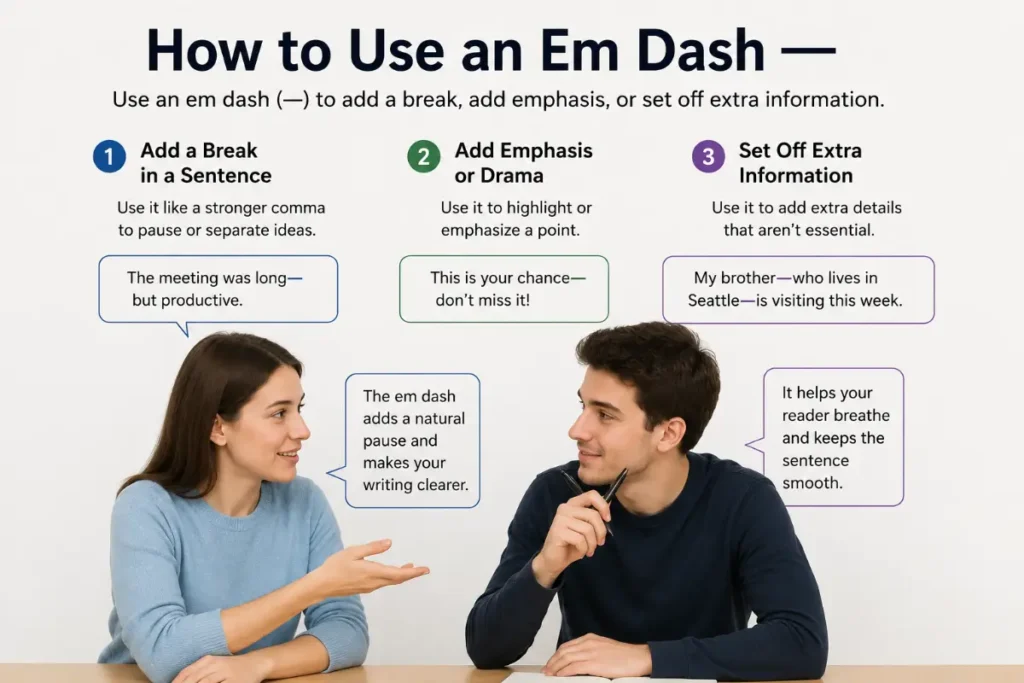
You may also find Hyphen vs En Dash vs Em Dash: The Ultimate 2026 Usage Guide helpful if you want to explore this topic further.
The Quick Answer
| What follows the colon | Capitalize? | Example |
|---|---|---|
| A list of words or phrases | No | She packed three things: sunscreen, a hat, and water. |
| A single word or fragment | No | He had one fear: failure. |
| A proper noun | Yes | She visited one city: Paris. |
| The pronoun “I” | Yes | He gave one answer: I don’t know. |
| One complete sentence | Depends on the style guide (AP and Chicago 18th: yes) | The reason was simple: The team had never practiced. |
| Two or more complete sentences | Yes (in every major guide) | He made two points: The cost is high. The timeline is short. |
| A full quoted sentence | Yes | She said it best: “Nothing worth having comes easy.” |
If you remember only one rule, remember this: lowercase for fragments and lists, capital letters for proper nouns, and a style-guide decision for single complete sentences.
What Every Style Guide Agrees On
Before the disagreements, here’s the solid ground.
Lowercase after a colon that introduces a list or fragment. The words after the colon continue the thought of the sentence, so they aren’t treated as a new sentence.
- The recipe needs three ingredients: flour, sugar, and butter.
- She wanted one thing: peace.
- There was only one explanation: traffic.
Capitalize proper nouns and the word “I.” These always get capital letters regardless of position.
- The tour has one stop: Rome.
- He gave one answer: I forgot.
Capitalize the first word after a colon when two or more complete sentences follow. Even guides that prefer lowercase for a single sentence agree on this.
These points settle most real-world cases. The remaining dispute concerns one specific scenario.

The Disputed Case: One Complete Sentence After a Colon
When a single complete sentence follows a colon, conventions split.
- The reason was simple: the team had never practiced. (lowercase)
- The reason was simple: The team had never practiced. (capital)
Both versions appear in published writing. Which one is correct depends on the style guide.
AP style capitalizes the first word after a colon when it begins a complete sentence, and so does the New York Times style manual. Both guides treat the capital as a way of signaling a new full sentence. A Columbia Journalism Review piece on this question quotes AP as saying to capitalize the first word after a colon only if it is a proper noun or the start of a complete sentence.
The Chicago Manual of Style has changed. Its 17th edition recommended lowercase after a colon unless two or more complete sentences followed. The Chicago Manual of Style’s own Q&A page now states that the 18th edition recommends an initial capital for any complete sentence following a colon. You can read their explanation on the Chicago Manual of Style Q&A page on capitalization after colons. If you’re following Chicago, check which edition your publisher or institution uses, because older house styles still follow the 17th-edition rule.
Other guides such as APA and MLA have their own wording, and many organizations publish internal style guides that differ from all of them. If you’re writing for a school, journal, or employer, look up their specific rule rather than assuming.
British usage generally keeps lowercase after a colon unless the next word is a proper noun, even when a complete sentence follows, though individual publications vary.
The practical lesson: there’s no universal answer for single complete sentences. Choose the rule that matches your required style guide, and if you have no required guide, pick one convention and apply it consistently throughout your document.
When the Words After the Colon Look Like a Sentence but Aren’t
A common source of confusion is deciding whether the words after the colon form a complete sentence. A complete sentence needs a subject and a verb and has to express a complete thought on its own.
- She had one goal: to win. (fragment, because “to win” has no subject, so lowercase)
- She had one goal: She wanted to win. (complete sentence, so capital under AP and Chicago 18)
- He had one rule: never lie to a customer. (an imperative, which is a complete sentence with an implied subject, so many guides would capitalize it; others treat short imperative rules more flexibly)
When you can’t tell, rewrite the sentence so the structure is clear: He had one rule: He never lied to a customer. or He had one rule, which was never to lie to a customer.
Quotations After a Colon
When a colon introduces a quotation that is a complete sentence, the quotation keeps its own capital letter.
- She said it best: “Nothing worth having comes easy.”
- The sign read: “Please keep off the grass.”
If the quoted material is only a fragment, lowercase applies: The review called the film one thing: “unforgettable.”
For help with how quotation marks work around these quotes, see our guide on how to use quotation marks correctly.
Titles and Subtitles
In titles, the colon separates the main title from the subtitle, and conventions differ from running text. In headline style (the usual style for titles of books, articles, and movies), the first word of the subtitle is capitalized no matter what part of speech it is.
- Eats, Shoots and Leaves: The Zero Tolerance Approach to Punctuation
- Grammar Basics: A Guide for Busy Writers
Even if the subtitle starts with a normally lowercase word like “a” or “the,” it receives a capital letter when it follows the colon: Writing Clearly: A Practical Guide. In sentence-style titles, the first word of the subtitle is also typically capitalized.
Labels, Notes, and Warnings
Short labels followed by a colon often introduce a full sentence or instruction, and in those cases the sentence usually starts with a capital.
- Note: This offer expires on Friday.
- Warning: Do not touch the wires.
- Tip: Save your work often.
This is a gray area in some guides, but capitalizing a full sentence after a label is the dominant convention in manuals, websites, and workplace documents. If the words after the label form a fragment, lowercase is fine: Ingredients: flour, sugar, butter.
Bulleted and Vertical Lists After a Colon
When a colon introduces a vertical list, the capitalization of each item depends on what the items are.
- Complete sentences: capitalize the first word and end with a period.
- Fragments: either lowercase or capitalize every item, but be consistent. Many organizations capitalize the first word of every bullet for a clean look, while others keep fragments lowercase.
Before you begin:
- Read the instructions.
- Gather your materials.
- Set a timer.
The kit includes:
- a charger
- a protective case
- a manual
For more on formatting lists, including semicolons and commas inside items, see our guide on how to punctuate a list with commas and semicolons.
“As Follows” and “The Following”
A colon after “as follows” or “the following” introduces whatever comes next, and the same rules apply.
- The rules are as follows: arrive early, dress neatly, and stay quiet. (list, lowercase)
- The rules are as follows: Everyone must arrive early. Everyone must dress neatly. (two sentences, capital)
Colons That Don’t Trigger the Question
Colons in times (3:30 p.m.), ratios (2:1), Bible citations (John 3:16), and salutations (Dear Ms. Alvarez:) don’t raise capitalization questions in the same way. The capitalization decision applies only to a colon within a sentence introducing explanatory or listed material.
How to Choose a Rule and Stick With It
If you’re unsure, follow this process.
- Check whether you must follow a specific style guide (a school, publisher, or employer). If so, follow its rule for single complete sentences.
- If no guide is required, choose a convention. Capitalizing a complete sentence after a colon is now the rule in AP, the NYT manual, and the Chicago Manual of Style’s latest edition, so it’s a safe modern default.
- Apply it consistently throughout the document. Mixed treatment looks careless.
- Keep lowercase for lists, fragments, and anything that isn’t a complete sentence.
Consistency matters more than which option you choose. A reader will rarely notice either approach but will notice a document that uses both.
Reading Colon Capitalization at a Glance
| Situation | AP / NYT | Chicago 17th | Chicago 18th |
|---|---|---|---|
| List or fragment | lowercase | lowercase | lowercase |
| One complete sentence | capital | lowercase | capital |
| Two or more sentences | capital | capital | capital |
| Proper noun | capital | capital | capital |

Common Mistakes People Make
Mistake 1: Capitalizing after a colon that introduces a list. We need three things: Milk, eggs, and bread. Use lowercase: milk, eggs, and bread.
Mistake 2: Using a colon after an incomplete clause. The ingredients are: flour, sugar, and butter. Remove the colon: The ingredients are flour, sugar, and butter. A colon should follow a complete clause.
For another useful perspective, check out Punctuate a List With Commas and Semicolons (2026).
Mistake 3: Mixing conventions within the same document. Capitalizing a sentence after a colon on page one and lowercasing the next one on page three looks unpolished.
Mistake 4: Lowercasing a proper noun. He had one destination: paris. Proper nouns are always capitalized.
Mistake 5: Forgetting that “I” is always capitalized. She said it clearly: i disagree. Use I disagree.
Mistake 6: Assuming one answer applies to every style guide. The “right” answer changes between guides and between editions of the same guide.
Mistake 7: Capitalizing both sides of a colon in a title but ignoring the subtitle rule. In headline style, always capitalize the first word of the subtitle.
Practice Exercise
Write C if the first word after the colon should be capitalized, or L if it should be lowercase. Use AP style or the Chicago 18th edition for complete sentences unless an item says otherwise. Answers follow.
- She packed three things: ___ (sunscreen, a hat, and water).
- The reason was simple: ___ (the team had never practiced).
- He visited one city: ___ (paris).
- She wanted one thing: ___ (to win).
- Remember this: ___ (practice makes progress).
- The ingredients are simple: ___ (flour, sugar, and butter).
- He gave one answer: ___ (i don’t know).
- They visited a famous capital: ___ (london).
- Warning: ___ (do not touch the wires).
- There’s a problem with the plan: ___ (it costs too much).
- He said it best: ___ (“nothing worth having comes easy”).
- She had two choices: ___ (stay or leave).
- In the title Quick and Easy Cooking: ___ (a guide for beginners), the subtitle’s first word.
- Chicago 17th edition: The weather was awful: ___ (we canceled the trip).
- Chicago 18th edition: The weather was awful: ___ (we canceled the trip).
- He made two points: ___ (the cost is high. The timeline is short.) The first word after the colon.
- Fix the punctuation: The recipe needs: eggs, milk, and flour.
- Which first word is capitalized after a colon in every major style guide? (a) a proper noun (b) a fragment (c) a list item
- True or false: Under AP style, a complete sentence after a colon begins with a capital letter.
- Which is correct? (a) She had one goal: to win. (b) She had one goal: To win.
Answer Key
- L
- C
- C (proper noun)
- L
- C
- L
- C (the pronoun “I”)
- C (proper noun)
- C
- C
- C (a complete quoted sentence keeps its capital)
- L
- C (subtitles are capitalized in headline style)
- L
- C
- C
- The recipe needs eggs, milk, and flour. (no colon after an incomplete clause)
- (a)
- True
- (a)
Frequently Asked Questions
Did the Chicago Manual of Style really change its colon rule?
Yes. The 17th edition recommended lowercase after a colon unless two or more complete sentences followed. The Chicago Manual of Style’s Q&A states that the 18th edition recommends an initial capital for any complete sentence after a colon. If your organization still uses the 17th edition, follow that edition’s rule.
Do I capitalize after a colon in an email subject line or a heading?
Headings and subject lines often follow title or sentence style. In title case, capitalize the first word after the colon. In sentence-style headings, many guides still capitalize the first word of a subtitle. Whichever you choose, keep it consistent across similar headings.
What if the words after the colon could be read as a sentence or a fragment?
Decide whether the words have both a subject and a verb. If you’re still unsure, rewrite the sentence to make the structure unambiguous, either by adding a subject (making it a clear sentence) or turning it into a phrase.
Is the rule different in British English?
Typically, yes. British usage generally keeps lowercase after a colon unless the next word is a proper noun, even when a complete sentence follows. Check the house style of the publication you’re writing for.
Should I capitalize the first word after a colon in a bulleted list?
If the items are complete sentences, yes. If they’re fragments, either approach is acceptable, as long as every item in the list follows the same pattern.
Does a colon always need a complete sentence before it?
For introducing a list or explanation, yes. If what comes before the colon isn’t a complete clause, remove the colon or rewrite the sentence. Our guide to colon vs semicolon explains how the mark works in more depth.
Before moving on, you may also want to read Colon vs Semicolon: The Ultimate Usage Guide for 2026 for more helpful grammar tips.
Wrapping Up
So, do you capitalize after a colon? Use lowercase for lists, fragments, and phrases. Capitalize proper nouns, the word “I,” full quoted sentences, subtitles in headline style, and the first word when two or more sentences follow. For a single complete sentence, follow your style guide, remembering that AP, the New York Times manual, and the 18th edition of the Chicago Manual of Style all call for a capital letter.
When you have no required style guide, choose the modern default (capitalize complete sentences) and apply it everywhere in the document. A consistent rule beats a “perfect” one. If your writing also involves capitalizing titles in running text, our guide on when to capitalize job titles covers another capitalization question that depends on position and style.