

Learning how to write a topic sentence is one of the fastest ways to make your writing clearer, because the topic sentence tells the reader exactly what a paragraph is about before the details begin. A good one works like a road sign: it shows where the paragraph is headed, keeps you from wandering off course, and lets a skimming reader grasp your argument in seconds.
This guide breaks the skill into simple parts. You’ll see what a topic sentence does, how to build one from a topic and a controlling idea, a five-step method you can use on any paragraph, and a table of common weak topic sentences with fixes. You’ll also learn where to place a topic sentence, how it connects to your thesis, how it changes across essays, emails, and web content, and how to rewrite flabby paragraphs. The guide ends with common mistakes and 20 practice items with answers.
What a Topic Sentence Actually Does
A topic sentence states the main idea of a paragraph. Purdue OWL’s guidance on paragraphs describes a topic sentence as the sentence that indicates, in a general way, what idea the paragraph is going to deal with. Every other sentence in the paragraph then supports, explains, or illustrates that idea.
A topic sentence performs four jobs at once.
- It focuses the paragraph. One paragraph, one main point.
- It guides the reader. Readers know what to expect before they read the details.
- It guides the writer. If a sentence doesn’t relate to the topic sentence, it probably belongs elsewhere or should be cut.
- It connects to the larger argument. Each topic sentence should support the thesis of the whole piece.
Think of a paragraph as a small essay, and the topic sentence as that small essay’s thesis.
The Anatomy of a Topic Sentence: Topic Plus Controlling Idea
Every effective topic sentence has two parts.
- The topic is the subject of the paragraph.
- The controlling idea is the specific point you’re making about that topic. It controls what the paragraph will and won’t discuss.
Here are three examples broken into parts.
| Topic Sentence | Topic | Controlling Idea |
|---|---|---|
| Remote work increases productivity for many employees. | remote work | increases productivity for many employees |
| Public libraries remain essential to small communities. | public libraries | remain essential to small communities |
| Learning a second language improves memory. | learning a second language | improves memory |
Notice how the controlling idea narrows the paragraph. “Remote work” alone could lead anywhere: costs, loneliness, technology, taxes. “Remote work increases productivity for many employees” tells the reader, and you, that the paragraph will provide evidence about productivity and nothing else.
A sentence with a topic but no controlling idea is just a label. Remote work is common names a subject but doesn’t commit to a point the paragraph can develop.
A Five-Step Method for Writing Any Topic Sentence
Use these steps whether you’re drafting an essay paragraph, a report section, or a blog subsection.
Step 1: Decide the one point of the paragraph. Before writing, complete this sentence: “The main thing I want my reader to understand from this paragraph is…” If you can’t finish it in one clear thought, the paragraph is trying to do too much and may need to be split.
Step 2: State that point as a claim, not just a fact. A claim is something that needs explanation or support. Many people work from home is a fact. Working from home allows employees to focus without constant interruptions is a claim you can support.
Step 3: Add the controlling idea. Make sure your sentence names both the subject and the specific direction you’re taking.
Step 4: Check the scope. If the sentence is too broad (Technology is important), the paragraph will sprawl. If it’s too narrow (My phone has 14 apps), the paragraph has nothing to develop. Aim for a sentence a paragraph of four to eight sentences can fully support.
Step 5: Test it against your supporting sentences. Read your topic sentence, then each supporting sentence. Does each one back up the topic sentence? If one doesn’t, either revise the topic sentence or move that detail.
Following these steps in order gives you a sentence that is focused, arguable, and the right size.

Strong vs. Weak Topic Sentences
Most weak topic sentences fall into a handful of patterns. Recognizing them makes revision much faster.
| Problem | Weak Example | Stronger Version |
|---|---|---|
| Announcement | In this paragraph, I will discuss climate change. | Climate change is raising sea levels and threatening coastal cities. |
| Too broad | Technology is important. | Technology has transformed how students research and share information. |
| Too narrow | My town’s library has 4,213 books in its children’s section. | My town’s library gives children a welcoming place to discover reading. |
| Plain fact | Many people drink coffee. | Coffee shops have become the modern community gathering place. |
| Question | What can schools do about bullying? | Schools can reduce bullying by training staff and teaching empathy. |
| Vague | There are many reasons for this. | Three factors explain the drop in sales: higher prices, weaker advertising, and new competitors. |
Announcements deserve special mention because they’re so common. Phrases like “In this paragraph, I will…” or “This paragraph is about…” describe the writing instead of making a point. Cut the announcement and state the point directly.
Where to Put the Topic Sentence
At the beginning (the default). Placing the topic sentence first gives readers an immediate signal. In academic essays, reports, and web content, this is the standard choice because it makes the paragraph easy to follow and easy to skim.
At the end. A topic sentence can come last when you want to build toward a conclusion. This works in persuasive and narrative writing, where the details create suspense or momentum before the main point lands.
In the middle. Occasionally, a sentence or two of context comes first, then the main point, then support. This is less common and works best with a clear transition.
Implied. In some narrative and descriptive writing, a paragraph has no explicit topic sentence, but a reader could still summarize its point in one sentence. Experienced writers use this deliberately. Beginners are usually better off stating the topic sentence outright.
A reliable rule for most writing: start with the topic sentence unless you have a specific reason to place it elsewhere.
Connecting Topic Sentences to Your Thesis
If your thesis is the main claim of the whole piece, topic sentences are the claims of its parts. Together they should read like an outline of your argument.
Suppose your thesis is: Cities should invest in public transportation because it saves money, reduces pollution, and improves access to jobs. Your body paragraphs might begin with these topic sentences:
- Public transportation saves households thousands of dollars each year.
- Fewer cars on the road mean cleaner air and lower carbon emissions.
- Reliable transit connects workers to jobs they could not otherwise reach.
Each sentence supports the thesis, covers one distinct point, and could stand alone as a summary of its paragraph.
Here’s a useful revision trick called the topic-sentence outline test: copy only the topic sentences of your draft onto a separate page and read them in order. If they don’t flow into a coherent argument, your paragraphs need reorganizing, merging, or cutting.
Topic Sentences by Function
Topic sentences don’t all do the same job. Matching the sentence to the paragraph’s purpose helps you write more precisely.
A claim: Daily reading improves vocabulary and comprehension. (supports the claim with evidence)
A contrast: Although remote work saves commuting time, it can blur the line between home and office. (acknowledges two sides before developing one)
A transition: Beyond cost savings, public transit offers environmental benefits. (links the new paragraph to the previous one)
A definition: Burnout is a state of chronic exhaustion caused by prolonged stress at work. (introduces a key term the paragraph explains)
An example lead-in: The 2008 financial crisis shows how quickly local problems can become global ones. (sets up a case study)
Choosing the right function keeps paragraphs from feeling repetitive, especially in longer pieces.
Topic Sentences in Different Kinds of Writing
Academic essays. Topic sentences link back to the thesis and often use precise, formal wording. They usually appear first and make an arguable point.
Workplace emails and reports. Readers skim, so the first sentence of each paragraph should carry the key information. The project will finish two weeks late because of supplier delays. tells the reader what matters immediately, and the rest of the paragraph provides details.
Blog posts and web content. Online readers scan headings and first lines. A strong topic sentence at the top of each section lets someone grasp the structure without reading every word, and it helps search engines understand the section’s focus.
Narrative and creative writing. Topic sentences are often subtler or implied, but a clear opening line still helps readers follow shifts in time, place, or focus.
In every context, the principle is the same: tell readers what the paragraph is about, early and clearly.
Writing Strong Topic Sentences: Style Tips
Use active, specific verbs. Exercise reduces stress is stronger and clearer than Stress is something that can be reduced by exercise. Our guide to active vs passive voice examples shows when to choose each.
Write complete sentences. A topic sentence needs a subject and a verb. If yours reads like a phrase, check it against our guide on how to fix a sentence fragment.
Make topic sentences parallel when paragraphs make parallel points. Consistent structure across paragraphs helps readers follow your argument, an idea explained further in our guide to parallel structure in writing.
Avoid overstating. Words like always, never, and everyone invite objections. Many employees is easier to support than all employees.
Keep it to one idea. If a topic sentence joins two unrelated claims with “and,” the paragraph will struggle to support both.
Rewrite Workshop
Before:
Coffee is popular. Lots of people drink it every morning. Some people like it black, and others add milk or sugar. Coffee shops are everywhere. Starbucks has thousands of locations. It can be expensive.
The paragraph has no clear point. The sentences list facts that wander in different directions.
After (topic sentence added and details focused):
Coffee shops have become the modern community gathering place. People meet friends there, hold interviews, and work for hours at shared tables. Many shops encourage this by offering free Wi-Fi and comfortable seating. For some neighborhoods, the local café has replaced the town square.
The new topic sentence makes a claim, and every sentence that follows supports it. Details that didn’t fit, such as how people take their coffee, were cut.
Before:
My experience at the company was good. I worked in several departments. The cafeteria had good food. The parking lot was large.
After:
My internship at the company gave me hands-on experience in three departments. In marketing, I wrote social media posts. In finance, I helped prepare monthly reports. In customer service, I answered questions from clients.
The vague opener became a specific claim, and the trivial details about parking and food were replaced by relevant evidence.
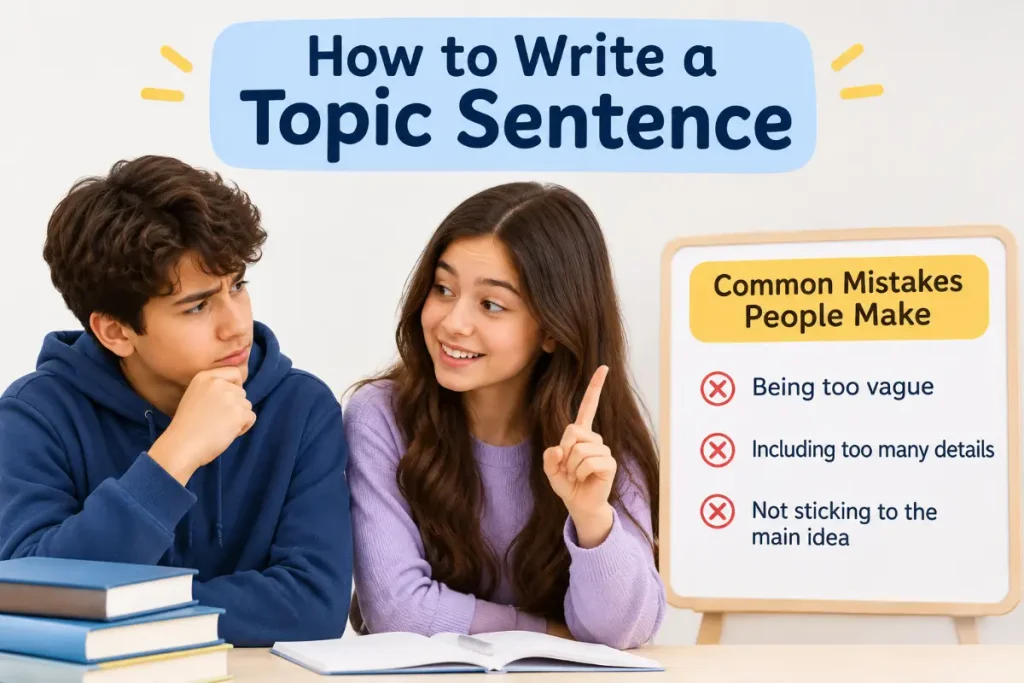
Common Mistakes People Make
Mistake 1: Announcing instead of stating. This paragraph will talk about recycling. State the point directly.
Mistake 2: Writing a topic sentence that’s too broad. Education is important gives you nowhere specific to go.
Mistake 3: Writing one that’s too narrow. A sentence packed with trivia leaves nothing to develop.
Mistake 4: Burying the topic sentence. In most academic and professional writing, readers shouldn’t have to hunt for it.
Mistake 5: Packing in two ideas. Recycling saves energy, and the government should ban plastic bags needs two paragraphs.
Mistake 6: Letting supporting sentences drift. If a sentence doesn’t connect to the topic sentence, cut it or move it.
Mistake 7: Repeating the same opening pattern in every paragraph. Vary the function and structure of your topic sentences so the writing doesn’t feel mechanical.
Quick Reference
| Element | What to Do |
|---|---|
| Content | Make one clear claim about one topic |
| Parts | Topic plus controlling idea |
| Scope | Not too broad, not too narrow |
| Placement | Usually first |
| Style | Active verb, complete sentence, specific wording |
| Test | Does every supporting sentence back it up? |
Practice Exercise
Complete each item. Answers follow.
Identify the controlling idea:
- Remote work increases productivity for many employees.
- Learning a second language improves memory.
- Public libraries remain essential to small communities.
- Cats make better apartment pets than dogs.
- Social media has changed how people get news.
- Regular exercise reduces stress.
Choose the stronger topic sentence: 7. (a) This paragraph is about recycling. (b) Recycling programs reduce the amount of waste sent to landfills. 8. (a) Many people drink coffee. (b) Coffee shops have become the modern community gathering place. 9. (a) Dogs are animals. (b) Training a dog requires patience, consistency, and positive reinforcement. 10. (a) Have you ever wondered about sleep? (b) Consistent sleep schedules improve concentration and mood.
Fix the weak topic sentence: 11. In this paragraph, I will discuss climate change. 12. Technology is important. 13. My town’s library has 4,213 books in its children’s section. 14. What can schools do about bullying?
Choose the topic sentence that best fits the supporting details: 15. Details: Walking boosts mood. Walking strengthens the heart. Walking costs nothing. (a) Walking is a simple, free way to improve health. (b) Exercise is popular. 16. Details: Fresh basil, ripe tomatoes, and good olive oil make the sauce. Overcooking ruins the flavor. (a) A great tomato sauce depends on fresh ingredients and careful cooking. (b) Italy has many sauces. 17. Details: Her office shut down. Her savings ran low. Her friends moved away. (a) A series of setbacks made the year hard for her. (b) She likes cities. 18. Details: Phones distract students in class. Notifications interrupt homework. Late-night scrolling reduces sleep. (a) Smartphones can harm students’ focus and rest. (b) Phones are new.
True or false: 19. A topic sentence must always be the first sentence of a paragraph. 20. A strong topic sentence states a fact that needs no support.
Answer Key
- increases productivity for many employees
- improves memory
- remain essential to small communities
- make better apartment pets than dogs
- has changed how people get news
- reduces stress
- (b)
- (b)
- (b)
- (b)
- Sample: Climate change is raising sea levels and threatening coastal cities.
- Sample: Technology has transformed how students research and share information.
- Sample: My town’s library gives children a welcoming place to discover reading.
- Sample: Schools can reduce bullying by training staff and teaching empathy.
- (a)
- (a)
- (a)
- (a)
- False (it’s usually first but can come last or be implied)
- False (a strong topic sentence makes a point the paragraph develops)
Frequently Asked Questions
Does every paragraph need a topic sentence?
In academic, professional, and web writing, yes, or at least a clear main idea a reader could summarize. In narrative and creative writing, the topic sentence may be implied, but beginners usually benefit from stating it directly.
How long should a topic sentence be?
One sentence, typically 15 to 30 words. Long enough to include a topic and a controlling idea, short enough to read at a glance.
Can a topic sentence be a question?
It can in some creative or conversational writing, but a statement is stronger because it commits to a claim. If you open with a question, follow it immediately with a direct answer that serves as the real topic sentence.
What’s the difference between a topic sentence and a thesis statement?
A thesis statement states the main argument of the entire piece. A topic sentence states the main idea of one paragraph, and it should support the thesis.
How many sentences should follow a topic sentence?
Enough to fully support the point. Many paragraphs use three to seven supporting sentences, but quality matters more than count. If you need much more, consider splitting the paragraph.
How do I know my topic sentence is working?
Try the summary test: cover the topic sentence and read the rest of the paragraph. Could a reader guess what the topic sentence says? If yes, the paragraph and its topic sentence are aligned.
Wrapping Up
Now that you know how to write a topic sentence, the process comes down to a few repeatable habits: decide the one point of the paragraph, state it as a claim with both a topic and a controlling idea, keep its scope realistic, and test it against your supporting sentences. Place it first in most writing, and make sure each topic sentence supports your thesis.
When a paragraph feels messy, the topic sentence is usually the place to start. Rewrite it, check every other sentence against it, and cut whatever doesn’t belong. With practice, writing a clear topic sentence becomes the natural first step of every paragraph, and your readers will follow your ideas with far less effort.