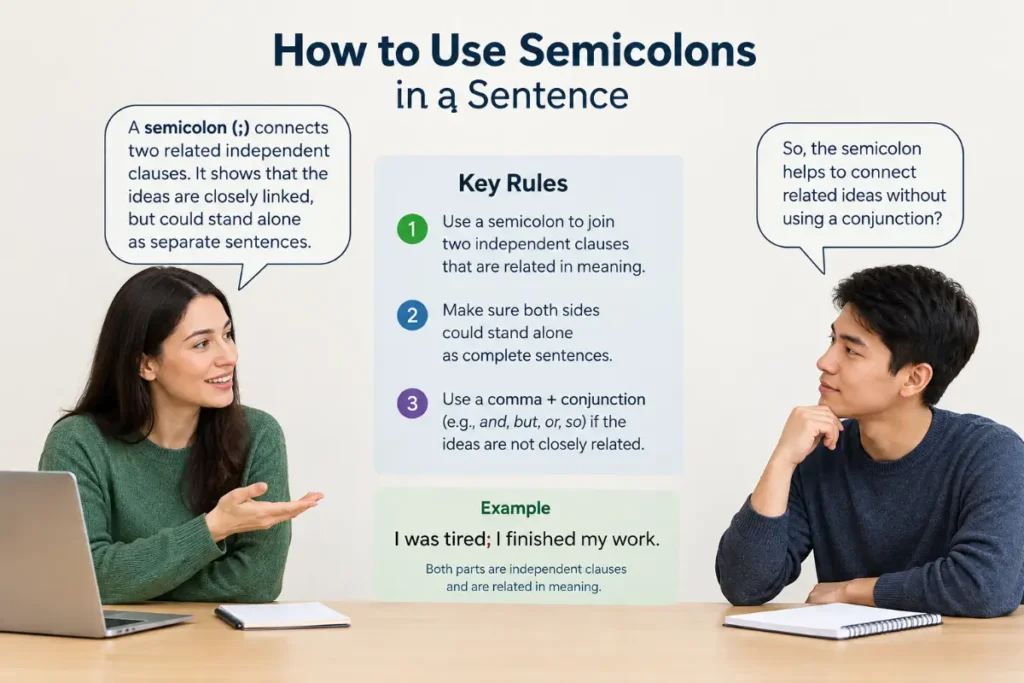
Semicolons can seem tricky at first, but once you understand where they fit, they become much easier to use. How to use semicolons in a sentence is really about recognizing the right moments to connect ideas, organize complex thoughts, and make your writing flow more smoothly.
We’ve already covered the full rule set in our complete guide to when to use a semicolon. This guide takes a different approach: rather than re-explaining the rule, it walks through usage of semicolons across the specific sentence patterns and writing situations where they show up most often in real writing — business emails, complex sentences, and structured lists. Purdue OWL confirms the core mechanic behind every pattern here: a semicolon joins two independent clauses without needing a coordinating conjunction, as long as the ideas are closely related.
You may also find A Misplaced Modifier? 20 Clear Examples (2026) helpful if you want to explore this topic further.
The Quick Answer
Semicolons show up naturally in three recurring sentence patterns:
- Two short, related statements presented as one balanced thought
- The proposal was strong; the budget was not.
- A cause-and-result pairing connected with a transitional word
- Sales dropped sharply; consequently, the board demanded a new strategy.
- A structured list where the items themselves contain commas
- The finalists were Maya Chen, a chef; Tom Reyes, a sommelier; and Priya Nair, a food critic.
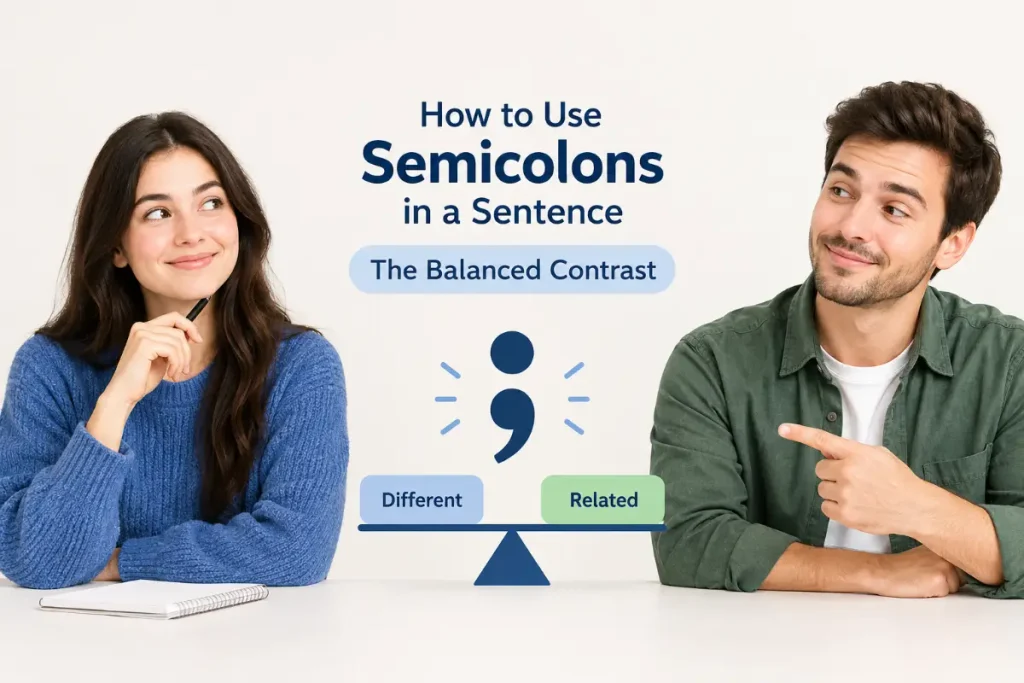
Pattern 1: The Balanced Contrast
This is one of the most common real-world uses of the semicolon — placing two short, related ideas side by side to highlight a contrast or comparison, without needing a full conjunction to connect them.
- The interview went well; the offer never came.
- He apologized quickly; she wasn’t ready to forgive.
- The plan looked perfect on paper; reality told a different story.
Notice how each of these reads almost like a punchline — the semicolon creates a deliberate pause that emphasizes the contrast between the two halves more than a period (which would fully separate them) or a comma with “but” (which would soften the emphasis).
Pattern 2: Cause and Result With a Transitional Word
This pattern shows up constantly in business, academic, and analytical writing, where one idea leads directly to a consequence, often signaled by “however,” “therefore,” “consequently,” or “moreover.”
- The client missed the deadline; consequently, the launch was postponed.
- Revenue grew steadily throughout the year; however, expenses grew even faster.
- The data supported the hypothesis; therefore, the team moved forward with the trial.
For the full breakdown of exactly why the semicolon (not a comma) belongs before these transitional words, see our complete semicolon guide.
Pattern 3: The Structured List With Internal Commas
This pattern appears constantly in reports, itineraries, and any writing that needs to introduce several items that each carry their own internal detail.
- The award went to three people: Dana Kim, the lead engineer; Marcus Webb, the project manager; and Elena Ruiz, the quality analyst.
- Our itinerary includes Lisbon, Portugal; Seville, Spain; and Marrakech, Morocco.
- The panel featured speakers from Google, based in California; SAP, based in Germany; and Rakuten, based in Japan.
Without the semicolons here, the commas inside each item would blur together with the commas meant to separate the items themselves, making the sentence genuinely hard to parse.
Pattern 4: Business and Professional Email Patterns
Semicolons show up frequently in professional writing to connect two closely related updates or observations within the same sentence, giving the message a more polished, deliberate tone than simply starting a new sentence for each point.
- The vendor confirmed the shipment; we should have inventory by Friday.
- I’ve reviewed the contract; a few clauses still need clarification.
- The team hit its Q3 targets; Q4 projections look even stronger.
Pattern 5: Academic and Analytical Writing
In academic prose, semicolons often connect two closely related findings or observations, particularly when the writer wants to draw a direct, deliberate comparison within a single sentence rather than across two separate ones.
- The control group showed no significant change; the treatment group improved by 23 percent.
- Early research suggested a weak correlation; later studies found a much stronger one.
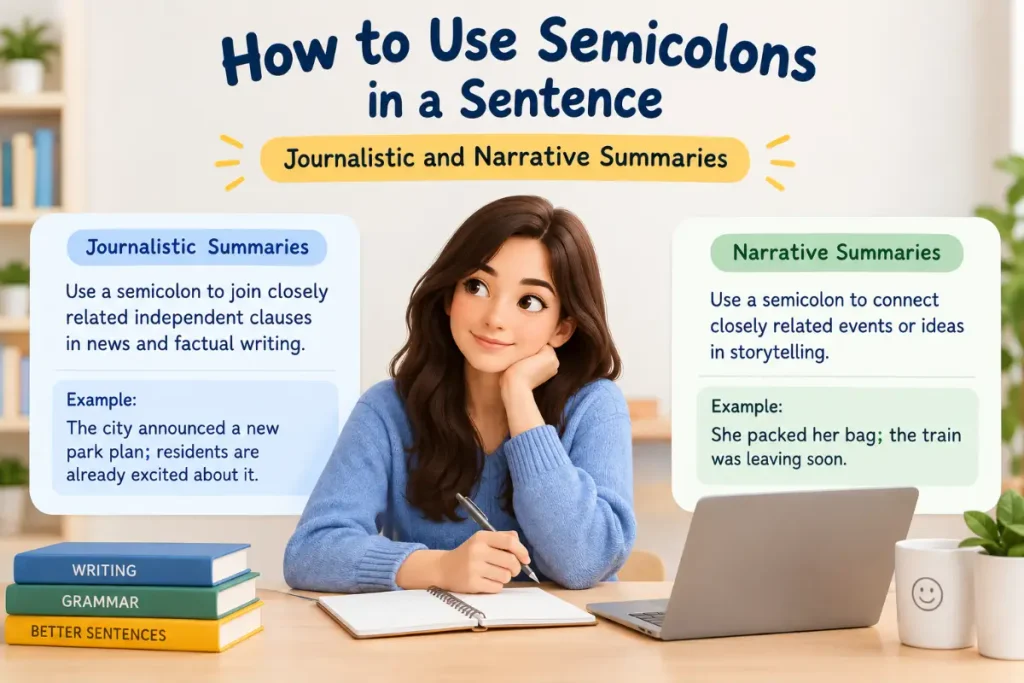
Pattern 6: Journalistic and Narrative Summaries
In journalism and long-form narrative writing, semicolons often connect two closely observed details within a single descriptive sentence, giving the prose a more controlled, deliberate pace than a string of short, choppy sentences would.
- The stadium was silent; even the vendors had stopped calling out.
- By midnight, the votes were still being counted; by dawn, a winner had finally emerged.
The Fastest Way to Check Yourself
Step 1: Could both halves of your sentence stand alone as complete sentences? If yes, and they’re closely related, a semicolon is a valid way to connect them.
Step 2: Are you using a transitional word like “however” or “therefore” to connect two independent ideas? Semicolon before it, comma after.
Step 3: Are you listing items that already contain their own internal commas? Use semicolons to separate the items clearly.
How to Use Semicolons in a Sentence: Quick Reference
| Pattern | Example |
|---|---|
| Balanced contrast | The plan was solid; the timing was wrong. |
| Cause and result with transition | Costs rose; therefore, prices increased. |
| Structured list with internal commas | Paris, France; Rome, Italy; and Cairo, Egypt. |
| Professional update | The report is finished; it’s ready for review. |
| Academic comparison | Group A improved significantly; Group B did not. |
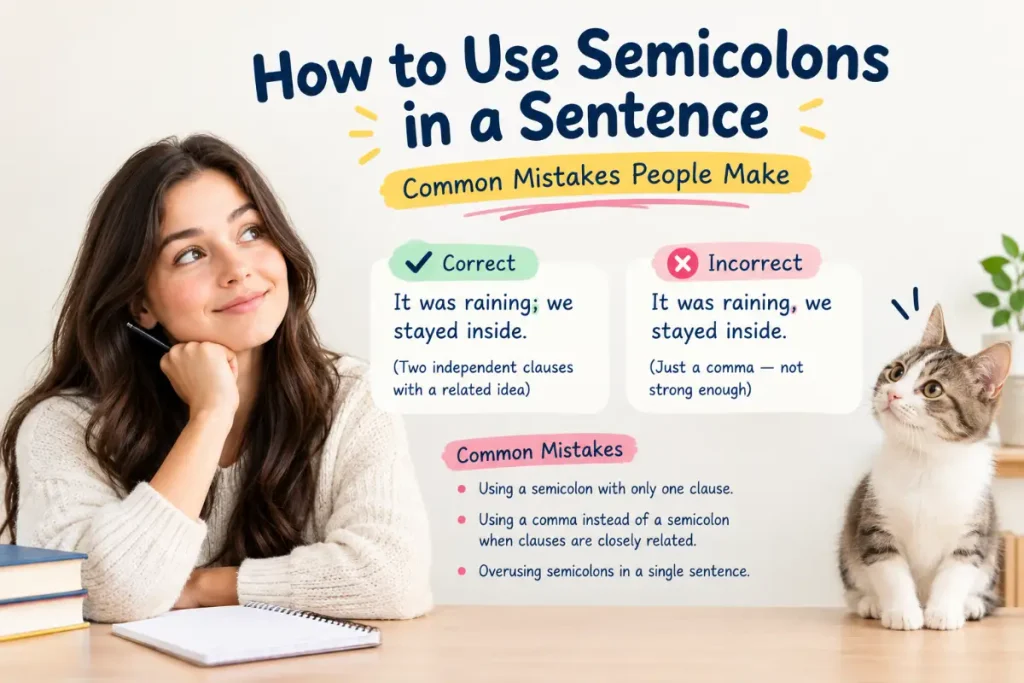
Common Mistakes People Make
Mistake 1: Using a semicolon where a comma-plus-conjunction reads more naturally. “The weather was perfect; and we spent the whole day outside” double-connects unnecessarily — pick one: either “The weather was perfect, and we spent the whole day outside” or “The weather was perfect; we spent the whole day outside.”
Mistake 2: Using a semicolon to join an independent clause to a dependent one. “She left early; because she felt sick” is incorrect, since “because she felt sick” can’t stand alone — a comma is needed instead: “She left early because she felt sick.”
Mistake 3: Skipping semicolons in a complex list, defaulting to commas instead. “We visited Lyon, France, Turin, Italy, and Bern, Switzerland” reads as a confusing string of six items instead of three — semicolons resolve this immediately.
Mistake 4: Overusing the balanced-contrast pattern until it loses its punch. A single well-placed semicolon contrast can be genuinely effective; using this exact structure in every paragraph dilutes its impact.
Mistake 5: Forgetting the comma after a transitional word following a semicolon. “The results were promising; however everyone remained cautious” is missing the comma after “however”: “The results were promising; however, everyone remained cautious.”
For another useful perspective, check out The Singular They Grammar Rule: A Simple 2026 Guide.
Semicolon vs Comma vs Period: Which One Should You Use?
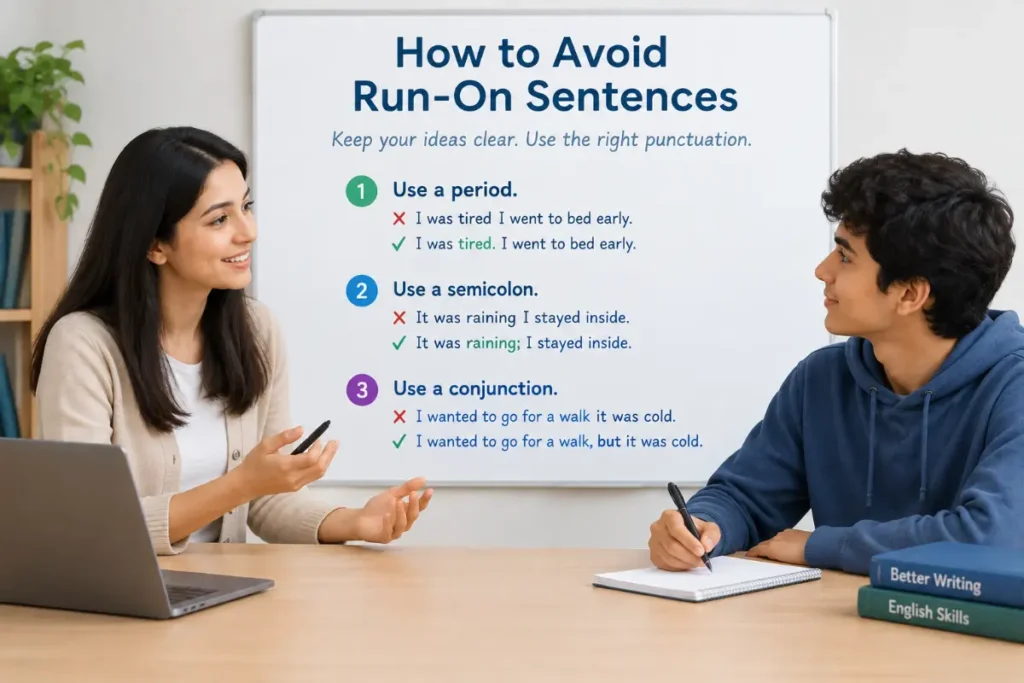
Choosing between a semicolon, comma, and period becomes easier when you look at how strongly the ideas are connected. Use a semicolon when two independent clauses are closely related and you want to keep them together. Use a comma when the sentence structure calls for one, such as before a coordinating conjunction joining two independent clauses. And use a period when you want to separate the ideas completely.
- Semicolon: The deadline was tight; the team finished on time.
- Comma + conjunction: The deadline was tight, but the team finished on time.
- Period: The deadline was tight. The team finished on time.
A simple test is to ask whether the two parts can stand alone as complete sentences. If they can and the relationship between them is close, a semicolon may work. If the ideas need a conjunction such as and, but, or, so, use the appropriate comma-plus-conjunction structure. Use a period if the ideas are better treated as separate thoughts.
The goal isn’t to choose the most sophisticated punctuation mark. Choose the one that makes the relationship between your ideas clearest.
More Examples to Lock It In
- The prototype tested well; the manufacturing costs did not add up.
- Interest rates climbed throughout the year; consequently, mortgage applications slowed.
- The delegation included Ana Torres, the ambassador; Wei Zhang, the trade minister; and Sofia Rossi, the economic advisor.
- He trained for months; the marathon still humbled him.
- Customer satisfaction improved; retention rates followed close behind.
Frequently Asked Questions
Is it ever wrong to use a semicolon in casual writing?
Not wrong exactly, but semicolons read as more formal and deliberate than commas or periods, so they can feel out of place in very casual texting or social media, where a period or comma-plus-conjunction usually fits the tone better.
Can a semicolon replace a period entirely?
Only when the two clauses are closely related — a semicolon signals a tighter connection between two ideas than a period would, but if the ideas are genuinely separate or unrelated, a period is the better, clearer choice.
Why do semicolons feel more common in business and academic writing than in casual writing?
These genres often need to express nuanced relationships between ideas — contrast, cause and effect, structured comparisons — that a semicolon captures more precisely than a simple period or comma, which is why the mark appears more frequently in more analytical or formal contexts.
Do semicolons work the same way in list formatting versus prose sentences?
Yes — the underlying rule (separating items that already contain internal commas) is identical whether the list appears within a flowing sentence or as part of a more structured report format.
What’s the fastest way to catch semicolon errors before publishing something?
For every semicolon, confirm both sides could stand alone as complete sentences, or confirm you’re separating list items that already contain their own commas — if neither applies, a comma or period is probably the better choice.
Practice Exercise
Decide whether each sentence uses its semicolon correctly. Try each one before checking the answer key.
- The report was thorough; the client still had questions.
- She left the office early; because she wasn’t feeling well.
- We toured Kyoto, Japan; Busan, South Korea; and Taipei, Taiwan.
- Sales increased; and profits followed.
- The engine failed; however, the backup system kicked in.
- The proposal looked promising; the budget raised several concerns.
- The meeting ended early; everyone returned to their desks.
- He wanted to attend the conference; but his flight was canceled.
- The company expanded into Austin, Texas; Denver, Colorado; and Portland, Oregon.
- The results were encouraging; therefore, the researchers continued the study.
- I checked the contract; a few sections still need clarification.
- Although the deadline was close; the team completed the project.
- The weather changed suddenly; consequently, the outdoor event was postponed.
- She enjoys hiking, especially in the mountains; swimming, particularly in the summer; and cycling on weekends.
- The restaurant was crowded; we decided to wait for a table.
- The report was submitted on time; however, several figures needed correction.
- Because the server was down; customers couldn’t access their accounts.
- The team prepared the presentation; the manager reviewed the final slides.
- We invited Sarah, the marketing director; James, the lead designer; and Nina, the project coordinator.
- The product received excellent reviews; nevertheless, sales remained lower than expected.
Answer Key
- Correct — Both sides are independent clauses that are closely related.
- Incorrect — “Because she wasn’t feeling well” is a dependent clause. The semicolon cannot join it to the independent clause.
- Correct — Semicolons clearly separate list items that already contain commas.
- Incorrect — A semicolon should not be paired with the coordinating conjunction “and” here. Use either “Sales increased, and profits followed” or “Sales increased; profits followed.”
- Correct — “However” connects two independent clauses, so a semicolon comes before it and a comma follows it.
- Correct — Both clauses can stand alone and express closely related ideas.
- Correct — The two independent clauses are closely connected.
- Incorrect — Use a comma before the coordinating conjunction “but”: “He wanted to attend the conference, but his flight was canceled.”
- Correct — The semicolons separate geographic items that already contain commas.
- Correct — “Therefore” is a transitional word connecting two independent clauses; the semicolon comes before it and the comma after it.
- Correct — Both sides are independent clauses with a close relationship.
- Incorrect — “Although the deadline was close” is dependent, so a semicolon cannot separate it from the main clause.
- Correct — “Consequently” connects two independent clauses, with the semicolon before it and a comma after it.
- Correct — The semicolons separate list items that contain internal commas.
- Correct — Both clauses are independent and closely related.
- Correct — “However” is a transitional word connecting two independent clauses.
- Incorrect — “Because the server was down” is a dependent clause and cannot be joined with a semicolon.
- Correct — Both sides are independent clauses and closely related.
- Correct — The semicolons separate people and their job titles, where the individual items already contain commas.
- Correct — “Nevertheless” is a transitional word connecting two independent clauses, so the semicolon and following comma are appropriate.
How Did You Do?
Below 10: Start with the independent-clause test before moving on to more complex examples.ou’ve internalized how to use semicolons in a sentence across the patterns that show up most often in real writing.
18–20 correct: You’ve got a strong handle on semicolon usage.
15–17 correct: You’re getting it; review transitional words and dependent clauses.
10–14 correct: Revisit the basic semicolon patterns and try the exercise again.
Before moving on, you may also want to read Double Negatives in English Grammar: What’s Correct? (2026 Guide) for more helpful grammar tips.
The Bottom Line
Seeing how to use semicolons in a sentence across real, recurring patterns — balanced contrasts, cause-and-result pairings, structured lists, and professional updates — makes the mark far less intimidating than memorizing the rule in the abstract. For the complete underlying rule set, including exactly when a semicolon is required versus optional, our full semicolon guide covers that foundation in depth.
Once you know this, the goal isn’t to add semicolons everywhere—it’s to use them when they genuinely improve clarity and connection. With a little practice, you’ll start recognizing the right spots naturally and write sentences that feel cleaner, smoother, and more polished.