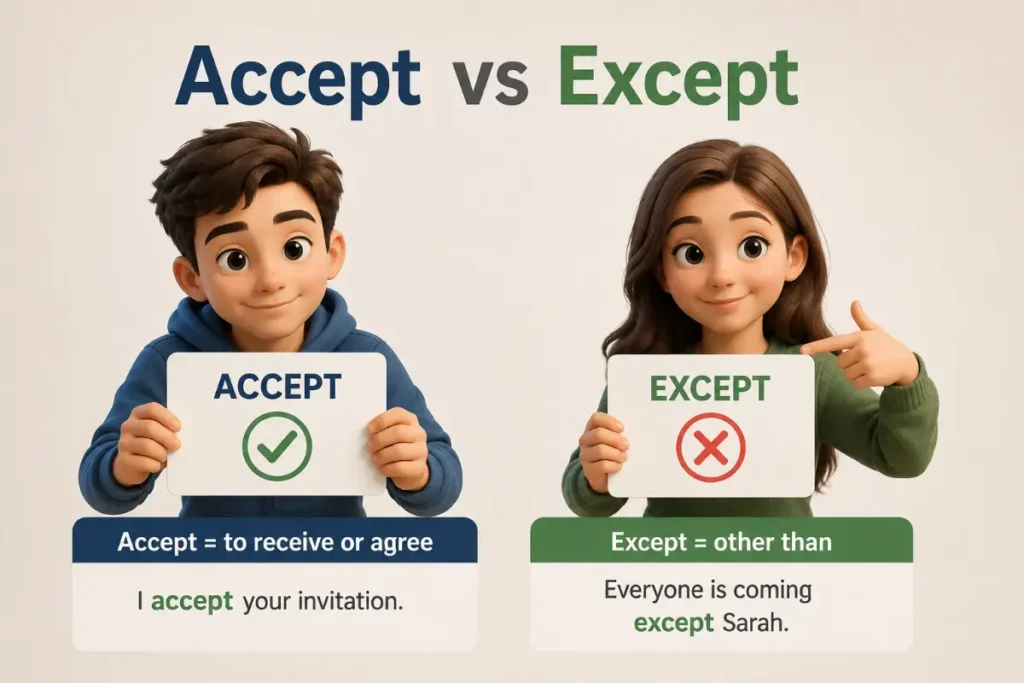
These two words sound almost identical in fast, casual speech, which is exactly why they get swapped so often. Accept vs Except is easier to remember once you know that one means receiving or agreeing to something, while the other means leaving something out.
Accept means to receive or agree to something willingly. Except means excluding or leaving something out. Opposite concepts, nearly identical sounds — that combination is precisely why this pair trips people up so consistently.
You may also find Less vs Fewer: 5 Easy Rules You’ll Never Forget (2026) helpful if you want to explore this topic further.
The Quick Answer
- Accept = to receive, agree to, or take willingly
- She accepted the job offer.
- Except = excluding, other than, but for
- Everyone came except Mark.
The test: try substituting “receive” or “agree to” for the word in question. If it fits, use accept. Try substituting “excluding” or “but for.” If that fits instead, use except.
Try it: “I can’t ___ this gift, it’s too generous.” Substitute “receive” — “I can’t receive this gift.” That works, so it’s accept.
Now try: “Everyone was invited ___ the new interns.” Substitute “excluding” — “everyone was invited excluding the new interns.” That works, so it’s except.
Why These Two Sound So Alike
Merriam-Webster points out that both words are typically pronounced with the same initial “ik-” sound followed by a stressed “-sept,” making them functional homophones in everyday speech, even though accept technically has alternate pronunciations starting with “ak-” that aren’t as widely used. On top of the shared sound, both words can technically function as verbs, which removes one of the usual clues (a difference in part of speech) that helps distinguish other confusable pairs.
That said, the meanings genuinely don’t overlap at all — accept is fundamentally about bringing something in or agreeing to it, while except is fundamentally about leaving something out. Once you anchor to that core opposition, the sound-alike problem stops mattering nearly as much.

Accept: To Receive or Agree
Accept functions only as a verb, and it covers a wide range of “receiving” or “agreeing to” situations — physical objects, ideas, responsibilities, apologies, and more.
Examples:
- She accepted the award graciously.
- He finally accepted responsibility for the mistake.
- We accept all major credit cards.
- I can’t accept this kind of behavior in the workplace.
- They accepted her explanation without further questions.
Notice the range here — you can accept a physical thing (an award), an abstract concept (responsibility), a payment method (credit cards), a standard of behavior, or someone’s reasoning. In every case, the core idea is the same: taking something in, agreeing to it, or approving of it.
Except: Excluding or Other Than
Except most commonly functions as a preposition (sometimes a conjunction), meaning “not including” or “other than” — essentially a more formal synonym for “but” in this specific sense.
Examples:
- The store is open every day except Sunday.
- Everyone finished the project except the new hires.
- I like all vegetables except mushrooms.
- Nothing was damaged except the fence.
- She would have come, except she had a prior commitment.
That last example shows except functioning as a conjunction, typically followed by “that” (spoken or implied) — “she would have come, except that she had a prior commitment.” This construction introduces a reason something didn’t happen as expected.
Except as a Verb: The Rare Exception (Literally)
Except does have a genuine, if uncommon, verb form, meaning “to leave out or exclude.” Merriam-Webster notes this usage shows up most often in formal or legal contexts.
Examples:
- The new regulation excepted small businesses from the requirement.
- He excepted himself from the general criticism of the department.
- The contract excepts certain properties from the sale.
This verb usage is genuinely rare in everyday writing — you’re far more likely to encounter “except” as a preposition. But it’s worth knowing it exists, both to understand it when you encounter it in formal or legal documents, and because it’s the direct source of the more familiar noun “exception,” which shows up constantly in ordinary writing.
The Fastest Way to Check Yourself
Step 1: Are you talking about receiving or agreeing to something? If yes, it’s accept.
Step 2: Are you talking about leaving something out or excluding it? If yes, it’s except.
Step 3: Try the substitution test. “Receive” or “agree to” for accept; “excluding” or “but for” for except.
A widely used memory trick: accept and agree both start with A, and both are about saying yes to something. Except and excluding both start with EX, and both are about leaving something out. That paired-letter association tends to stick well, since it links each word to a synonym that shares its first letters.
This kind of sound-alike confusion is closely related to what makes advice and advise tricky too — though in that pair’s case, the two words at least sound slightly different once you listen closely, which isn’t true here.
Accept vs. Except: Side-by-Side Comparison
| Accept | Except | |
|---|---|---|
| Part of speech | Verb only | Preposition, conjunction; rarely a verb |
| Meaning | To receive or agree to | Excluding, other than |
| Example | She accepted the invitation. | Everyone came except her. |
| Substitution test | “Receive” or “agree to” | “Excluding” or “but for” |
| Related noun | Acceptance | Exception |
| Common context | Offers, gifts, ideas, responsibility | Lists, exclusions, contrasts |
Common Mistakes People Make
Mistake 1: “I’ll except your apology.” Should be “accept your apology” — you’re receiving and agreeing to the apology, not excluding anything.
Mistake 2: “Everyone accept John showed up on time.” Should be “everyone except John” — John is being excluded from the group that showed up on time.
Mistake 3: “She was accepted from the requirement due to her experience.” Should be “excepted from the requirement” (or more commonly, rephrased as “exempted from” or “excluded from”) — this is a rare case where the correct word is genuinely the verb form of “except,” not “accept.”
Mistake 4: “We will except payment in cash or card.” Should be “accept payment” — this is about receiving payment, not excluding anything.
Mistake 5: Autocorrect swapping the words silently. Because both are correctly spelled real words, spell-check won’t catch a wrong-but-valid choice. This error is common enough in fast typing and voice-to-text transcription that it’s worth specifically double-checking in anything formal, like resumes, cover letters, or professional emails.
More Examples to Lock It In
- He accepted the promotion, except he asked for a later start date.
- Everyone on the team accepted the new schedule except for two people who had conflicts.
- She’ll accept feedback on anything except her personal writing style.
- The committee accepted most of the proposal, except the budget section, which needed revision.
- I would have accepted the offer, except the salary didn’t match my expectations.
- All applicants were accepted except those who missed the deadline.
What the Style Guides Say
Merriam-Webster attributes the confusion between these two words specifically to their shared pronunciation, noting that despite both functioning as verbs in some contexts, their meanings are distinctly dissimilar enough that mixing them up is considered a more noticeable error than some other homophone confusions. The AP Stylebook and Chicago Manual of Style both treat this as a standard, well-established distinction with no genuine debate or gray area, unlike some of the more contested pairs covered elsewhere on this site.
Because the confusion here stems from sound rather than any real overlap in meaning or usage, every major English-language authority treats the distinction identically — this is purely a matter of catching a homophone slip, not navigating conflicting guidance.
For another useful perspective, check out Continual vs Continuous: 20 Examples That Make It Clear (2026).
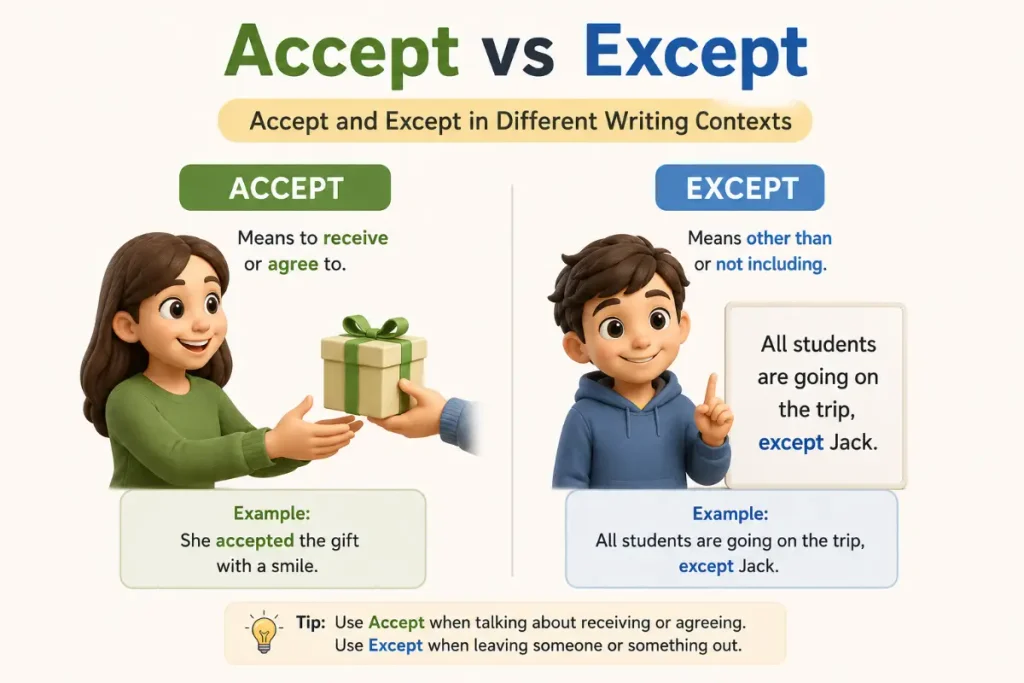
Accept and Except in Different Writing Contexts
In business and professional writing, “accept” appears constantly around offers, terms, payments, and responsibilities, while “except” shows up in policy language, lists of exclusions, and terms and conditions — getting these swapped in a contract or formal document can genuinely create confusion about what’s included or excluded.
“We accept” (returns, payment methods, certain conditions) is extremely common phrasing, and mixing it up with “except” in signage or policy text is one of the more visible, public versions of this error in customer service and retail writing.
In academic and legal writing, “except” as both a preposition and its rarer verb form appears more frequently than in casual writing, particularly in contracts and regulations that carve out specific exclusions.
In everyday and casual writing, this mix-up is common enough in fast typing that it’s worth a specific proofreading pass, especially since both words are correctly spelled and won’t be caught by standard spell-check.
A Closer Look at Accept’s Range of Meanings
Because accept covers so much ground — physical objects, ideas, terms, responsibility, apologies — it’s worth breaking down its main senses individually, since seeing them side by side makes the word’s flexibility easier to hold onto.
Receiving something offered. She accepted the gift graciously. This is the most literal, concrete sense — physically taking something someone hands you.
Agreeing to terms or conditions. He accepted the job offer. Here, accept means saying yes to an arrangement, not receiving a physical object.
Acknowledging something as true. I accept that mistakes happen. This sense is about recognizing or admitting a fact, even an uncomfortable one.
Approving or welcoming someone. The club accepted three new members this year. This usage involves formally including someone in a group.
Tolerating or allowing something. We don’t accept that kind of language here. Often used in the negative, this sense is about what behavior or standards are permitted.
Across all five senses, the underlying thread stays consistent: accept is always about bringing something in, saying yes, or allowing it — never about leaving something out, which is exactly the opposite of what “except” does.
Frequently Asked Questions
Is “except” ever really used as a verb, or is that just a technicality?
It’s a genuine, if uncommon, usage — meaning “to exclude or leave out” — and it shows up most often in formal, legal, or regulatory writing. In everyday writing, you’re far more likely to see except functioning as a preposition than as this rarer verb form.
What’s the connection between “except” and “exception”?
“Exception” is the noun form of the verb “except” (to exclude), referring to something or someone left out of a general rule or category. This connection is actually a useful memory anchor — if you can remember that “exception” relates to something being left out, you can extend that same logic to “except.”
Is there a difference between “except” and “except for”?
Not really — “except for” is a common, slightly more emphatic variant of “except” used the same way, particularly at the start of a sentence or clause: “Except for the weather, the trip was perfect” works the same as “The trip was perfect except for the weather.”
Why does accept have more than one pronunciation?
Accept is most commonly pronounced starting with “ik-,” which is exactly what creates the overlap with except’s pronunciation, but it also has less common variants starting with “ak-” or “ek-.” None of these pronunciation differences affect spelling or meaning; they’re simply regional or individual speech variations.
What’s the fastest way to catch this error before publishing something?
Search your document for every instance of “accept” and “except,” and for each one, try the substitution test: “receive/agree to” for accept, “excluding/but for” for except. Since spell-check won’t catch a wrong-but-valid word, this manual check is the most reliable method.
Practice Exercise
Fill in the blank with either “accept” or “except.” Answers are listed right after — try each one before checking.
- She couldn’t ______ the criticism gracefully.
- Everyone passed the test ______ two students.
- We ______ all forms of payment here.
- I like every genre of music ______ heavy metal.
- He finally ______ed the terms of the agreement.
- The store is closed every day ______ Sunday.
- Please ______ my sincere apology.
- Nobody objected ______ for one board member.
- They ______ed the invitation without hesitation.
- All the files were recovered ______ one corrupted folder.
- She was willing to ______ full responsibility.
- The rule applies to everyone ______ minors.
- He couldn’t ______ defeat easily.
- Everything went smoothly ______ for a minor delay.
- We happily ______ constructive feedback.
- The offer applies to all customers ______ those under 18.
- She ______ed the challenge without complaint.
- Nothing was left in the room ______ a single chair.
- I would ______ the job, except the commute is too long.
- They ______ed his resignation immediately.
Answer Key
- accept
- except
- accept
- except
- accept
- except
- accept
- except
- accepted
- except
- accept
- except
- accept
- except
- accept
- except
- accepted
- except
- accept
- accepted
If you got sixteen or more correct, the substitution test has already become instinct. For any you missed, go back and ask: am I receiving/agreeing to something, or leaving something out?
Before moving on, you may also want to read Peak vs Peek vs Pique: 7 Key Differences Explained (2026 Guide) for more helpful grammar tips.
The Bottom Line
Accept means to receive or agree to something. Except means excluding or leaving something out. The substitution test — “receive” for accept, “excluding” for except — resolves nearly every case instantly, and remembering that “exception” connects to “except” gives you a reliable anchor whenever the sound-alike confusion strikes.
In short, Accept vs Except becomes much easier once you focus on the meaning rather than the similar sound. When in doubt, ask whether you mean receiving or agreeing to something, or leaving something out. That quick check can help you choose the right word with confidence every time.