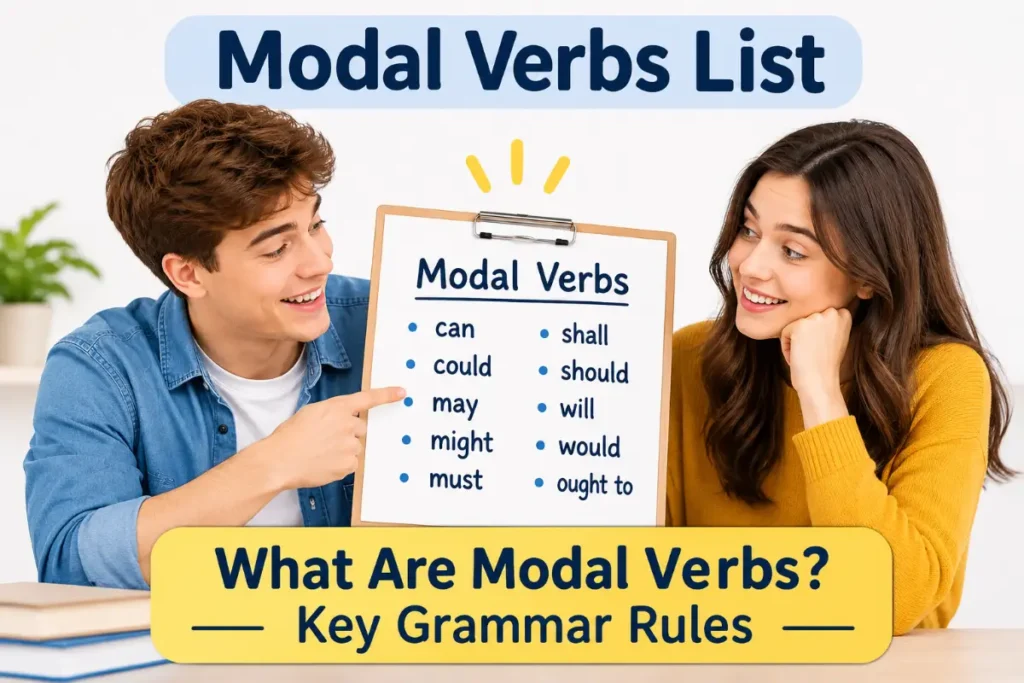
This modal verbs list covers the ten small words English speakers lean on every day to talk about ability, permission, possibility, advice, and obligation: can, could, may, might, shall, should, will, would, must, and ought to. They look tiny, but each one packs in a lot of meaning, which is exactly why they trip up so many writers.
Below, you’ll find the full list sorted by what each verb actually does, the grammar rules that make modals different from ordinary verbs, the past forms people get wrong most often, and 20 practice sentences so you can test yourself before you leave.
You may also find Future Perfect Tense Examples: 25 Simple Sentences + Rules (2026) helpful if you want to explore this topic further.
Quick Answer: What Is a Modal Verb?
A modal verb is a helping verb used with a main verb to express ability, permission, possibility, advice, obligation, or necessity. A modal verbs list includes ten commonly taught English modal verbs: can, could, may, might, shall, should, will, would, must, and ought to. For example, “She can swim” expresses ability, while “You should study” gives advice. Modal verbs generally take the base form of the main verb and never add -s for he, she, or it.
Complete Modal Verbs List at a Glance
| Modal | Main Jobs | Example |
|---|---|---|
| can | ability, informal permission, possibility | She can speak three languages. |
| could | past ability, polite requests, weak possibility | Could you pass the salt? |
| may | formal permission, possibility | You may begin. |
| might | weaker possibility | It might rain later. |
| shall | offers and suggestions (mostly “I/we”) | Shall we go? |
| should | advice, expectation | You should rest. |
| will | predictions, promises, quick decisions | I will call you tonight. |
| would | polite requests, hypotheticals, past habits | Would you mind waiting? |
| must | strong obligation, strong deduction | You must wear a seatbelt. |
| ought to | advice, moral duty | We ought to apologize. |

What Are Modal Verbs? Key Grammar Rules
The British Council’s LearnEnglish grammar reference explains that we use modals to show whether we believe something is certain, possible, or impossible. Grammatically, modals follow three rules that ordinary verbs don’t:
- No -s for he, she, or it. She can swim, never she cans swim.
- The next verb is the plain base form. He should leave, not he should to leave or he should leaves.
- Questions and negatives skip “do.” Can you help? and You mustn’t go, not Do you can help?
Because modals never change form to match the subject, they sidestep the agreement headaches covered in our subject verb agreement rules guide. That’s one of the few perks of this category.
Types of Modal Verbs: Meanings and Uses
Ability: can (present), could (past). I can lift this. When I was young, I could run for miles.
Permission: can (casual), could (polite), may (formal). Can I sit here? Could I borrow your car? May I come in?
Possibility: may, might, could, listed here roughly from stronger to weaker. It may snow. It might snow. It could snow.
Advice: should and ought to. You should call her. You ought to see a doctor.
Obligation and prohibition: must for strong obligation, must not for prohibition. Drivers must stop at red lights. You must not enter.
Deduction: must for strong conclusions, can’t for strong negative conclusions. The lights are on, so they must be home. That can’t be right.
Predictions and willingness: will and would. For a closer look at how “will” competes with other future forms, see our guide on how to use will vs going to.
Modal Verbs Examples in Everyday English Sentences
Modal verbs appear in everyday conversations, emails, instructions, and professional writing. They help speakers express what they can do, what they should do, what might happen, and what they are required to do.
Here are practical examples of all ten common modal verbs in complete sentences:
| Modal Verb | Example Sentence | What It Expresses |
|---|---|---|
| Can | I can finish this project today. | Ability |
| Could | Could you help me with this box? | Polite request |
| May | May I use your computer? | Formal permission |
| Might | We might visit Chicago this weekend. | Possibility |
| Shall | Shall we order some food? | Suggestion |
| Should | You should get some rest. | Advice |
| Will | I will send you the documents tomorrow. | Future intention |
| Would | Would you like a cup of coffee? | Polite offer |
| Must | All passengers must wear seat belts. | Strong obligation |
| Ought to | You ought to thank her for her help. | Advice or moral duty |
Notice how the same modal can sometimes express different meanings depending on the context.
For example, “Can you drive?” asks about someone’s ability, while “Can I leave early?” asks for permission. Similarly, “Could you open the window?” is a polite request, not a question about someone’s past ability.
When choosing a modal, pay attention to the purpose of the sentence rather than memorizing just one meaning for each word.
For another useful perspective, check out Subjunctive Mood Examples: 25+ Easy Sentences (2026).
Can vs. Could vs. May: What’s the Difference?
Can, could, and may are three commonly used modal verbs that often cause confusion, especially when asking for permission or expressing possibility. Although they sometimes overlap, each has a slightly different tone and purpose.
Can usually expresses present ability or informal permission.
- I can drive a truck.
- Can I borrow your notebook?
- She can speak Spanish fluently.
Could can express past ability, polite requests, or uncertain possibilities.
- When I was younger, I could run five miles.
- Could you help me move this table?
- We could go hiking tomorrow if the weather improves.
May is commonly used for formal permission and possibility.
- May I come into your office?
- You may leave after finishing the assignment.
- It may snow tonight.
Here’s a quick comparison:
| Modal | Main Use | Example |
|---|---|---|
| Can | Present ability or casual permission | Can I sit here? |
| Could | Past ability, polite requests, possibility | Could you wait a moment? |
| May | Formal permission or possibility | May I ask a question? |
Which one should you use?
In everyday American English, “can” is perfectly acceptable for asking permission. “May” sounds more formal or polite, while “could” is a natural choice when making a softer request.
For example, you might say “Can I use your phone?” when speaking with a friend and “May I speak with the manager?” in a more formal situation.
Modal Verbs in the Past: Modal + Have + Past Participle
To talk about the past, most modals take “have” plus a past participle.
- She should have called. (she didn’t, and it was a mistake)
- They must have left. (strong guess about the past)
- He might have forgotten. (weak possibility about the past)
- We could have won. (the chance existed but didn’t happen)
The most common error here is writing “of” instead of “have.” The Cambridge Dictionary blog flags “should of” and “might of” as mistakes that come from how “should’ve” and “might’ve” sound in speech. In writing, it is always should have or should’ve.
Semi-Modal Verbs: The Near Relatives
A few expressions behave like modals in meaning but not in grammar: have to, be able to, had better, used to, and need to. Many grammars also treat ought to as a semi-modal. These change form normally (she has to, he had to), which is why they’re handy for past and future obligation: You will have to wait, not you will must wait.
Must vs. Have To vs. Should: Understanding Obligation and Advice
Must, have to, and should are often used when talking about responsibilities, rules, and recommendations. However, they don’t communicate the same level of necessity.
Understanding their differences helps you choose the right expression without making your sentences sound too forceful or too weak.
1. Must: Strong obligation
Use “must” when something is extremely important, required, or necessary. It often expresses a strong personal obligation or a rule.
- You must wear a seat belt while driving.
- Students must submit their assignments by Friday.
- We must protect the environment.
2. Have to: External requirement or necessity
“Have to” usually describes an obligation caused by a rule, situation, or outside requirement. Unlike core modal verbs, it changes form depending on the subject and tense.
- I have to wake up early for work.
- She has to attend the meeting.
- They had to cancel their trip because of the storm.
3. Should: Advice or recommendation
Use “should” when recommending an action or explaining what would be a good idea. It expresses a weaker obligation than “must” or “have to.”
- You should drink more water.
- He should apologize for his mistake.
- We should leave early to avoid traffic.
Compare all three in this table:
| Expression | Main Meaning | Example |
|---|---|---|
| Must | Strong obligation | You must follow the safety rules. |
| Have to | Necessary requirement | I have to work tomorrow. |
| Should | Advice or recommendation | You should get more sleep. |
Remember the difference between “mustn’t” and “don’t have to.”
These expressions are particularly easy to confuse:
- You mustn’t park here. This means parking is prohibited.
- You don’t have to park here. This means parking isn’t necessary, but you can do it if you want.
The first sentence expresses a restriction, while the second removes an obligation. Understanding this difference is important for clear communication in everyday American English.
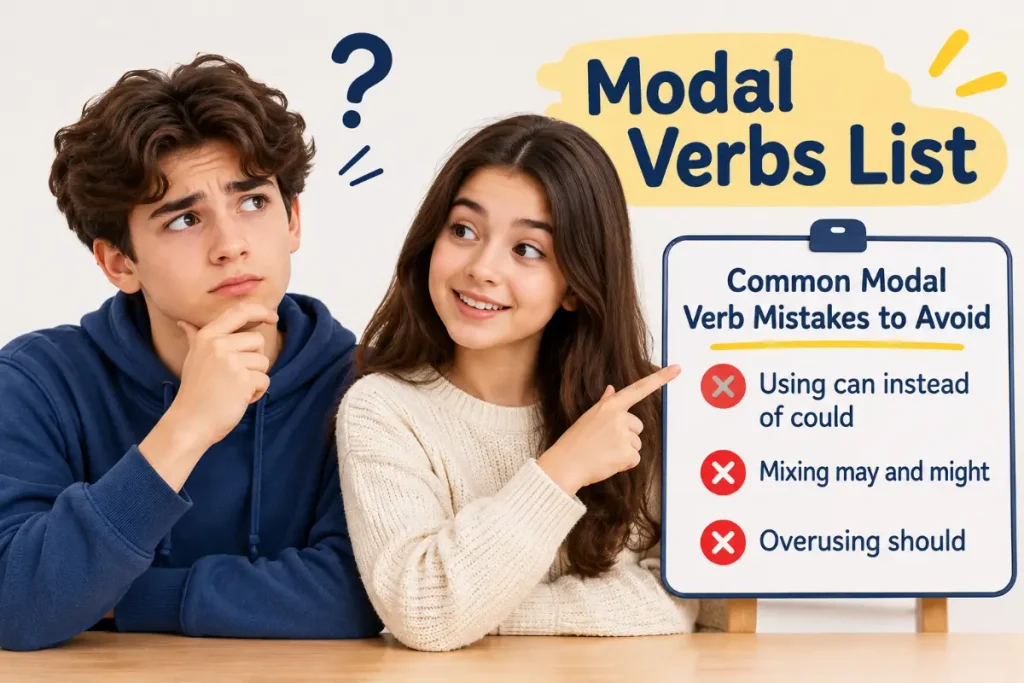
Common Modal Verb Mistakes to Avoid
Mistake 1: She cans swim. Modals never take -s. Correct: She can swim.
Mistake 2: He should to leave. Drop the “to”: He should leave.
Mistake 3: Do you can help me? Invert instead: Can you help me?
Mistake 4: They must of left. Correct: They must have left.
Mistake 5: You must not worry when you mean “you don’t need to.” “Must not” forbids; “needn’t” or “don’t have to” removes the need.
Modal Verbs Practice Exercise
Choose the best answer or fix the error. Answers follow.
- She ___ (can/could) swim when she was five.
- ___ (May/Must) I borrow your pen?
- You ___ (should/must) see a doctor if the pain continues.
- Visitors ___ (must not/needn’t) feed the animals.
- It ___ (might/must) rain later, but I’m not sure.
- He ___ (should have/should of) called earlier.
- The lights are off, so they ___ (must/should) be asleep.
- When I was young, I ___ (can/could) run a mile in six minutes.
- You ___ (needn’t/mustn’t) wear a tie; it’s a casual event.
- I ___ (will/would) help you if I could.
- “She ___ (might/should) have forgotten,” he said, “but I doubt it.”
- She ___ (cans/can) speak four languages.
- He ___ (musts/must) finish the report by Friday.
- Fix: She can to drive.
- Fix: Does he can swim?
- ___ (Shall/Will) we start the meeting?
- If you ___ (would/could) come, we’d love to see you.
- They ___ (must have/must of) left already; the car is gone.
- Which sentence expresses prohibition? (a) You mustn’t park here. (b) You needn’t park here.
- I ___ (would/will) always walk to school when I lived in Ohio.
Answer Key
- could
- May
- should
- must not
- might
- should have
- must
- could
- needn’t
- would
- might
- can
- must
- She can drive.
- Can he swim?
- Shall
- could
- must have
- (a)
- would
Frequently Asked Questions About Modal Verbs
How many modal verbs are there in English?
Most grammars count nine or ten core modals: can, could, may, might, shall, should, will, would, must, and often ought to. Some lists add semi-modals like “had better” and “need,” which behave modal-like in some structures.
What’s the difference between “can” and “may” for permission?
Both work. “May” sounds more formal, while “can” is the everyday choice. In casual speech, nobody will blink at either one.
Is “shall” still used in American English?
It’s rare in everyday American speech outside offers and suggestions with “I” or “we” (“Shall we begin?”) and in formal or legal writing, where it signals obligation.
Can I use two modals together, like “might could”?
In standard written English, no. You’d use a modal plus a semi-modal instead: “might be able to.” Double modals show up in some regional dialects but aren’t standard.
What’s the fastest way to catch modal mistakes before publishing?
Check three things: no -s on the modal, a bare base verb right after it, and “have” (never “of”) in past forms.
Before moving on, you may also want to read Use Will vs Going To: Simple Guide (2026) for more helpful grammar tips.
Wrapping Up: Use Modal Verbs Correctly
Keep this modal verbs list nearby and sort each modal by its job: ability, permission, possibility, advice, obligation, or prediction. Once you know which job a sentence needs, the right modal usually becomes obvious, and the three grammar rules (no -s, base verb next, no “do”) keep the structure clean.
The biggest wins come from the small habits: say “should have” instead of “should of,” use “must not” only for prohibition, and lean on semi-modals like “have to” and “be able to” when you need past or future forms. Modals reward precision, and a little of it goes a long way.