Learning how to use neither nor correctly comes down to three separate rules that most people only half-remember: the pair must always travel together, the verb must agree with the noun closest to it, and both halves of the pair must have matching grammatical structure. Miss any one of the three and the sentence goes wrong, even if it sounds fine on a quick read.
This guide takes the rules one at a time, then shows the most common ways they collide, like a plural subject sitting next to a singular one or a negative verb sneaking in and creating an accidental double negative. It builds on the correlative conjunction basics in our guide to using conjunctions correctly, zooming in on the one pair that causes the most trouble.
You may also find Use Commas in a List: 7 Easy Rules (2026) helpful if you want to explore this topic further.
Rule 1: Neither Always Needs Nor
Neither and nor are a matched set. If you open with “neither,” the second half must be “nor,” not “or.”
- Correct: She could neither confirm nor deny the rumor.
- Incorrect: She could neither confirm or deny the rumor.
The Government of Canada’s Writing Tips Plus describes neither…nor as a correlative conjunction that coordinates two or more words, phrases, or clauses, which is why both halves have to show up for the construction to work. Dropping “neither” and leaving a lone “nor” behind leaves the sentence feeling unfinished, and swapping in “or” mixes two different pairs (either/or and neither/nor) into one.

Rule 2: The Verb Agrees With the Nearest Subject
When neither…nor joins two subjects, the verb takes its number from whichever subject sits closest to it.
- Neither the coach nor the players were satisfied. (players is closest and plural, so “were”)
- Neither the players nor the coach was satisfied. (coach is closest and singular, so “was”)
The same two nouns produce a different verb just by swapping their order, which surprises many writers. The Canadian government’s guide uses a first-person example that shows the same logic with pronouns:
- Neither my friends nor I am interested in modern art.
- Neither I nor my friends are interested in modern art.
Sentences like the first one are grammatically correct but can sound stiff. When that happens, a common editing move is to reorder the subjects so the plural one comes last, which usually reads more naturally.
Rule 3: Both Halves Must Match in Structure
This is the parallel structure rule applied to a specific pair. Whatever grammatical form follows “neither” must also follow “nor.” If a noun follows one, a noun follows the other; if a verb phrase follows one, a verb phrase follows the other. For a full look at the underlying principle, see our parallel structure in writing guide.
- Incorrect: The coach neither wanted to lose nor to tie.
- Correct: The coach wanted neither to lose nor to tie.
In the incorrect version, “neither” sits before the verb “wanted,” while “nor” sits before the infinitive “to tie,” so the two halves aren’t parallel. Moving “neither” so it sits right before “to lose” fixes the mismatch without changing any other word.
- Incorrect: She is neither talented nor works hard.
- Correct: She is neither talented nor hardworking.
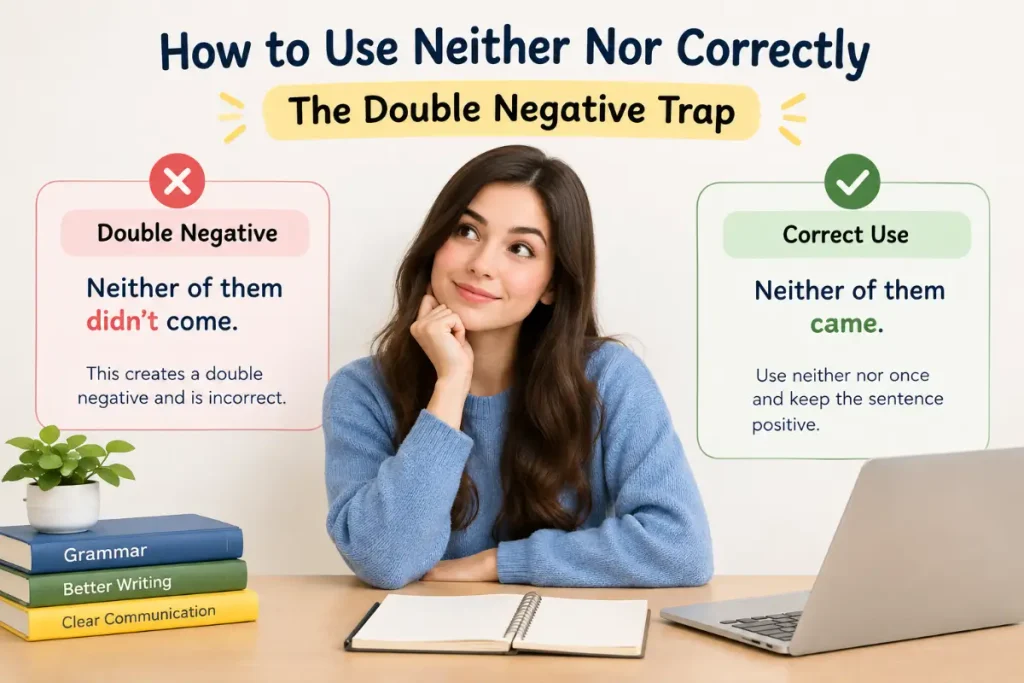
The Double Negative Trap
Neither and nor already carry the negative meaning, so adding another negative word creates an accidental double negative.
- Incorrect: Neither Tom nor Jerry didn’t show up.
- Correct: Neither Tom nor Jerry showed up.
The verb after neither…nor should be positive, because the negation is already built into the pair. If you want to see how stacked negatives fit into the bigger picture of English, our guide to double negatives in English grammar covers the history and the exceptions.
What About “Neither Of”?
A separate but related construction is “neither of,” as in “neither of the options.” In formal, edited writing, “neither” in this construction is treated as singular and takes a singular verb.
- Neither of the options seems ideal.
- Neither of the candidates has submitted references.
Plural verbs after “neither of” are common in casual speech, but singular remains the standard for polished writing.
Quick Reference Table
| Situation | Rule | Example |
|---|---|---|
| Choosing the second half | Always “nor,” never “or” | neither here nor there |
| Two singular subjects | Singular verb | Neither Sam nor Priya is late. |
| Singular + plural subject | Verb matches the nearest subject | Neither Sam nor the twins are late. |
| Joining verbs or phrases | Keep both halves parallel | wanted neither to lose nor to tie |
| Adding a negative verb | Avoid; creates a double negative | Neither of them came. |
| “Neither of” + plural noun | Singular verb in formal writing | Neither of the answers is correct. |
How to Use Neither Nor Correctly in Real Sentences
Knowing the rules is one thing; using how to use neither nor correctly in everyday writing is another. The easiest approach is to look at what comes after neither and nor, then make sure the two parts match and the verb agrees with the subject closest to it.
Here are some common sentence patterns you can use as a quick guide:
Neither + Noun + Nor + Noun
Use this pattern when you are excluding two people, things, or choices.
- Neither Sarah nor James is available.
- Neither coffee nor tea is included.
- Neither the manager nor the employees were prepared.
Remember that when two subjects are joined by neither…nor, the verb follows the subject closest to it.
Neither + Verb + Nor + Verb
When neither…nor connects two actions, keep the verb forms parallel.
- She neither called nor texted.
- He neither apologized nor explained his decision.
- They neither confirmed nor denied the report.
The two verbs should have the same grammatical structure, making the sentence easier to read.
Neither + Adjective + Nor + Adjective
Neither…nor can also connect two descriptions.
- The answer is neither simple nor obvious.
- The movie was neither exciting nor memorable.
- The proposal is neither practical nor affordable.
This structure works particularly well when you are describing two qualities that do not apply.
Neither + Infinitive + Nor + Infinitive
When connecting infinitive phrases, place neither directly before the first infinitive and nor before the second.
- She decided neither to stay nor to leave.
- He wanted neither to complain nor to argue.
- The company plans neither to expand nor to relocate.
This avoids the common mistake of placing neither too early in the sentence and breaking the parallel structure.

A Quick Editing Check
Before publishing a sentence with neither…nor, read the two halves separately. Then check:
- Does neither pair with nor?
- Does the verb agree with the subject closest to it?
- Do the words or phrases after neither and nor use matching grammatical forms?
- Is there an unnecessary not or n’t creating a double negative?
- Would reversing the order of the subjects make the sentence sound more natural?
For example:
Awkward: Neither my friends nor I am interested in the event.
Reordered: Neither I nor my friends are interested in the event.
Both follow the agreement rule, but changing the order can make the sentence flow more naturally.
The goal isn’t to memorize one sentence pattern. It’s to recognize what neither…nor is connecting and then keep the grammar consistent from the first half to the second. Once you check the pair, the agreement, and the parallel structure, using neither and nor correctly becomes much more predictable.
For another useful perspective, check out A Dangling Modifier? Learn It in 9 Easy Steps (2026 Guide).
Common Mistakes People Make
- Mistake 1: Using “or” instead of “nor” to finish the pair, which mixes up neither/nor with either/or.
- Mistake 2: Choosing the verb by the first subject instead of the closest one. “Neither the manager nor the employees was informed” checks the wrong noun.
- Mistake 3: Placing “neither” before a verb when “nor” is followed by something that isn’t a verb, breaking the parallel structure.
- Mistake 4: Adding “not” or “n’t” to the verb, creating an unintended double negative.
- Mistake 5: Forgetting that “neither of” takes a singular verb in formal writing, even though the noun after “of” is plural.
Practice Exercise
Correct each sentence if needed, or write “C” if it’s already correct. Answers are listed right after, so try each one before checking.
- Neither the coach nor the players was happy with the result.
- Neither the players nor the coach were happy with the result.
- Neither Maria nor I are attending the meeting.
- Neither of the options seem ideal.
- The coach neither wanted to lose nor to tie.
- Neither Tom nor Jerry didn’t show up.
- I can neither confirm or deny the rumor.
- Neither the cat nor the dog is allowed on the couch.
- She is neither talented nor works hard.
- Neither the teachers nor the principal were available.
- Neither my parents nor my brother know the answer.
- Neither the report nor the presentation were finished on time.
- He neither called nor wrote.
- Neither of the candidates have submitted references.
- Neither you nor she is responsible.
- Neither she nor you is responsible.
- Neither the dogs nor the cat are hiding.
- Neither rain nor snow nor heat stop the mail carrier.
- Neither the students nor the teacher have any questions.
- Neither he nor I am worried.
Answer Key
- “Neither the coach nor the players were happy with the result.” (players is nearest)
- “Neither the players nor the coach was happy with the result.” (coach is nearest)
- “Neither Maria nor I am attending the meeting.” (I is nearest)
- “Neither of the options seems ideal.”
- “The coach wanted neither to lose nor to tie.”
- “Neither Tom nor Jerry showed up.”
- “I can neither confirm nor deny the rumor.”
- C
- “She is neither talented nor hardworking.”
- “Neither the teachers nor the principal was available.” (principal is nearest)
- “Neither my parents nor my brother knows the answer.” (brother is nearest)
- “Neither the report nor the presentation was finished on time.”
- C
- “Neither of the candidates has submitted references.”
- C (she is nearest, so “is”)
- “Neither she nor you are responsible.” (you is nearest)
- “Neither the dogs nor the cat is hiding.” (cat is nearest)
- “Neither rain nor snow nor heat stops the mail carrier.”
- “Neither the students nor the teacher has any questions.” (teacher is nearest)
- C (I is nearest, so “am”)
Frequently Asked Questions
Can I use “neither” with “or” if I’m only joining two words?
No. Neither pairs with nor every time, regardless of how short the items are. “Neither hot or cold” is incorrect; “neither hot nor cold” is the standard form.
Why does the verb follow the nearest subject instead of the first one?
This is the standard convention for correlative pairs like either/or and neither/nor, which present alternatives rather than combining subjects the way “and” does. The nearest-subject rule keeps the verb grammatically anchored to one clear noun.
Is a plural verb ever acceptable after “neither of”?
It’s common in casual speech and some informal writing, but formal, edited writing still expects a singular verb, since “neither” is the true subject of the construction.
How do I fix a sentence that sounds awkward because of the nearest-subject rule?
Reorder the subjects so the plural noun comes last, or rephrase entirely. “Neither my friends nor I am interested” is correct but stiff; “Neither I nor my friends are interested” reads more naturally.
What’s the fastest way to catch neither-nor errors before publishing something?
Check three things in order: that “nor” (not “or”) closes the pair, that the verb matches the closest subject, and that whatever follows “neither” mirrors whatever follows “nor” in grammatical form.
Before moving on, you may also want to read Fix a Sentence Fragment: The Easy 2026 Guide for more helpful grammar tips.
Wrapping Up
Knowing how to use neither nor correctly means keeping three habits in mind at once: always pair neither with nor, match the verb to the closest subject, and keep both halves grammatically parallel. Add one more rule of thumb, avoiding negative verbs, and nearly every mistake with this pair disappears.
When a sentence still feels awkward after you’ve applied all three rules, reordering the subjects or rephrasing is usually the cleanest fix. For related agreement questions, our subject verb agreement rules guide covers the wider set of patterns this pair belongs to.