If you already understand the difference between active and passive voice, the next real question is how to avoid passive voice in writing once you’ve spotted it in your own drafts — because knowing a sentence is passive and knowing how to efficiently fix it are two different skills. Our active vs passive voice examples guide covers the definitions and the cases where passive voice is actually the better choice; this guide picks up from there with concrete editing techniques for converting passive sentences quickly and reliably during a revision pass.
Most writers who struggle with this aren’t confused about the grammar — they’re just not sure what to actually do once they’ve circled a passive sentence in their draft. Purdue OWL notes that active voice generally “makes your meaning clear for readers, and keeps the sentences from becoming too complicated or wordy,” which is exactly the outcome these five techniques aim to produce during a revision pass.
You may also find Use Neither Nor Correctly: The Easy 2026 Guide helpful if you want to explore this topic further.
Technique 1: Find the Real Actor and Make It the Subject
This is the core move behind almost every passive-to-active conversion. Passive sentences already contain the actor — it’s just tucked into a “by” phrase, or missing from the sentence entirely. Find that actor, and place it at the front.
- Passive: The proposal was reviewed by the committee.
- Active: The committee reviewed the proposal.
- Passive (actor missing): Mistakes were made during the rollout.
- Active: The engineering team made mistakes during the rollout.
Notice the second example required supplying an actor that wasn’t stated at all — this is common in passive constructions specifically designed (consciously or not) to avoid naming who did something.
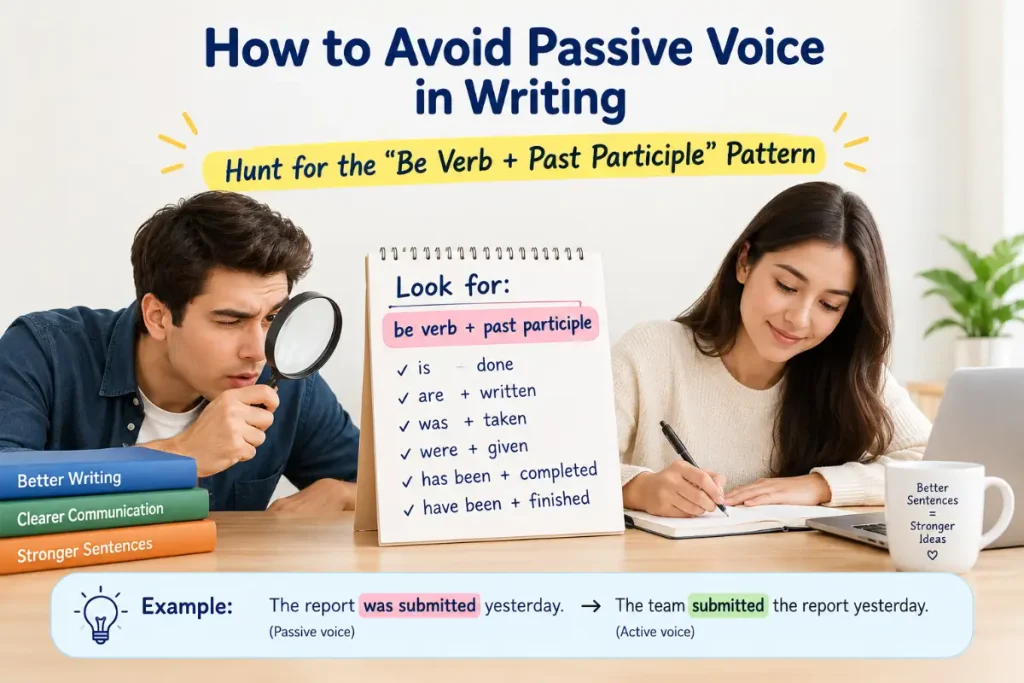
Technique 2: Hunt for the “Be Verb + Past Participle” Pattern
Passive voice always follows a recognizable formula: a form of “be” (is, was, were, has been, will be) immediately followed by a past participle. Training yourself to scan specifically for this two-word combination is faster than trying to “feel out” passive sentences by ear.
- is written, was completed, has been approved, will be announced, were damaged
Once you spot the pattern, ask: who or what is actually doing this action? That answer becomes your new subject.
Technique 3: Convert Nominalizations Back Into Verbs
A subtler, related habit that often travels alongside passive voice is turning verbs into abstract nouns (nominalizations) — “make a decision” instead of “decide,” “conduct an investigation” instead of “investigate.” These constructions often pair with passive voice and compound the wordiness problem.
- Weak: A decision was made by the board regarding the merger.
- Strong: The board decided on the merger.
- Weak: An investigation was conducted by police into the incident.
- Strong: Police investigated the incident.
Converting the buried verb (“decision” → “decided,” “investigation” → “investigated”) often eliminates the passive construction automatically, since the sentence no longer needs “was made” or “was conducted” as a filler verb.

Technique 4: Read Your Draft Backward, Sentence by Sentence
This sounds unusual, but it’s a genuinely effective editing trick specifically for catching passive voice: reading a document from the last sentence to the first breaks the narrative flow you’re used to, forcing you to evaluate each sentence’s structure in isolation rather than skimming for meaning. Passive constructions, which often hide comfortably within a paragraph’s overall flow, become much more visible in this out-of-context view.
Technique 5: Use Your Word Processor’s Search Function Strategically
Search your document for the most common “be verb” forms — “was,” “were,” “is,” “are,” “been,” “being” — and check each result individually. Not every instance will be passive voice (some are simply describing a state: “she was tired”), but this search surfaces the vast majority of passive constructions in a single pass, which is far more systematic than hoping to catch them by eye.
When NOT to Convert: A Quick Gut-Check
Before converting every passive sentence you find, apply a quick check: does naming the actor actually improve the sentence, or would it add unnecessary or unknown information? If the actor is genuinely irrelevant, unknown, or would clutter the sentence, leaving it passive may be the better editorial choice — the goal of these techniques is reducing unnecessary passive voice, not eliminating it entirely.
- Fine as passive: The package was delivered this morning. (naming the specific delivery person would be unnecessary)
- Worth converting: The report was finished by the deadline team. (the vague “deadline team” is clunky; naming who specifically finished it, if known, reads better)
How to Avoid Passive Voice in Writing Without Making It Awkward
Learning how to avoid passive voice in writing does not mean changing every passive sentence you find. The real goal is to make your writing more direct without forcing active constructions that sound unnatural. A useful approach is to check who performs the action, whether that person or thing matters, and whether putting the actor first actually improves the sentence.
Put the Doer First When the Doer Matters
If the person, team, or organization responsible for an action is important to the reader, make that actor the subject.
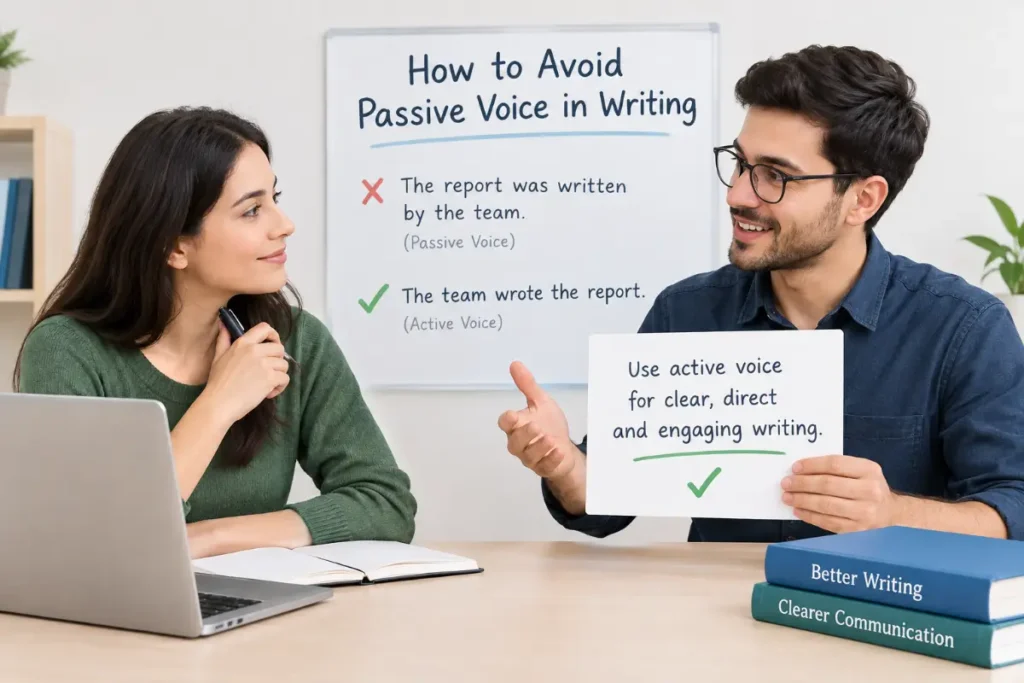
- Passive: The report was approved by the director.
- Active: The director approved the report.
The active version immediately tells readers who took the action and usually feels more direct.
Replace Vague Passive Constructions
Passive voice can become especially unclear when the actor is left out.
- Passive: Several mistakes were made during the launch.
- Clearer active: The development team made several mistakes during the launch.
However, only name an actor when you actually know who performed the action. Adding a made-up or overly vague subject simply to avoid passive voice can make the sentence less accurate.
Watch for Passive Voice Hidden in Longer Sentences
Passive constructions can be easy to miss when they appear inside a longer sentence.
- Passive: After the proposal was reviewed by the committee, several changes were requested.
- Active: After the committee reviewed the proposal, it requested several changes.
During revision, look beyond obvious short sentences and check dependent clauses and longer constructions too.
Don’t Confuse “Be” Verbs With Passive Voice
Seeing is, are, was, were, been, or being does not automatically mean a sentence is passive.
- She was tired after work. → not passive
- The report was completed yesterday. → passive
The important question is whether the be verb is followed by a past participle forming a passive construction, rather than simply assuming every form of “be” needs to be changed.
Keep Passive Voice When It Serves the Sentence
Sometimes passive voice is the clearest option because the actor is unknown, irrelevant, or less important than the action or result.
- The package was delivered this morning.
- The building was constructed in 1932.
- The road was closed because of flooding.
In these cases, forcing an active subject into the sentence can add information the reader does not need.
Use a Final Editing Check
Before finishing a draft, scan passive constructions and ask three questions:
- Who performed the action?
- Does the reader need to know who performed it?
- Would naming that actor make the sentence clearer and more direct?
If the answer to all three is yes, convert the sentence to active voice. If the actor is unknown or unimportant, keeping the passive construction may be the better choice.
The best way to avoid passive voice in writing is therefore not to eliminate passive voice completely. Instead, use active voice when it makes the actor and action clearer, and keep passive voice when shifting attention away from the actor genuinely improves the sentence.
Quick Reference: Editing Techniques at a Glance
| Technique | What It Catches | Example Fix |
|---|---|---|
| Find the real actor | Any passive sentence | report was reviewed → committee reviewed report |
| Scan for be+participle | The exact grammatical pattern | was completed → finished |
| Convert nominalizations | Passive + buried verbs together | decision was made → decided |
| Read backward | Passive hidden in narrative flow | Reveals sentences skimmed over normally |
| Search “was/were/is/are” | Systematic full-document sweep | Surfaces every candidate at once |
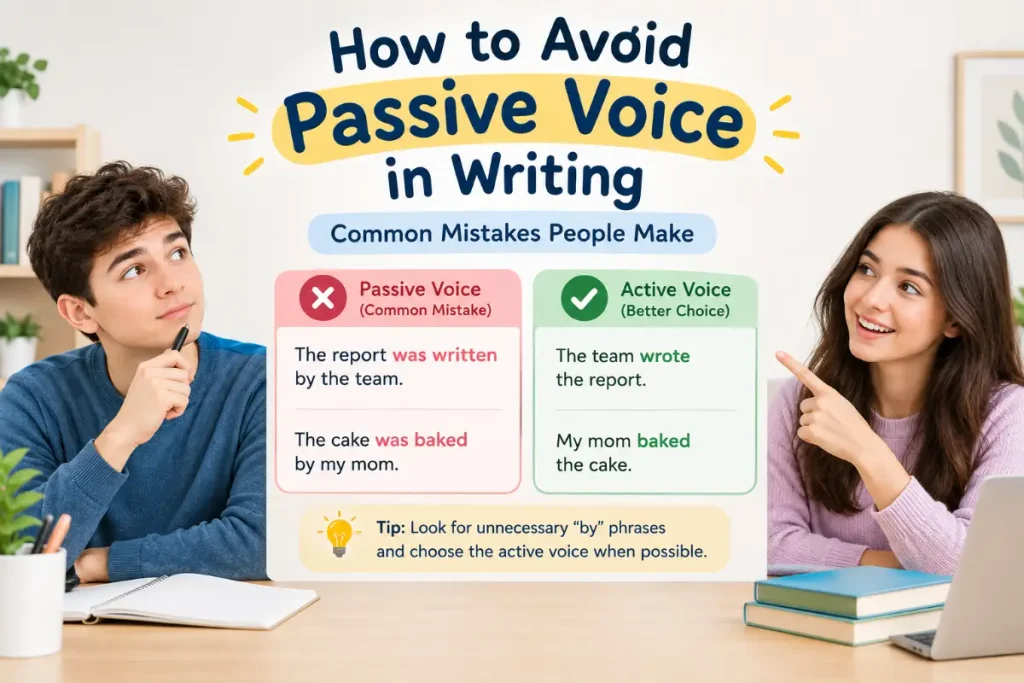
Common Mistakes People Make
- Mistake 1: Treating every single passive sentence as an error requiring conversion, even when the passive version is genuinely clearer or more appropriate for the context.
- Mistake 2: Converting a passive sentence but leaving a vague or invented actor in its place, which can be worse than the original passive construction if the actor wasn’t actually known or relevant.
- Mistake 3: Missing passive constructions that lack an obvious “by” phrase, since these are easy to overlook without specifically scanning for the be-verb-plus-participle pattern.
- Mistake 4: Overcorrecting into awkward, unnatural active constructions purely to avoid passive voice, when a well-placed passive sentence would have read more smoothly.
- Mistake 5: Ignoring nominalizations, which often travel together with passive voice and compound a sentence’s wordiness even after the passive verb itself gets fixed.
Practice Exercise
Convert each passive sentence to active voice, or explain why it might be better left passive. Answers are listed right after — try each one before checking.
- The cake was baked by my sister.
- An announcement was made regarding the schedule change.
- The window was broken sometime last night.
- The report was submitted by the finance team.
- A decision was reached by the jury after six hours.
- The building was constructed in 1932.
- The car was repaired by the local mechanic.
- Several complaints were filed against the company.
- The award was presented to her by the mayor.
- An investigation was launched by regulators.
- The email was sent by the assistant this morning.
- The bridge was damaged during the storm.
- The proposal was rejected by the board.
- The music was composed by a local artist.
- The results were announced by the committee chair.
- The house was sold within a week.
- The letter was written by the CEO herself.
- The vaccine was developed by a team of researchers.
- The concert was canceled due to weather.
- The contract was signed by both parties.
Answer Key
- My sister baked the cake.
- Officials announced a schedule change.
- Better left passive — actor unknown.
- The finance team submitted the report.
- The jury reached a decision after six hours.
- Better left passive — actor unimportant to the sentence’s point.
- The local mechanic repaired the car.
- Customers filed several complaints against the company.
- The mayor presented her with the award.
- Regulators launched an investigation.
- The assistant sent the email this morning.
- Better left passive, unless a specific cause needs naming.
- The board rejected the proposal.
- A local artist composed the music.
- The committee chair announced the results.
- Better left passive — buyer likely unknown or irrelevant.
- The CEO herself wrote the letter.
- A team of researchers developed the vaccine.
- Better left passive — the weather isn’t a true “actor” in the usual sense.
- Both parties signed the contract.
If you correctly converted (or justified keeping passive) sixteen or more, these five techniques have already started becoming an automatic part of your editing process.
Frequently Asked Questions
How many passive sentences is “too many” in a piece of writing?
There’s no fixed number, but if a significant portion of your sentences follow the be-verb-plus-participle pattern, especially with the actor omitted, your writing likely reads as flatter and less direct than it could. Aim for active voice as the default, reserving passive for the specific cases where it genuinely serves the sentence.
Do these techniques work the same way for scientific or academic writing?
Mostly yes, though academic and scientific writing conventionally tolerates more passive voice than other genres. The same techniques still apply for tightening prose — the goal there isn’t eliminating passive voice, but avoiding unnecessary, unclear, or overly frequent use of it.
For another useful perspective, check out Double Negatives in English Grammar: What’s Correct? (2026 Guide).
Is reading a document backward really an effective editing technique?
Yes — this is a genuinely recommended proofreading method, since it disrupts your brain’s tendency to read for meaning and forces closer attention to each individual sentence’s grammatical structure, making patterns like passive voice and nominalizations easier to spot.
What’s a nominalization, and why does it matter for passive voice?
A nominalization turns a verb into an abstract noun (“decide” becomes “decision,” “investigate” becomes “investigation”), often requiring a passive filler verb like “was made” or “was conducted” to complete the sentence. Converting the noun back into its original verb form often eliminates the passive construction as a side effect.
What’s the fastest way to catch passive voice across a long document?
Use your word processor’s search function to find every instance of “was,” “were,” “is,” “are,” “been,” and “being,” then evaluate each one individually for whether it’s forming a passive construction and whether converting it would genuinely improve the sentence.
Before moving on, you may also want to read A Misplaced Modifier? 20 Clear Examples (2026) for more helpful grammar tips.
Wrapping Up
Learning how to avoid passive voice in writing in practice comes down to building a repeatable editing habit rather than trying to catch every instance by instinct alone: search systematically for the telltale be-verb-plus-participle pattern, identify the real actor behind each passive sentence, and watch for nominalizations that often travel alongside passive constructions.
Not every passive sentence needs fixing — the goal is a default toward active voice, applied thoughtfully rather than mechanically, so the sentences that do remain passive are the ones that genuinely earn their place.