Have you ever written a sentence that looks right at first, only to realize it feels unfinished when you read it back? You’re probably dealing with a sentence fragment. These incomplete thoughts are easy to overlook, especially when writing quickly, but they can make your meaning unclear or interrupt the natural flow of your writing. The good news is that fixing a sentence fragment is usually simple once you know what to look for.
Learning fixing a sentence fragment starts with understanding what makes a sentence complete in the first place. Purdue OWL defines fragments simply: “incomplete sentences,” usually pieces that have become disconnected from the main clause they actually belong to. Once you can spot exactly what’s missing — a subject, a complete verb, or an independent clause — fixing the fragment becomes straightforward.
You may also find Active vs Passive Voice Examples: 15 Easy Examples (2026) helpful if you want to explore this topic further.
The Quick Answer
A sentence needs three things to be complete: a subject, a full verb, and an independent clause that can stand alone. Fragments are missing at least one of these.
- Ate a sandwich. (missing a subject — fragment)
- The students ate a sandwich. (complete — has a subject)
- They trying to improve their writing skills. (incomplete verb — fragment)
- They were trying to improve their writing skills. (complete — “were” completes the verb)
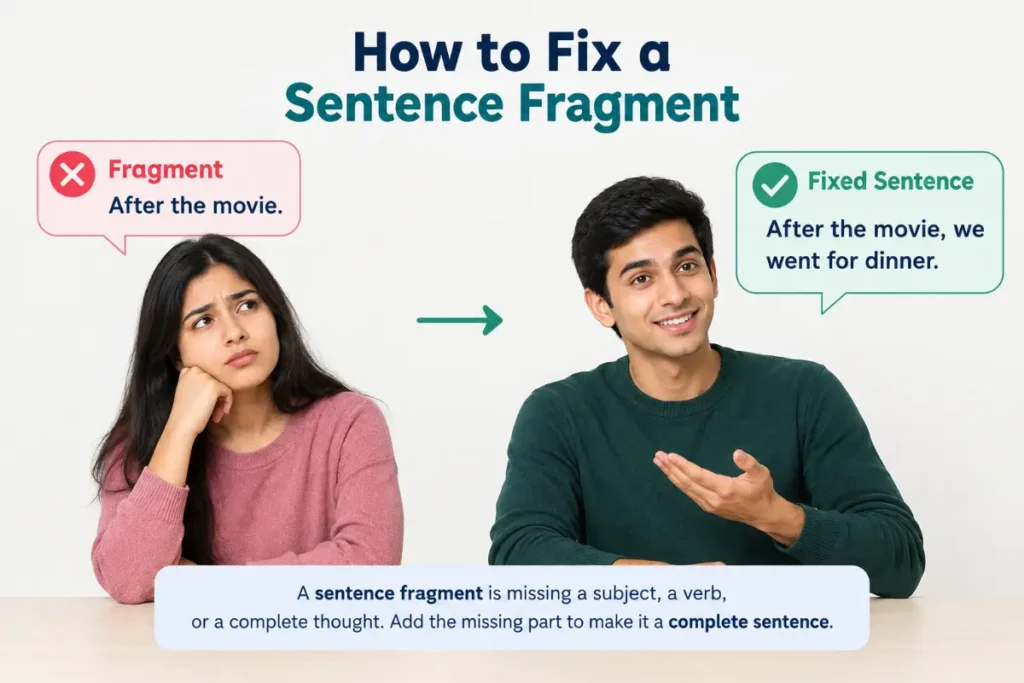
- Because I forgot the exam was today. (a dependent clause standing alone — fragment)
- Because I forgot the exam was today, I didn’t study. (complete — now attached to an independent clause)
The most common fix, per Purdue OWL: simply remove the period separating the fragment from the main clause it belongs to, joining them into one complete sentence with appropriate punctuation.
Type 1: Missing a Subject
Every complete sentence needs someone or something performing the action. Without a subject, you’re left with a fragment.
- Ate a sandwich. (who ate it?)
- Ran to catch the bus. (who ran?)
Fix by adding the missing subject:
- The students ate a sandwich.
- She ran to catch the bus.
Type 2: Incomplete Verb
Sometimes a sentence has what looks like a verb, but it’s missing a necessary helping verb to function as a complete predicate.
- They trying to improve their writing skills. (“trying” alone isn’t a complete verb)
Fix by adding the missing helping verb:
- They were trying to improve their writing skills.
Type 3: A Dependent Clause Standing Alone
This is one of the most common fragment types, and it happens when a clause that starts with a subordinating word (because, although, since, when, while, if) is punctuated as though it were a complete sentence on its own — even though dependent clauses can never stand alone.
- Because I forgot the exam was today. (this leaves the reader waiting for the rest of the thought)
Fix by attaching it to an independent clause:
- Because I forgot the exam was today, I didn’t study.
Or by removing the dependent marker word entirely, turning it into its own independent clause:
- I forgot the exam was today.
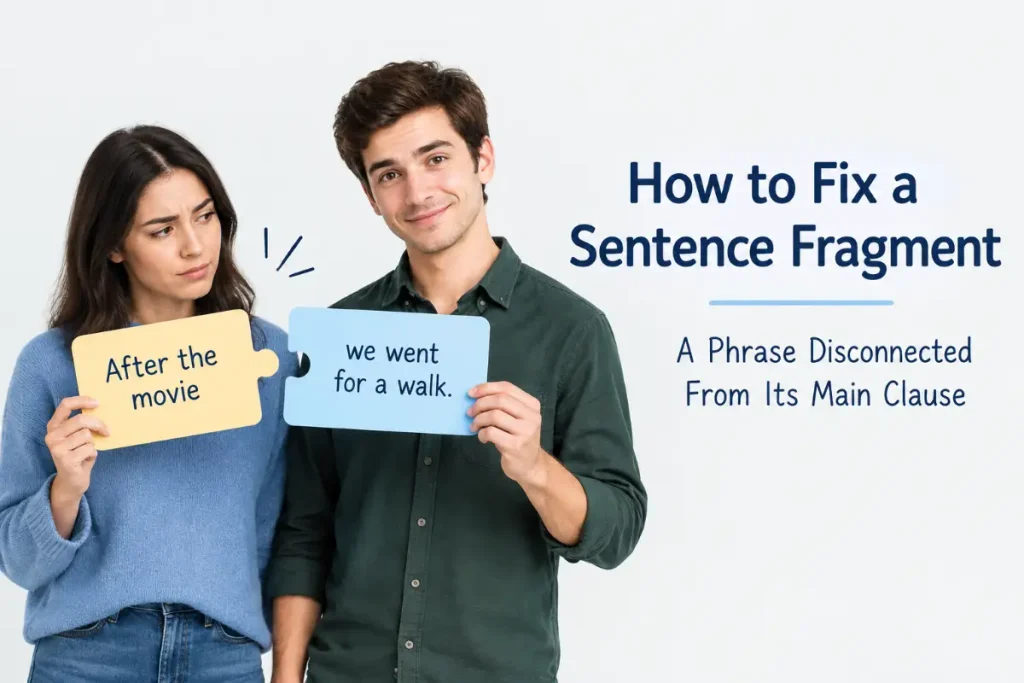
Type 4: A Phrase Disconnected From Its Main Clause
Purdue OWL’s own classic example shows this pattern clearly: “Purdue offers many majors in engineering. Such as electrical, chemical, and industrial engineering.” The second sentence isn’t complete on its own — it’s a phrase that was meant to attach to the sentence before it.
Fix by removing the period and joining the pieces:
- Purdue offers many majors in engineering, such as electrical, chemical, and industrial engineering.
Type 5: Mixed Constructions (Prepositional Phrases Mistaken for Sentences)
This type happens when a sentence starts with a long prepositional phrase and never actually introduces a proper subject and verb to complete the thought — Purdue OWL notes this often involves a gerund (an “-ing” word functioning as a noun) that was actually meant to be the subject.
- By working overtime every week for the past six months. (this never actually completes a thought)
Fix by removing the introductory preposition so the gerund can properly function as the subject:
- Working overtime every week for the past six months exhausted her.
The Fastest Way to Check Yourself
Step 1: Does the group of words have a clear subject? If not, that’s your fragment type.
Step 2: Does it have a complete verb, including any necessary helping verbs? If not, add what’s missing.
Step 3: Does it start with a subordinating word (because, although, since, when) and stand alone with a period? That’s a dependent clause pretending to be complete — attach it to an independent clause or remove the subordinating word.
Step 4: Read the fragment together with the sentence right before or after it. Often, the fragment was clearly meant to attach to a neighboring sentence, and simply removing the period between them fixes the problem.
How to Fix a Sentence Fragment: Quick Reference
| Fragment Type | Example | Fix |
|---|---|---|
| Missing subject | Ran to the store. | Add a subject: She ran to the store. |
| Incomplete verb | They trying hard. | Add a helping verb: They were trying hard. |
| Dependent clause alone | Although it rained. | Attach to a main clause: Although it rained, we stayed. |
| Disconnected phrase | Such as apples and pears. | Join to the previous sentence with a comma. |
| Mixed construction | By working late every night. | Remove the preposition to reveal the subject. |
Common Mistakes People Make
Mistake 1: “Because she was tired. She went to bed early.” The first sentence is a fragment — it should be joined: “Because she was tired, she went to bed early.”
Mistake 2: “Running every morning before work.” Missing both a clear subject and a complete predicate — needs restructuring: “She started running every morning before work.”
Mistake 3: Assuming any sentence starting with “because,” “although,” or “since” is automatically a fragment. These words only create a fragment when the clause stands entirely alone without an attached independent clause — “Because it rained, we canceled the picnic” is complete and correct, since the dependent clause is properly attached.
Mistake 4: “The company. Which was founded in 1998.” This should be one sentence: “The company, which was founded in 1998, has grown steadily,” joining the fragment to its intended main clause.
Mistake 5: Overcorrecting by adding unnecessary words rather than fixing the actual structural gap. Padding a fragment with extra words without addressing the missing subject, verb, or independent clause doesn’t resolve the underlying issue — the fix needs to target the specific missing piece.
For another useful perspective, check out Parallel Structure in Writing: 15 Common Mistakes to Avoid (2026).
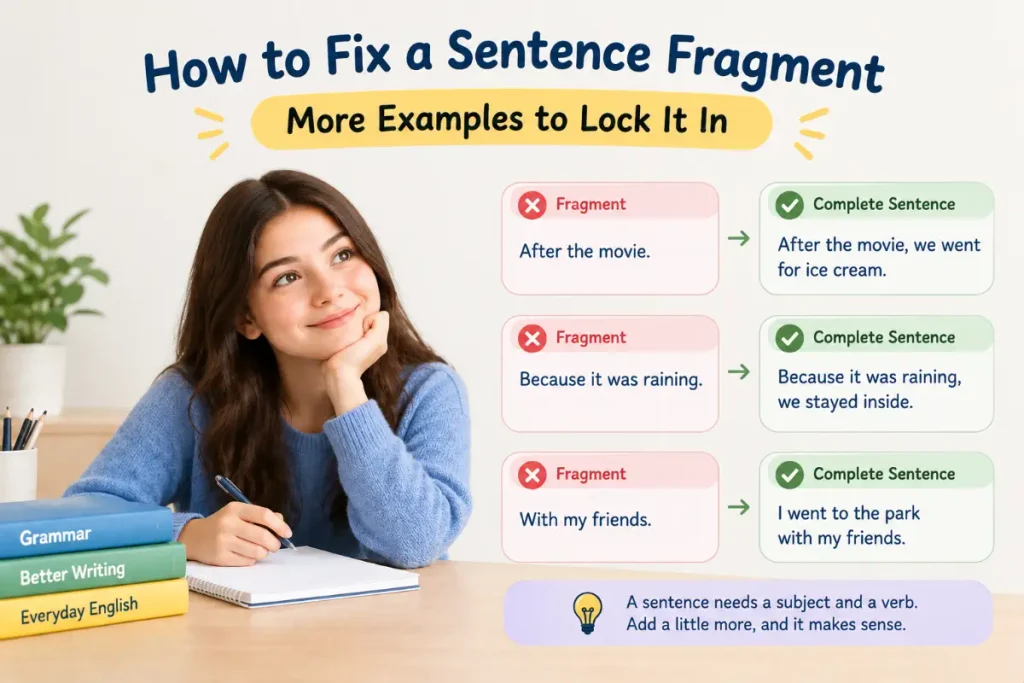
More Examples to Lock It In
- Fragment: Studying every night for the exam. Fixed: She spent every night studying for the exam.
- Fragment: Which is exactly why the plan failed. Fixed: The team ignored the budget constraints, which is exactly why the plan failed.
- Fragment: A decision that changed everything. Fixed: It was a decision that changed everything.
Frequently Asked Questions
Are sentence fragments ever acceptable in professional or published writing?
In casual or creative writing, short fragments are sometimes used deliberately for stylistic emphasis or pacing (“Never again.”) — a conscious choice by writers aware of the convention. In formal, academic, and most professional writing, fragments are considered errors and should be fixed using the strategies covered here.
How can I tell the difference between a fragment and a short, complete sentence?
A short sentence like “She left.” is complete because it has a clear subject (“she”) and a full verb (“left”). A fragment like “Left early.” is missing the subject entirely, even though both are similarly short.
Do fragments always start with a subordinating word like “because” or “although”?
No — fragments can also result from a missing subject, an incomplete verb, or a disconnected phrase, none of which require a subordinating word at all. The dependent-clause fragment is simply one of the more common types.
What’s the easiest single fix for most sentence fragments?
Removing the period between the fragment and the sentence it logically belongs to, then adding whatever punctuation the newly combined sentence needs — this resolves the majority of fragments, according to Purdue OWL’s own general guidance.
What’s the fastest way to catch sentence fragments before publishing something?
For every sentence, check for a clear subject, a complete verb, and confirm it isn’t a dependent clause standing alone. Reading each sentence in isolation, separate from the sentences around it, is one of the most reliable ways to catch a fragment that otherwise reads smoothly in context.
Practice Exercise
Identify and fix the fragment in each pair. Answers are listed right after — try each one before checking.
- She loves to travel. Especially to places with rich history.
- Because the meeting ran late.
- Working long hours every week.
- The book. Which won several awards.
Answer Key (fixes may vary; one valid option shown for each)
- She loves to travel, especially to places with rich history.
- Because the meeting ran late, we missed our dinner reservation.
- She has been working long hours every week.
- The book, which won several awards, became a bestseller.
If you fixed three or more correctly, you’ve got a solid handle on how to fix a sentence fragment across its most common forms.
Sentence Fragments in Different Writing Contexts
In academic and professional writing, fragments are almost always treated as errors, since formal writing expects every sentence to stand as a complete, independent grammatical unit.
In advertising, marketing, and creative writing, short fragments are commonly used on purpose for punch and rhythm — “Just do it.” “Because you’re worth it.” These aren’t accidental fragments; they’re a deliberate stylistic device chosen for emphasis, which is different from an unintentional fragment slipping into a formal document.
In fiction, fragments often appear in narration to mimic natural thought patterns or create dramatic pacing, particularly in tense or emotional scenes.
In everyday texting and casual writing, fragments are extremely common and rarely cause confusion, since context and conversational rhythm fill in what’s missing.
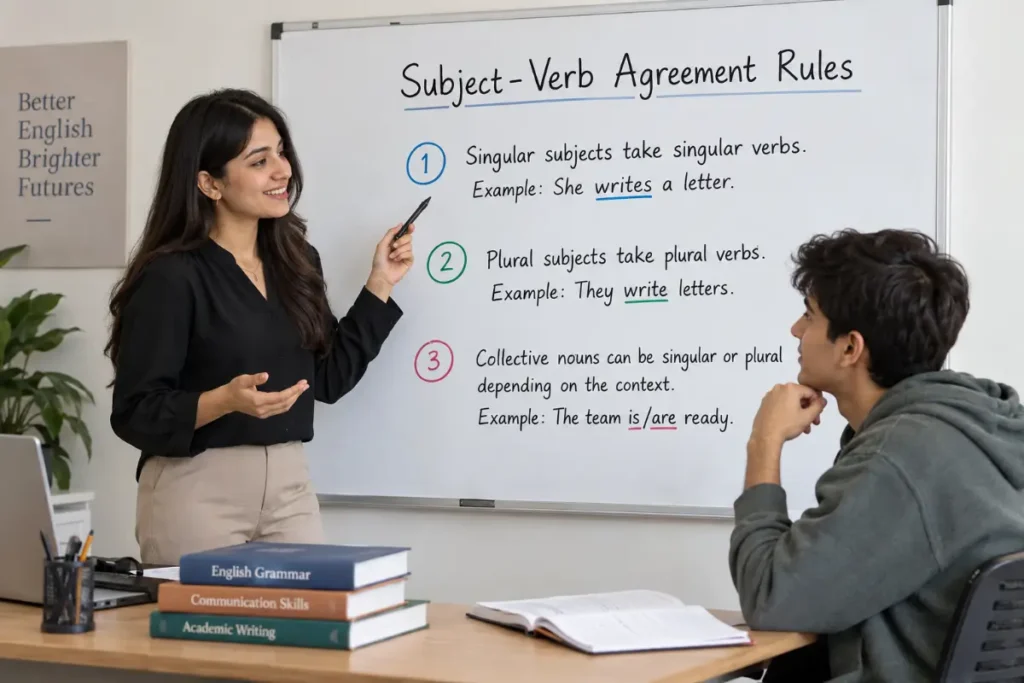
Before moving on, you may also want to read Subject Verb Agreement Rules: 15 Rules + Easy Examples (2026) for more helpful grammar tips.
The Bottom Line
Mastering how to fix a sentence fragment comes down to identifying exactly what’s missing — a subject, a complete verb, or a properly attached independent clause — and then either supplying that missing piece or joining the fragment to the sentence it was always meant to be part of. Reading each sentence in isolation during editing is the single most reliable way to catch fragments that otherwise slip past a normal read-through.
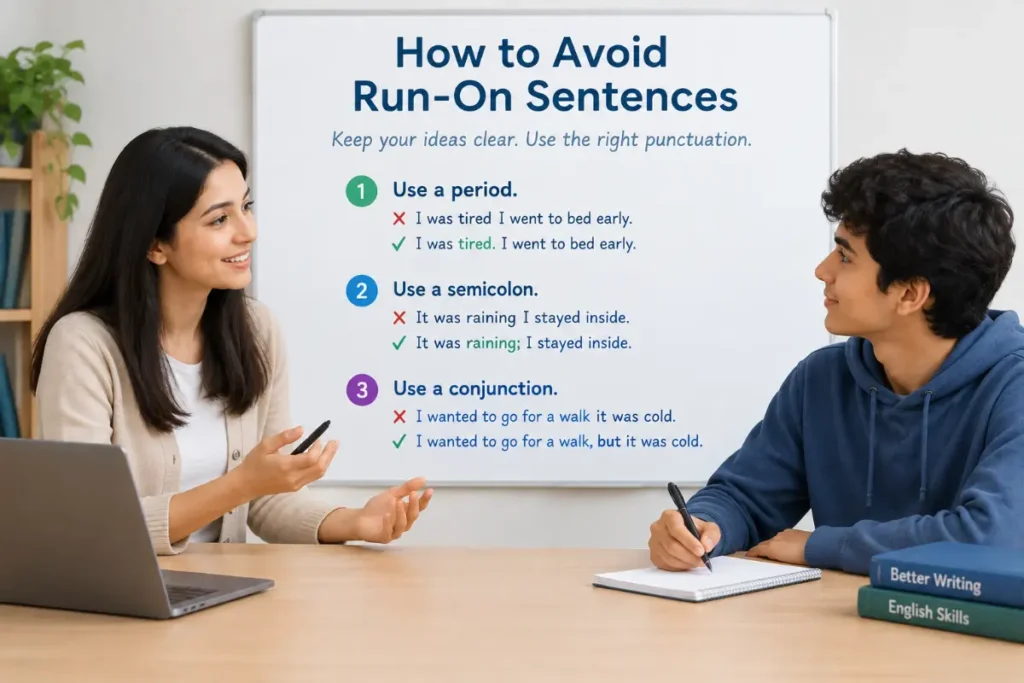
For a related sentence-structure error involving too much rather than too little, our comma splice examples and fixes guide and how to avoid run-on sentences guide cover the opposite end of the same underlying skill.