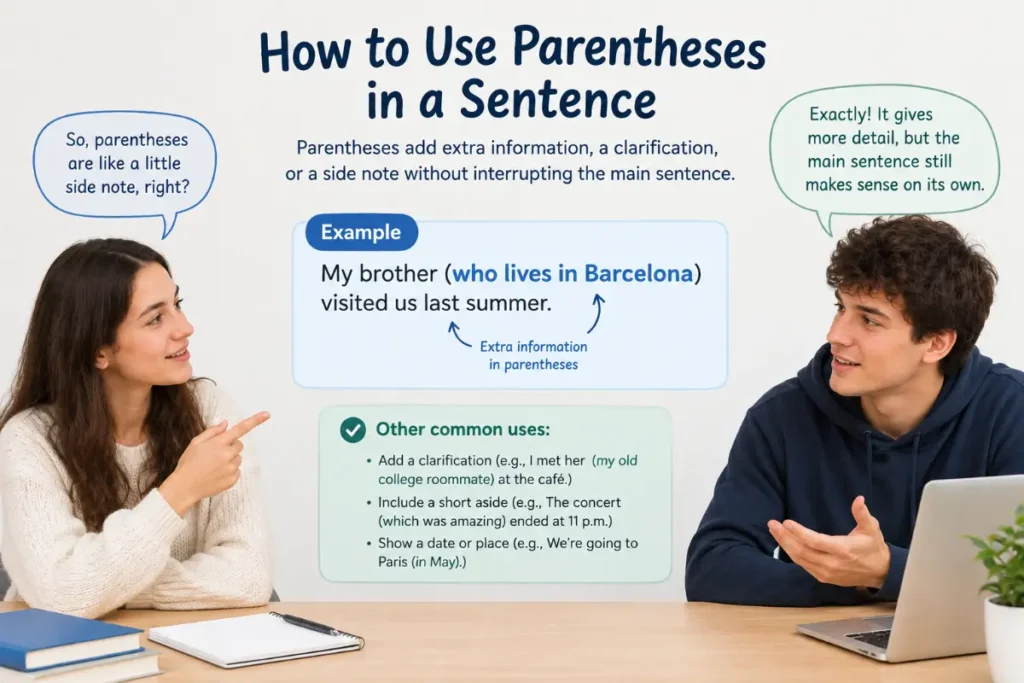
Wondering how to use parentheses in a sentence without making your writing feel cluttered? Parentheses are handy for adding extra details, quick explanations, or helpful asides without interrupting your main point. The trick is knowing when they actually improve a sentence—and when they simply get in the way.
Learning usage of parentheses correctly comes down to understanding one core idea: parentheses exist to include information that matters without letting it derail your main point. Purdue OWL describes their purpose precisely — parentheses are “used to say something that is important to the main message you are writing but is not an immediate part of it, something that would interrupt the flow of your writing if you didn’t keep it separate.”
You may also find Use an Ellipsis Correctly: 20 Simple Examples (2026) helpful if you want to explore this topic further.
The Quick Answer
Use parentheses to:
- Add a relevant detail or clarification without disrupting the main sentence
- The report (published last Tuesday) confirmed our projections.
- Provide an example, abbreviation, or definition
- Several major cities (New York, Chicago, and Los Angeles) reported increases.
- Insert an aside, personal comment, or additional thought
- She finally finished the marathon (her third this year).
- Enclose citation information in academic writing
- The results were statistically significant (p < 0.05).
The core test for how to use parentheses in a sentence correctly: if you removed the parenthetical content entirely, would the sentence still make complete grammatical sense on its own? If yes, the parentheses are doing their job properly.
Rule 1: The Sentence Must Work Without the Parenthetical Content
This is the single most important principle behind how to use parentheses in a sentence. Whatever sits inside the parentheses should be removable without breaking the sentence’s grammar.
- Sang-hoon finished the report (he types 85 words per minute) two hours after receiving the assignment.
Remove the parenthetical content, and the sentence still stands: “Sang-hoon finished the report two hours after receiving the assignment.” That’s exactly the test Purdue OWL’s example demonstrates — the detail about his typing speed is genuinely interesting context, but it’s not essential to the sentence’s core grammatical structure.
Rule 2: Punctuation Placement Depends on What’s Inside
This is where how to use parentheses in a sentence gets slightly technical, but the rule is consistent once you know it.
If the parenthetical content is part of a larger sentence, punctuation (commas, periods) goes outside the closing parenthesis:
- After the meeting (which ran long), we grabbed lunch.
- The results were surprising (though not entirely unexpected).
If the parenthetical content is a complete, standalone sentence on its own, the closing punctuation goes inside the parentheses:
- The team celebrated their win. (They’d been waiting all season for this moment.)
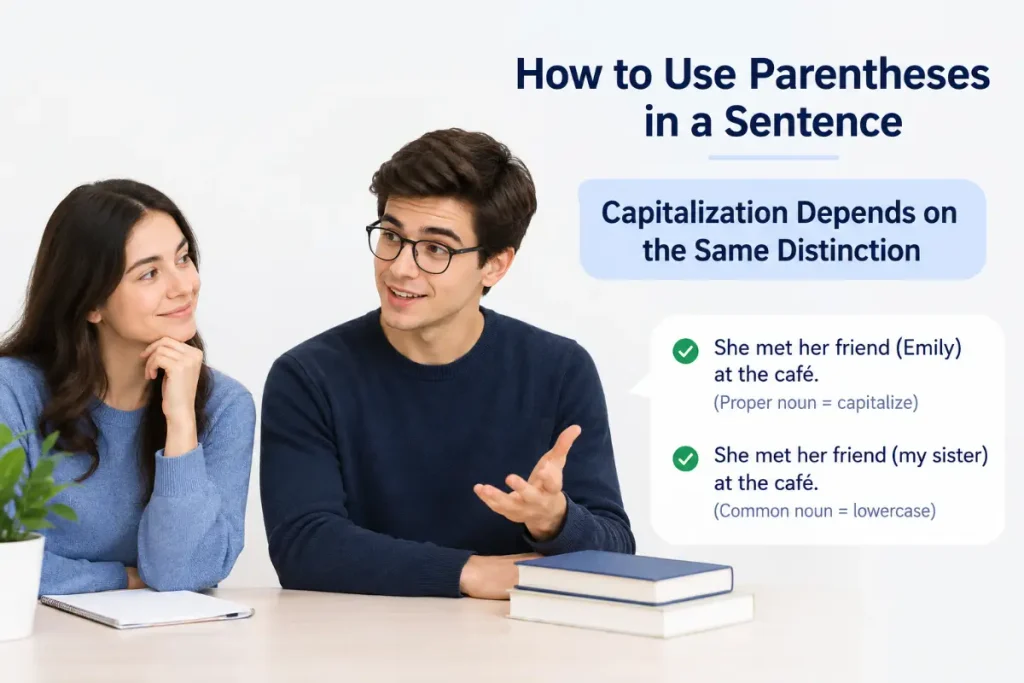
Rule 3: Capitalization Depends on the Same Distinction
A parenthetical phrase embedded inside a larger sentence does not start with a capital letter, unless it’s a proper noun. A parenthetical sentence standing entirely on its own does start with a capital letter, just like any other sentence.
- The proposal (originally rejected in March) was finally approved. (lowercase “originally,” embedded phrase)
- The proposal was rejected. (It was resubmitted with revisions in March.) (capitalized, standalone sentence)
Common Uses Across Different Types of Writing
Adding a brief clarification or example:
- Several team members (including the project lead) missed the deadline.
Introducing an abbreviation for later use:
- The World Health Organization (WHO) issued new guidelines.
Providing a citation in academic writing:
- Sales increased significantly during this period (Chen, 2023).
Offering a personal aside or light commentary:
- He insisted the meeting would be short (it wasn’t).
Clarifying numbers or specifying a range:
- The event drew a large crowd (approximately 3,000 attendees).
Parentheses vs. Commas vs. Em Dashes
Understanding how to use parentheses in a sentence also means knowing when a different mark would work better. All three of these can technically set off extra information, but they carry different tones.
- The proposal, which took months to draft, was finally approved. (comma — neutral, standard)
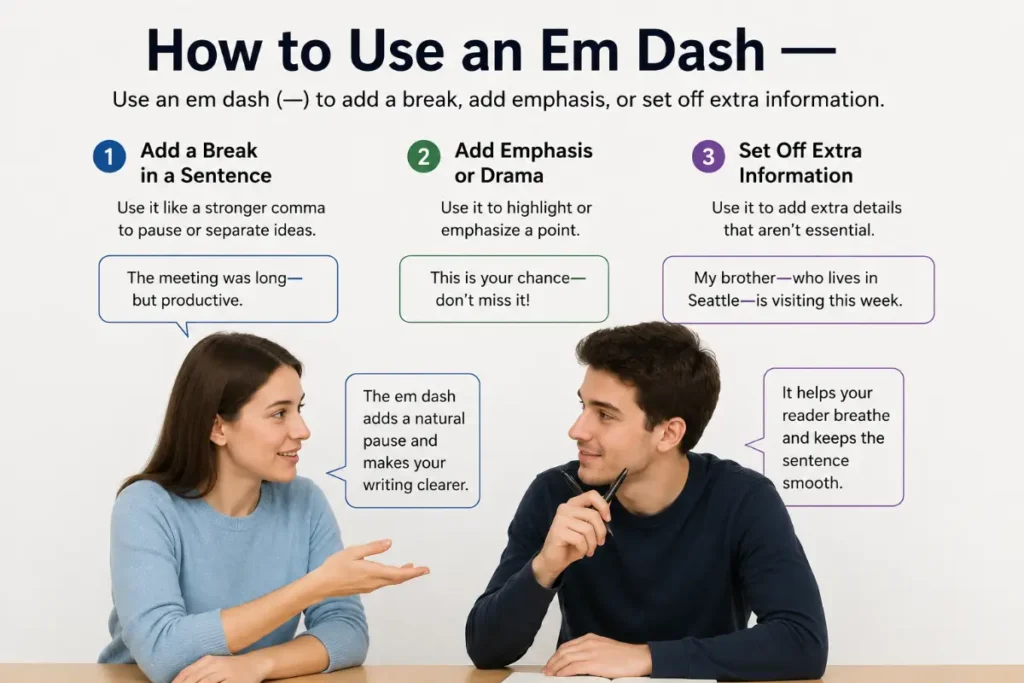
- The proposal — which took months to draft — was finally approved. (em dash — emphatic, draws attention)
- The proposal (which took months to draft) was finally approved. (parentheses — quiet, treated as a true aside)
Parentheses are the most “whispered” of the three options — they signal to the reader that the enclosed information is genuinely secondary, almost an afterthought, while an em dash does the opposite, drawing more attention to the inserted content. For the full breakdown of the em dash’s distinct jobs, see our complete em dash guide.
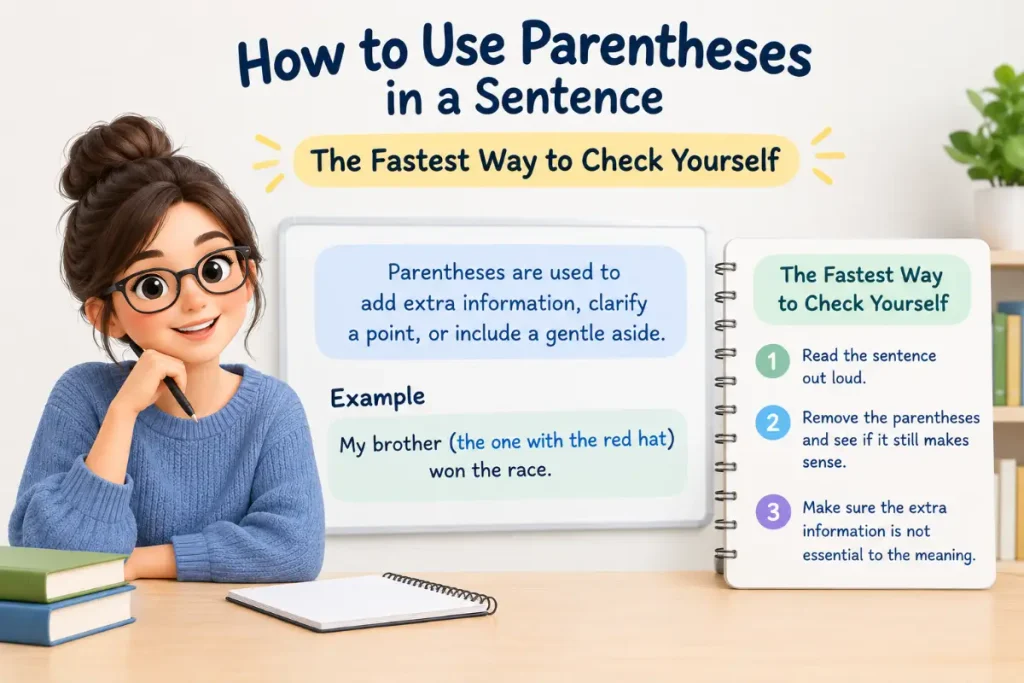
The Fastest Way to Check Yourself
Step 1: Could the sentence stand alone grammatically without the parenthetical content? If yes, parentheses are being used correctly.
Step 2: Is the parenthetical content a standalone sentence, or part of the larger sentence? This determines whether punctuation and capitalization go inside or outside.
Step 3: Do you want this information to feel like a quiet aside, or do you want it emphasized? If quiet, use parentheses. If emphasized, an em dash may serve you better.
How to Use Parentheses in a Sentence: Quick Reference
| Situation | Rule | Example |
|---|---|---|
| Phrase embedded in larger sentence | Lowercase, punctuation outside | The event (held annually) drew record crowds. |
| Standalone sentence in parentheses | Capitalized, punctuation inside | The event drew record crowds. (It was the largest yet.) |
| Introducing an abbreviation | No special punctuation needed | The Federal Trade Commission (FTC) responded. |
| Academic citation | Follows specific style guide format | (Smith, 2020) |
Common Mistakes People Make
Mistake 1: “The report (which took weeks to write) was late.” This is actually correct — but a common mistake is writing “The report (which took weeks to write.) was late” with a period incorrectly placed inside the parentheses when the content is embedded in a larger sentence, not standalone.
Mistake 2: Overusing parentheses for information that actually matters. If a detail is essential to understanding the sentence, it shouldn’t be tucked into parentheses at all — genuinely important information belongs in the main sentence structure, not set aside as an afterthought.
Mistake 3: Nesting parentheses within parentheses. Avoid constructions like “The results (see Table 2 (page 14)) were conclusive” — this is visually confusing. Use brackets for the inner set if nesting is truly unavoidable: “(see Table 2 [page 14]).”
Mistake 4: Forgetting to close a parenthesis. Every opening parenthesis needs a matching closing one — an easy error to miss in longer sentences, especially during editing.
Mistake 5: Using parentheses so frequently that they clutter the writing. Learning how to use parentheses in a sentence effectively also means learning restraint — a paragraph with a parenthetical aside in every sentence becomes genuinely difficult to read smoothly.
For another useful perspective, check out Colon vs Semicolon: The Ultimate Usage Guide for 2026.
More Examples to Lock It In
- The study (funded by a private foundation) surveyed over 2,000 participants.
- She eventually agreed to the proposal (after several rounds of negotiation).
- The organization changed its name in 2019 (formerly known as Tech Forward).
- He arrived early. (He always does.)
- Multiple factors (including weather, staffing, and demand) affected the outcome.
Frequently Asked Questions
Can a sentence contain more than one set of parentheses?
Yes, though it’s worth using sparingly — multiple separate parenthetical asides within one sentence can make it harder to follow. If you find yourself needing several, consider whether some of that information belongs in separate sentences instead.
Are parentheses used the same way in formal and casual writing?
The core mechanical rules stay the same, but formal and academic writing tends to use parentheses more for citations, abbreviations, and technical clarifications, while casual and creative writing uses them more often for personal asides, humor, or informal commentary.
Is it ever correct to start a sentence with a parenthetical phrase?
It’s uncommon but not incorrect — more often, parenthetical content that would open a sentence is instead rephrased as a standalone sentence in parentheses immediately after the sentence it relates to, which tends to read more smoothly.
What’s the difference between parentheses and square brackets?
Parentheses are the standard mark for adding an author’s own aside or clarification. Square brackets are specifically used when inserting a word or clarification into someone else’s exact quotation, to show the insertion wasn’t part of the original text: “The mayor said the plan [to raise taxes] was necessary.”
What’s the fastest way to catch parenthesis errors before publishing something?
Read the sentence with the parenthetical content removed entirely — if it still makes complete grammatical sense, the parentheses are being used correctly. Then double-check whether the content is embedded or standalone, since that determines punctuation and capitalization placement.
Practice Exercise
Decide where parentheses belong and how to punctuate around them. Answers are listed right after — try each one before checking.
- The company founded in 1998 has grown steadily.
- The report which covers three regions was released today.
- He finally called back four hours late.
- The vaccine developed by a local research team received approval.
- She loves hiking especially in the fall.
Answer Key
- The company (founded in 1998) has grown steadily.
- The report (which covers three regions) was released today.
- He finally called back (four hours late).
- The vaccine (developed by a local research team) received approval.
- She loves hiking (especially in the fall).
If you got four or more correct, you’ve internalized the core principle behind how to use parentheses in a sentence — information that’s relevant but removable belongs inside them.
Parentheses in Different Writing Contexts
In academic writing, parentheses appear constantly for citations, statistical values, and brief clarifications — this is one of the fields where knowing exactly how to use parentheses in a sentence according to your specific style guide (APA, MLA, or Chicago) genuinely matters, since citation formatting is closely checked by editors and reviewers.
In business and technical writing, parentheses are commonly used to define acronyms on first use, provide brief measurement conversions, or flag internal cross-references, keeping the main sentence uncluttered while still supplying necessary detail.
In journalism, parentheses are used sparingly, since news style favors direct, uncluttered sentences — when they do appear, it’s usually for a brief clarification or an editor’s note distinguishing added context from a speaker’s original words.
In creative and narrative writing, parenthetical asides often carry a more personal, conversational tone, letting a narrator step outside the main action briefly to comment, joke, or add perspective before returning to the story.
Before moving on, you may also want to read When to Capitalize Job Titles: 7 Rules You Need to Know (2026) for more helpful grammar tips.
The Bottom Line
Mastering how to use parentheses in a sentence comes down to one central test: the sentence must remain grammatically complete without the parenthetical content, since parentheses exist specifically to add relevant but non-essential detail. Punctuation and capitalization depend on whether that content is embedded in a larger sentence or standing entirely on its own, and choosing parentheses over a comma or em dash signals that the added information is meant to feel like a quiet aside rather than an emphasized point.
For more on when an em dash might serve your sentence better than parentheses, see our guide to using an em dash — and if punctuation placement around quoted material is still uncertain, our guide to using quotation marks correctly covers that closely related ground.