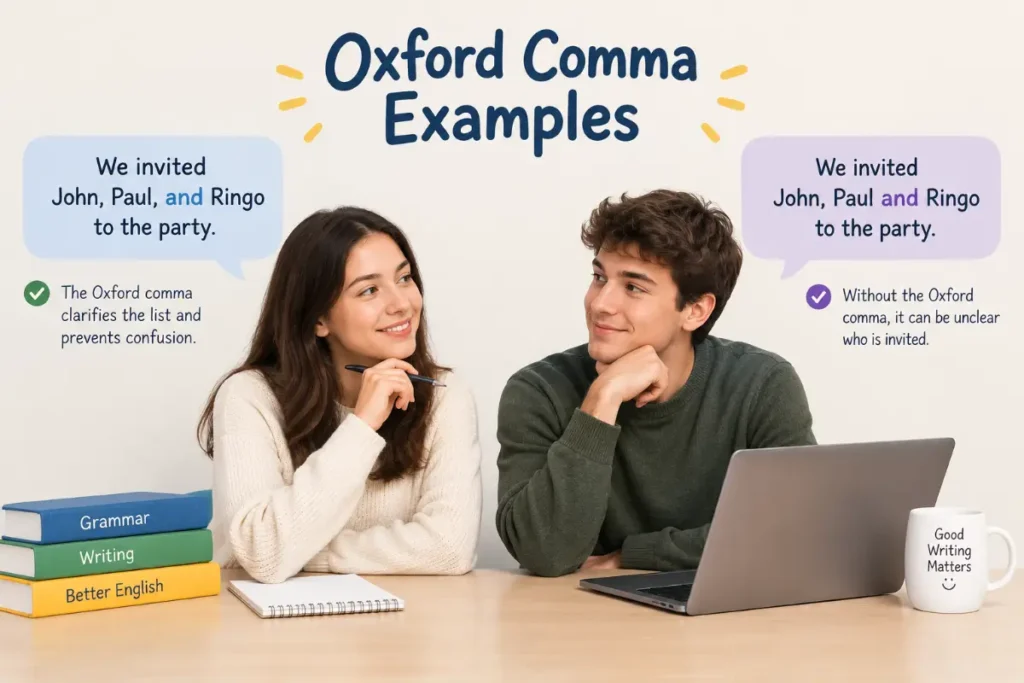
Looking for clear Oxford Comma Examples? See how the Oxford comma works in everyday sentences, when to use it, and how it can make lists easier to understand.
We’ve already covered the full rule behind the comma before “and”, including when the Oxford comma is required versus optional. This guide takes a different angle: rather than re-explaining the rule, it’s a gallery of real, concrete examples showing exactly when that one small comma changes what a sentence actually means — the cases that make this such a famously debated punctuation mark in the first place.
You may also find When to Capitalize Job Titles: 7 Rules You Need to Know (2026) helpful if you want to explore this topic further.
What the Oxford Comma Actually Is, in One Sentence
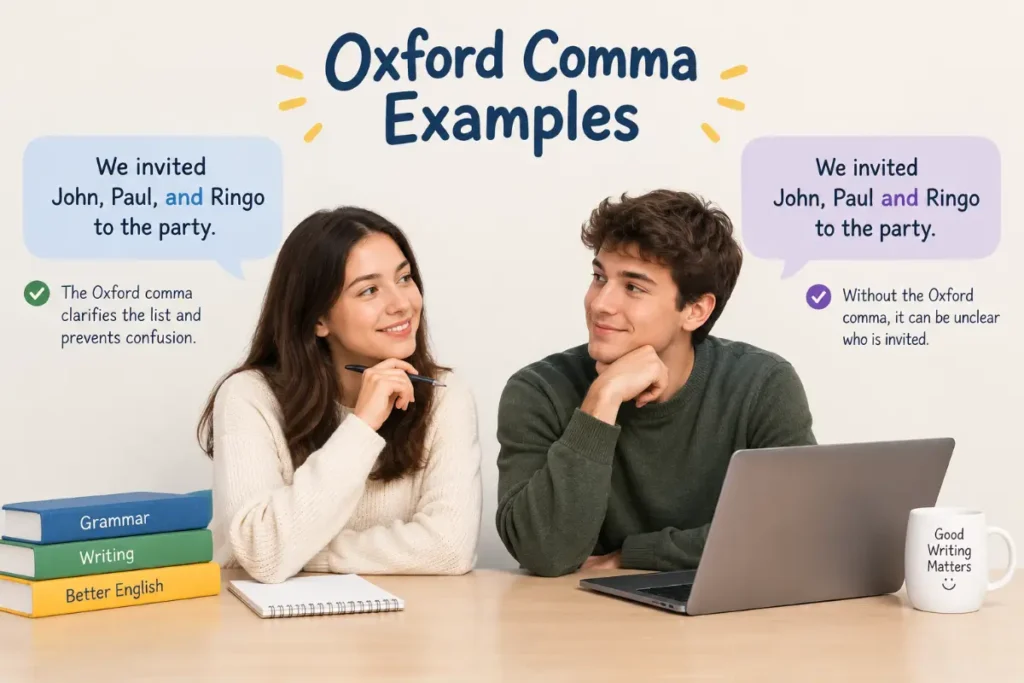
The Oxford comma (also called the serial comma) is the comma placed right before “and” or “or” in a list of three or more items: red, white, and blue (with it) versus red, white and blue (without it). Both are grammatically acceptable — Merriam-Webster confirms it’s genuinely optional — but the examples below show exactly why so many writers and editors choose to use it anyway.
Example 1: The Classic Dedication
Without the Oxford comma:
- I’d like to thank my parents, Ayn Rand and God.
With the Oxford comma:
- I’d like to thank my parents, Ayn Rand, and God.
Without the comma, this sentence reads as though the speaker’s parents are named Ayn Rand and God — a genuinely famous example cited by usage authorities specifically because it demonstrates how the missing comma collapses a list into an unintended description.
Example 2: The Ex-Wives Mix-Up
Without the Oxford comma:
- The documentary features his two ex-wives, Kris Kristofferson and Robert Duvall.
With the Oxford comma:
- The documentary features his two ex-wives, Kris Kristofferson, and Robert Duvall.
This example is drawn from a real published caption, and without the comma, it briefly suggests that Kris Kristofferson and Robert Duvall are the two ex-wives, rather than being three entirely separate list items. This is exactly the kind of unintentional, slightly absurd misread that convinces many style guides to recommend the comma as a default.
Example 3: The Job Titles Problem
Without the Oxford comma:
- We interviewed the candidates, a former teacher and a nurse.
With the Oxford comma:
- We interviewed the candidates, a former teacher, and a nurse.
Without the comma, this could mean the candidates themselves are described as “a former teacher and a nurse” (two people, described), rather than three separate items: the candidates in general, plus a former teacher, plus a nurse, being interviewed as three distinct entries in a list.
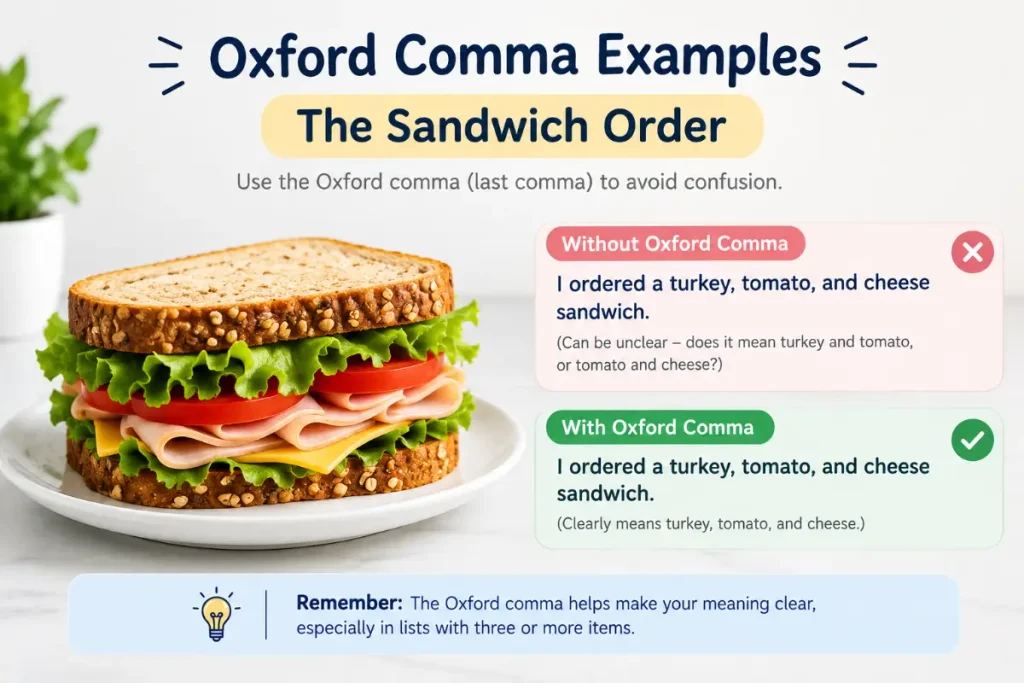
Example 4: The Sandwich Order
Without the Oxford comma:
- For lunch I had a turkey sandwich, chips and salsa.
With the Oxford comma:
- For lunch I had a turkey sandwich, chips, and salsa.
This one is subtler, but without the comma, “chips and salsa” reads as a single combined item (a common snack pairing), while with the comma, chips and salsa become two clearly separate items on the list. Neither reading is wrong exactly, but the comma resolves the ambiguity about whether two items were intended as one combined dish or two separate ones.
Example 5: The Award Recipients
Without the Oxford comma:
- The award went to my two closest friends, Maria and Devon.
With the Oxford comma:
- The award went to my two closest friends, Maria, and Devon.
Without the comma, “Maria and Devon” reads as an appositive describing who the two closest friends are — arguably the intended and clear meaning here, and actually a case where omitting the comma works perfectly well. This example is worth including specifically because it shows the Oxford comma isn’t always the fix — sometimes the version without it is exactly what you want, precisely because it’s identifying, not adding, a separate list item. Context always matters more than a blanket rule.
Example 6: The Legal Case That Made Headlines
A well-documented 2017 labor dispute in Maine hinged partly on the absence of an Oxford comma in state overtime law. The law exempted certain categories of work from overtime pay, listing activities including “packing for shipment or distribution” — without a comma before “or distribution,” it was genuinely unclear whether “packing for shipment” and “distribution” were meant as one combined activity or two separate ones. That ambiguity became central to the legal argument, and the case was ultimately settled in favor of the interpretation the missing comma made possible. This remains one of the most cited real-world examples of how a single “optional” comma can carry genuine financial and legal consequences.
Example 7: When Omitting It Causes No Confusion at All
Not every list needs the Oxford comma to stay perfectly clear — plenty of lists work fine either way:
- We packed sandwiches, apples and water bottles.
- We packed sandwiches, apples, and water bottles.
Both versions are equally clear here, since there’s no way to misread “apples and water bottles” as a single combined item or an appositive. This is worth including because it demonstrates the real, practical rule: the comma matters most when ambiguity is genuinely possible, and matters far less in a straightforward list of clearly separate things.
Example 10: The Team Roster
Without the Oxford comma:
- The starting lineup includes the captain, a rookie defender and last season’s top scorer.
With the Oxford comma:
- The starting lineup includes the captain, a rookie defender, and last season’s top scorer.
Without the comma, a reader unfamiliar with the roster could momentarily read this as describing the captain as both a “rookie defender” and “last season’s top scorer” — an unusual but not impossible combination of achievements for one player, which is exactly what makes the ambiguity plausible enough to cause a genuine pause. The comma removes any doubt that three separate players are being named.
The Pattern Across All These Examples
Looking at the examples together, the Oxford comma tends to matter most in exactly one specific situation: when the final two items in a list could plausibly be read as a single combined unit, or as a description of the item that came before them, rather than as two separate list entries. In lists where that risk doesn’t exist, the comma becomes a matter of pure style rather than clarity.
Example 8: The Menu Description
Without the Oxford comma:
- The special includes soup, a sandwich with turkey, ham and cheese.
With the Oxford comma:
- The special includes soup, a sandwich with turkey, ham, and cheese.
Without the comma, it briefly reads as though the sandwich contains “turkey, ham and cheese” as one described filling combination — which might actually be accurate, but the sentence structure makes it ambiguous whether “ham” is a separate menu item or part of the sandwich description. The comma clarifies that turkey, ham, and cheese are all separate ingredients being listed.
Example 9: The Speaker Introduction
Without the Oxford comma:
- Joining the panel today are the founder, a former senator and an economist.
With the Oxford comma:
- Joining the panel today are the founder, a former senator, and an economist.
Without the comma, this could describe a single person as both a “founder” and “a former senator and an economist” combined — an unlikely but genuinely possible misreading, especially if the reader doesn’t already know how many panelists to expect. This kind of appositive ambiguity is a close cousin of the placement issues covered in how to use quotation marks correctly — in both cases, a single small mark carries more structural weight than its size suggests.
21 Ways to Use It Correctly
The best way to master the Oxford comma is to see how it works in different types of sentences. These examples cover lists, names, compound items, long phrases, and situations where punctuation can affect meaning.
1. Use It in a Simple Three-Item List
When listing three separate things, place a comma before the final and.
Example:
I bought apples, oranges, and bananas.
2. Use It With Four or More Items
The comma remains useful as a list gets longer.
Example:
The box contained notebooks, pens, folders, markers, and envelopes.
3. Use It Before “Or” in a Series
The same principle applies when the final item follows or.
Example:
You can walk, take the bus, or call a taxi.
4. Separate Items That Already Contain “And”
The Oxford comma helps distinguish compound items from one another.
Example:
We ordered fish and chips, macaroni and cheese, and tomato soup.
5. Separate Names in a List
Use it when several people are being mentioned as separate items.
Example:
The meeting included Sarah, James, and Olivia.
6. Separate Places in a Series
Geographical names can follow the same pattern.
Example:
She has lived in Dallas, Denver, and Phoenix.
7. Separate Foods or Ingredients
A comma can make individual ingredients immediately recognizable.
Example:
The recipe needs flour, sugar, butter, and eggs.
8. Separate Multiple Actions
The Oxford comma can organize a series of actions performed by the same subject.
Example:
He opened the email, read the message, and replied immediately.
9. Separate Multiple Descriptions
Three or more coordinated descriptions can be presented as a clear series.
Example:
The new office is bright, modern, and comfortable.
10. Use It in Academic Writing
Research papers often contain detailed lists of concepts, variables, or subjects.
Example:
The study examined age, income, education, and employment status.
11. Use It in Professional Instructions
Lists in workplace communication are easier to scan when each item is clearly separated.
Example:
Please bring your ID, application form, and payment receipt.
12. Use It When List Items Are Long
Longer items benefit from a clear break before the final entry.
Example:
The program includes weekly lectures, individual research projects, group presentations, and practical assessments.
13. Use It With Technical Terms
Specialized terms can become difficult to parse when several appear together.
Example:
The course covers data analysis, machine learning, natural language processing, and artificial intelligence.
14. Use It to Avoid an Unintended Meaning
Sometimes the missing comma makes the final two words look connected in an unintended way.
Example:
I’d like to thank my parents, Beyoncé, and my teacher.
Without the final comma, the sentence can briefly suggest that Beyoncé and the teacher are the speaker’s parents.
15. Use It When Names Could Look Like Descriptions
A final pair of names can otherwise appear to identify the noun before them.
Example:
The guests included the director, Emma, and Daniel.
The comma makes the three entries distinct.
16. Don’t Use It for Two Items
The Oxford comma belongs to a series of three or more items. A basic two-item combination does not need one.
Example:
I bought coffee and tea.
17. Don’t Add It Just Because “And” Appears
The presence of and alone doesn’t call for a comma.
Example:
She grabbed her coat and left the house.
18. Recognize When the Final Words Identify the Noun
Sometimes and introduces information that identifies the preceding noun rather than a separate list item.
Example:
My two sisters, Anna and Mia, are visiting.
Here, Anna and Mia tells us who the two sisters are.
19. Keep Compound Phrases Intact
Don’t insert a comma inside a single item simply because it contains several words.
Example:
The café serves grilled chicken with rice, pasta with vegetables, and soup.
Each complete dish remains one list item.
20. Follow the Style Required for Your Writing
The Oxford comma is handled differently by different style guides. If you’re writing for a school, workplace, publication, or organization with a specific style guide, follow its preference.
Example:
The report reviewed costs, profits, and annual growth.
21. Choose Clarity When Style Allows Flexibility
When no specific style guide controls your writing, using the Oxford comma consistently is a practical choice, particularly in complicated lists.
Example:
The winners were the students, the judges, and the event organizers.
The goal isn’t to add commas everywhere. It’s to make the structure of your list immediately understandable.
For another useful perspective, check out When to Use a Comma After an Introductory Phrase: 7 Easy Rules (2026).
The simple takeaway: use the Oxford comma consistently when your preferred style permits it, and pay particular attention to sentences where leaving it out could make readers pause or interpret the list differently.
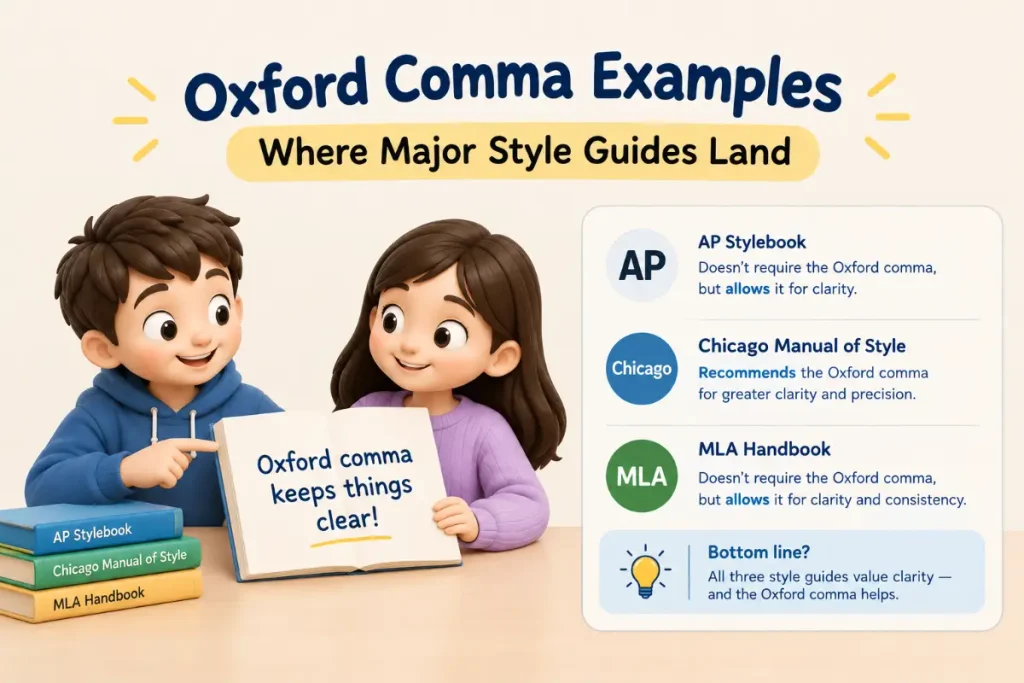
Where Major Style Guides Land
Merriam-Webster frames the comma as genuinely optional, not a fixed rule. The Chicago Manual of Style and MLA Handbook both recommend using it consistently in all writing, specifically to avoid the kind of ambiguity shown in the examples above. The AP Stylebook, followed by most U.S. newspapers, generally omits it to save space in print — but explicitly makes an exception whenever leaving it out would create a confusing or misleading sentence, exactly like several of the examples here.
Frequently Asked Questions
Is the Oxford comma ever grammatically required?
Not by a fixed universal grammar rule — it’s a style choice. However, in specific sentences where omitting it creates genuine ambiguity (like the parents/Ayn Rand/God example), most style guides — including AP, which otherwise skips it — recommend adding it back in for clarity.
Why is it called the “Oxford” comma specifically?
The name comes from Oxford University Press, whose in-house style guide has long recommended using the comma consistently, which is how the name became attached to this particular punctuation convention over time.
Does using or skipping the Oxford comma signal anything about a writer’s education or skill?
No — this is purely a house-style and clarity choice, not an indicator of grammatical knowledge. Skilled, professional writers and major publications land on both sides of this convention, depending on which style guide they follow.
Are there other well-known ambiguous sentences caused by a missing Oxford comma?
Yes — a frequently cited joke example is a book dedication reading “to my parents, Mother Teresa and the Pope,” which reads as an accidental (and clearly unintended) claim about the author’s parentage without the comma before “and.”
Does the Oxford comma ever create ambiguity instead of resolving it?
Occasionally, yes — as Example 5 shows, adding the comma can sometimes make a sentence read as a list of separate items when an appositive description was actually intended. This is exactly why context matters more than a blanket rule: the goal is always clarity, not mechanically applying (or omitting) the comma regardless of what the sentence actually needs.
What’s the safest approach if I’m not bound by a specific style guide?
Using the Oxford comma consistently is the safer default, since it prevents ambiguity in the cases where it matters, and it’s never grammatically wrong to include it — even AP style permits it when needed for clarity.
Practice Exercise
Decide whether each sentence needs an Oxford comma to avoid ambiguity, or whether it reads clearly either way. Answers are listed right after — try each one before checking.
- I’d like to thank my roommates, Sarah and my dog.
- We bought apples, bananas and grapes.
- The meeting included the CEO, the two founders and their assistant.
- She packed a jacket, gloves and a scarf.
- My favorite hobbies are reading, hiking and my sister.
- The recipe calls for flour, sugar and eggs.
- I invited my cousins, an artist and a chef.
- He collects stamps, coins and old maps.
- Please bring your ID, a pen and your application.
- The winners were my best friends, Alex and Jordan.
Answer Key
- Needed — without it, “Sarah and my dog” could misleadingly describe the roommates.
- Reads clearly either way.
- Needed — without it, “the two founders and their assistant” could describe one group.
- Reads clearly either way.
- Needed — without it, “hiking and my sister” absurdly reads as one item.
- Reads clearly either way.
- Needed — without it, “an artist and a chef” could describe the cousins.
- Reads clearly either way.
- Reads clearly either way.
- Needed — without it, “Alex and Jordan” could describe who the best friends are (though this may sometimes be the intended meaning).
If you got eight or more correct, you’ve internalized the real pattern: the comma matters most when the last two items could be misread as describing or combining with what came before them.
Before moving on, you may also want to read Punctuate Dialogue: Master 4 Rules Like a Pro (2026) for more helpful grammar tips.
The Bottom Line
The Oxford comma is optional by strict grammar rules, but the examples above show exactly why so many careful writers use it anyway: in lists where the final two items could be misread as a single unit or as a description of an earlier item, that one small comma is often the only thing standing between a clear sentence and an accidentally funny (or legally significant) one.