Here’s a genuinely rare situation in English usage: the particular mix-up in Flaunt vs Flout is so widespread that Merriam-Webster itself now lists “flout” as a secondary definition of “flaunt” — while simultaneously warning that most careful readers will still consider it a mistake if you use it that way. That’s about as tangled as word confusion gets, which makes this pair worth understanding properly rather than just guessing.
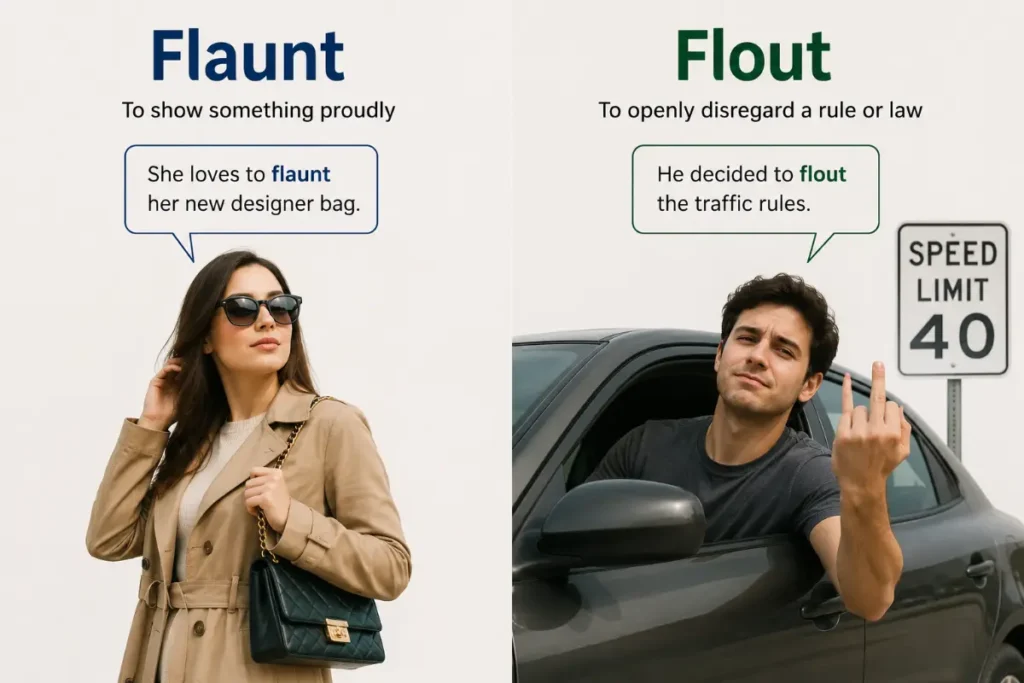
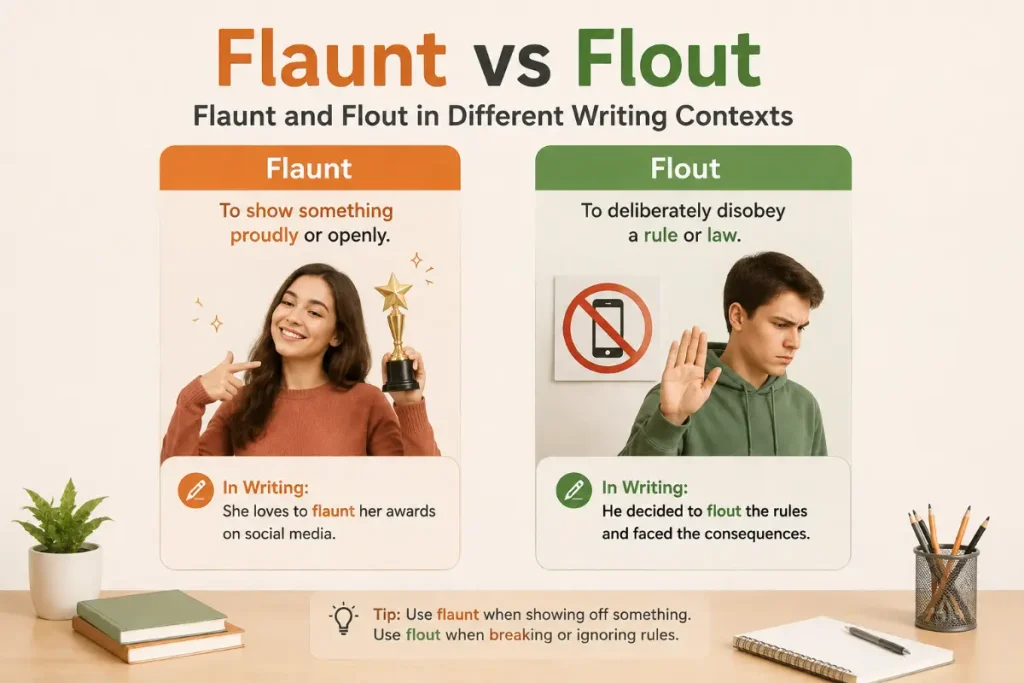
Flaunt means to show off, to display proudly and often ostentatiously. Flout means to openly disregard or defy a rule, law, or convention. Showing off versus breaking rules — genuinely opposite kinds of behavior, despite how often they get swapped.
You may also find Assure vs Ensure vs Insure: 7 Key Differences Explained (2026) helpful if you want to explore this topic further.
The Quick Answer
- Flaunt = to show off, display proudly
- She flaunted her new car all over social media.
- Flout = to openly defy or ignore a rule
- He flouted the dress code by wearing sneakers to the gala.
The test: are you describing someone showing off or displaying something proudly? Use flaunt. Are you describing someone openly breaking or ignoring a rule? Use flout.
Try it: “The company ___ its record profits in the annual report.” Is this about showing off? Yes — so it’s flaunt: “The company flaunted its record profits in the annual report.”
Now try: “The driver openly ___ traffic laws, speeding past every camera.” Is this about defying rules? Yes — so it’s flout: “The driver openly flouted traffic laws, speeding past every camera.”
Why This Is One of the Messiest Word Pairs in English
Merriam-Webster doesn’t sugarcoat this one: “flaunt” being used to mean “flout” (treat with contemptuous disregard) has become common enough that it now appears as a secondary dictionary definition — but the usage note attached to it warns explicitly that “if you use ‘flaunt’ to mean ‘flout,’ most people will think you’ve made a mistake.” Meanwhile, “flout” is occasionally used to mean “flaunt” too, though Merriam-Webster calls that direction of confusion “extremely uncommon” and something that “can only be regarded as a genuine error.”
So the honest picture here is this: flaunt-meaning-flout has become common enough that dictionaries acknowledge it exists, but it still isn’t considered correct or professional usage by most careful readers, editors, and usage guides. Bryan Garner, a leading usage authority, puts it plainly: “confusion about these terms is so distressingly common that some dictionaries have thrown in the towel… but the words are best kept separate.” That’s the standard worth following in your own writing — even knowing that the confused usage is out there, and even common.
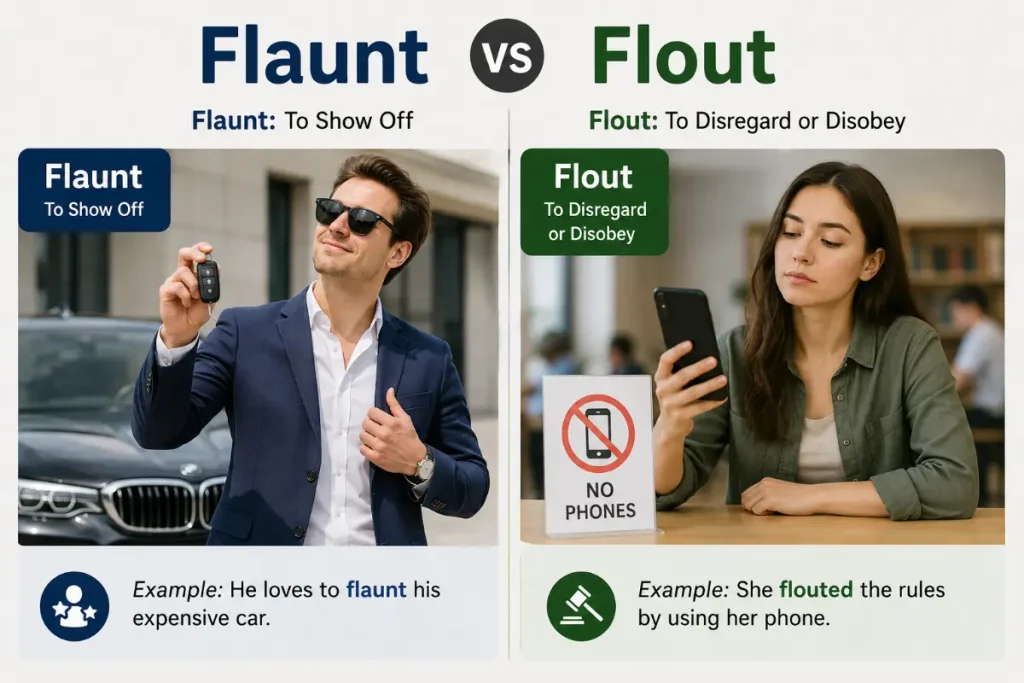
Flaunt: To Show Off
Flaunt describes displaying something — an achievement, possession, or quality — proudly, boldly, and often ostentatiously.
Examples:
- He loves to flaunt his new watch at every opportunity.
- The peacock flaunted its colorful tail feathers.
- She flaunted her promotion on every social media platform.
- The ad campaign flaunted the car’s top-of-the-line features.
- He flaunted his knowledge of wine to impress the table.
Notice the throughline: flaunt is always about pride and visibility — putting something on display so others notice it, often with a hint of showing off or bragging.
Flout: To Defy a Rule Openly
Flout describes openly disregarding, mocking, or ignoring a rule, law, or expected standard of behavior — and doing so without hiding it.
Examples:
- The company flouted safety regulations for years before getting caught.
- He flouted convention by showing up in casual clothes to the formal event.
- Protesters flouted the curfew, staying in the streets past the deadline.
- The restaurant flouted health codes, risking closure.
- She flouted her parents’ rules the moment she left for college.
Merriam-Webster notes precisely: “if you flout a rule or societal norm, you ignore it without hiding what you’re doing, or showing fear or shame; you flout it ‘out’ in the open.” That’s a genuinely useful detail — flouting isn’t secretive rule-breaking; it’s defiant, visible rule-breaking, done without concealment.
The Fastest Way to Check Yourself
Step 1: Is someone showing off or displaying something with pride? If yes, it’s flaunt.
Step 2: Is someone openly breaking or ignoring a rule, law, or convention? If yes, it’s flout.
Step 3: If you’re picturing pride and visibility around a possession or achievement, you want flaunt. If you’re picturing defiance toward a rule or authority, you want flout.
A widely used memory trick, courtesy of usage guide author Patricia O’Conner’s rhyme: “to flout is to defy or ignore; to flaunt is to show off.” Another version: flaunt rhymes with “haunt” — and showing off, like a ghost haunting a house, is all about drawing attention to your presence. Flout contains “out” — you flout a rule “out” in the open, defiantly, exactly as Merriam-Webster’s own explanation puts it.
This is one of the rare pairs on this site where even major dictionaries themselves are visibly conflicted, similar in spirit to the historical messiness behind continual and continuous — worth knowing both the modern professional standard and the fact that the boundary hasn’t always been as clean as it’s taught today.
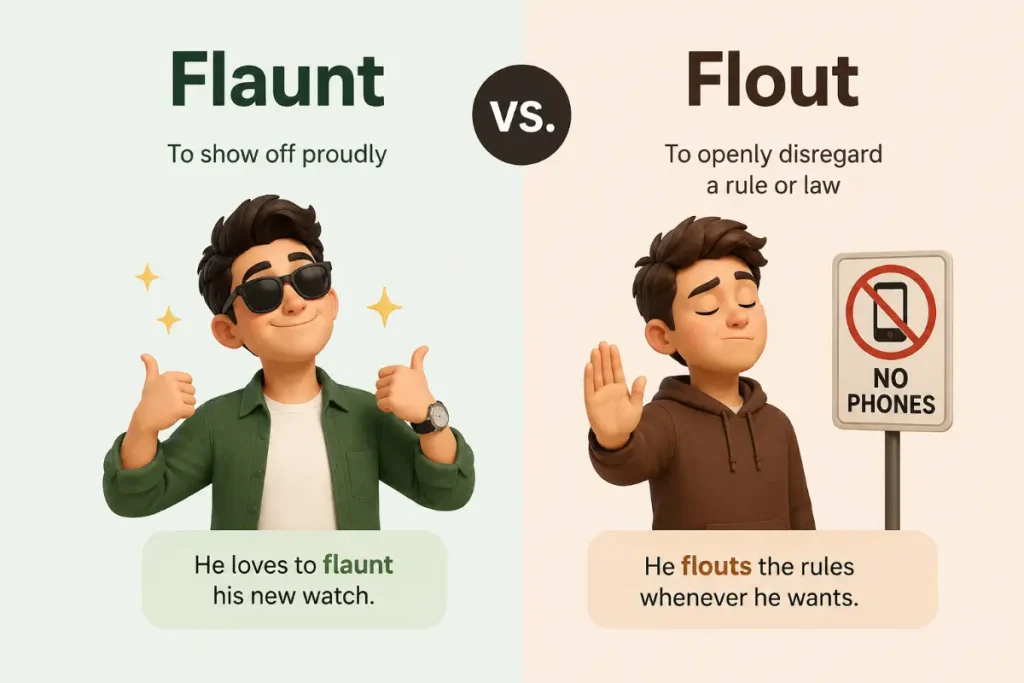
Flaunt vs. Flout: Side-by-Side Comparison
| Flaunt | Flout | |
|---|---|---|
| Meaning | To show off, display proudly | To openly defy or disregard a rule |
| Object | Possessions, achievements, qualities | Rules, laws, conventions |
| Example | flaunt your success | flout the regulations |
| Attitude | Pride, boastfulness | Defiance, contempt |
| Secrecy | None — meant to be seen | None — done openly, without hiding |
| Dictionary status of crossover use | Flaunt-as-flout listed but discouraged | Flout-as-flaunt considered a clear error |
Common Mistakes People Make
Mistake 1: “Those who flaunt the rules will face consequences.” While Merriam-Webster notes this exact usage does appear in some published writing, it’s still widely regarded as incorrect by careful readers and editors. “Those who flout the rules” is the standard, expected phrasing — reserve “flaunt” for showing off, not for rule-breaking.
Mistake 2: “He flouted his new sports car to all his coworkers.” Should be “flaunted his new sports car” — this describes showing off a possession, which is squarely flaunt’s territory.
Mistake 3: “The company flaunted environmental regulations for a decade.” Should be “flouted environmental regulations” — this describes ongoing, open disregard for rules, which needs flout.
For another useful perspective, check out Less vs Fewer: 5 Easy Rules You’ll Never Forget (2026).
Mistake 4: “She flouted her wealth in a way that made others uncomfortable.” Should be “flaunted her wealth” — this is about ostentatious display, not rule-breaking.
Mistake 5: Trusting your instinct that they might be interchangeable, since some dictionaries technically list overlapping definitions. Even though Merriam-Webster’s own entry acknowledges the crossover usage exists, its explicit guidance is that most readers will judge “flaunt” used to mean “flout” as a mistake — meaning the safer, more professional choice is always to keep them separate, regardless of what a secondary dictionary definition technically permits.
More Examples to Lock It In
- The influencer flaunted her designer wardrobe while openly flouting the platform’s advertising disclosure rules.
- He flouted the noise ordinance every weekend, flaunting his new sound system to the entire neighborhood.
- The company’s ads flaunted its eco-friendly branding, even as internal reports showed it was flouting environmental standards.
- She flaunted her promotion at the reunion, unconcerned that she’d flouted the company’s confidentiality policy to share the news early.
- Celebrities who flout tax laws while flaunting their wealth tend to attract unwanted media attention.
Frequently Asked Questions
Is it ever actually correct to use “flaunt” to mean “flout”?
Not by the standard most usage guides, editors, and careful readers apply, even though Merriam-Webster’s dictionary does list it as a secondary, less-preferred definition due to how common the confusion has become. In professional, academic, or published writing, keeping the words separate is the expected, safer choice.
Why is the flout-meaning-flaunt direction considered worse than the flaunt-meaning-flout direction?
Merriam-Webster specifically calls the flout-as-flaunt usage “extremely uncommon” and a “genuine error,” whereas flaunt-as-flout has become common enough to earn (reluctant) dictionary recognition. In practice, this means using “flout” to mean “show off” is almost never seen as acceptable, while the reverse confusion, though still discouraged, is at least widely documented.
What’s the origin of each word?
Flaunt’s origin is somewhat uncertain, though it’s been used in English since the 16th century to mean displaying something showily. Flout comes from a word related to “flute” or “to play the flute mockingly,” eventually evolving into its modern sense of open, mocking defiance.
Is there a word that means “to secretly break a rule,” as opposed to flout’s open defiance?
Not a direct synonym in the same word family, but words like “circumvent” or “skirt” (as in “skirt the rules”) capture a more secretive, less openly defiant kind of rule-breaking, in contrast to flout’s specifically visible, unashamed disregard.
What’s the fastest way to catch this error before publishing something?
Ask whether the sentence is about pride and display (flaunt) or defiance toward a rule (flout). Given how genuinely common this specific confusion is — even among professional writers — this pair is worth a deliberate double-check during proofreading rather than relying on instinct alone.
Practice Exercise
Fill in the blank with either “flaunt” or “flout.” Answers are listed right after — try each one before checking.
- She loves to ______ her new jewelry at every event.
- The driver openly ______ed the speed limit.
- He ______ed his academic achievements to anyone who’d listen.
- The factory ______ed pollution regulations for years.
- They ______ed their wealth with an extravagant party.
- The teenager ______ed curfew every single weekend.
- The brand’s ads ______ its luxury status.
- Protesters ______ed the newly imposed restrictions.
- He ______ed his connections to get ahead.
- The company was fined for ______ing labor laws.
- She ______ed her engagement ring to her coworkers.
- He ______ed convention by wearing jeans to the wedding.
- The politician ______ed his accomplishments during the debate.
- The restaurant ______ed health codes despite repeated warnings.
- They ______ed their success on social media constantly.
- The company ______ed antitrust regulations for a decade.
- He ______ed his fitness by posting shirtless gym photos.
- She ______ed the rules by parking in a restricted zone.
- The celebrity ______ed her designer handbags in every interview.
- The corporation ______ed environmental laws to cut costs.
Answer Key
- flaunt
- flout
- flaunt
- flout
- flaunt
- flout
- flaunt
- flout
- flaunt
- flout
- flaunt
- flout
- flaunt
- flout
- flaunt
- flout
- flaunt
- flout
- flaunt
- flout
If you got sixteen or more correct, you’ve mastered a pair that trips up even professional writers regularly. For any you missed, ask again: showing off with pride (flaunt), or openly defying a rule (flout)?
Flaunt and Flout in Different Writing Contexts
In journalism and legal reporting, “flout” is the standard, expected term for describing open defiance of laws or regulations — companies flout environmental rules, individuals flout court orders, nations flout international agreements. Getting this word right matters in this context specifically because it carries real legal and reputational weight.
In marketing, lifestyle, and celebrity coverage, “flaunt” dominates — flaunting wealth, flaunting a new relationship, flaunting a fitness transformation. This is squarely the territory of proud, visible display, and it’s one of the more frequently used words in entertainment and lifestyle journalism.
In business and compliance writing, both words show up, often close together — a company might flaunt its sustainability credentials in marketing materials while a report reveals it has been flouting the actual environmental standards behind the scenes. This kind of contrast is common enough in investigative writing that getting both words right in the same piece matters for clarity.
In everyday and social writing, the flaunt-meaning-flout confusion is genuinely widespread, including in casual professional writing — which is exactly why this is one of the pairs worth double-checking even when you feel confident, given how normalized the mix-up has become.
Before moving on, you may also want to read Accept vs Except: The Two Sounds That Cause Nonstop Confusion for more helpful grammar tips.
The Bottom Line
Flaunt means to show off, to display proudly. Flout means to openly defy a rule or convention. Despite one dictionary technically acknowledging the crossover confusion, the professional, expected standard is to keep them separate — flaunt is about pride and visibility, flout is about defiance and disregard.
When in doubt about Flaunt vs Flout, remember the simple distinction: you flaunt something when you proudly show it off, but you flout something when you deliberately ignore or break a rule. Keeping the difference between Flaunt vs Flout in mind will help you use both words confidently and avoid a common English mistake.