Merriam-Webster frames this trio perfectly: “peek, peak, and pique” sound the same but mean very different things. Peak vs Peek vs Pique can seem confusing at first, but once you know each word’s specific meaning and job, this stops being a messy mix-up and becomes three easy words to remember.
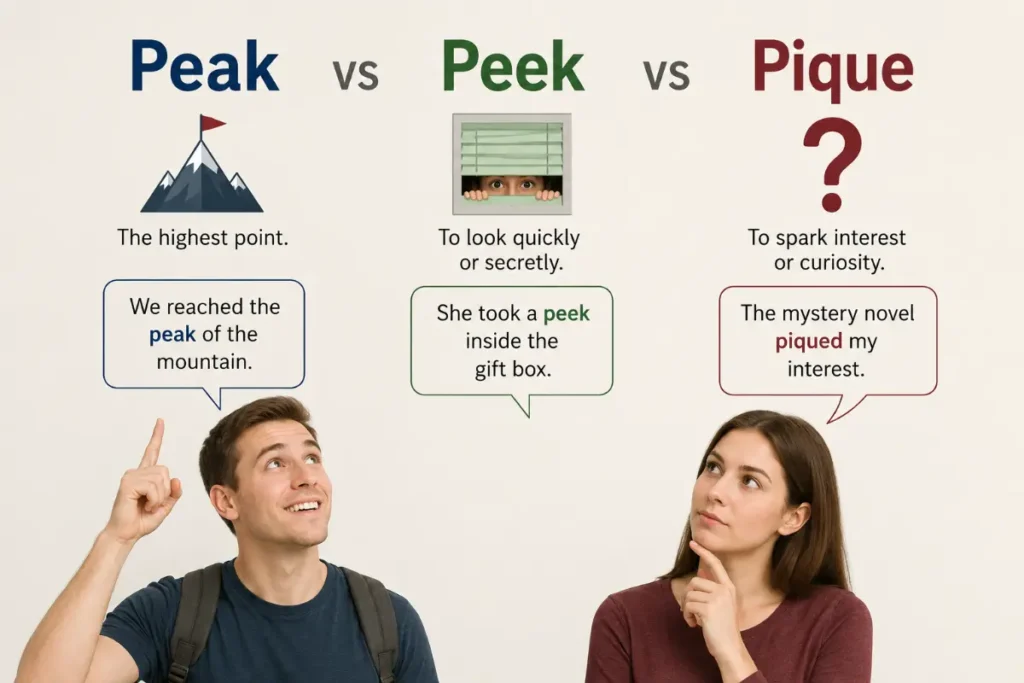
Peak refers to a highest point or maximum. Peek refers to a quick or furtive look. Pique refers to arousing interest or curiosity (or, as a noun, a feeling of irritation). Mountain, glance, curiosity — three unrelated concepts sharing one sound.
You may also find Less vs Fewer: 5 Easy Rules You’ll Never Forget (2026) helpful if you want to explore this topic further.
The Quick Answer
- Peak = highest point, maximum
- Sales reached their peak in December.
- Peek = a quick or secretive look
- She took a peek inside the box.
- Pique = to arouse interest, or a feeling of irritation
- The trailer piqued my curiosity.
The test: are you talking about a maximum or highest point? Use peak. Are you talking about looking, especially quickly or secretly? Use peek. Are you talking about arousing interest, or a flash of irritation? Use pique.
Try it: “The novel’s opening chapter really ___ my interest.” Is this about arousing curiosity? Yes — so it’s pique: “The novel’s opening chapter really piqued my interest.”
Now try: “He couldn’t resist taking a ___ at his gift before the party.” Is this about a quick, secretive look? Yes — so it’s peek: “He couldn’t resist taking a peek at his gift before the party.”
Where Each Word Actually Comes From
Understanding each word’s distinct history is genuinely the fastest way to keep all three straight, since they trace back to completely unrelated origins despite their identical modern pronunciation.
Peek is the oldest of the three in this specific spelling, dating back to the 14th century, related to Middle English words for looking or peering — Merriam-Webster notes it shares roots with “peekaboo,” the classic baby game, which has been called that for more than four centuries.
Peak as a noun describing a mountaintop or pointed projection dates to the 15th century, while its use as a verb (to reach a maximum) is actually much newer, not appearing until the late 1800s. Merriam-Webster suggests associating the “a” in peak with the “a” in “maximum,” or picturing a capital letter A as the most mountain-like, pointed letter — a genuinely useful visual trick.
Pique is, in Merriam-Webster’s own words, “the oddball of this trio” — it comes from a French word meaning literally “to prick,” and its earliest English use was actually as a noun describing a feeling of wounded pride or irritation, before it developed into the more common modern verb meaning “to arouse or excite.”
Peak: Highest Point or Maximum
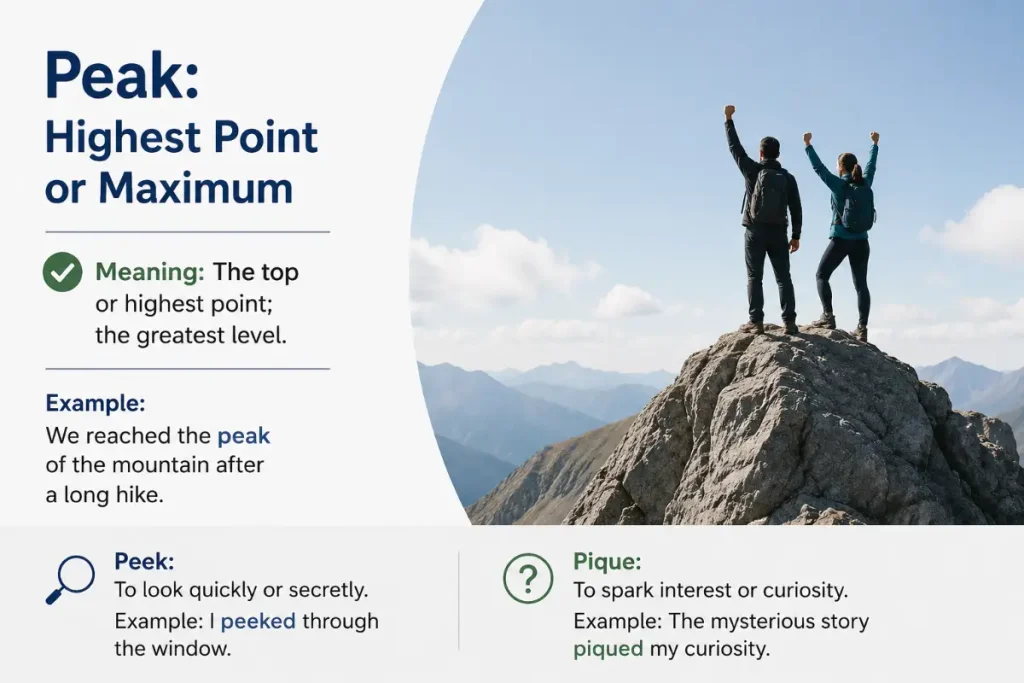
Peak functions as both a noun and a verb, always relating to a maximum, highest point, or culmination — literal or figurative.
Examples:
- The hikers reached the mountain’s peak by noon.
- Traffic peaks between 5 and 6 p.m. on weekdays.
- She’s at the peak of her career right now.
- The band’s popularity peaked in the late 1990s.
- Demand for the product hit its peak during the holidays.
Notice that “peak” as an adjective is also extremely common — “peak performance,” “peak season,” “peak condition” — all describing something at its maximum or best state.
Peek: A Quick or Secretive Look
Peek functions as both a noun and a verb, always relating to looking — usually briefly, quickly, or with a hint of secrecy.
Examples:
- She peeked through the curtains to see who was at the door.
- Take a peek at the final chapter if you can’t wait.
- He peeked over his coworker’s shoulder to see the screen.
- The kids peeked out from behind the couch during hide-and-seek.
- Can I get a sneak peek at the new design?
Merriam-Webster’s own suggested memory trick: “you peek in order to see” — a simple, direct association between peek and the act of looking.
Pique: To Arouse Interest, or a Feeling of Irritation
Pique functions as a verb (to arouse or excite, especially interest or curiosity) and as a less common noun (a feeling of resentment or wounded pride).
Verb examples:
- The headline piqued my curiosity immediately.
- Her unusual approach piqued the investors’ interest.
- The mystery novel’s first line piqued readers from page one.
- His offhand comment piqued her interest in the topic.
Noun examples (less common but still standard):
- He left the meeting in a fit of pique.
- There was a note of pique in her voice after being overlooked.
Notice that pique almost always pairs with “interest” or “curiosity” in its verb form — “piqued my interest” and “piqued my curiosity” are by far the most common constructions, which makes this a useful pattern to watch for when deciding among the three words.
7 Key Differences Explained
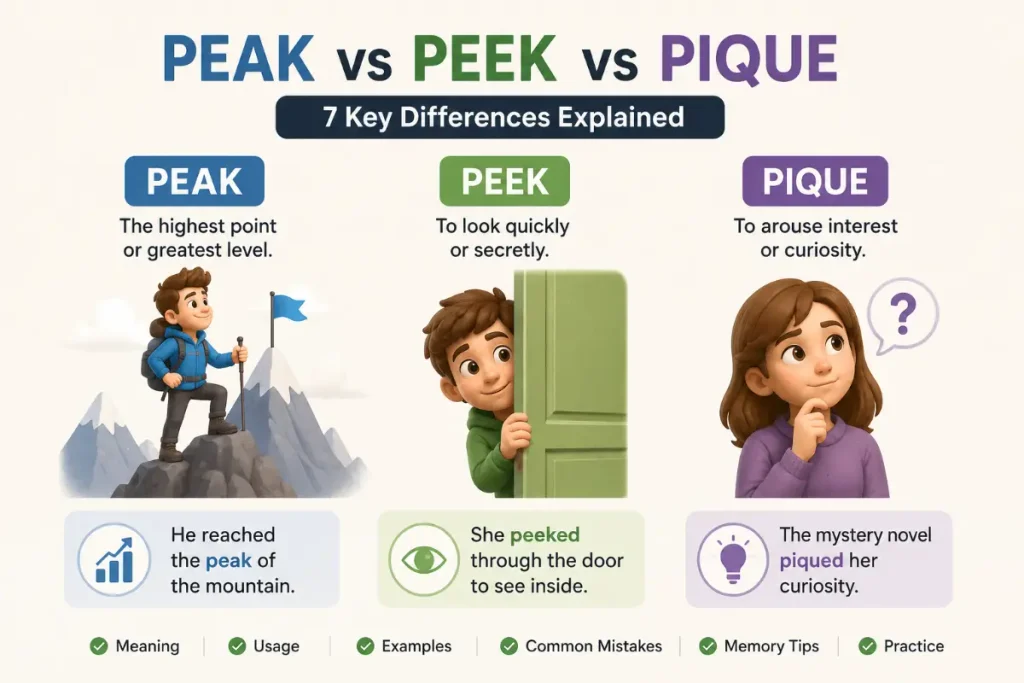
Understanding Peak vs Peek vs Pique becomes much easier when you look at how each word functions, what it means, and where it fits in a sentence. Although these three words sound exactly alike, their meanings and spellings are completely different. Here are the seven key differences to remember.
1. Their Meanings Are Completely Different
The biggest difference is what each word means:
- Peak refers to the highest point, level, or amount.
- Peek means to take a quick or secret look.
- Pique means to arouse interest, curiosity, or sometimes irritation.
Examples:
- The athlete reached the peak of her career.
- I took a quick peek inside the box.
- The unusual headline piqued my curiosity.
2. Peak Relates to a Highest Point
Use peak when you’re talking about the top, maximum, or most successful point of something. It can describe physical heights, performance, popularity, activity, or intensity.
Examples:
- We reached the peak of the mountain before noon.
- Traffic is heavy during peak hours.
- She was at the peak of her career in her thirties.
A simple memory trick is to associate peak with a mountain’s peak—the very top.
3. Peek Means to Look Quickly
Peek is about seeing something, usually with a quick, brief, or sometimes secretive look. It can be used as both a verb and a noun.
Examples:
- She peeked through the doorway.
- Can I take a peek at your new phone?
- He peeked at the answers before the test ended.
If the sentence involves looking, peek is probably the word you need.
4. Pique Means to Spark Interest or Curiosity
Use pique when something catches someone’s attention or makes them curious. It is commonly used in the phrase “pique someone’s interest.”
Examples:
- The mystery piqued my interest.
- Her unusual story piqued his curiosity.
- The documentary piqued my interest in astronomy.
This is where many people make a spelling mistake. The correct expression is “piqued my interest,” not “peaked my interest.”
5. Pique Can Also Mean Irritation
Pique has another, less common meaning: a feeling of irritation, annoyance, or wounded pride. This meaning is different from the more familiar idea of sparking curiosity.
Examples:
- His criticism piqued her pride.
- She left in a fit of pique after the argument.
- The comment piqued his irritation.
The context usually makes the intended meaning clear.
6. They Have Different Grammatical Uses
Another useful distinction is how each word behaves in a sentence.
Peak can work as a noun, verb, or adjective:
- The mountain’s peak was covered in snow. (noun)
- Sales peaked in December. (verb)
- We traveled during peak season. (adjective)
Peek can be a noun or verb:
- Take a quick peek. (noun)
- She peeked through the window. (verb)
Pique can be a noun or verb:
- The mystery piqued my curiosity. (verb)
- He reacted out of pique. (noun)
Knowing the grammatical role can help you choose the correct spelling.
7. The Easiest Memory Trick
When you are stuck between peak, peek, and pique, connect each spelling to a simple idea:
- Peak = top → Think of the top of a mountain.
- Peek = look → Think of taking a quick look.
- Pique = interest → Think of something that sparks your curiosity.
So remember:
Peak = highest point
Peek = quick look
Pique = interest or irritation
The three words sound the same, but their meanings are easy to separate once you attach each spelling to its specific job. If you’re ever unsure, ask yourself: Am I talking about a top, a look, or an emotion/interest? That quick check can prevent most Peak vs Peek vs Pique mistakes.
The Fastest Way to Check Yourself
Step 1: Is this about a highest point, maximum, or culmination? If yes, it’s peak.
Step 2: Is this about looking, especially quickly or secretly? If yes, it’s peek.
Step 3: Is this about arousing interest or curiosity, or a feeling of irritation? If yes, it’s pique.
A widely used memory trick set: peek has two E’s, like two eyes peeking — a visual pun that’s stuck with generations of writers. Peak contains “a,” matching “maximum” — or picture a capital A as a mountain peak. Pique is the unusual French import; if the sentence involves curiosity or interest being stirred up, and neither of the other two meanings fit, pique is very likely your answer by process of elimination.
For another useful perspective, check out Affect vs Effect: The Simple Way to Never Mix Them Up Again.
This is a three-way homophone split much like assure, ensure, and insure — three words sharing one sound, each carved out into its own specific, non-overlapping job.
Peak vs. Peek vs. Pique: Side-by-Side Comparison
| Peak | Peek | Pique | |
|---|---|---|---|
| Meaning | Highest point, maximum | Quick or secretive look | Arouse interest; or irritation |
| Part of speech | Noun, verb, adjective | Noun, verb | Verb (mainly); noun (less common) |
| Example | peak performance | take a peek | piqued my interest |
| Common pairing | Peak season, peak hours | Sneak peek, peek inside | Piqued my curiosity |
| Origin | Mountain-related, 15th c. | Middle English “look,” 14th c. | French “to prick” |
Common Mistakes People Make
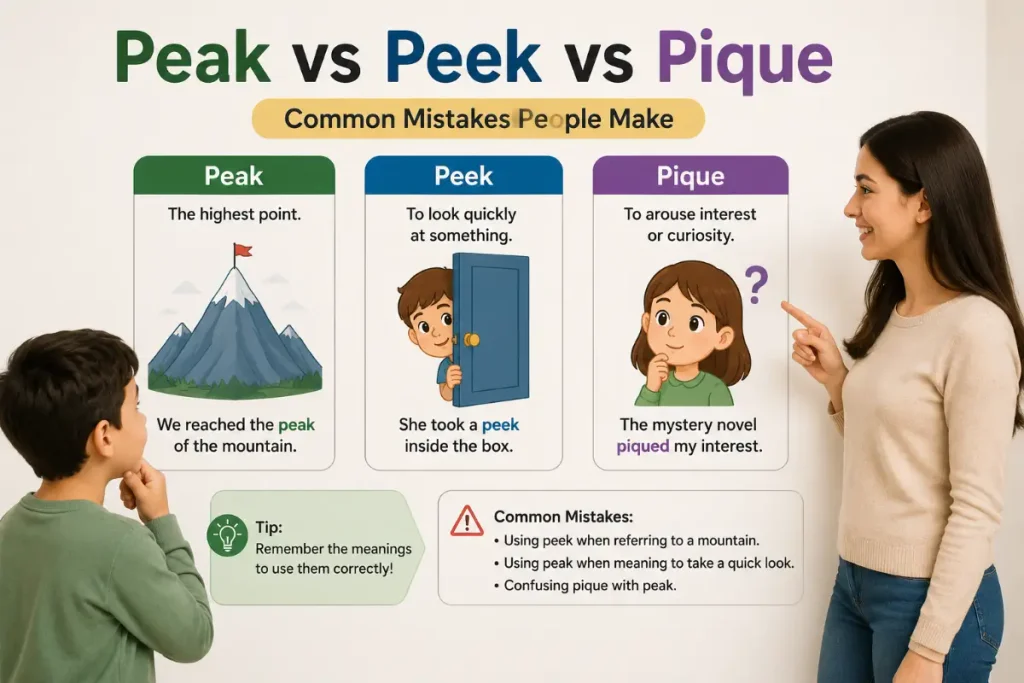
Mistake 1: “The article really peaked my interest.” Should be “piqued my interest” — this is genuinely one of the most common errors involving this trio, since “peak” feels intuitively connected to something reaching a high point of interest, but the correct word here is specifically pique.
Mistake 2: “She took a quick peak inside the box.” Should be “peek inside the box” — this describes a quick look, which needs peek, not the mountain-related peak.
Mistake 3: “Sales are expected to peek during the holiday season.” Should be “peak during the holiday season” — this describes reaching a maximum, which needs peak.
Mistake 4: “His comment left her in a fit of peak.” Should be “fit of pique” — this describes irritation or wounded pride, the less common but standard noun use of pique.
Mistake 5: “The trailer peeked everyone’s curiosity.” Should be “piqued everyone’s curiosity” — another version of the peak/pique mix-up, this time confusing pique with peek instead of peak, though this specific direction of error is less common than pique-for-peak.
More Examples to Lock It In
- The documentary’s trailer piqued my curiosity, so I snuck a peek at the reviews before it hit its peak popularity.
- Ticket sales peaked in the final week, after a teaser campaign that piqued fans’ interest for months.
- She peeked at her phone during the meeting, hoping no one would notice her curiosity had been piqued by the message.
- The mountain’s peak was still visible even as clouds gave hikers only brief peeks through the fog.
- His sudden interest, clearly piqued by the announcement, led him to peek at the company’s stock price throughout the day.
Frequently Asked Questions
Why is “peaked my interest” such a common mistake?
It’s an understandable slip, since “peak” intuitively suggests reaching a high point, and interest genuinely can build toward a high point. But the specific idiom for arousing curiosity has always used “pique” (from the French word for “to prick” or provoke), not “peak” — this is one of the most frequently corrected errors among all commonly confused word pairs in English.
Is “pique” ever used outside the phrase “piqued my interest/curiosity”?
Yes, though less commonly — pique can describe arousing other reactions too (“piqued suspicion,” “piqued controversy”), and its noun form describes a feeling of irritation or wounded pride (“stormed off in a fit of pique”), a somewhat old-fashioned but still standard usage.
What’s the difference between a “peek” and a “glimpse”?
They’re closely related, but “peek” specifically implies a deliberate, sometimes secretive act of looking (often through a gap or opening), while “glimpse” more often implies a brief, incidental, unplanned view of something, whether you intended to see it or not.
Does “peak” as a verb always describe something positive, like reaching success?
Not necessarily — “peak” simply describes reaching a maximum point, which can be neutral or even negative depending on context (“the infection rate peaked in March,” “his anxiety peaked right before the presentation”). It’s about the high point itself, not whether that high point is good or bad.
What’s the fastest way to catch this error before publishing something?
For each instance of peak, peek, or pique, ask: highest point (peak), a quick look (peek), or arousing interest/irritation (pique)? Since “peaked my interest” is by far the most common error in this trio, that specific phrase is worth double-checking every time it appears.
Practice Exercise
Fill in the blank with “peak,” “peek,” or “pique.” Answers are listed right after — try each one before checking.
- The article really ______d my curiosity.
- They reached the mountain’s ______ just before sunset.
- She took a quick ______ at the answer key.
- Traffic tends to ______ around 8 a.m.
- His unusual theory ______d the professor’s interest.
- Can I get a sneak ______ at the new product?
- The band’s popularity ______ed in the early 2000s.
- She left the room in a fit of ______.
- He ______ed through the blinds to see who was outside.
- Demand for the toy ______s every December.
- The mystery novel’s cover alone ______d my interest.
- They snuck a ______ at the surprise before it was unveiled.
- Her performance was at its absolute ______ during the finals.
- The unexpected plot twist ______d readers everywhere.
- He couldn’t resist a ______ inside the wrapped gift.
- Ticket sales are expected to ______ this weekend.
- The rumor ______d everyone’s curiosity instantly.
- She reached the ______ of her fitness after months of training.
- He took a brief ______ at his phone during the lecture.
- The scandal ______d public interest overnight.
Answer Key
- piqued
- peak
- peek
- peak
- piqued
- peek
- peaked
- pique
- peeked
- peaks
- piqued
- peek
- peak
- piqued
- peek
- peak
- piqued
- peak
- peek
- piqued
If you got sixteen or more correct, you’ve mastered a trio that catches even careful writers off guard. For any you missed, go back and ask: highest point, quick look, or arousing curiosity?
Peak, Peek, and Pique in Different Writing Contexts
- In business and marketing writing, “peak” appears constantly — peak season, peak hours, peak performance — and it’s one of the more heavily used adjectives in retail, travel, and operations writing specifically.
- In journalism and headline writing, “piqued interest” or “piqued curiosity” is a standard phrase for describing what draws readers in, making this exactly the kind of high-visibility phrase where the peak/pique mix-up is most likely to be spotted and judged by careful readers.
- In product and content marketing, “sneak peek” is an extremely common promotional phrase — offering audiences an early, brief look at something before a full release — making “peek” one of the more frequently and correctly used words in this trio, likely because the phrase itself is so familiar and fixed.
- In everyday and casual writing, this is where “peaked my interest” shows up most often, precisely because the phrase is spoken so much more frequently than it’s carefully written, and the ear doesn’t distinguish the three words at all.
Before moving on, you may also want to read Who vs Whom: The Simple Test That Ends the Confusion (2026 Guide) for more helpful grammar tips.
The Bottom Line
Peak is a highest point or maximum. Peek is a quick or secretive look. Pique means to arouse interest (or, less commonly, a flash of irritation). The single most useful thing to remember: it’s always “piqued my interest,” never “peaked my interest” — that one fix alone resolves the most common error in this entire trio.
Peak vs Peek vs Pique becomes much easier once you connect each word to its meaning: peak is the highest point, peek is a quick or secret look, and pique means to spark interest or irritation. Remember, it’s always “piqued my interest,” never “peaked my interest”—a simple distinction that helps you avoid the most common mistake with this trio.