These two words look almost identical — just two letters swapped — and both relate to the general idea of opposition or dislike, which is exactly why Adverse vs Averse get confused so often. The good news is there’s a genuinely reliable pattern here: one word describes things, the other describes people’s feelings, and knowing that split resolves the vast majority of cases.
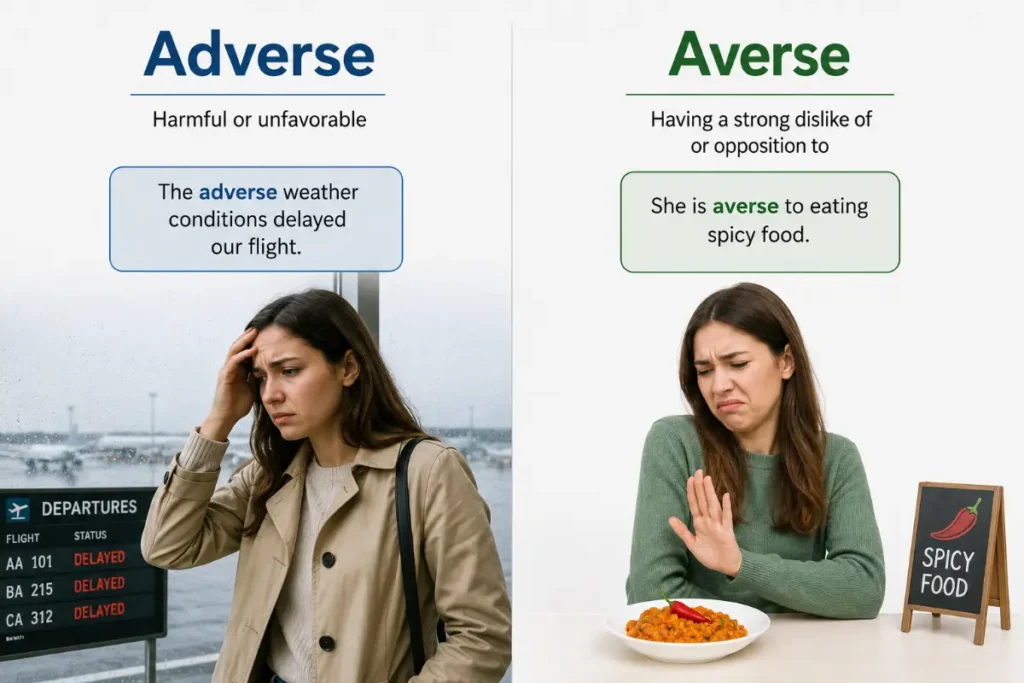
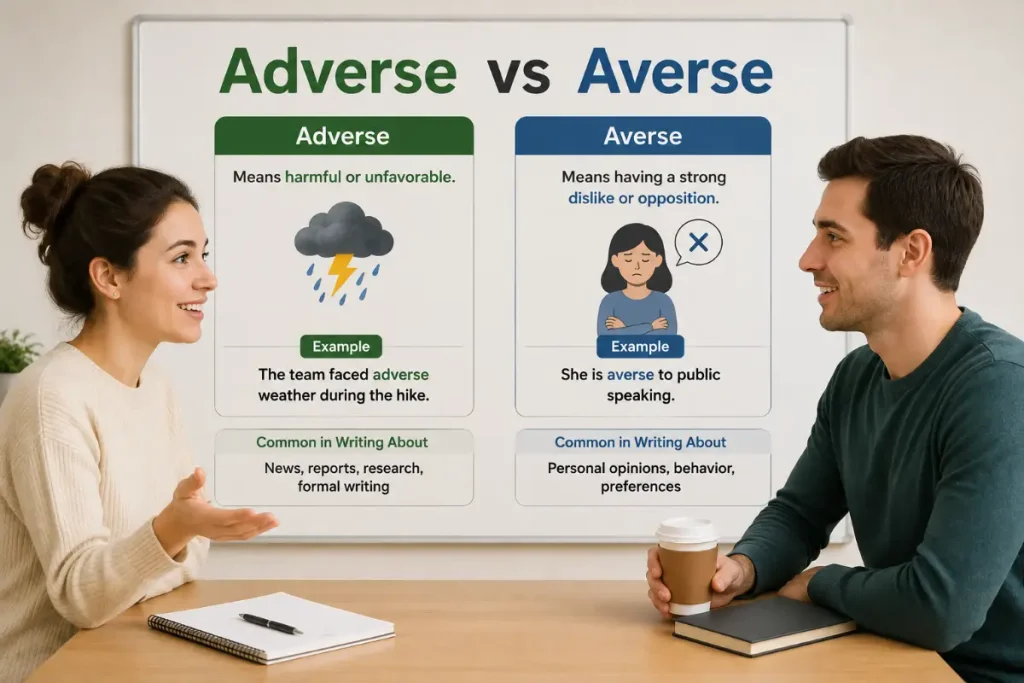
Adverse describes something harmful or unfavorable — typically conditions, effects, or events. Averse describes a person’s feeling of strong dislike or reluctance toward something. Things are adverse; people are averse.
You may also find Who’s vs Whose: 7 Easy Rules to Get It Right (2026 Guide) helpful if you want to explore this topic further.
The Quick Answer
- Adverse = harmful, unfavorable (usually describes things)
- The medication caused adverse side effects.
- Averse = feeling strong dislike or reluctance (usually describes people)
- She’s averse to taking unnecessary risks.
The test: are you describing a condition, effect, or event as harmful? Use adverse. Are you describing a person’s feeling of dislike or reluctance? Use averse, almost always paired with “to.”
Try it: “The storm caused ___ weather conditions for the flight.” Is this describing a condition, or a person’s feeling? A condition — so it’s adverse: “The storm caused adverse weather conditions for the flight.”
Now try: “He’s ___ to spending money on things he doesn’t need.” Is this describing a person’s feeling? Yes — so it’s averse: “He’s averse to spending money on things he doesn’t need.”
The Distinction Is Real, But Not Absolute
Merriam-Webster is upfront that “it would be overly simplistic to say that adverse should be entirely restricted to things and averse to people” — after all, we can certainly say a specific person “had an adverse effect on our lives,” using adverse to describe that person’s impact rather than their feelings. The more precise version of the rule: adverse tends to describe effects, conditions, and results, while averse refers specifically to feelings and inclinations. So even when both words technically could apply to a person, they’re doing different jobs — adverse describes what that person caused or represents, while averse describes what that person feels.
Merriam-Webster’s own usage dictionary adds a useful historical nuance here too, citing an old distinction from a 1934 usage note: “we are adverse to that which we disapprove, but averse to that which we dislike.” That’s a subtler distinction than most people need day to day, but it captures the core difference well — adverse leans toward judgment or opposition in principle, while averse leans toward personal feeling or distaste.
Adverse: Harmful or Unfavorable
Adverse typically describes conditions, effects, results, or circumstances — things, not feelings.
Examples:
- The drug’s adverse effects included nausea and dizziness.
- Adverse weather conditions delayed the flight for hours.
- The company faced adverse publicity after the recall.
- Investors were wary of the adverse market conditions.
- The team performed well despite adverse circumstances.
Notice that “adverse” is not typically followed by “to” the way averse almost always is — you’d say “adverse effects on the economy,” not “adverse to the economy” in the same construction.
Averse: Feeling Reluctance or Dislike
Averse describes a person’s internal feeling of distaste, reluctance, or opposition, and it’s almost always paired with the preposition “to.”
Examples:
- She’s averse to confrontation of any kind.
- He’s not averse to trying new restaurants.
- Many investors are risk-averse during uncertain times.
- I’m averse to the idea of moving across the country.
- The team was averse to changing their strategy mid-season.
Notice the very common compound form “risk-averse” (or “risk averse”), which describes someone reluctant to take financial or strategic risks — this is one of the most frequently used forms of “averse” in business and finance writing specifically.
The Fastest Way to Check Yourself
Step 1: Is the word describing a condition, effect, or circumstance? If yes, it’s adverse.
Step 2: Is the word describing a person’s feeling of dislike or reluctance? If yes, it’s averse — and check whether “to” follows it, since that’s a strong confirming signal.
Step 3: If you’re describing a person but talking about their impact or effect on something else (not their feelings), adverse can still apply — “she had an adverse effect on morale” is correct, even though the subject is a person, because it’s describing the effect, not her feelings.
A widely used memory trick: averse is closely related to aversion, a feeling — both relate to personal dislike. Adverse is closely related to adversity, circumstances — both relate to difficult conditions or events. If you’re thinking about a feeling, reach for the “aversion” family; if you’re thinking about circumstances, reach for the “adversity” family.
This kind of nuanced, not-quite-absolute distinction is similar to what makes assure, ensure, and insure tricky too — words genuinely close enough in meaning that even careful writers occasionally land in different places at the margins.
Adverse vs. Averse: Side-by-Side Comparison
| Adverse | Averse | |
|---|---|---|
| Describes | Conditions, effects, results | A person’s feelings or reluctance |
| Typically applies to | Things, events, circumstances | People |
| Common pairing | Adverse effects, adverse conditions | Averse to (something) |
| Related word | Adversity | Aversion |
| Example | adverse weather | averse to risk |
| Common compound | — | Risk-averse |
Common Mistakes People Make
Mistake 1: “He’s not adverse to trying new things.” Should be “not averse to trying new things” — this describes a personal feeling of reluctance (or its absence), which is averse’s territory.
Mistake 2: “The company reported averse effects from the new policy.” Should be “adverse effects” — this describes harmful outcomes or conditions, which needs adverse.
Mistake 3: “The weather was quite adverse to picnicking today.” While understandable, this is slightly imprecise — “adverse” doesn’t typically pair with “to” in this construction the way “averse” does. Better phrasing would be “the weather was unfavorable for a picnic” or restructuring to avoid the “adverse to” pattern, which reads as a blend of both words.
For another useful perspective, check out Imply vs Infer: 7 Key Differences You Need to Know (2026).
Mistake 4: “She’s averse weather made the trip miserable.” Should be “adverse weather” — this describes a harmful condition, not a person’s feeling.
Mistake 5: Confusing which word takes “to.” “Averse to” is extremely common and standard; “adverse to” is genuinely rarer and, per Merriam-Webster’s own usage notes, has historically been more confined to specific legal contexts. In everyday and general writing, if you’re about to write “adverse to,” double-check whether “averse to” is actually what you mean.
Where “Adverse” and “Averse” Come From
Both words trace back to Latin roots relating to “turning against” — adverse comes from “adversus,” meaning “turned toward” in an opposing sense, while averse comes from “aversus,” meaning “turned away from.” That etymological distinction is genuinely useful: adverse describes something turning against you (an unfavorable condition confronting you), while averse describes you turning away from something (your own feeling of avoidance or dislike). If you picture the direction of “turning” in each case — something coming at you (adverse) versus you pulling back from something (averse) — the distinction maps onto the words’ literal origins in a way that can make the modern usage feel less arbitrary.
More Examples to Lock It In
- Despite adverse conditions on the trail, the hikers weren’t averse to pushing through to the summit.
- The board was averse to any decision that might create adverse publicity for the company.
- He’s risk-averse by nature, which served him well during the market’s adverse downturn.
- The medication’s adverse side effects made her averse to continuing the treatment.
- Investors remained averse to volatility, even as adverse economic indicators started to stabilize.
Practice Exercise
Fill in the blank with either “adverse” or “averse.” Answers are listed right after — try each one before checking.
- The medication caused several ______ side effects.
- She’s not ______ to trying new cuisines.
- ______ weather conditions delayed the launch.
- He’s naturally risk-______ when it comes to investing.
- The company faced ______ publicity after the scandal.
- I’m not ______ to the idea of working weekends occasionally.
- The team overcame ______ circumstances to win the championship.
- Many voters are ______ to higher taxes.
- The drug’s ______ effects were listed on the label.
- She’s ______ to confrontation and avoids conflict.
- The economy faced ______ conditions throughout the quarter.
- He wasn’t ______ to relocating for the new job.
- The ruling had an ______ impact on small businesses.
- Investors remained ______ to any unnecessary risk.
- The trial was halted due to ______ reactions in patients.
- She’s not ______ to constructive criticism.
- ______ market trends worried shareholders.
- He’s ______ to spending money on luxury items.
- The policy had an ______ effect on morale.
- They were ______ to changing their long-standing tradition.
Answer Key
- adverse
- averse
- Adverse
- averse
- adverse
- averse
- adverse
- averse
- adverse
- averse
- adverse
- averse
- adverse
- averse
- adverse
- averse
- Adverse
- averse
- adverse
- averse
If you got sixteen or more correct, the things-vs-feelings distinction has already become instinct. For any you missed, ask again: is this describing a condition (adverse) or a personal reluctance (averse)?
Adverse and Averse in Different Writing Contexts
In medical and pharmaceutical writing, “adverse” is the standard, precise term — adverse effects, adverse reactions, adverse events — appearing constantly on medication labels, clinical trial reports, and health documentation. This is one of the fields where getting adverse right (and not accidentally writing averse) matters most, since these documents are read carefully and precision is expected.
In finance and investment writing, “averse” shows up constantly in the compound “risk-averse,” describing an investor’s or institution’s reluctance to take on risk. “Adverse” also appears frequently here, describing unfavorable market conditions or economic indicators — meaning both words often show up in the same financial article, each doing its own distinct job.
In legal writing, Merriam-Webster notes an interesting historical wrinkle: “adverse to” (rather than the more common “averse to”) has specifically been used in legal contexts to describe conflicting interests, such as a lawyer having interests “adverse to” a client. This is a specialized legal usage worth knowing if you write about or work in law, since it doesn’t follow the general things-versus-feelings pattern quite as cleanly.
In everyday and business writing, most writers can rely on the simple version of the rule almost all the time: adverse for conditions and effects, averse for personal feelings and reluctance, nearly always followed by “to.”
Frequently Asked Questions
Can “adverse” ever describe a person’s feelings, or “averse” ever describe conditions?
Rarely, and it’s not the standard modern usage. Merriam-Webster notes an older, more nuanced distinction where both could technically apply to people, but in current everyday and professional writing, sticking to “adverse” for conditions/effects and “averse” for personal feelings is the clearer, safer, and more widely expected choice.
Why does “averse” almost always come with “to,” while “adverse” usually doesn’t?
This reflects their different grammatical roles — averse describes a personal relationship or attitude toward something specific, which naturally needs “to” to introduce what that attitude is directed at (“averse to risk”). Adverse more often functions as a straightforward descriptive adjective attached directly to a noun (“adverse conditions”), without needing a preposition to complete its meaning.
What does “risk-averse” mean, and why is it hyphenated?
“Risk-averse” describes someone reluctant to take risks, especially financial ones, and it’s commonly seen both hyphenated and as two words. This is one of the most frequently used forms of “averse” in business, finance, and investment writing specifically.
Is there a connection between “adversity” and “adverse”?
Yes — “adversity” (difficult circumstances or hardship) is directly related to “adverse,” both describing unfavorable conditions. This connection is a useful memory anchor: if you’re thinking about difficult circumstances, you’re in “adverse” territory.
What’s the fastest way to catch this error before publishing something?
Ask whether the sentence is describing a condition or effect (adverse) or a person’s feeling of reluctance (averse), and check for a following “to” — its presence is a strong signal you want averse. Since both are correctly spelled real words, spell-check won’t catch a wrong-but-valid choice, so this manual check is essential.
Before moving on, you may also want to read Accept vs Except: The Two Sounds That Cause Nonstop Confusion for more helpful grammar tips.
Key Takeaway
Adverse describes harmful conditions, effects, or circumstances — it’s about things. Averse describes a person’s feeling of dislike or reluctance, almost always paired with “to” — it’s about people’s attitudes. When in doubt, remember: adversity is what’s adverse; aversion is what’s averse.
Adverse vs Averse becomes much easier once you remember the core distinction: adverse describes harmful conditions, effects, or circumstances—it’s about things. Averse describes a person’s dislike or reluctance, usually followed by “to”—it’s about people’s attitudes. When in doubt, think of adversity as adverse and aversion as averse.