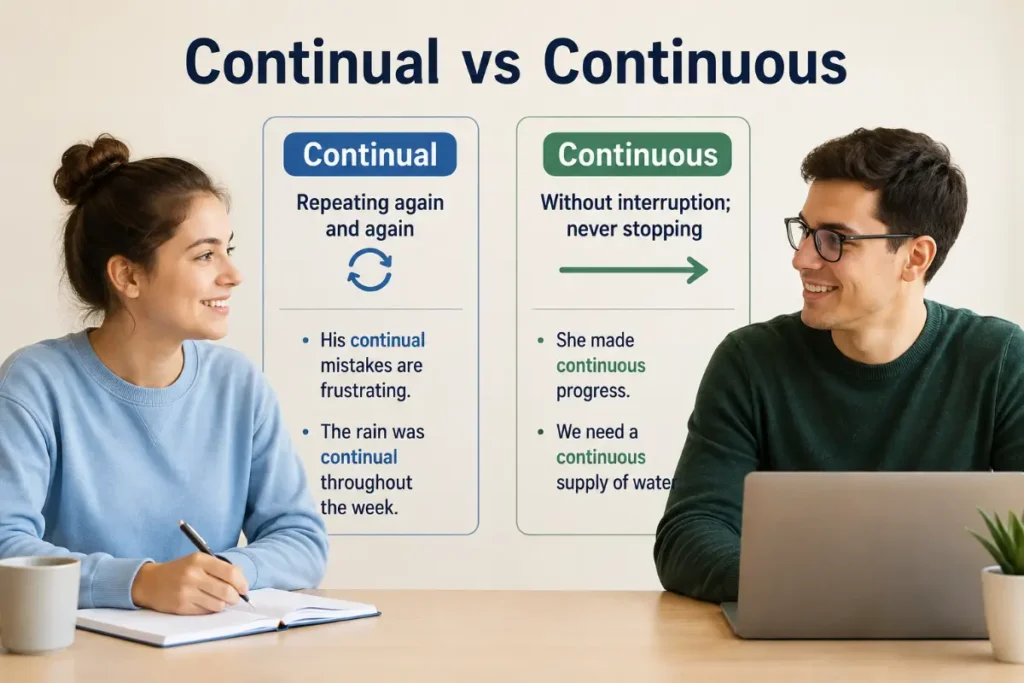
Here’s a genuinely useful visual to keep in mind for Continual vs Continuous: a leaky faucet drips continually—stopping and starting, over and over. A river flows continuously—never stopping at all. That simple image resolves most of the confusion between these two words.
Continual describes something that happens repeatedly, often with breaks in between. Continuous describes something that happens without any interruption at all. Similar-looking words, genuinely different rhythms.
You may also find Lie vs Lay vs Laid: 20 Examples That Make It Easy (2026 Guide) helpful if you want to explore this topic further.
The Quick Answer
- Continual = repeated, with pauses or breaks in between
- The continual interruptions made it hard to focus.
- Continuous = uninterrupted, without any breaks
- The continuous hum of the air conditioner filled the room.
The test: does the thing you’re describing stop and start repeatedly, or does it run in one unbroken stretch? Stopping and starting means continual. One unbroken stretch means continuous.
Try it: “The ___ dripping of the faucet kept her awake.” Does dripping happen in a steady, unbroken flow, or in repeated individual drops with tiny gaps between them? Repeated drops — so it’s continual: “The continual dripping of the faucet kept her awake.”
Now try: “The river’s ___ flow carved the canyon over millions of years.” Is this one unbroken flow, or a series of repeated starts and stops? One unbroken flow — so it’s continuous: “The river’s continuous flow carved the canyon over millions of years.”
Why Even Style Guides Don’t Fully Agree Here
Merriam-Webster is unusually direct about this pair, noting that the strict recurring-versus-uninterrupted distinction that “many grammarians have drawn since the mid-19th century… overlooks the fact that continual is the older word and was used with both meanings for centuries before continuous appeared on the scene.” In other words, the clean modern rule is a relatively recent convention laid on top of a messier, older history — continual has been used to mean “uninterrupted” since the 14th century, well before continuous existed to take over that specific job.
That said, Merriam-Webster also confirms that in current usage, continual is now the more likely of the two to mean “recurring,” which is exactly the distinction most modern style guides teach and expect. So while the “rule” isn’t as ancient or absolute as some grammar guides suggest, it does reflect how careful writers use these words today — which makes it worth following, even knowing its history is a bit more tangled than the clean version most people learn.
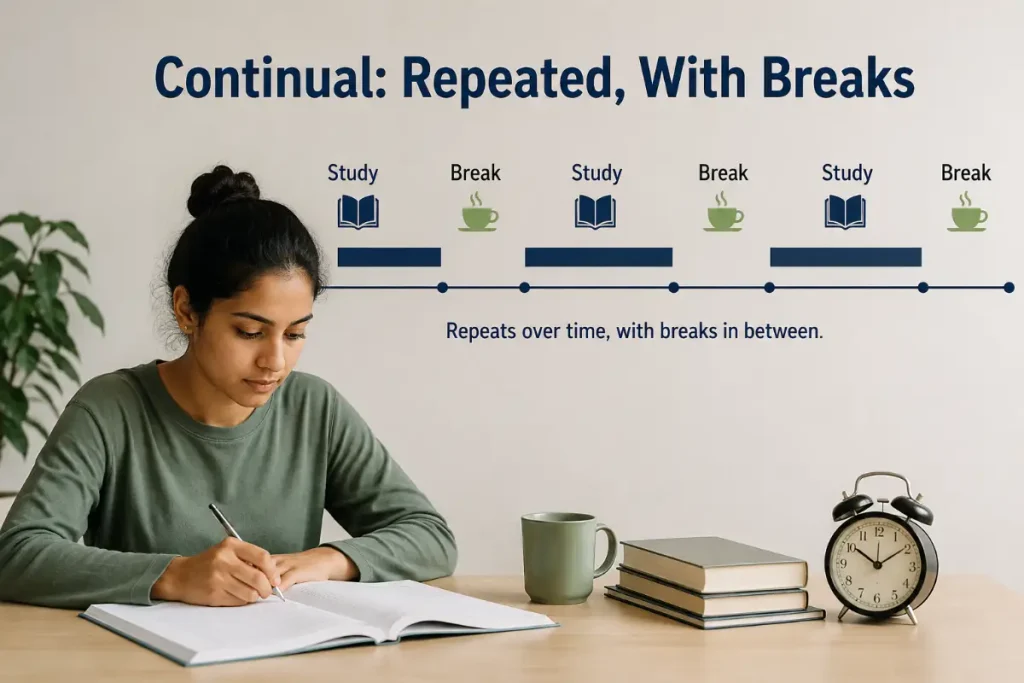
Continual: Repeated, With Breaks
Continual describes something that happens again and again, typically with gaps or pauses between occurrences.
Examples:
- The continual noise from construction next door was exhausting.
- Her continual questions showed genuine curiosity.
- We’ve had continual problems with this printer all month.
- The country has faced continual political instability for years.
- His continual lateness finally caught his manager’s attention.
Notice that in each of these, the thing being described happens repeatedly over time, but not in one single, unbroken stretch — there are gaps between each instance of noise, each question, each printer problem, each instance of lateness.
Continuous: Unbroken and Uninterrupted
Continuous describes something happening in one steady, unbroken stretch, without any gaps or pauses at all.
Examples:
- The continuous hum of the refrigerator was barely noticeable after a while.
- We experienced continuous rainfall for eighteen hours straight.
- The factory runs on a continuous production line.
- She kept up a continuous stream of conversation the entire drive.
- The patient was placed on continuous monitoring overnight.
In each of these, there’s no gap or pause described — the hum doesn’t stop and start, the rain didn’t pause and resume, the production line doesn’t halt between items.
The Leaky Faucet vs. the Flowing River
This comparison is worth dwelling on because it’s genuinely the clearest mental model for this entire distinction. A leaky faucet drips — plink, pause, plink, pause, plink — recurring at intervals, with silence in between each drop. That’s continual. A flowing river never pauses; the water moves in one unbroken current from start to finish. That’s continuous.
Apply that same mental image to abstract situations too: continual meetings happen repeatedly throughout a week, with breaks between each one. A continuous meeting would mean one single meeting that never ends or pauses — a much rarer, more specific situation. Continual improvement happens in a series of distinct steps or efforts over time. Continuous improvement (a phrase borrowed from manufacturing and business, notably) implies something closer to an unbroken, ongoing process — though in practice, this specific business phrase is often used more loosely than the strict definition would technically support.
The Fastest Way to Check Yourself
Step 1: Does the thing you’re describing have gaps, breaks, or pauses between occurrences? If yes, it’s continual.
Step 2: Does it run in one steady, unbroken stretch with no interruption at all? If yes, it’s continuous.
Step 3: If you’re genuinely unsure, picture the faucet versus the river. Dripping and repeating means continual; flowing and unbroken means continuous.
A spelling-based memory trick some writers use: contin-U-ous contains a run of vowels (u-o-u-s) that flow together smoothly, mirroring its “unbroken” meaning. Contin-u-AL is interrupted partway through by the standalone “al,” mirroring its “interrupted, recurring” meaning. It’s a small, slightly playful trick, but it maps the spelling onto the meaning in a way that helps it stick.
This is another case, like among and between, where the tidy rule taught in classrooms turns out to be a simplified, more recent gloss on a messier historical reality — worth knowing both the modern convention and the fact that it wasn’t always this clean.
Continual vs Continuous: Side-by-Side Comparison
| Continual | Continuous | |
|---|---|---|
| Meaning | Repeated, with breaks | Unbroken, uninterrupted |
| Visual | Leaky faucet, dripping | Flowing river |
| Example | continual interruptions | continuous flow |
| Adverb form | Continually | Continuously |
| Historical note | Also meant “uninterrupted” until fairly recently | Newer word, always meant “unbroken” |
| Common in | Recurring problems, habits, patterns | Physical flows, unbroken processes, monitoring |
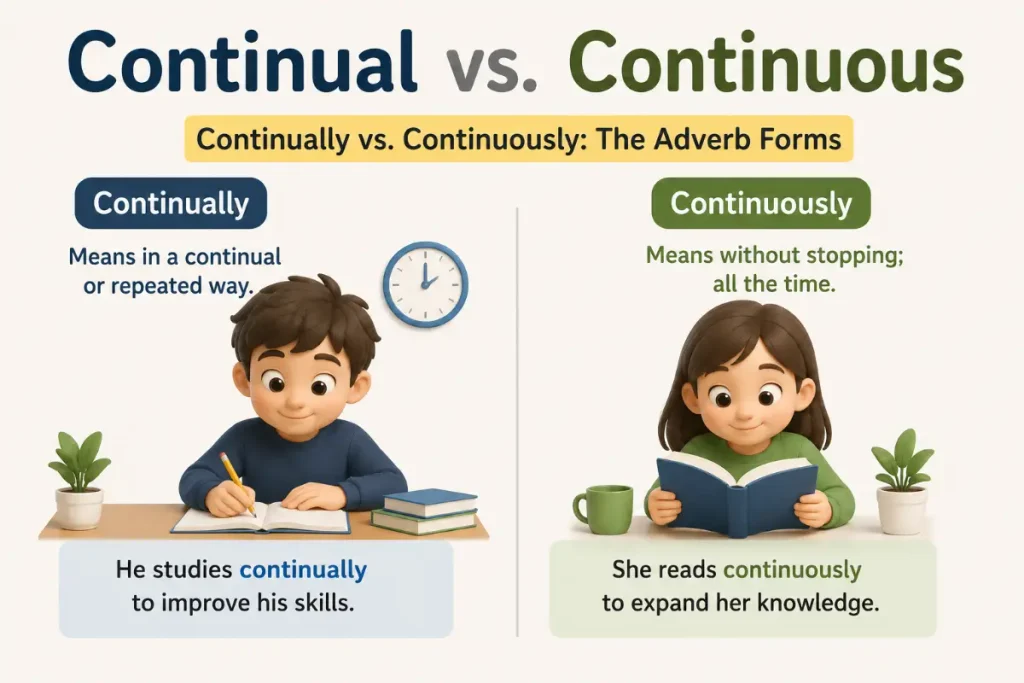
Continually vs Continuously: The Adverb Forms
Since these show up just as often as the adjective forms, they’re worth covering directly, and they follow the exact same logic.
- She continually checks her phone during meetings. (repeatedly, with pauses)
- The machine ran continuously for twelve hours without stopping. (one unbroken stretch)
- He continually apologized throughout the conversation. (repeated instances)
- Water flowed continuously from the broken pipe. (unbroken flow)
The same faucet-versus-river test applies here without any adjustment — just swap in the adverb form of whichever image fits your sentence.
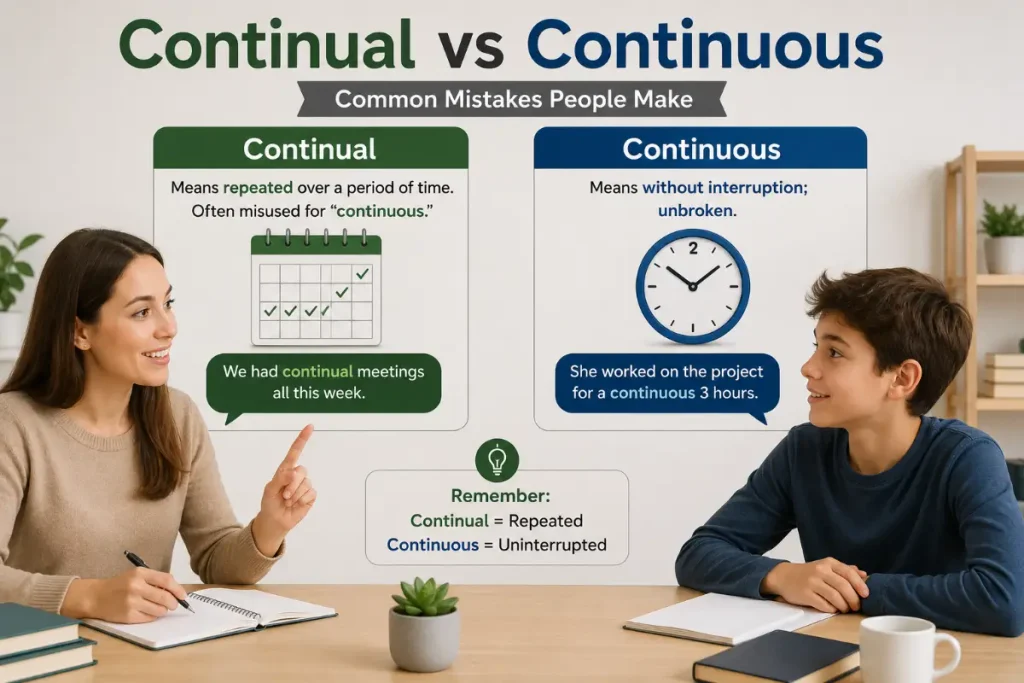
Common Mistakes People Make
Mistake 1: “The machine ran continually for twelve hours without a single stop.” Should be “continuously” — the phrase “without a single stop” explicitly describes an unbroken stretch, which is exactly continuous’s territory.
Mistake 2: “I’ve had continuous problems with my neighbor’s dog barking.” In careful usage, this should be “continual problems” — barking that happens repeatedly, with gaps of silence in between, fits the recurring sense of continual more precisely than continuous.
Mistake 3: “The river flows continually through the valley.” Should be “flows continuously” — a river’s flow is a classic example of an unbroken, uninterrupted process, which calls for continuous, not the recurring sense of continual.
For another useful perspective, check out Elicit vs Illicit: Same Sound, Completely Unrelated Meanings (2026).
Mistake 4: “Her continuous complaints wore everyone down.” Should generally be “continual complaints” — complaints, by nature, happen as distinct, separate instances with gaps between them, which fits continual more precisely than continuous.
Mistake 5: Assuming these words are always used with strict precision, even by professional writers. Merriam-Webster’s own usage notes acknowledge that even careful writers sometimes use continuous where continual would be more precise, and vice versa, given how tangled the historical usage has been. Getting this exactly right is worth aiming for, but it’s also one of the pairs where reasonable, careful writers sometimes land in slightly different places.
More Examples to Lock It In
- The continual buzzing of her phone interrupted the continuous flow of the meeting.
- Despite continual setbacks, the team maintained continuous progress toward the deadline.
- The continuous hum of traffic outside was less bothersome than the continual honking.
- He experienced continual pain that flared up throughout the day, unlike the continuous ache he’d had after the surgery.
- The company’s continual policy changes disrupted what had been a continuous workflow for years.
Practice Exercise
Fill in the blank with either “continual” or “continuous” (or their adverb forms). Answers are listed right after — try each one before checking.
- The ______ dripping of the faucet kept everyone awake.
- The factory operates on a ______ production line.
- Her ______ questions showed real curiosity about the topic.
- Water flowed ______ from the broken pipe for hours.
- We’ve had ______ technical issues with the software this week.
- The patient remained under ______ monitoring overnight.
- His ______ interruptions made the meeting drag on.
- The river runs ______ through the entire valley.
- The company has faced ______ leadership changes over the past year.
- She kept up a ______ stream of chatter during the drive.
- The alarm sounded ______ until someone silenced it.
- Their ______ arguments finally led to a serious conversation.
- The machine ran ______ for eighteen hours without stopping.
- The neighbor’s ______ complaints started to feel excessive.
- A ______ hum came from the old refrigerator.
- The team made ______ progress, hitting milestones every week.
- The signal transmitted ______ throughout the entire test.
- His ______ lateness eventually became a serious issue.
- The wound required ______ pressure to stop the bleeding.
- Despite ______ setbacks, they never gave up on the project.
Answer Key
- continual
- continuous
- continual
- continuously
- continual
- continuous
- continual
- continuously
- continual
- continuous
- continuously
- continual
- continuously
- continual
- continuous
- continual
- continuously
- continual
- continuous
- continual
If you got sixteen or more correct, the faucet/river distinction has already become instinct. For any you missed, picture the image again: repeated drips with gaps (continual), or one unbroken flow (continuous)?
A Closer Look at Where This Distinction Matters Most
Since continual and continuous show up across such different fields, it’s worth knowing where getting the distinction precisely right actually changes meaning, versus where it’s more of a stylistic nicety.
In medical and technical writing, the distinction genuinely matters for clarity. “Continuous monitoring” (an unbroken stream of data) is a meaningfully different clinical situation than “continual monitoring” (checking repeatedly at intervals) — a patient on continuous cardiac monitoring is being watched without any gaps, while continual monitoring might mean vitals are checked every hour. Mixing these up in medical documentation could genuinely misrepresent the level of care being described.
In legal and contractual writing, precision matters similarly — a “continuous obligation” implies an unbroken, ongoing duty, while a “continual obligation” might imply a recurring one with defined intervals, a distinction that can carry real weight in how a contract is interpreted.
The two words are used more loosely, and readers rarely notice or care about the distinction unless it’s flagrantly wrong (like describing a river as flowing “continually” rather than “continuously”) in everyday and casual writing.
In manufacturing and business process writing, established phrases like “continuous improvement” and “continuous integration” (in software development) have become fixed industry terms, used consistently even though the actual processes they describe often happen in discrete stages rather than one truly unbroken stretch — this is a case where convention has settled the word choice regardless of the strict technical definition.
Frequently Asked Questions
Is it true that “continual” used to mean the same thing as “continuous”?
Yes — Merriam-Webster confirms continual is the older word and was used with both the “recurring” and “uninterrupted” meanings for centuries before continuous entered the language and gradually took over the “uninterrupted” sense specifically. The modern, cleaner distinction between the two is a relatively recent convention, even though it’s now the standard most careful writers follow.
Which word should I use for “continuous improvement” in a business context?
“Continuous improvement” is the established, standard business term (borrowed from manufacturing methodology), even though the actual process it describes often happens in distinct stages or cycles rather than one truly unbroken stretch. This is a case where the fixed phrase has become standard through convention, regardless of how strictly it matches the technical definition.
Is there a simple visual trick to remember the difference?
Yes — picture a leaky faucet (continual: repeated drips with pauses) versus a flowing river (continuous: one unbroken current). This single image resolves the vast majority of continual/continuous decisions without needing to consult a rule.
Do continually and continuously follow the exact same logic as continual and continuous?
Yes — the adverb forms follow identically: continually describes repeated action with gaps, continuously describes unbroken, uninterrupted action. The same faucet-versus-river test applies to both pairs equally.
What’s the fastest way to catch this error before publishing something?
For each instance of continual/continually or continuous/continuously, ask whether what you’re describing has gaps or pauses (continual) or runs in one unbroken stretch (continuous). Since spell-check won’t catch a wrong-but-valid word, and even careful writers sometimes disagree at the margins, this is one pair worth a deliberate second look during proofreading.
Before moving on, you may also want to read Good vs Well: Why “I Feel Good” Isn’t Actually Wrong in 2026 for more helpful grammar tips.
The Bottom Line
Continual describes something recurring, with breaks in between — the leaky faucet. Continuous describes something unbroken and uninterrupted — the flowing river. The modern distinction is more recent than most grammar guides let on, but it’s the standard careful writers follow today, and the faucet-versus-river image is the fastest way to keep it straight.
Once you understand Continual vs continuous, the distinction becomes much easier to spot in everyday writing. Think of continual as something that keeps happening again and again, while continuous refers to something that carries on without stopping. Keep that simple difference in mind, and you’ll be less likely to mix them up.