If you’ve ever typed “affect vs effect” and then stared at it wondering if it should actually be one or the other, you’re not alone. These two words trip up native English speakers just as often as learners—sometimes more, because we’re moving too fast to stop and think about the difference.
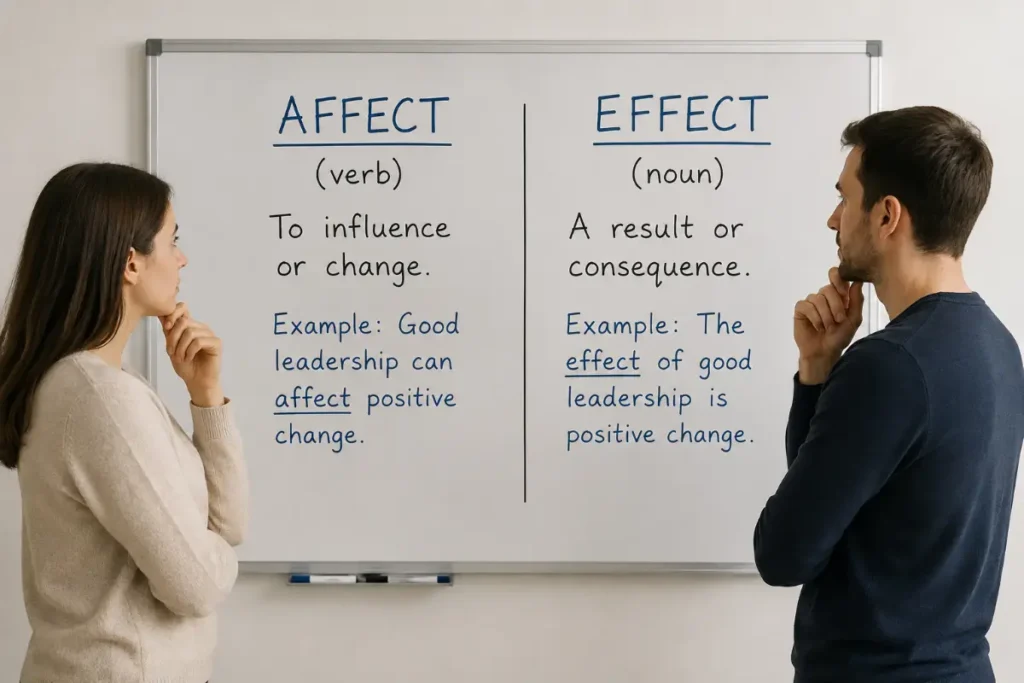
Here’s the short answer: affect is usually a verb, effect is usually a noun. “Affect” means to influence something. “Effect” means the result of that influence.
That one sentence solves about 90% of cases. But there are exceptions, and this guide walks through every version you’re likely to run into — plus a trick that makes the decision automatic once it clicks.
You may also find Accept vs Except: The Two Sounds That Cause Nonstop Confusion helpful if you want to explore this topic further.
The Quick Answer
- Affect (verb) = to influence, to change, to have an impact on something
- The weather can affect your mood.
- Effect (noun) = the result of a change, the outcome
- The weather had a strange effect on my mood.
If you can swap in the word “influence” and the sentence still makes sense, use affect. If you can swap in the word “result,” use effect.
Try it: “The new policy will ___ our schedule.” Swap in “influence” — “The new policy will influence our schedule.” That works, so it’s affect.
Now try: “The new policy had a big ___ on our schedule.” Swap in “result” — that doesn’t quite fit grammatically, but “the result on our schedule” gestures at the right meaning, so it’s effect.
Why This Mix-Up Happens So Often
Part of the problem is that the words sound almost identical when spoken. “Affect” and “effect” differ by one vowel sound that a lot of American English speakers barely distinguish in casual conversation. Add to that the fact that both words deal with cause and consequence, and it’s easy to see why your brain treats them as interchangeable even though they’re not.
It’s the same reason their, there, and they’re trip people up so often — sound-alike words are just easier to mix up under time pressure, no matter how well you actually know the rule.
The other issue is that English loves exceptions, and this pair has a few genuine ones. So even people who know the “affect is a verb” rule get thrown off when they hit a sentence where effect is a verb, or affect is a noun. We’ll cover those below, because pretending they don’t exist doesn’t help you when you actually run into one.
Affect as a Verb (The Common Case)
In everyday writing, affect is almost always doing the job of a verb — describing an action, specifically the action of influencing or changing something.
Examples:
- Lack of sleep can affect your ability to concentrate.
- The medication may affect your appetite.
- Her decision affected everyone on the team.
- Loud noise affects wildlife in unexpected ways.
- Interest rate hikes affect the housing market.
In each case, you could replace “affect” with “influence” or “change” and the sentence would still hold together. That’s the test.
Effect as a Noun (The Common Case)
Effect, meanwhile, is almost always the thing that happened because of something else. It’s the outcome, the consequence, the result.
Examples:
- The medication had a strange effect on his stomach.
- We’re still feeling the effects of the storm.
- One effect of the new law was a spike in applications.
- The special effects in that movie were impressive.
- Her speech had a powerful effect on the audience.
Notice the pattern: effect usually shows up after words like “the,” “an,” “a,” or “some” — the telltale signs of a noun. “The effect,” “a strange effect,” “some effects.” If you see an article sitting right in front of the word, it’s very likely effect.
The Exceptions (Where It Gets Tricky)
When Affect Is a Noun
In psychology and psychiatry, “affect” is used as a noun to describe someone’s outward emotional expression — the facial expressions, tone, and body language that show what someone is feeling.
- The patient displayed a flat affect during the interview.
- Her affect seemed unusually cheerful given the circumstances.
You’ll mostly encounter this in clinical or academic writing. Outside of psychology, treating affect as a noun is rare enough that you can generally ignore this exception — unless you work in mental health, medicine, or a related field.
When Effect Is a Verb
Effect can act as a verb, but it means something more specific than “affect.” To “effect” something means to bring it about, to cause it to happen — usually used with big, deliberate, structural changes.
- The new CEO effected sweeping changes to company policy.
- Protesters hoped to effect real political change.
- The board voted to effect the merger by year’s end.
Here’s the distinction that matters: “affect change” means to influence change that’s already in motion. “Effect change” means to actually cause the change to happen. They’re close in meaning but not identical, and in formal writing — legal documents, policy papers, corporate announcements — using “effect” correctly in this sense signals precision.
Most people will never need to use effect as a verb. If you’re writing a casual email or a blog post, you’re safe sticking with “affect” as your verb and “effect” as your noun about 95% of the time.

A Trick That Actually Works: RAVEN
If the swap-test (influence vs. result) doesn’t stick for you, try the acronym RAVEN:
Remember Affect Verb, Effect Noun
Some people prefer a slightly different version: think of “A” for Action (Affect = Action, both start with A). Whatever mental hook works for you, the goal is the same — build a fast, automatic association so you’re not stopping to think mid-sentence.
Another trick some writers use: “The Arrow Affects” (verb, action) and “End Effect” (noun, ending result). Alliteration sticks in memory better than rules do, which is exactly why this pair is so commonly taught with tricks instead of grammar terminology.
For another useful perspective, check out Among vs Between: 5 Common Mistakes to Avoid in 2026.
Affect vs. Effect: Side-by-Side Comparison
| Affect | Effect | |
|---|---|---|
| Most common part of speech | Verb | Noun |
| Meaning | To influence or change something | The result of a change |
| Example | Stress can affect your sleep. | Stress has a real effect on sleep. |
| Less common usage | Noun (psychology term for emotional expression) | Verb (to bring about, to cause) |
| Quick test | Can you swap in “influence”? | Can you swap in “result”? |
| Typically follows | A subject + verb structure | An article (a, an, the, some) |
Common Mistakes People Make
Mistake 1: “The new manager will effect the whole department.” This should be “affect the whole department” unless the manager is literally causing a deliberate, structural change to happen (in which case “effect” works, but it reads oddly in casual writing). In everyday use, stick with affect here.
Mistake 2: “I can’t believe the affect this had on her.” This should be “effect” — you’re talking about the result of something, and “the” in front of it is your clue.
Mistake 3: Using “affects” as a plural noun meaning “results.” “The affects of climate change” should be “the effects of climate change.” This is one of the most common errors in professional and academic writing, and spell-check often won’t catch it because “affects” is a real word — just the wrong one here.
Mistake 4: Overcorrecting into “effect” as a verb when “affect” is right. Once people learn that effect can be a verb, they sometimes start using it everywhere, which actually creates new errors. Remember: “effect” as a verb specifically means to cause something to happen, not just to influence it. “The rain effected my mood” is wrong — rain doesn’t cause your mood to exist, it influences the mood you already have. That’s “affect.”
How to Check Yourself Fast
Before you hit publish or send, run this two-second check on any sentence with affect or effect in it:
- Does the word come right after “the,” “an,” “a,” or “some”? → It’s probably effect.
- Is the word describing something happening to something else, acting like a verb? → It’s probably affect.
- Still unsure? Try swapping in “influence” (affect) or “result” (effect) and see which one makes sense.
If you’re writing something formal — a report, a resume, a published article — and you land on one of the rare exception cases (effect as a verb, affect as a noun), it’s worth a second look before you commit to it, since those uses are easy to get slightly wrong even when you know the rule exists.
Affect vs Effect Across Different Writing Contexts
The rule stays the same everywhere, but the stakes for getting it right change depending on what you’re writing.
In casual writing — texts, social posts, personal emails — nobody’s going to call you out for a slip. But small errors like “affects” where you meant “effects” do register subconsciously with readers, even ones who couldn’t explain the grammar rule themselves. It’s the kind of mistake that makes writing feel slightly less polished without anyone being able to say exactly why.
In academic writing, this pair shows up constantly in research and social science papers, since so much of that writing is about cause and consequence. “The independent variable affected the outcome” and “the effect size was statistically significant” are both extremely common sentence patterns. Professors and peer reviewers notice this error more than almost any other, partly because getting it wrong can genuinely confuse the meaning of a results section.
In business and professional writing, this is one of the errors that quietly undermines credibility. A report that says “the affects of the new policy” instead of “the effects of the new policy” doesn’t just look sloppy — it can make a reader wonder what else in the document wasn’t proofread carefully. This is especially true in resumes, cover letters, and client-facing documents, where a single grammar slip can outweigh strong content in a reader’s snap judgment.
In journalism and content writing, precision matters because “affect” and “effect” often appear in headlines, where there’s no room for a sentence-level fix. “How Inflation Affects Your Grocery Bill” reads correctly and clearly; “How Inflation Effects Your Grocery Bill” would confuse readers or make the headline look like a typo before they even click.
Across all of these contexts, the underlying rule doesn’t change — it’s still verb versus noun, influence versus result. What changes is how much a mistake costs you in a reader’s eyes, and that’s exactly why it’s worth getting automatic at this instead of pausing to think every time.
Real-World Examples From Everyday Writing
To make this stick, here are a few longer, natural sentences the way you’d actually encounter them:
- Social media use has been shown to affect attention span in teenagers, and researchers are still studying the long-term effects.
- The company’s decision to cut prices had an immediate effect on sales, though it’s unclear how it will affect profits over time.
- Doctors warned that the drug could affect blood pressure, and patients reported side effects within the first week.
- Nobody expected the merger to affect so many jobs, but the ripple effects reached departments that weren’t directly involved.
Notice how both words often show up in the same sentence — that’s actually common, because “affect” describes the action while “effect” names what resulted from it. Once you see them working together like this, the distinction becomes a lot more intuitive.
What the Style Guides Say
This isn’t just a rule of thumb — it’s backed consistently across the major English-language references. Merriam-Webster defines “affect” primarily as a verb meaning “to produce an effect upon,” and lists “effect” primarily as a noun meaning “something that inevitably follows an antecedent.” The AP Stylebook, which most U.S. newsrooms follow, gives the same guidance journalists are trained on: affect is a verb, effect is usually a noun, and effect as a verb specifically means “to bring about.” The Chicago Manual of Style, the standard reference for U.S. book publishing and academic writing, draws the identical distinction in its Glossary of Problematic Words and Phrases.
The reason all three agree isn’t coincidence — it reflects genuinely settled usage, not a debated or evolving point of grammar. Unlike some rules that shift between style guides (the serial comma, for instance), affect versus effect is one of the more stable, universally agreed-upon distinctions in English usage.
More Examples to Lock It In
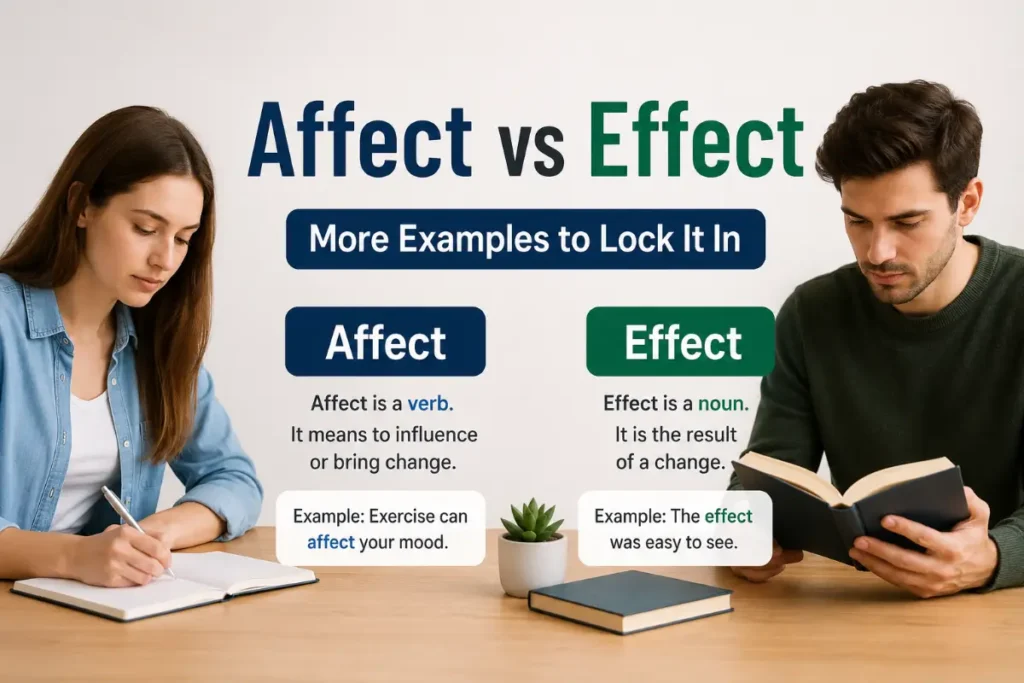
Sometimes the fastest way to internalize a rule isn’t more explanation — it’s just seeing enough correct examples that your ear starts to recognize the pattern on its own. Here’s a longer batch, mixing both words the way you’d actually encounter them in daily writing, work emails, and casual conversation.
- Caffeine can affect your sleep quality, even if you drink it early in the day.
- The bridge closure had a noticeable effect on morning traffic.
- Her tone of voice affected how the whole room reacted to the news.
- Scientists are studying the long-term effects of screen time on attention span.
- A small change in interest rates can affect the entire housing market.
- The special effects team spent months on that one scene.
- Smoking affects nearly every organ in the body.
- One unexpected effect of the policy was a drop in enrollment.
- Loud construction noise affects concentration far more than people realize.
- The drug’s side effect was mild drowsiness.
- Her leadership style affected morale across the department.
- The economic downturn had ripple effects that lasted years.
- Poor sleep affects memory, mood, and decision-making all at once.
- The new lighting had a calming effect on the waiting room.
- Changes in diet can affect energy levels within just a few days.
Read through that list once out loud. Notice how “affect” always slots in right where an action word belongs, and “effect” always shows up as the thing being described — the result, the outcome, the noun sitting there doing noun things. That rhythm is exactly what you’re training your ear to catch.
Practice Exercise
Fill in the blank with either “affect” or “effect.” Answers are listed right after, so resist the urge to peek until you’ve made your best guess on each one.
- The medication may ______ your appetite for the first few days.
- Nobody could predict the ______ the announcement would have on the stock price.
- Bright light can ______ how well you sleep at night.
- The teacher’s encouragement had a lasting ______ on the students.
- Rising fuel costs continue to ______ shipping prices nationwide.
- One surprising ______ of remote work was a rise in productivity for some employees.
- Loud music can ______ your ability to focus while studying.
- The company’s rebrand had a positive ______ on customer trust.
- Stress tends to ______ both physical and mental health over time.
- Doctors are still researching the long-term ______s of the new treatment.
- The board voted to ______ major changes to the budget by year’s end.
- A poor night’s sleep can noticeably ______ your mood the next day.
- The drought had a devastating ______ on local farmers.
- Social media use continues to ______ how teenagers communicate.
- The ______s of the earthquake were felt for miles.
- Her calm demeanor seemed to ______ the entire room.
- Economists are studying the ______ of tariffs on consumer prices.
- The new manager hopes to ______ real change in team culture this quarter.
- Secondhand smoke can ______ people who don’t smoke at all.
- The film’s special ______s took nearly a year to complete.
Answer Key
- affect
- effect
- affect
- effect
- affect
- effect
- affect
- effect
- affect
- effects
- effect (verb form, meaning “to bring about”)
- affect
- effect
- affect
- effects
- affect
- effect
- effect (verb form, meaning “to cause to happen”)
- affect
- effects
If you got sixteen or more correct, the swap test has probably already become instinct. Numbers 11 and 18 are the trickier verb-form use of “effect” — if those two threw you off, that’s completely normal, since that usage is genuinely rarer and worth a second look even for confident writers.
Frequently Asked Questions
Is it “take effect” or “take affect”?
It’s “take effect.” This phrase means a rule, law, or agreement starts being active — “The new policy takes effect on Monday.” Because effect here is a noun (the state of being active), affect would be incorrect.
Is it “in effect” or “in affect”? “
In effect” is correct. It means something is currently active or, in another sense, essentially true (“The rule is in effect” or “In effect, this means we’re starting over”).
What about “side effects” vs. “side affects”?
Always “side effects.” This refers to the secondary results of a medication or treatment, so it’s a noun phrase — effect is correct.
Is “personal effects” a real phrase, and why is it spelled that way?
Yes — “personal effects” refers to someone’s belongings, especially in a legal or formal context (“The officer collected the victim’s personal effects”). This is an older use of effect as a noun meaning “possessions” or “things brought about,” and it’s always effect, never affect.
Can I just avoid the problem by using different words?
Sometimes, yes — “impact” or “influence” can replace affect, and “result” or “outcome” can replace effect. This isn’t cheating; professional editors do this all the time when a sentence is at risk of being misread. But it’s worth learning the actual rule too, since affect and effect are so common that avoiding them entirely isn’t always practical.
Before moving on, you may also want to read Principal vs Principle: The “Pal” Trick That Actually Works (2026) for more helpful grammar tips.
The Bottom Line
Affect is almost always the verb — the action of changing or influencing something. Effect is almost always the noun — the result of that change. The exceptions exist, but they’re rare enough that you can treat them as special cases rather than the rule.
If you take one thing from this guide, make it the swap test: influence for affect, result for effect. Say the sentence both ways in your head, and the right word usually announces itself.