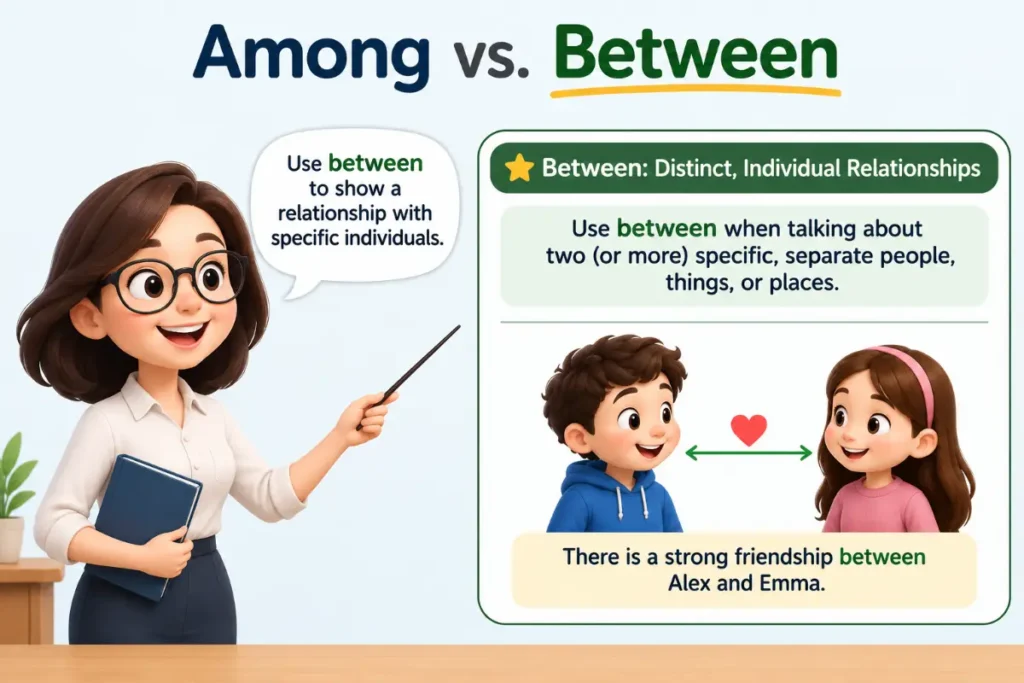
Chances are you were taught a clean rule in school: among vs between means between is for two things and among is for three or more. It’s a useful starting point—but it’s also an oversimplification of how these words actually work in English.
Between is used for distinct, individual relationships — even among more than two things. Among is used for things considered collectively, as part of a group. The real distinction isn’t about counting; it’s about whether you’re treating things individually or as a mass.
You may also find Lay vs Lie: The Verb Pair That’s Confused English Speakers In 2026 helpful if you want to explore this topic further.
The Quick Answer
- Between = distinct, individual relationships (regardless of number)
- The negotiations were between the three department heads.
- Among = part of a collective group, not individually distinguished
- She felt at home among her new colleagues.
The test: are you describing specific, distinct relationships between individual things, even if there are more than two? Use between. Are you describing something as part of an undifferentiated group or collective? Use among.
Try it: “She had to choose ___ three job offers.” Are the offers being considered individually, one against another? Yes — so it’s between: “She had to choose between three job offers.”
Now try: “He felt comfortable ___ strangers.” Is this about individual relationships, or blending into a group? Blending into a group — so it’s among: “He felt comfortable among strangers.”
The Rule Everyone Was Taught (and Why It’s Incomplete)
Merriam-Webster is direct about this: the “between is for two, among is for more than two” rule is what most usage guides will tell you, but “a more accurate rule is to use between when you want to talk about the relationship of distinct and usually equal entities… and use among when referring to things collectively or as a group.” Number genuinely isn’t the deciding factor — the deciding factor is whether you’re treating the items as individually distinct or as a lump collective.
This matters because “between the three finalists” is completely standard, correct English, even though it technically involves more than two items. Merriam-Webster’s usage guide on “between” goes even further, calling the two-items-only rule “a persistent but unfounded notion,” and noting that between has been used correctly with more than two items since Old English — this isn’t a recent loosening of the rule, it’s how the word has always worked.
Between: Distinct, Individual Relationships
Examples with exactly two items (the uncontroversial case):
- The choice is between coffee and tea.
- There’s a strong bond between the two sisters.
- He sat between his mother and his father.
Examples with more than two items, where between is still correct because each relationship is distinct:
- Negotiations between the five countries lasted for weeks. (each country has an individual relationship with the others)
- She had to choose between Harvard, Brown, and Yale. (three distinct, individually weighed options)
- The rivalry between the three tech giants continues to shape the industry. (each company relates individually to the others)
- There’s very little difference between the three finalists’ proposals.
Notice the pattern: in every one of these, you could meaningfully compare any two of the items to each other individually. That one-to-one comparability is the real signal for “between,” regardless of the total count.
Among: Part of a Collective Group
Examples where things are being treated as a mass or group, not individually distinguished:
- The prize money was divided among the team members.
- She felt a sense of belonging among her new coworkers.
- The tradition is popular among young professionals.
- He wandered among the market stalls, taking in the sights.
- There’s a growing concern among parents about screen time.
In each of these, the items or people involved aren’t being compared one-to-one — they’re being treated as a group, a collective, or a surrounding mass. You wouldn’t naturally rephrase “the prize was divided among the team” as “the prize was divided between team member A and team member B and team member C individually” — the money is being spread across the group as a whole, not distributed through individual, distinct relationships.
The Fastest Way to Check Yourself
Step 1: Could you meaningfully compare any two of the items to each other, one-on-one? If yes, lean toward between, even with three or more items.
Step 2: Are the items being treated as a single collective mass or group, rather than individually distinguished? If yes, use among.
Step 3: If you’re genuinely unsure, ask whether “distribution across a group” or “individual relationships” better describes what you mean. Distribution across a group points to among; individual relationships point to between.
A useful reframe from Merriam-Webster’s own etymology: “among” originally meant something closer to “in a crowd” or “mixed in with,” while “between” relates historically to the word for “two” and carries a sense of distinct, paired relationships even when extended beyond two items. If you’re picturing a crowd or a mixture, reach for among. If you’re picturing distinct points being connected or compared, reach for between.
Much like farther and further, this is a case where the “rule” most people were taught in school turns out to be a simplified shortcut rather than the actual, full story — and knowing the real distinction gives you more confidence in edge cases than memorizing a shortcut ever could.
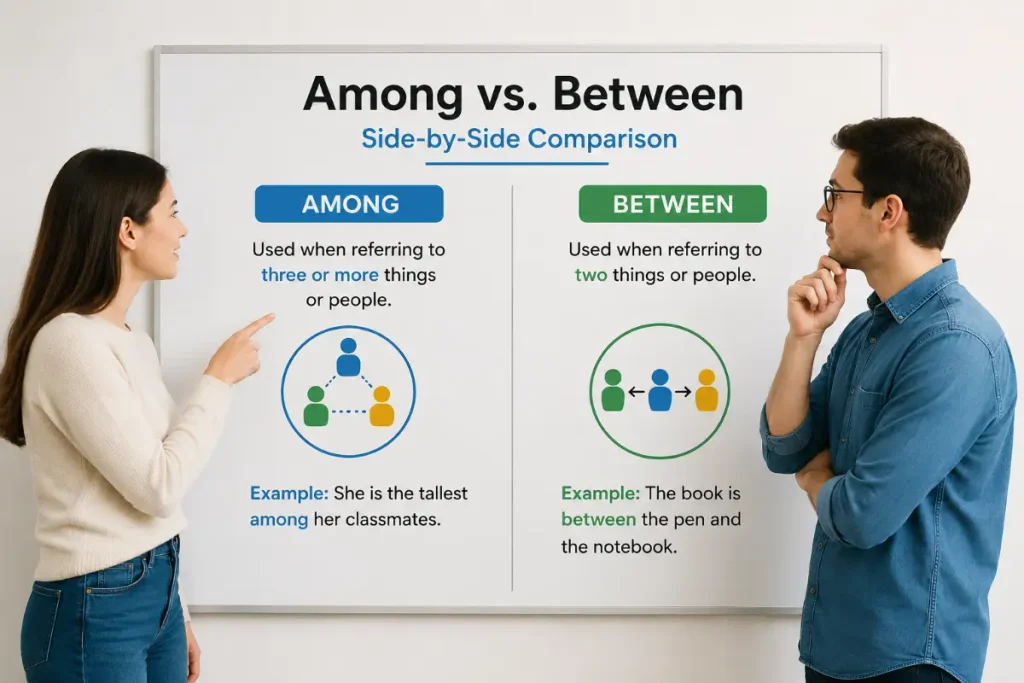
Among vs. Between: Side-by-Side Comparison
Understanding among vs between becomes much easier when you compare how each word works in a sentence. Between usually connects two people, places, or things, while among is commonly used for three or more. The comparison below shows their key differences with clear examples.
| Between | Among | |
|---|---|---|
| Core idea | Distinct, individual relationships | Collective, undifferentiated group |
| Works with two items | Yes, always | Rare — needs three or more |
| Works with three or more | Yes, if relationships are distinct | Yes, typically |
| Example | choose between three colleges | popular among students |
| Historical root | Related to “two” (Old English twā) | Related to “in a crowd” (Old English gemong) |
| Emphasis | Individual comparison | Collective distribution |
Common Mistakes People Make
Mistake 1: “The award was shared between all five team members.” While not strictly wrong under the historical rule, “shared among all five team members” is generally the more natural choice here, since the sharing describes distribution across a group rather than distinct, individually compared relationships.
Mistake 2: “She felt out of place between the other guests.” Should be “among the other guests” — this is about being surrounded by or part of a group, not a distinct, individual relationship with each guest.
Mistake 3: Assuming “between the three of us” is automatically wrong because there are three items. This is actually fine, and often the more natural phrasing, when the three items or people have a genuinely distinct, individual relationship with each other — “just between the three of us” (implying a shared confidence) is standard, correct usage.
Mistake 4: “The tension among John and his brother was obvious.” Should be “between John and his brother” — this describes a distinct, individual relationship between exactly two specific people, which is squarely between’s territory.
Mistake 5: Overcorrecting every “between” with three-plus items to “among.” Since the real rule is about individual versus collective relationships (not counting), automatically swapping “between” for “among” any time you spot three or more items actually introduces errors rather than fixing them — “the differences between the three proposals” is correct as written.
For another useful perspective, check out Stationary vs Stationery: The Simple Trick That Never Fails.
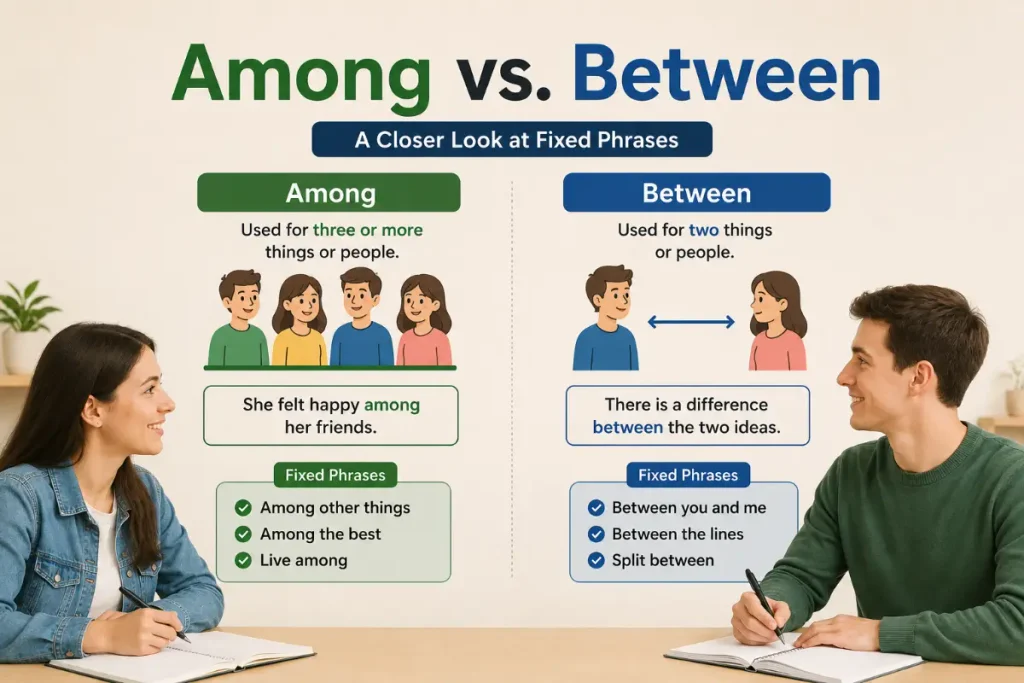
A Closer Look at Fixed Phrases Using Between and Among
Both words appear in a number of set phrases and idioms that are worth knowing individually, since they don’t always announce their logic as obviously as a fresh, original sentence would.
“Between you and me” — a fixed phrase for sharing something in confidence, always using between regardless of how many people are technically part of the conversation being described.
“Just between us” — similarly fixed, implying a private, individual understanding shared by the specific people involved.
“Between a rock and a hard place” — an idiom describing a difficult choice between two bad options, always between, never among.
“Among other things” — a common phrase meaning “as one item within a larger, unspecified group,” always among, since it explicitly refers to an undifferentiated collection.
“Among friends” — describing a comfortable, informal social setting, emphasizing belonging to a group rather than any individual relationship.
“Falling between the cracks” — describing something overlooked in a system or process, using between to suggest a specific, narrow gap rather than a broad collective space.
Recognizing these as fixed expressions — rather than sentences you’re constructing fresh each time — can help you avoid “correcting” them incorrectly, since idioms sometimes preserve older or more specific usage patterns than the general rule might suggest on its own.
More Examples to Lock It In
- The rivalry between the three siblings never faded, even as they grew comfortable among their own separate friend groups.
- There’s a clear divide between the two political parties, but a surprising amount of agreement among voters on this specific issue.
- Negotiations between the company and its four regional partners dragged on for months.
- She distributed the flyers among the crowd, hoping word would spread between the various community groups.
- The decision between the two finalists came down to a coin toss, since the judges felt no clear standout among the full pool of candidates.
Frequently Asked Questions
Is “between the three of us” actually correct, or is it a common mistake?
It’s correct — and has been standard usage since Old English. Between applies to distinct, individual relationships regardless of how many items are involved, so “between the three of us” is fine as long as you’re describing a distinct relationship shared by those three specific people, rather than a general collective grouping.
Where did the “between is only for two” rule come from, if it’s not actually accurate?
It traces back to usage commentators, including Samuel Johnson in 1755, who framed it as a general tendency rather than an absolute law. Over time, that soft observation calcified into what many people now teach as a strict, unbreakable rule — even though Merriam-Webster notes considerable historical evidence of “between” being used correctly with more than two items throughout the history of English.
Is “amongst” the same as “among,” or is there a difference?
They mean exactly the same thing — “amongst” is simply a more old-fashioned, somewhat more formal-sounding variant of “among,” more common in British English and older writing. There’s no meaningful difference in usage; it’s purely a stylistic choice.
How can I tell if something should be shared “between” or “among” a group?
Ask whether the sharing involves distinct, one-to-one relationships (between) or a general distribution across an undifferentiated group (among). “Divided between the two heirs” treats them as distinct individuals; “divided among the heirs” treats the group collectively, which matters more once there are several heirs and no need to specify individual relationships.
What’s the safest default if I’m genuinely unsure which one to use?
If you’re picturing a crowd, a group, or a general spread across many things, among is the safer choice. If you’re picturing specific, comparable relationships — even if there are more than two — between is usually correct. When truly torn, among tends to sound more natural for larger, less individually distinguished groups.
Practice Exercise
Fill in the blank with either “between” or “among.” Answers are listed right after — try each one before checking.
- The prize was divided ______ the top three finishers.
- There’s a strong friendship ______ the two of them.
- She felt comfortable ______ her new classmates.
- The negotiations ______ the four countries continued for weeks.
- He wandered ______ the crowded market stalls.
- There’s little difference ______ the three proposals.
- The tradition remains popular ______ young professionals.
- Just ______ us, I think the plan will fail.
- The rivalry ______ the two companies intensified.
- She distributed the samples ______ the attendees.
- He had to choose ______ three excellent job offers.
- There’s growing concern ______ parents about screen time.
- The bond ______ the siblings never wavered.
- The responsibilities were split ______ the team members.
- There’s a clear difference ______ the two approaches.
- He felt like an outsider ______ the group.
- The decision came down to a choice ______ two finalists.
- The rumor spread quickly ______ the students.
- There’s ongoing tension ______ the three business partners.
- She sat quietly ______ the strangers at the conference.
Answer Key
- among
- between
- among
- between
- among
- between
- among
- between
- between
- among
- between
- among
- between
- among
- between
- among
- between
- among
- between
- among
If you got sixteen or more correct, you’ve internalized the real rule — individual relationships versus collective grouping — rather than the oversimplified “two versus more than two” version. For any you missed, ask again: distinct comparison, or general collective?
Before moving on, you may also want to read Principal vs Principle: The “Pal” Trick That Actually Works (2026) for more helpful grammar tips.
The Key Takeaways
Between is for distinct, individual relationships, even among more than two things. Among is for things treated collectively, as part of an undifferentiated group. The old “two versus more than two” rule isn’t the real rule — it never fully was — so trust the individual-versus-collective test over the number of items involved.
Understanding Among vs Between comes down to one simple idea: use between for distinct, individual relationships and among when things are treated as part of a group. Once you focus on that distinction rather than the number of items, choosing the right word becomes much easier.