These two little abbreviations show up constantly in professional writing, and I.e. vs E.g. get swapped so often that plenty of readers don’t even notice when a writer gets them wrong. Understanding the real distinction takes about two minutes, and it can make your writing noticeably more precise.
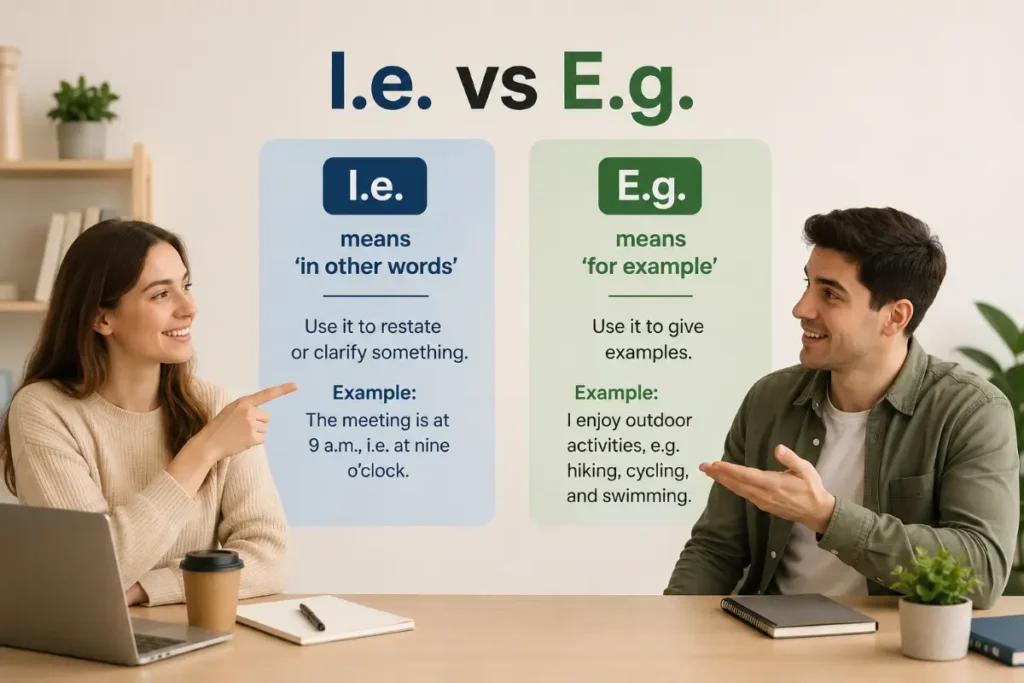
I.e. means “that is” — it restates or clarifies something you just said. E.g. means “for example” — it introduces one or more examples from a larger category. They are not interchangeable, even though they often show up in similar spots in a sentence.
You may also find Who’s vs Whose: 7 Easy Rules to Get It Right (2026 Guide) helpful if you want to explore this topic further.
The Quick Answer
- I.e. = “that is” (clarifies or restates)
- She’s a Hoosier, i.e., she’s from Indiana.
- E.g. = “for example” (introduces examples)
- She roots for the local teams, e.g., the Colts and the Pacers.
The test: try substituting the actual English phrase. If “that is” fits, use i.e. If “for example” fits, use e.g.
Try it: “Bring something warm to wear, ___, a jacket or sweater.” Substitute “for example” — “bring something warm to wear, for example, a jacket or sweater.” That works, and it’s clearly one option among several, so it’s e.g.
Now try: “We’ll meet at the usual spot, ___, the coffee shop on Main Street.” Substitute “that is” — “we’ll meet at the usual spot, that is, the coffee shop on Main Street.” That works, and it’s identifying the one specific place, not giving one example among many, so it’s i.e.
Why These Two Get Confused So Often
Both abbreviations are Latin, both are two letters followed by periods, both typically appear after a comma and are followed by another comma, and both tend to show up in the exact same sentence position — right after a statement, adding a bit more clarity. Visually and structurally, they’re nearly identical, which is exactly why writers default to whichever one they remember first, rather than actually checking which meaning the sentence calls for.
The actual distinction, though, is completely different in function. I.e. narrows and restates — it says “here’s precisely what I mean.” E.g. broadens with examples — it says “here are some instances, among possibly others.” Confusing them doesn’t just look sloppy; it can genuinely change what a sentence communicates, especially in instructions, legal writing, or technical documentation where the distinction between “this is exactly what I mean” and “here’s one example of what I mean” actually matters.
I.e.: Restating or Clarifying
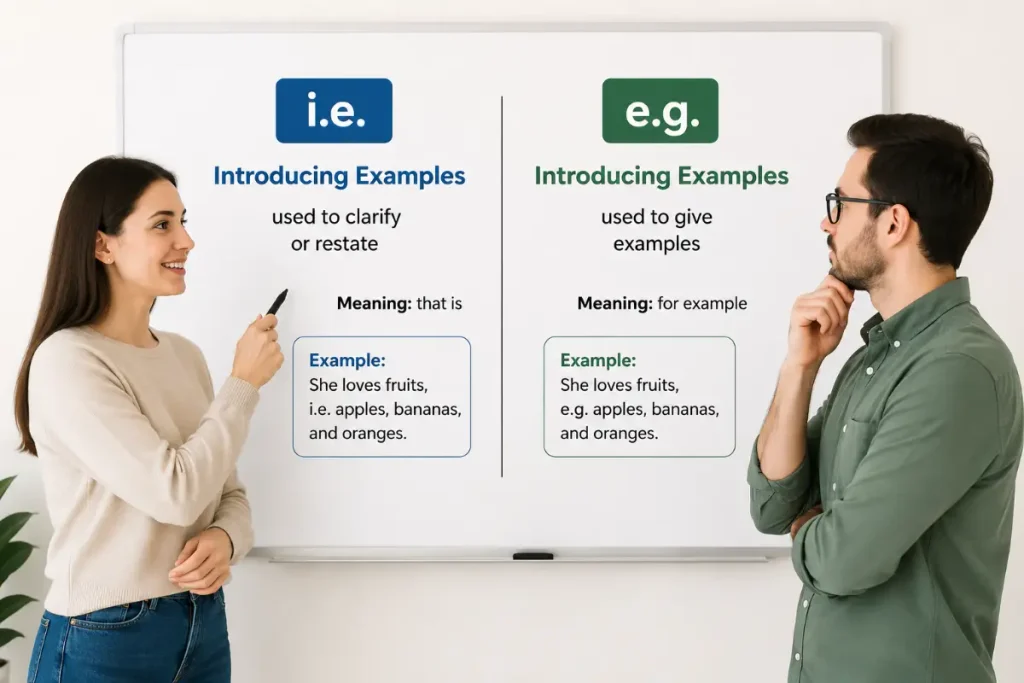
I.e. stands for the Latin “id est,” meaning “that is.” Use it when you’re rephrasing or precisely defining something you just referenced — not giving an example, but pinning down the exact meaning.
Examples:
- He works in the tech sector, i.e., software development.
- We need to cut costs, i.e., reduce staff and renegotiate contracts.
- The meeting is at the top of the hour, i.e., 3:00 p.m.
- She’s fluent in the Romance languages, i.e., Spanish, French, and Italian.
- Take the medication on an empty stomach, i.e., at least one hour before eating.
Notice that in each case, what follows i.e. is a complete, specific restatement — not a partial list of possibilities, but the actual, precise meaning of what came before.
E.g.: Introducing Examples
E.g. stands for the Latin “exempli gratia,” meaning “for example.” Use it when you’re offering one or more illustrative examples from a broader category, without implying that the list is complete or exhaustive.
Examples:
- She enjoys outdoor activities, e.g., hiking and kayaking.
- We import goods from several countries, e.g., France, Germany, and Japan.
- Bring a snack, e.g., fruit or granola bars.
- The recipe uses common herbs, e.g., basil, thyme, and rosemary.
- He’s interested in several subjects, e.g., history, physics, and economics.
In every case, what follows e.g. is a sample — a few representative items from what’s presumably a larger set. Swap in “she also enjoys plenty of other outdoor activities” and the sentence still logically holds, which wouldn’t be true of an i.e. sentence.
The Fastest Way to Check Yourself
Step 1: Are you restating or precisely defining something, or giving examples from a larger set? If you’re pinning down the exact meaning, it’s i.e. If you’re offering a sample, it’s e.g.
Step 2: Try the substitution test. Swap in “that is” for i.e. or “for example” for e.g., and see which phrase actually fits the sentence’s logic.
Step 3: Ask if there could be more items beyond what you listed. If yes — if your list is just a sample, not the complete picture — you want e.g. If no — if what follows is the entire, exact clarification — you want i.e.
A widely used memory trick: i.e. shares its first letter with “in other words,” and e.g. shares its first letter with “example.” That single-letter association is often enough to keep them straight under pressure.
This kind of “check what the abbreviation is actually doing in the sentence” approach is the same underlying skill that helps with who and whom — resisting the urge to default to whichever option feels more familiar, and instead pausing to check what the sentence structure actually calls for.
I.e. vs. E.g.: Side-by-Side Comparison
| I.e. | E.g. | |
|---|---|---|
| Latin origin | id est | exempli gratia |
| Means | “That is” | “For example” |
| Function | Restates or clarifies precisely | Introduces examples from a set |
| Implies completeness | Yes — this is the exact meaning | No — more examples could exist |
| Substitution test | “That is” | “For example” |
| Example | the capital, i.e., Washington, D.C. | capital cities, e.g., Paris and Tokyo |
Punctuation and Formatting Rules
Both abbreviations follow the same formatting conventions, which is worth covering since getting this part wrong is nearly as common as mixing up the meanings.
Comma placement. In standard American usage, both i.e. and e.g. are preceded by a comma (or set off with a dash or parentheses) and followed by a comma: “…the closest option, i.e., the one two blocks away, …” Some style guides are relaxing the comma-after rule slightly, but including it remains the safer, more traditional choice, especially in formal writing.
Periods after each letter. Both are written with a period after each letter — i.e. and e.g., not ie or eg. This is standard in American English; some non-American style guides drop the periods, but American publications almost universally keep them.
Capitalization. Neither is capitalized mid-sentence. At the start of a sentence, i.e. and e.g. are capitalized like any other word, though most style guides actually recommend restructuring the sentence to avoid starting with either abbreviation, since it tends to read awkwardly.
Italics. Because both are Latin abbreviations that have been fully absorbed into everyday English, neither needs to be italicized — treat them as ordinary English abbreviations, the same way you would “etc.” or “vs.”
For another useful perspective, check out Imply vs Infer: 7 Key Differences You Need to Know (2026).
Common Mistakes People Make
Mistake 1: “Bring comfortable shoes, i.e., sneakers or hiking boots.” This should be e.g. — sneakers and hiking boots are examples of comfortable shoes, not an exhaustive definition of the category. Using i.e. here incorrectly implies those are the only two acceptable options.
Mistake 2: “The deadline is next Friday, e.g., October 9th.” This should be i.e. — October 9th isn’t an example of a deadline, it’s the precise, specific date being clarified. There’s only one correct answer here, which is the signal for i.e., not e.g.
Mistake 3: Using i.e. and e.g. interchangeably without noticing. Because both often “sound fine” in the exact same sentence slot, many writers use whichever one comes to mind first, without checking whether they mean “that is” or “for example.” This is the single most common error with this pair, and running the substitution test catches it every time.
Mistake 4: Forgetting the periods or the comma. “Ie” and “eg” without periods, or missing the comma before and after, aren’t incorrect exactly, but they fall outside the standard American convention that most style guides and readers expect.
Mistake 5: Using e.g. when listing a genuinely complete, exhaustive list. If you’re listing literally every item in a category with no exceptions, i.e. is actually more accurate than e.g., since e.g. specifically implies the list is a sample, not the whole picture. “The primary colors, i.e., red, blue, and yellow” is more precise than using e.g. there, since there are exactly three primary colors, not just a few examples among many.
More Examples to Lock It In
- We need to focus on the core issue, i.e., customer retention, rather than getting distracted by smaller metrics, e.g., click-through rates or page views.
- The package includes several accessories, e.g., a charger and a case, and arrives on the promised date, i.e., within five business days.
- She specializes in one specific area, i.e., tax law, though she also handles related fields, e.g., estate planning and business formation.
- The report covers the last fiscal quarter, i.e., July through September, and highlights several key metrics, e.g., revenue growth and customer churn.
What the Style Guides Say
Merriam-Webster explains the distinction in exactly these terms — i.e. restates or clarifies, e.g. introduces examples — and specifically recommends the substitution trick (swap in “that is” or “for example” and see which one fits) as the fastest way to check yourself in the moment. The AP Stylebook and Chicago Manual of Style both maintain the same fundamental distinction, differing mainly on smaller formatting details like exactly how strictly to enforce the surrounding commas, but agreeing completely on the core i.e./e.g. meanings.
Because this is a functional distinction (what the abbreviation actually communicates) rather than a stylistic preference, every major English-language authority treats the i.e./e.g. difference the same way, with no real debate or gray area — unlike some of the other pairs on this site, where usage guides genuinely disagree.
I.e. and E.g. in Different Writing Contexts
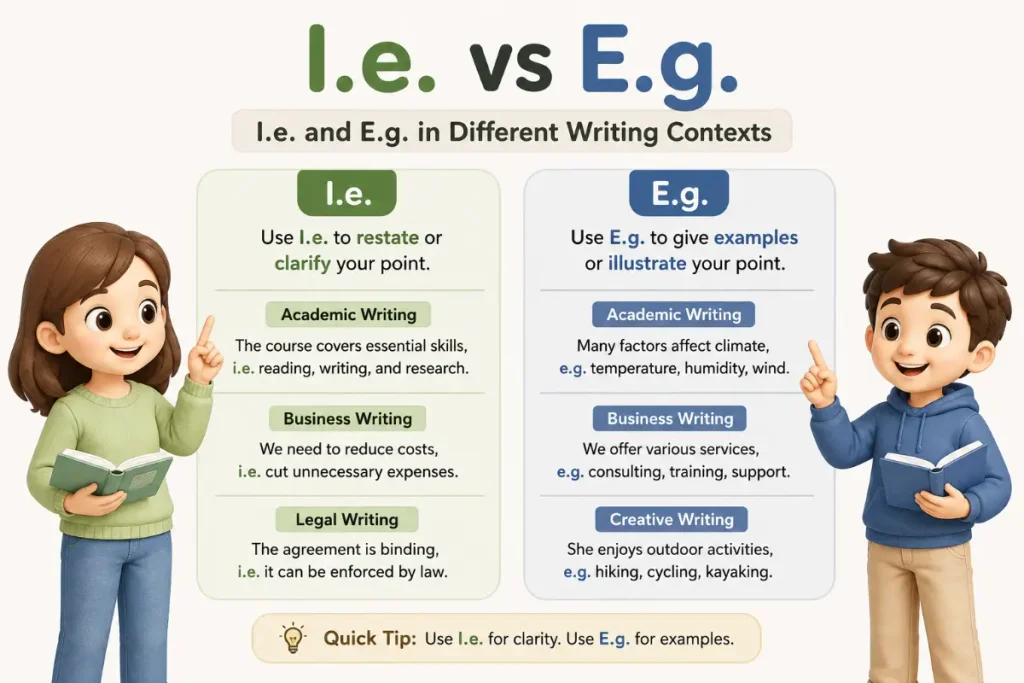
In casual writing, mixing these up rarely derails communication, since context often makes the intended meaning clear regardless of which abbreviation was technically correct — but it’s still one of the more noticeable errors to readers who know the distinction.
In technical, legal, and instructional writing, this distinction genuinely matters. “Submit the required documents, i.e., your passport and visa” tells the reader those two documents are the complete requirement. “Submit the required documents, e.g., your passport and visa” incorrectly suggests those are just examples, potentially leaving the reader unsure what else might be needed — a real, practical consequence of getting this wrong.
In academic writing, both abbreviations appear constantly in citations, footnotes, and parenthetical clarifications, and precision matters since misusing either one can subtly misrepresent whether a list is exhaustive or merely illustrative.
In business and professional writing, correct use of i.e. and e.g. is a small but real signal of careful, precise communication — the kind of detail that experienced editors and readers notice, even if only subconsciously.
Frequently Asked Questions
Can I just avoid using i.e. and e.g. altogether if I’m not confident?
Yes — writing out “that is” or “for example” in full is always a safe, correct alternative, and many style guides for less formal writing actually prefer the spelled-out phrase over the abbreviation anyway, since it’s unambiguous to every reader regardless of their familiarity with Latin abbreviations.
Is it “e.g.” or “eg” — do the periods actually matter?
In standard American English, yes — both letters get periods (e.g., not eg), following the convention for Latin abbreviations. Some international or informal style guides drop the periods, but American publications almost universally include them.
Do I need a comma after i.e. and e.g., or just before?
Standard American usage includes a comma both before and after: “…the closest branch, i.e., the one on Fifth Street, is closed today.” Some style guides are relaxing the comma-after requirement, but including it remains the more traditional, widely expected choice.
Is it wrong to start a sentence with “I.e.” or “E.g.”?
It’s not strictly wrong, and both are capitalized correctly at the start of a sentence, but most style guides recommend restructuring the sentence to avoid it, since starting with an abbreviation like this tends to read awkwardly in formal writing.
What’s the single fastest way to catch this error before publishing something?
Search your document for every instance of “i.e.” and “e.g.,” and for each one, try substituting the full English phrase (“that is” or “for example”). If the substituted sentence doesn’t logically make sense, you’ve used the wrong abbreviation — this test resolves nearly every case in seconds.
Practice Exercise
Fill in the blank with either “i.e.” or “e.g.” Answers are listed right after — try each one before checking.
- We need basic supplies, ______, paper and pens.
- The meeting starts at the top of the hour, ______, 9:00 a.m.
- She collects vintage items, ______, records and postcards.
- Please bring proof of residency, ______, a utility bill.
- He studies the natural sciences, ______, biology and chemistry.
- The deadline is the end of the month, ______, the 30th.
- We serve several cuisines, ______, Italian and Thai.
- The award goes to the top scorer, ______, the highest total.
- Pack layers for the trip, ______, a jacket and sweater.
- This applies to the primary applicant, ______, the person named on the form.
- She plays several instruments, ______, piano and violin.
- The store closes at the usual time, ______, 9:00 p.m.
- Bring identification, ______, a driver’s license or passport.
- This refers to the lead investigator, ______, Dr. Chen.
- We’re targeting a specific demographic, ______, college students.
- The kit includes basic tools, ______, a screwdriver and wrench.
- The winner is determined by one factor, ______, total points scored.
- She enjoys several genres, ______, mystery and sci-fi.
- This policy covers the primary residence, ______, where you live full-time.
- Bring snacks for the trip, ______, granola bars or fruit.
Answer Key
- e.g.
- i.e.
- e.g.
- e.g.
- e.g.
- i.e.
- e.g.
- i.e.
- e.g.
- i.e.
- e.g.
- i.e.
- e.g.
- i.e.
- i.e.
- e.g.
- i.e.
- e.g.
- i.e.
- e.g.
If you got sixteen or more correct, the substitution test has already become instinct. For any you missed, go back and ask: is this the one, exact, complete answer (i.e.), or one example among possibly several (e.g.)?
Before moving on, you may also want to read Elicit vs Illicit: Same Sound, Completely Unrelated Meanings (2026) for more helpful grammar tips.
The Bottom Line
I.e. means “that is” — it restates or precisely clarifies. E.g. means “for example” — it introduces a sample from a larger set. The substitution test (swap in the full English phrase) resolves nearly every case instantly, and when you’re genuinely unsure, spelling out “that is” or “for example” is always a safe, correct alternative.