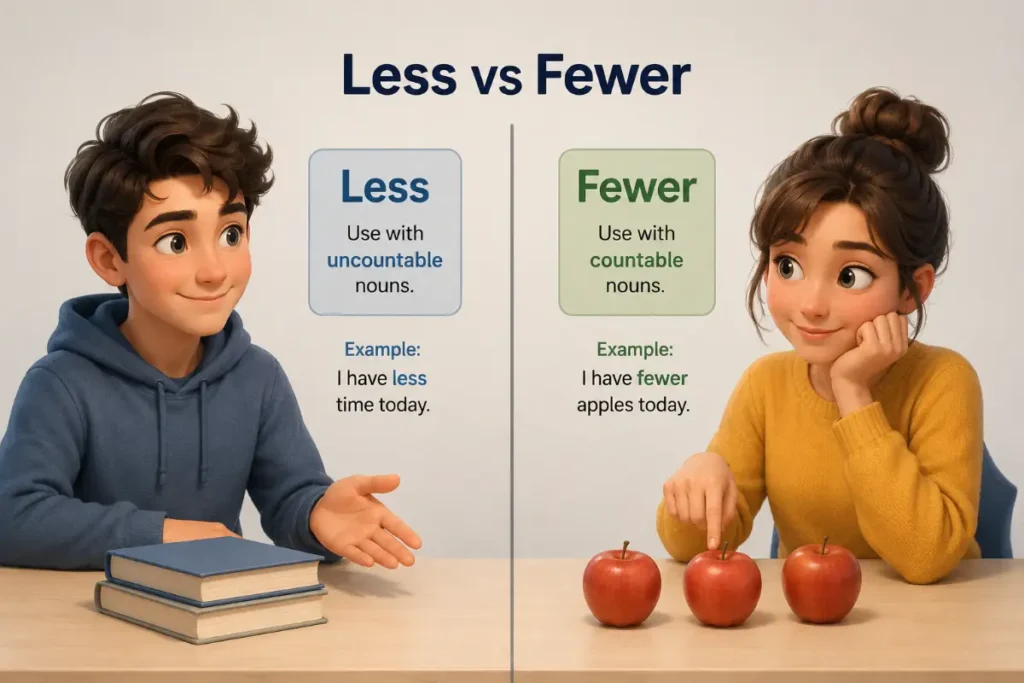
If you’ve ever side-eyed a “12 items or less” sign at the checkout line and thought “shouldn’t that be fewer?” — you’re not wrong, but you’re also not entirely right. Less vs Fewer is one of the most debated rules in English usage, and even the people who popularized the rule two and a half centuries ago never meant it to be as absolute as it’s often taught today.
Fewer is used for things you can count individually. Less is used for things measured in bulk or as a single amount. That’s the core rule — but there’s real nuance in exactly where the line falls, and it’s worth understanding both the rule and its exceptions.
You may also find Farther vs Further: 5 Easy Rules to Get It Right (2026) helpful if you want to explore this topic further.
The Quick Answer
- Fewer = countable items (things you can count one by one)
- Fewer people showed up than expected.
- Less = uncountable amounts (things measured in bulk, not counted individually)
- There’s less traffic today.
The test: can you count the thing individually — one, two, three? If yes, use fewer. If it’s measured as a whole amount rather than counted piece by piece, use less.
Try it: “There are ___ apples in the basket.” Can you count apples one by one? Yes — so it’s fewer: “There are fewer apples in the basket.”
Now try: “There’s ___ water in the tank.” Can you count water piece by piece? No — water is measured, not counted. So it’s less: “There’s less water in the tank.”
Why This Grammar Rule Causes So Much Debate
Unlike most of the pairs on this site, less vs. fewer isn’t really a spelling confusion or a sound-alike problem — it’s a genuine, long-running dispute among grammarians about how strict the rule should actually be. Merriam-Webster traces the “rule” back to a single 1770 comment by grammarian Robert Baker, who expressed it as his personal preference rather than a hard law of grammar. Over the following two centuries, that preference gradually calcified into what many people now treat as an absolute, unbreakable rule — even though English speakers had been using “less” with countable nouns for over a thousand years before Baker ever wrote his comment.
That history matters because it explains why you’ll see “less” used with countable nouns constantly, even in careful, edited writing — “an essay of 250 words or less,” “a team of 11 players or less,” and yes, “12 items or less” at the grocery store. These aren’t necessarily errors; in several specific categories, “less” is actually the more natural and even preferred choice, which we’ll cover next.
Fewer: Countable Things
Fewer applies to plural nouns you could, in principle, count one at a time.
Examples:
- We had fewer applicants this year than last.
- There are fewer restaurants open on Mondays.
- She made fewer mistakes on the second try.
- Fewer students signed up for the class this semester.
- The company reported fewer customer complaints this quarter.
In each case, you could point at individual units — applicants, restaurants, mistakes, students, complaints — and count them one by one.
Less: Uncountable or Bulk Amounts
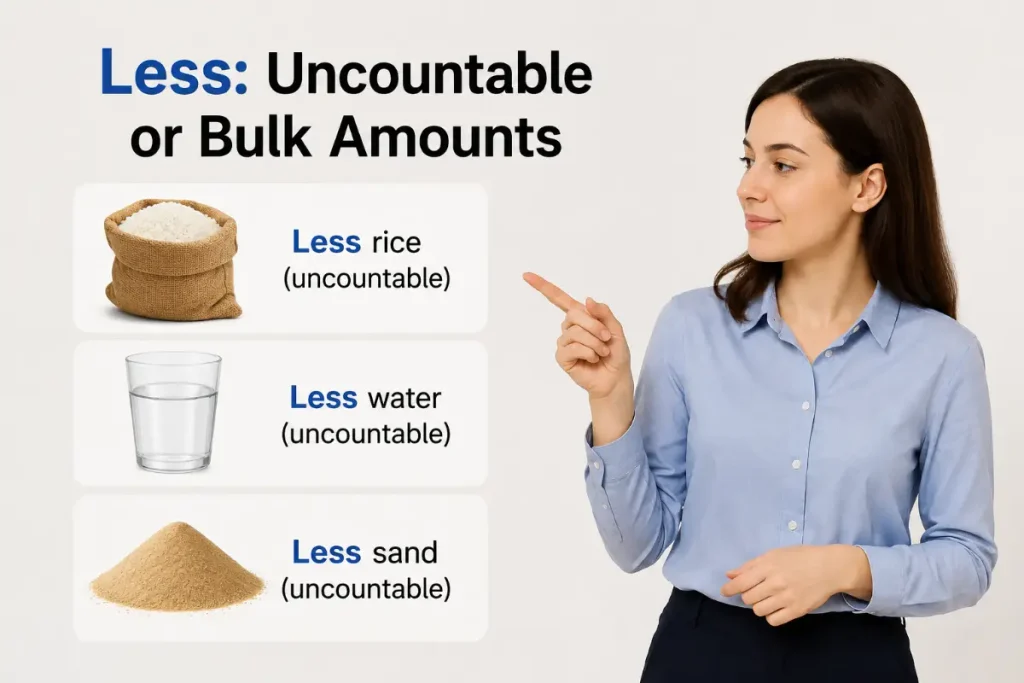
Less applies to singular, uncountable nouns — things measured as a whole rather than counted individually.
Examples:
- I have less patience for this than I used to.
- There’s less traffic on the highway this morning.
- We need less sugar in this recipe.
- The new phone uses less battery than the old one.
- There’s less enthusiasm for the project than expected.
Patience, traffic, sugar, battery life, enthusiasm — none of these are things you’d naturally count one by one. You measure them as an amount, which is exactly the territory “less” is built for.
The Exceptions That Make This Rule More Flexible Than People Think
This is the part most quick grammar guides skip, and it’s genuinely useful to know, since these exceptions are widely accepted even by careful editors:
Money. “The repair cost less than $200.” Even though dollars are technically countable, money is usually treated as an amount rather than individual units, so “less” is standard and preferred here.
Distance. “We drove less than ten miles.” Distance is treated the same way — as a measured quantity, not a count of individual miles.
Time. “It took less than an hour.” Time follows the same logic; “fewer than an hour” would sound distinctly odd to most English speakers.
Weight. “The package weighs less than five pounds.” Again, weight is a measured amount, not something counted piece by piece.
Statistical or general enumerations. “Less than 50,000 people attended.” When a number functions more like a general amount or statistic than a literal headcount, “less” is often the more natural, and even preferred, choice — this is exactly the reasoning Merriam-Webster gives for why “12 items or less” isn’t really breaking any rule at all.
Notice the pattern across all five exceptions: even though the underlying units (dollars, miles, minutes, pounds, people) are technically countable, we tend to think and talk about them as amounts rather than individual items being tallied one by one. That’s the real logic behind why “less” fits naturally in these cases, not just a random list of exceptions to memorize.
It’s a similar kind of nuance to farther and further — a rule that gets taught as absolute in school, but turns out to have documented, widely accepted exceptions once you look at how major style guides actually treat it.
The Fastest Way to Check Yourself
Step 1: Could you count the thing one at a time in normal conversation? Apples, people, mistakes, cars — yes, easily. Use fewer.
Step 2: Is it something you’d naturally measure instead of count? Water, sugar, time, money, distance — yes. Use less.
Step 3: If it’s money, distance, time, or weight, “less” is usually the more natural choice, even though the underlying unit is technically countable.
For another useful perspective, check out I.e. vs E.g.: The Two-Second Trick to Never Mix Them Up in 2026.
A simple memory trick: if you could reasonably answer the question “how many?” with a specific count, you want fewer. If you’d more naturally answer “how much?”, you want less.
Less vs Fewer: Side-by-Side Comparison
| Fewer | Less | |
|---|---|---|
| Used for | Countable nouns | Uncountable / bulk nouns |
| Test | “How many?” | “How much?” |
| Example | Fewer cars on the road. | Less traffic on the road. |
| Money, time, distance, weight | Traditionally avoided | Standard and often preferred |
| “Words or ___” | Technically “fewer” | “Less” is widely accepted and common |
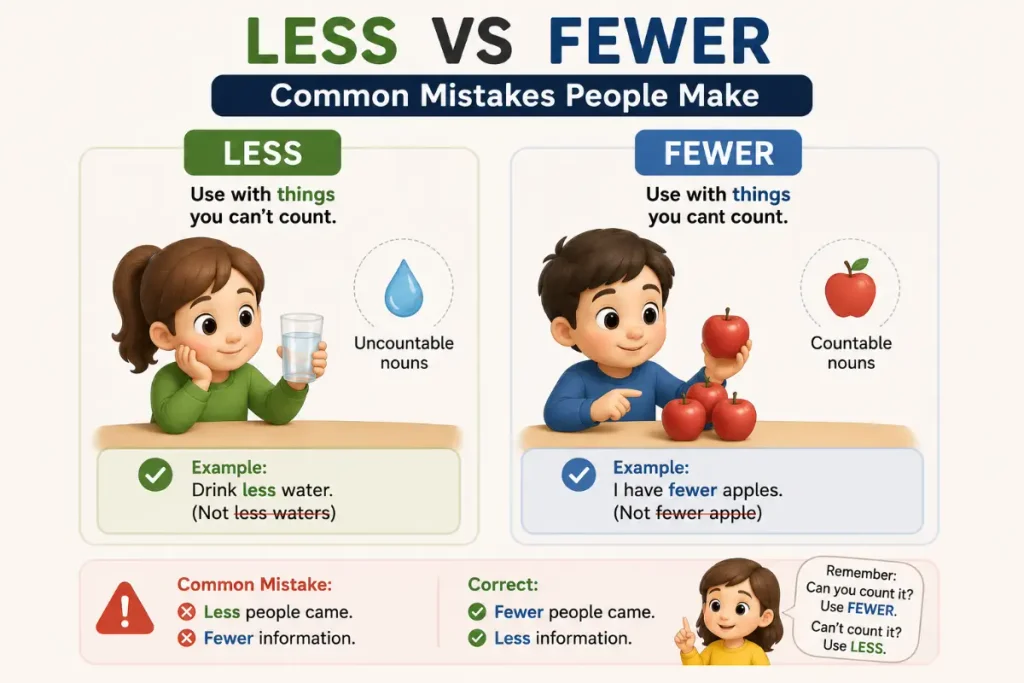
Common Mistakes People Make
Mistake 1: “I have less friends than I used to.” Should be “fewer friends” — friends are individually countable, so this is a clear case for “fewer,” without the money/time/distance exceptions applying.
Mistake 2: “There were fewer than $500 in the account.” Should be “less than $500” — money is one of the standard exceptions where “less” is preferred, even though dollars are technically countable.
Mistake 3: Over-correcting every “less” with a number nearby. Not every sentence with “less” and a number is wrong. “Less than ten miles,” “less than an hour,” and “less than $50” are all standard, correct usage — they’re not errors just because a number appears next to “less.”
Mistake 4: “We need less ideas, not more.” Should be “fewer ideas” — ideas are countable individually, so this doesn’t fall under any of the standard exceptions.
Mistake 5: Assuming the grocery store sign is definitely wrong. “12 items or less” is technically the less traditionally “correct” phrasing by the strict count/mass noun rule, but it’s also extremely common, arguably falls into the “general enumeration” exception, and multiple major usage authorities, including Merriam-Webster, have noted it’s far from an outright error, just a matter of register and long-standing convention.
More Examples to Lock It In
- We had fewer than ten guests, which meant less food went to waste.
- There’s less competition for the role now that fewer candidates applied.
- The trip took less time because we hit fewer delays on the highway.
- With fewer employees working overtime, the company saved less overall than projected, since fewer hours doesn’t always mean proportionally less cost.
- She spends less money now that she buys fewer impulse purchases.
- There were fewer than 200 people at the event, and noticeably less energy in the room than last year.
What the Style Guides Say
Merriam-Webster is unusually candid on this topic, tracing the “rule” to a single 18th-century grammarian’s stated preference and noting explicitly that less has been used with countable nouns in English for well over a thousand years — describing the strict modern rule as one that “was somehow generalized and elevated to an absolute, inviolable rule” despite the original source presenting it as personal opinion, not law. The AP Stylebook and Chicago Manual of Style both maintain the traditional fewer-for-count, less-for-mass distinction as the standard for formal and edited writing, while acknowledging the well-established exceptions for money, time, distance, and weight.
The consistent theme across every major authority: the core distinction is real and worth following in formal writing, but the “rule” has always been more of a strong convention with well-documented exceptions than an absolute law — which is a more accurate (and honestly more useful) way to think about it than the oversimplified version many people were taught in school.
Less and Fewer in Different Writing Contexts
In casual writing and speech, “less” gets used with countable nouns constantly, and it rarely draws real criticism outside of people who specifically enjoy pointing out this particular rule.
In professional and formal writing, following the traditional fewer/less distinction (while remembering the money, time, distance, and weight exceptions) signals careful, polished writing, and it’s one of the more commonly checked rules in professional editing and proofreading.
Furthermore, In marketing and retail copy, “less” often wins out for rhythm and simplicity even in technically countable contexts (“save with less hassle,” “fewer clicks” versus “less clicks” both appear depending on the exact phrasing), so this is an area where house style and tone sometimes take precedence over the strict grammatical rule.
In academic and scientific writing, precision matters more, and the traditional distinction — including the standard exceptions — is generally expected and enforced by editors and peer reviewers.
A Related Pair Worth Knowing: Fewest and Least
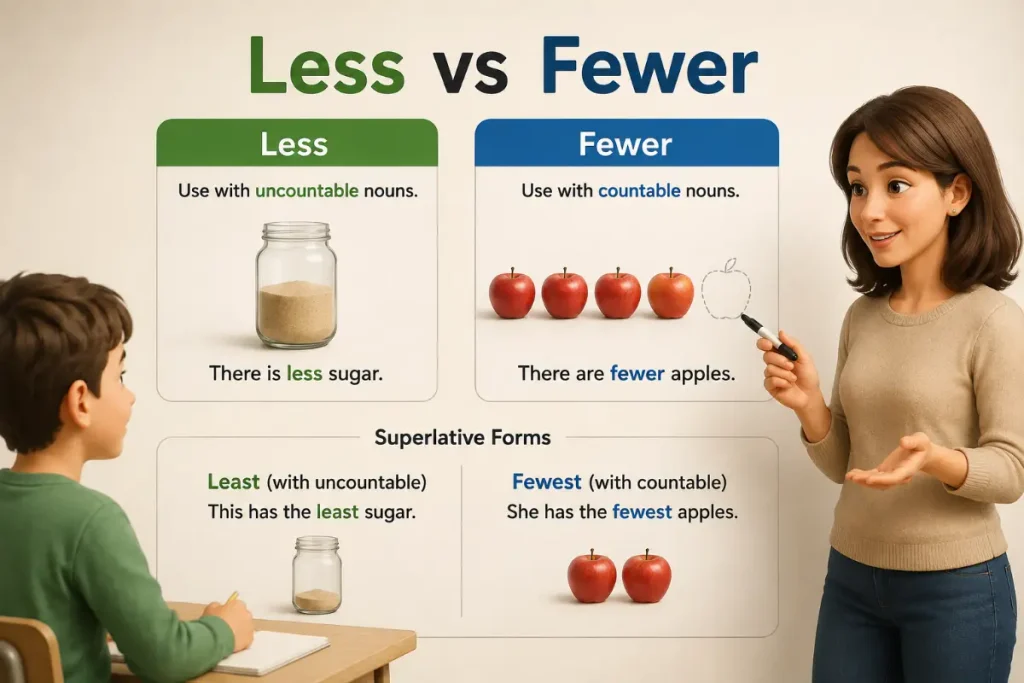
The fewer/less distinction extends to their superlative forms too, and the same logic applies. “Fewest” is for countable things at their smallest number (“this team had the fewest injuries all season”), while “least” is for uncountable amounts at their smallest measure (“this recipe uses the least sugar of the three”). The same money, time, distance, and weight exceptions carry over as well — you’d say “the least expensive option” (money) rather than “the fewest expensive option,” following the same logic that makes “less than $500” standard rather than “fewer than $500.”
Getting fewest and least right follows exactly the same test as fewer and less: ask whether you’re counting individual units or measuring a bulk amount, and the correct word follows the same pattern you’ve already learned.
Frequently Asked Questions
Is “12 items or less” actually wrong?
Not definitively — while “12 items or fewer” is the more traditionally “correct” phrasing under the strict count-noun rule, “12 items or less” is extremely common, has been used this way for a long time, and Merriam-Webster specifically notes it falls into a gray area where less is widely accepted, especially in statistical or general-enumeration phrasing.
Why is “less than five miles” considered correct instead of “fewer than five miles”?
Distance, like money, time, and weight, is conventionally treated as a measured amount rather than a literal count of individual units, so “less” is the standard, preferred choice here even though miles are technically countable.
Is this rule the same in British English?
Yes — the fewer/less distinction and its standard exceptions (money, time, distance, weight) apply consistently across American and British English, though “less” with countable nouns tends to draw fewer complaints in British usage overall.
Where did this rule actually come from?
It traces back to an offhand comment by 18th-century grammarian Robert Baker in 1770, who framed it as his personal stylistic preference rather than an established rule — it was later picked up and enforced more rigidly by generations of usage guides and English teachers, well after the “rule” had already been treated as settled fact for decades.
What’s the safest approach if I want to follow the traditional rule without overthinking every sentence?
Use fewer for anything you’d naturally count one at a time (people, items, mistakes, complaints), and default to less for money, time, distance, weight, and anything measured in bulk rather than individually. That covers the vast majority of real-world sentences correctly, without needing to memorize every documented exception.
Practice Exercise
Fill in the blank with either “less” or “fewer.” Answers are listed right after — try each one before checking.
- We had ______ rain this month than last.
- There are ______ seats available than we expected.
- She spends ______ time on social media now.
- The recipe calls for ______ sugar than the original.
- ______ students enrolled in the class this year.
- The trip cost ______ than $300.
- We need ______ paperwork to process this request.
- There were ______ than 100 attendees at the event.
- He made ______ errors on this report than the last one.
- The tank has ______ gas than I thought.
- ______ companies are hiring this quarter.
- It took ______ than an hour to finish.
- There’s ______ noise in this part of the building.
- We received ______ complaints after the update.
- The bridge is ______ than two miles from here.
- ______ people showed up than we planned for.
- I have ______ patience for excuses these days.
- The store sells ______ items than it used to.
- She weighs ______ than she did last year.
- There are ______ reasons to worry than you might think.
Answer Key
- less
- fewer
- less
- less
- Fewer
- less
- less
- fewer
- fewer
- less
- Fewer
- less
- less
- fewer
- less
- Fewer
- less
- fewer
- less
- fewer
If you got sixteen or more correct, you’ve got a solid grip on both the core rule and its exceptions — the money, time, distance, and weight cases (6, 12, 15) are the ones that trip up even experienced writers, so don’t worry if those needed a second look.
Before moving on, you may also want to read Their vs There vs They’re: How to Finally Stop Mixing Them Up for more helpful grammar tips.
The Bottom Line
Fewer is for things you count one at a time; less is for things measured in bulk. The exceptions — money, time, distance, weight, and general statistical amounts — are well-established and widely accepted, even by strict style guides. This is a rule worth following in formal writing, but it’s also one where knowing the documented exceptions matters just as much as knowing the basic distinction.