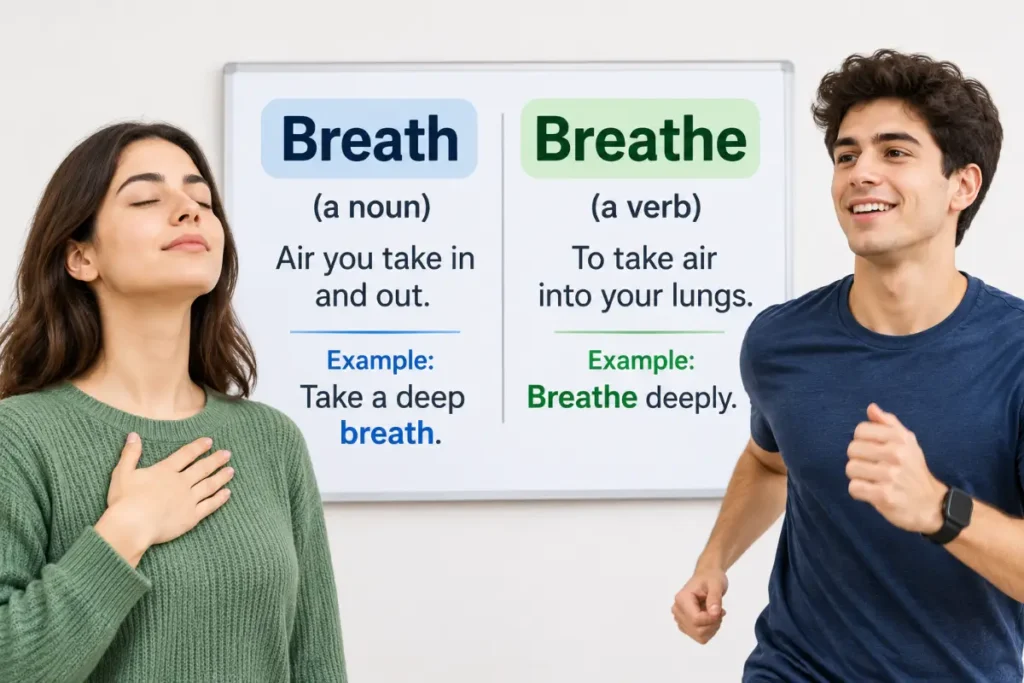
Have you ever wondered whether to write breath or breathe when talking about air, breathing, or taking a moment to relax? These two words look almost identical, but they have different meanings, pronunciations, and grammatical uses. Choosing the wrong one can change the meaning of your sentence or create a spelling mistake.
The confusion is understandable. Both words relate to the same everyday action, and the only difference in spelling is the final letter e. However, one is a noun, and the other is a verb. Once you understand this simple distinction, you can use both words correctly in conversations, emails, school assignments, and everyday writing.
In this guide, you’ll learn the difference between these words, how to pronounce them, when to use each one, and how to avoid common mistakes. You’ll also find easy examples, helpful comparisons, and practice questions to test your understanding.
You may also find Stationary vs Stationery: The Simple Trick That Never Fails helpful if you want to explore this topic further.
Quick Answer: Breath vs Breathe
Breath is a noun. It refers to the air you inhale or exhale, or the act of taking air into your lungs.
Breathe is a verb. It means to take air into your lungs and release it.
Here’s the easiest way to remember the difference:
| Word | Part of Speech | Meaning | Example |
|---|---|---|---|
| Breath | Noun | Air taken into or released from the lungs | Take a deep breath. |
| Breathe | Verb | To inhale and exhale air | Try to breathe slowly. |
Simple memory trick: The word breathe has an extra e at the end, just like the verb exhale. Think of the extra letter as a reminder that you’re describing an action.
- Take a breath. (Noun)
- Breathe deeply. (Verb)
If you can replace the word with air, you probably need breath. If you can replace it with inhale and exhale, you need breathe.
What Does Breath Mean?
The word breath is a noun that refers to the air you take into your lungs and release when you breathe. It can also describe a single cycle of breathing or the feeling associated with breathing.
In everyday American English, the word appears in many common expressions, including “take a deep breath,” “hold your breath,” and “out of breath.”
Breath Meaning and Usage
The primary meaning of breath is the air that enters or leaves your lungs.
For example:
- She took a deep breath before speaking.
- His breath was warm in the cold air.
- I could see my breath on the chilly morning.
- Take a breath and relax.
- He held his breath while swimming underwater.
In each example, breath names something rather than describing an action.
Breath as a Single Inhalation or Exhalation
Sometimes, breath refers to one complete or partial act of breathing.
Examples:
- She took one last breath before diving.
- He let out a long breath of relief.
- I could hear her breathing, but each breath was shallow.
Here, the word describes an individual instance of air entering or leaving the lungs.
Breath in Figurative Expressions
The word breath also appears in expressions that do not always refer to literal breathing.
Examples:
- The new policy brought a breath of fresh air to the company.
- She was the breath of fresh air the team needed.
- He waited with bated breath for the announcement.
- The news took my breath away.
These expressions use breath to communicate relief, excitement, surprise, or a refreshing change.
What Does Breathe Mean?
The word breathe is a verb. It describes the action of taking air into the lungs and releasing it.
Unlike breath, which names the air or an instance of breathing, breathe tells us what someone or something does.
Breathe Meaning and Usage
The most common meaning of breathe is to inhale and exhale air.
Examples:
- I need to breathe more slowly.
- She breathed deeply before starting the presentation.
- The baby is breathing normally.
- You should breathe through your nose during this exercise.
- He couldn’t breathe because of the smoke.
Notice how the word describes an action in each sentence.
Breathe in Different Verb Tenses
Because breathe is a verb, it changes form depending on the tense.
| Verb Form | Example |
|---|---|
| Base form | I breathe fresh air every morning. |
| Third-person singular | She breathes slowly. |
| Present participle | He is breathing normally. |
| Simple past | They breathed a sigh of relief. |
| Past participle | She has breathed deeply all morning. |
The past tense and past participle of breathe are both breathed.
Remember that breath does not change into breathed. They are different words with different grammatical functions.
Breathe in Figurative Expressions
The verb breathe can also mean to rest, recover, or have room to grow.
Examples:
- I finally have time to breathe after a busy week.
- The business needs room to breathe.
- Let the project breathe before making more changes.
- The garden needs space to breathe.
In these examples, the word does not necessarily describe literal breathing. Instead, it communicates the idea of having time, space, or freedom.
Breath vs Breathe Pronunciation
One of the main reasons people confuse these words is that their spelling is nearly identical. However, their pronunciation is different.
The difference comes from the final sound.
| Word | Pronunciation | Final Sound |
|---|---|---|
| Breath | /brɛθ/ | Unvoiced “th” |
| Breathe | /briːð/ | Voiced “th” |
In American English, breath sounds like “breth,” while breathe sounds like “breeth.”
How to Pronounce Breath
The word breath has one syllable.
To pronounce it correctly:
- Start with the /br/ sound, as in bring.
- Use the short /ɛ/ vowel sound, as in bed.
- Finish with the unvoiced /θ/ sound, as in think.
The final sound is made by placing your tongue lightly between your teeth and letting air pass through.
You should not vibrate your vocal cords when making this sound.
How to Pronounce Breathe
The word breathe also has one syllable, but its vowel and final consonant are different.
To pronounce it correctly:
- Start with the /br/ sound.
- Use the long /iː/ vowel sound, as in see.
- Finish with the voiced /ð/ sound, as in this.
For the final sound, your tongue stays near or between your teeth, but your vocal cords vibrate.
An Easy Pronunciation Trick
Try saying these words aloud:
- Breath: Think of the word death.
- Breathe: Think of the word seethe.
The words breath and death share a similar vowel and final consonant. Likewise, breathe and seethe share a similar vowel and voiced final consonant.
Practicing these pairs can help you remember both the spelling and pronunciation.

Breath vs Breathe: Key Differences
The easiest way to understand the difference is to compare their grammatical roles, meanings, and sentence structures.
| Feature | Breath | Breathe |
|---|---|---|
| Part of speech | Noun | Verb |
| Meaning | Air taken into or released from the lungs | To inhale and exhale air |
| Pronunciation | /brɛθ/ | /briːð/ |
| Vowel sound | Short e | Long e |
| Final consonant | Unvoiced th | Voiced th |
| Example | Take a breath. | Breathe deeply. |
| Common phrase | Out of breath | Breathe slowly |
When Should You Use Breath?
Use breath when you need a noun.
A noun can name a person, place, thing, or idea. In this case, breath names the air or the act of taking a breath.
Examples:
- I took a breath before answering.
- Her breath smelled like peppermint.
- He was out of breath after running.
- The fresh air was a breath of fresh air.
When Should You Use Breathe?
Use breathe when you need a verb.
A verb describes an action or state. In this case, breathe describes the action of inhaling and exhaling.
Examples:
- Remember to breathe during the exercise.
- She can breathe more easily now.
- The athlete breathed deeply after the race.
- I need a few minutes to breathe.
Quick grammar test: If the word follows a phrase such as take a, hold your, or out of, you usually need the noun breath. If it follows a subject and describes an action, you usually need the verb breathe.
Breath vs Breathe Examples in Everyday English
Looking at real-life sentences is one of the easiest ways to understand how these words work.
Here are some common examples.
Examples Using Breath
- Take a deep breath before you begin.
- She held her breath during the scary scene.
- I was out of breath after climbing the stairs.
- His breath smelled like coffee.
- The doctor checked the patient’s breath.
- The new manager was a breath of fresh air.
- He took a breath and started speaking.
- I could see my breath in the winter air.
- She let out a breath of relief.
- The runner struggled to catch his breath.
Examples Using Breathe
- Try to breathe slowly when you feel nervous.
- She breathed deeply before the interview.
- I can breathe better outside.
- The baby is breathing peacefully.
- He couldn’t breathe in the smoky room.
- Remember to breathe through your nose.
- She breathed a sigh of relief.
- I need some time to breathe.
- The plants need room to breathe.
- He was breathing heavily after the workout.
Compare These Sentences
| Sentence With Breath | Sentence With Breathe |
|---|---|
| Take a breath before speaking. | Breathe before speaking. |
| He was out of breath. | He struggled to breathe. |
| Her breath smelled fresh. | She breathed fresh air. |
| I held my breath. | I tried to breathe slowly. |
| She took a breath of fresh air. | She stepped outside to breathe fresh air. |
The difference becomes clearer when you focus on the job each word performs in the sentence.
Common Expressions: Breath vs Breathe
Both words appear in many everyday English expressions. Learning these phrases can help you use them naturally in American English.
Take a Breath
This expression means to inhale air, often to relax or prepare for something.
Examples:
- Take a breath before answering the question.
- I need to take a breath and think.
- She took a deep breath before walking onstage.
Hold Your Breath
This expression means to stop breathing temporarily.
It can also mean waiting anxiously for something to happen.
Examples:
- Hold your breath while you go underwater.
- We were holding our breath during the final minutes of the game.
- Don’t hold your breath waiting for him to apologize.
Out of Breath or Breathe?
The correct expression is out of breath, not out of breathe.
The phrase describes a condition in which someone is breathing heavily or has difficulty catching their breath after physical activity.
Examples:
- I was out of breath after running.
- She arrived at school out of breath.
- He was completely out of breath after climbing the hill.
Why is breath correct?
The word out of is followed by the noun breath. The phrase describes a state rather than an action.
You can also use breathe in a related sentence:
- I was out of breath because I couldn’t breathe properly.
Here, breath is a noun, while breathe is a verb.
Breath vs Breathe of Fresh Air
The correct expression is a breath of fresh air.
This phrase has both a literal and a figurative meaning.
Literally, it refers to a small amount of fresh air that someone inhales.
Figuratively, it describes something new, refreshing, or different from what came before.
For another useful perspective, check out Who vs Whom: The Simple Test That Ends the Confusion (2026 Guide).
Examples:
- I went outside to get a breath of fresh air.
- Her positive attitude was a breath of fresh air.
- The new design is a breath of fresh air for the company.
- His honest approach was a welcome breath of fresh air.
You might also see the phrase breathe fresh air.
For example:
- I went outside to breathe fresh air.
In this sentence, breathe is a verb because it describes the action of inhaling.
Compare:
- Take a breath of fresh air. (Noun)
- Breathe fresh air. (Verb)
Breathe a Sigh of Relief or Breath a Sigh of Relief?
The correct expression is breathe a sigh of relief.
Examples:
- She breathed a sigh of relief after passing the exam.
- We all breathed a sigh of relief when the storm ended.
- He breathed a sigh of relief when he found his wallet.
Although the phrase contains the noun sigh, the word breathed is the verb describing the action.
Breath vs Breathe vs Breadth
Another word that often causes confusion is breadth.
Although breath, breathe, and breadth look similar, they have different meanings.
| Word | Part of Speech | Meaning | Example |
|---|---|---|---|
| Breath | Noun | Air taken into or released from the lungs | Take a deep breath. |
| Breathe | Verb | To inhale and exhale | Breathe slowly. |
| Breadth | Noun | The width or extent of something | The table has a breadth of 4 feet. |
What Does Breadth Mean?
Breadth refers to the width of something or the range of something.
It can describe physical measurements or the variety and extent of knowledge, experience, or ideas.
Examples:
- The breadth of the river is impressive.
- The table has a breadth of three feet.
- She has a broad breadth of knowledge across several subjects.
- The course covers a wide breadth of topics.
A more natural way to express the third example would be “She has broad knowledge across several subjects.” The word breadth itself already communicates the idea of range or extent.
How to Remember the Difference
Use these simple memory tricks:
- Breath: Think of air.
- Breathe: Think of an action.
- Breadth: Think of width or range.
Examples:
- I took a breath.
- I need to breathe.
- The breadth of the bridge is impressive.
The extra letters in breadth can help you remember that it refers to something broad or wide.

Common Mistakes With Breath and Breathe
Even experienced writers sometimes confuse these words. Here are some common errors and their correct forms.
| Incorrect Sentence | Correct Sentence | Explanation |
|---|---|---|
| Take a deep breathe. | Take a deep breath. | Use the noun after “take a.” |
| I can’t breath. | I can’t breathe. | Use the verb after “can’t.” |
| She was out of breathe. | She was out of breath. | “Out of” takes the noun here. |
| He took a breathe of fresh air. | He took a breath of fresh air. | “Took a” requires a noun. |
| Remember to breath slowly. | Remember to breathe slowly. | “To” is followed by the base verb. |
| She breathed a breath of relief. | She breathed a sigh of relief. | This is the standard expression. |
| I need to take a breathe. | I need to take a breath. | Use the noun after “take a.” |
| He couldn’t breath properly. | He couldn’t breathe properly. | Use the base verb after “couldn’t.” |
Mistake 1: “I Can’t Breathe” or “I Can’t Breath”?
The correct phrase is I can’t breathe.
The word can’t is a modal verb. Modal verbs such as can, could, should, and must are followed by the base form of a verb.
Examples:
- I can’t breathe.
- She can’t sleep.
- He can’t swim.
- They can’t speak.
Therefore, I can’t breath is grammatically incorrect.
Mistake 2: “Out of Breath” or “Out of Breathe”?
The correct phrase is out of breath.
The word breath is a noun in this expression.
Examples:
- I was out of breath.
- She was out of breath after the race.
- We were out of breath after climbing the stairs.
Remember that the phrase describes a condition, not an action.
Mistake 3: “Take a Breath” or “Take a Breathe”?
The correct phrase is take a breath.
The article a is used before a singular countable noun.
Examples:
- Take a breath.
- Take a break.
- Take a seat.
- Take a moment.
Because breath is a noun, it fits naturally in this structure.
Practice Exercises: Breath or Breathe?
Test your understanding by choosing the correct word in each sentence.
Fill in the Blanks
- Take a deep ______ before you start.
- Remember to ______ slowly during the exercise.
- I was out of ______ after running.
- She couldn’t ______ because of the smoke.
- He took a ______ of fresh air.
- I need a moment to ______.
- The baby is ______ peacefully.
- She held her ______ underwater.
- He was struggling to ______.
- We all breathed a sigh of ______.
Answer Key
- Breath
- Breathe
- Breath
- Breathe
- Breath
- Breathe
- Breathing
- Breath
- Breathe
- Relief
Challenge Questions
Choose the correct word in each sentence.
- I need to take a (breath / breathe).
- She was out of (breath / breathe).
- He couldn’t (breath / breathe) properly.
- The new policy was a (breath / breathe) of fresh air.
- Take a moment to (breath / breathe).
- The (breath / breathe) of the runner was heavy.
- She (breathes / breaths) deeply before every race.
- The patient is (breathing / breath) normally.
- He (breathed / breath) a sigh of relief.
- I could see my (breath / breathe) in the cold air.
Answers: 1. Breath, 2. Breath, 3. Breathe, 4. Breath, 5. Breathe, 6. Breath, 7. Breathes, 8. Breathing, 9. Breathed, 10. Breath.
Frequently Asked Questions
1. What Is the Difference Between Breath and Breathe?
Breath is a noun that refers to the air you inhale or exhale. Breathe is a verb that describes the action of inhaling and exhaling.
For example, “Take a breath” uses the noun, while “Breathe slowly” uses the verb.
2. Is It “I Can’t Breathe” or “I Can’t Breath”?
The correct phrase is “I can’t breathe.”
The word can’t is followed by the base form of a verb. Since breathe is the verb, it is the correct choice.
3. Is It “Out of Breath” or “Out of Breathe”?
The correct expression is “out of breath.”
The word breath is a noun in this phrase. It describes a condition in which someone is breathing heavily or needs to catch their breath.
4. Is It “Breath of Fresh Air” or “Breathe of Fresh Air”?
The correct expression is “a breath of fresh air.”
The word breath is a noun in this phrase. It can refer to literal fresh air or something refreshing and new.
5. How Do You Pronounce Breath and Breathe?
In American English, breath is pronounced /brɛθ/, while breathe is pronounced /briːð/.
The first word has a short e sound and an unvoiced th. The second has a long e sound and a voiced th.
6. Is Breathed the Past Tense of Breathe?
Yes. Breathed is both the simple past tense and the past participle of breathe.
Examples:
- She breathed deeply.
- He has breathed fresh air all morning.
- They breathed a sigh of relief.
7. Is Breath a Verb?
No. In standard English, breath is a noun.
The verb is breathe. You can say “I need to breathe,” but you should not write “I need to breath.”
8. What Is the Difference Between Breath, Breathe, and Breadth?
Breath refers to air taken into or released from the lungs. Breathe describes the action of inhaling and exhaling. Breadth refers to the width or range of something.
For example:
- Take a breath.
- Breathe deeply.
- The breadth of the river is impressive.
9. Why Do Breath and Breathe Have Different Spellings?
The words developed from the same historical root but have different grammatical functions and pronunciations in modern English.
The spelling difference helps distinguish the noun breath from the verb breathe.
10. What Is the Easiest Way to Remember Breath vs Breathe?
Remember that breath is a thing, while breathe is an action.
You take a breath, but you breathe.
This simple rule works in most everyday sentences.
Before moving on, you may also want to read Among vs Between: 5 Common Mistakes to Avoid in 2026 for more helpful grammar tips.
Conclusion
Understanding the difference between breath and breathe becomes much easier when you focus on their grammatical roles. One is a noun, and the other is a verb. Although they look similar and share related meanings, they cannot be used interchangeably.
Use breath when referring to air, a single inhalation or exhalation, or expressions such as “out of breath” and “a breath of fresh air.” Use breathe when describing the action of inhaling and exhaling, as in “I need to breathe” or “She breathed deeply.”
The easiest way to remember the distinction is simple: You take a breath, but you breathe. Keep this rule in mind, practice the examples, and you’ll be able to choose the correct word confidently in your everyday writing.