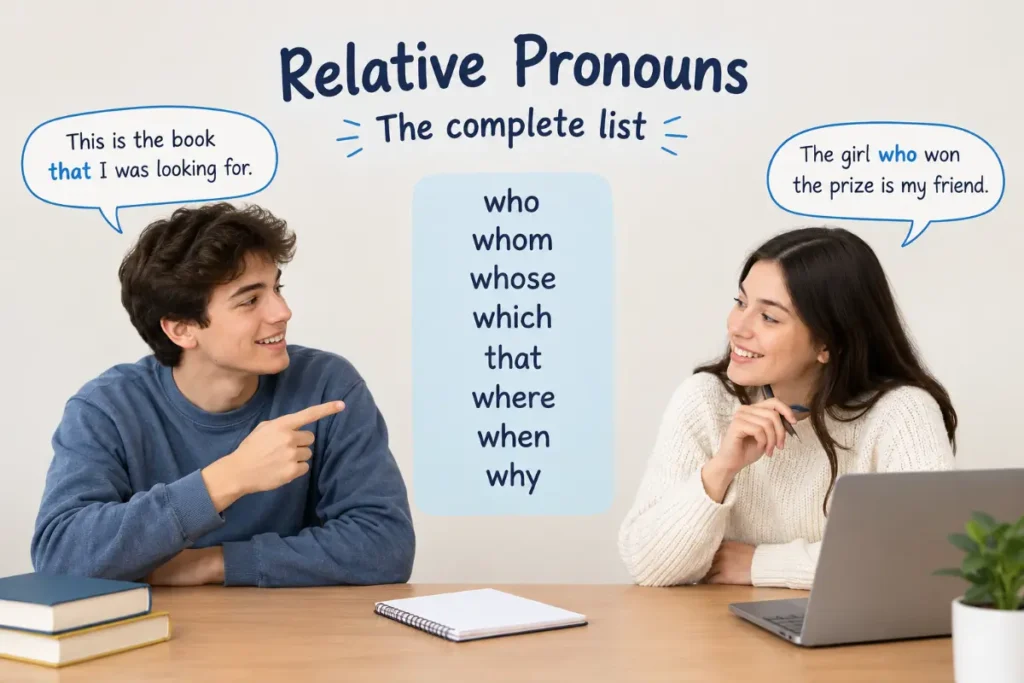
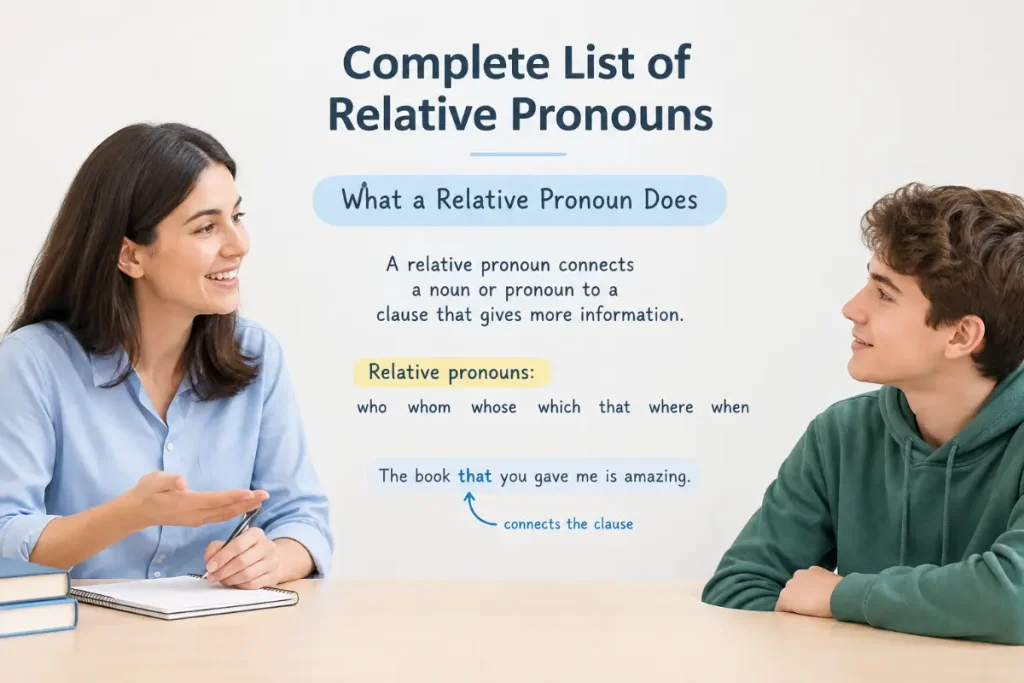
Here’s a complete list of relative pronouns: who, whom, whose, which, and that, plus the compound forms whoever, whomever, whichever, and whatever. Relative pronouns connect a descriptive clause to a noun, so they show up in nearly every long sentence you write, usually without you noticing.
This guide sorts them by what they refer to, shows the job each one does inside its clause, and covers the choices that cause the most trouble: who versus whom, that versus which, and when you can drop the pronoun entirely.
You may also find Examples of Transitive Verbs: 50+ Clear Examples & Rules (2026) helpful if you want to explore this topic further.
What a Relative Pronoun Does
Purdue OWL’s handout on relative pronouns explains that relative pronouns introduce relative clauses, a type of dependent clause that modifies a word, phrase, or idea in the main clause. The word being modified is the antecedent.
- The house that Jack built is large. (“that” introduces a clause describing “house”)
- The professor, whom I respect, received tenure. (“whom” introduces a clause describing “professor”)
Inside its own clause, the pronoun also does a grammatical job. Purdue OWL notes it can function as a subject, an object, or a possessive.
The List, Sorted by What They Refer To
For People
- who — subject: The woman who called is my aunt.
- whom — object: The man whom I met was kind.
- whoever — subject, “any person who”: Whoever finishes first wins.
- whomever — object, “any person whom”: Give it to whomever you choose.
For Things
- which — The car, which is brand new, broke down.
- whichever — Take whichever seat you like.
- whatever — Do whatever helps you learn.
For People or Things
- that — The dog that barks all night is my neighbor’s.
For Possession
- whose — The family whose house burned received help.
Purdue OWL calls “whose” the only possessive relative pronoun in English, and notes its antecedent can be a person or a thing: “The book whose author won a Pulitzer has become a bestseller.”
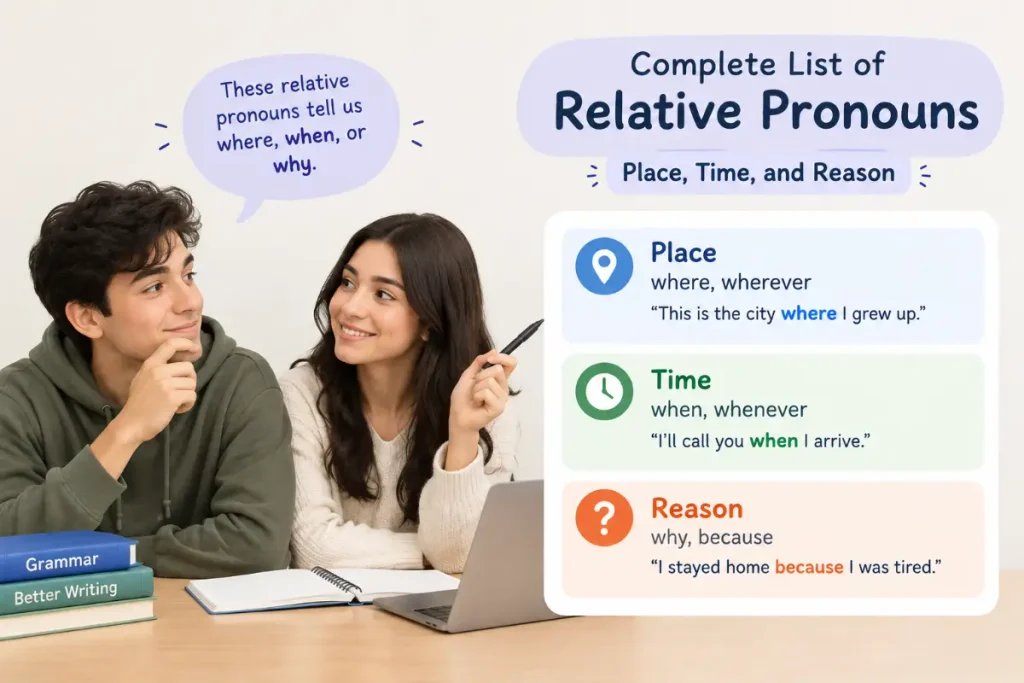
Place, Time, and Reason
Purdue OWL’s table also covers where, when, and why in relative clauses, since they connect a clause to a noun of place, time, or reason.
- where — This is the house where I grew up.
- when — I remember the day when we met.
- why — That’s the reason why I called.
Many grammar books call these relative adverbs rather than pronouns, but they do the same connecting job.
Who vs. Whom
Choose by the pronoun’s role inside its own clause: “who” for subjects, “whom” for objects. The he/him test from our guide to who vs whom settles most cases, and the compound forms follow the same logic, a trap covered in our guide to how to use whomever correctly.
Purdue OWL adds a practical note: in American English “whom” is used less often and sounds more formal, and it’s commonly dropped in speech. But it can’t be dropped after a preposition: “The visitor for whom you were waiting has arrived.”
That vs. Which
This pair depends on whether the clause is essential.
Restrictive (essential) clause: use “that,” with no commas.
- The spatula that has a cracked handle is in the drawer.
Non-restrictive (nonessential) clause: use “which,” with commas.
- The spatula, which has a cracked handle, is in the drawer.
Purdue OWL states that “that” can only be used in restrictive clauses, and that “which” is the preferred pronoun for non-restrictive ones. For the comma logic behind this, see our guide to what is a non-restrictive clause.
When “That” Is the Better Choice
Purdue OWL lists two situations where “that” works better than “which”:
- After words like all, any, every, few, little, many, much, no, none, and some (including their -thing forms): Dessert is all that he wants.
- After a noun modified by a superlative: This is the best resource that I have ever read.
Which After a Preposition
When the relative pronoun is the object of a preposition, formal English uses “which” rather than “that.”
- The theater in which the play debuted held 300 people.
Can You Leave the Relative Pronoun Out?
In the object position of a restrictive clause, the pronoun is often optional in informal English.
- Formal: The library did not have the book that I wanted.
- Informal: The library didn’t have the book I wanted.
It can’t be omitted when it’s the subject of its clause (“The man who called left a message”) or when it follows a preposition (“the man to whom I spoke”).
Relative Pronoun Examples in Sentences
Relative pronouns make sentences more informative by connecting a noun to a clause that describes or identifies it. The best way to understand how they work is to see each pronoun used in everyday American English.
| Relative pronoun | Example sentence |
|---|---|
| Who | The student who won the contest received a scholarship. |
| Whom | The coach whom we interviewed was very helpful. |
| Whose | The neighbor whose dog went missing posted flyers. |
| Which | The laptop, which I bought last year, still works well. |
| That | The recipe that you shared turned out perfectly. |
| Whoever | Whoever completes the assignment first may leave early. |
| Whomever | Give the invitation to whomever you think should attend. |
| Whatever | Whatever you decide, let me know by Friday. |
| Whichever | Choose whichever option works best for your schedule. |
Notice that each relative pronoun connects information to a noun or introduces a clause that identifies a person, thing, or choice. For example, in “The student who won the contest received a scholarship,” the clause “who won the contest” identifies which student received the scholarship.
Remember that where, when, and why also introduce relative clauses, although they are generally classified as relative adverbs rather than relative pronouns.
How to Choose the Correct Relative Pronoun
Choosing the correct relative pronoun becomes easier when you consider what the pronoun refers to and what job it performs in the clause. Instead of memorizing every example, use these simple guidelines.
- Use who when referring to a person who performs the action: The woman who called is my manager.
- Use whom when referring to a person who receives the action or follows a preposition in formal English: The client whom I contacted replied.
- Use whose to show possession: The student whose backpack disappeared reported it.
- Use which when referring to things or animals, especially in nonessential clauses: My car, which is ten years old, still runs well.
- Use that to identify a specific person or thing in an essential clause: The book that I borrowed is overdue.
- Use whoever or whomever according to the pronoun’s grammatical role: Whoever arrives first can choose a seat.
- Use whichever or whatever when referring to a choice or an unspecified thing: Take whichever route is faster.
A Quick Trick for Who vs. Whom
Replace the pronoun with he or him to determine which form fits.
- If he works, use who.
- If him works, use whom.
For example: “Who/whom did you invite?”
You would say, “I invited him,” not “I invited he.” Therefore, whom is the formal grammatical choice.
In everyday American English, however, who is widely used instead of whom in informal questions and conversation.
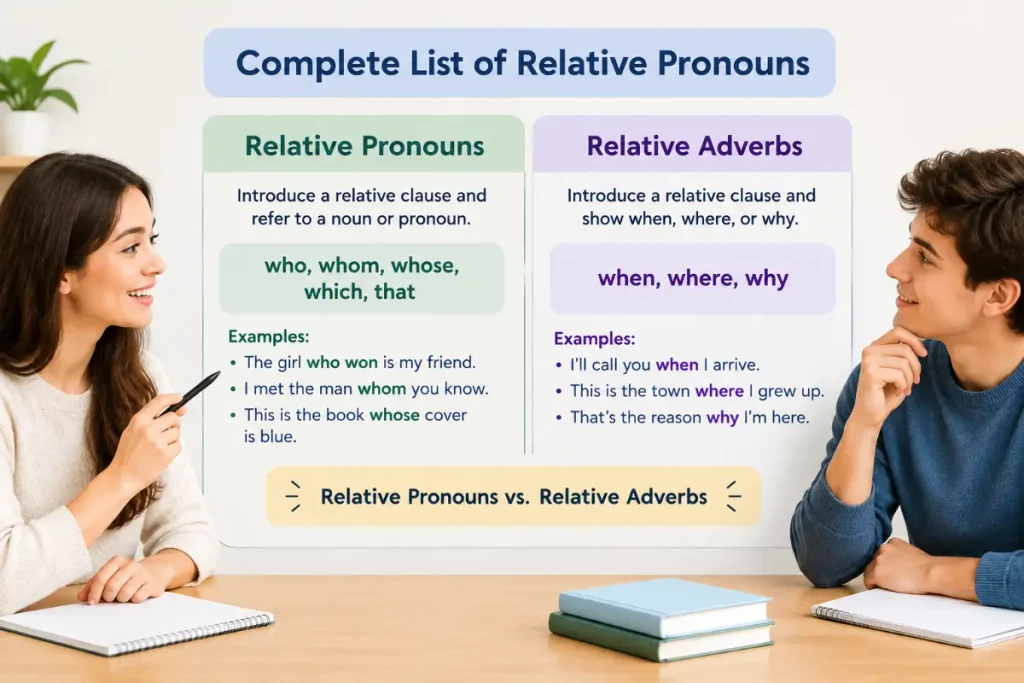
Relative Pronouns vs. Relative Adverbs: What’s the Difference?
Relative pronouns and relative adverbs both introduce relative clauses, but they perform different grammatical jobs. Understanding this distinction helps you choose the right word when describing a person, place, time, or reason.
Relative pronouns include who, whom, whose, which, and that. They refer to a noun or antecedent and perform a grammatical role within their clause, such as subject, object, or possessive.
For another useful perspective, check out A Conjunction? The 2026 Guide to Types & Uses.
Examples:
- The teacher who helped me was patient.
- The movie that we watched was entertaining.
- The author whose book won an award attended the event.
Relative adverbs include where, when, and why. They connect a clause to a place, time, or reason and express a relationship such as location or time.
Examples:
- This is the restaurant where we had dinner.
- I remember the summer when we moved to California.
- That is the reason why she left early.
Here’s a quick comparison:
| Relative pronoun or adverb | What it connects | Example |
|---|---|---|
| Who | A person | The man who called |
| Which | A thing | The phone which rang |
| Whose | Possession | The girl whose bag was lost |
| Where | A place | The house where I grew up |
| When | A time | The day when we met |
| Why | A reason | The reason why I stayed |
The key difference is that relative pronouns serve as nouns or noun-related forms within their clauses, while relative adverbs express relationships involving place, time, or reason.
For a complete list of relative pronouns, keep the core five—who, whom, whose, which, and that—at the center of your study. Learn the compound forms next, and remember that where, when, and why belong to the related category of relative adverbs.
Quick Reference Table
| Pronoun | Refers To | Role in Clause | Example |
|---|---|---|---|
| who | people | subject | The man who called left. |
| whom | people | object | The man whom I met left. |
| whose | people or things | possessive | The woman whose car was stolen left. |
| which | things | subject or object | The car, which is new, broke. |
| that | people or things | subject or object (restrictive only) | The dog that barks left. |
| whoever | people | subject | Whoever wins gets a prize. |
| whomever | people | object | Invite whomever you like. |
Common Mistakes People Make
- Mistake 1: Using “which” in a restrictive clause, as in “The car which has a dent is mine,” where “that” is the standard choice.
- Mistake 2: Using “that” in a nonessential clause with commas, as in “My car, that is brand new, broke down.”
- Mistake 3: Choosing “who” or “whom” by looking at the whole sentence instead of the clause the pronoun introduces.
- Mistake 4: Writing “who’s” when you mean “whose,” as in “the woman who’s car was stolen.”
- Mistake 5: Dropping “whom” after a preposition, as in “the man to I spoke.”
Practice Exercise
Choose the correct relative pronoun, or answer the question. Answers are listed right after, so try each one before checking.
- The man (who/whom) called earlier left a message.
- The woman to (who/whom) you spoke is my teacher.
- The book (that/who) I borrowed was excellent.
- My neighbor, (who/whose) dog barks constantly, apologized.
- The car, (which/that) is brand new, broke down.
- Everything (that/which) he said was true.
- This is the best movie (that/which) I have ever seen.
- The house (where/which) I grew up has been sold.
- (Whoever/Whomever) finishes first wins.
- Give the prize to (whoever/whomever) you choose.
- The professor (who/whom) I respect retired. (Choose the formal form.)
- Name the relative pronoun: The science fair, which lasted all day, ended at six.
- Name the relative pronoun: The girl who wore a red dress left early.
- Can the pronoun be omitted? The library did not have the book that I wanted.
- Can the pronoun be omitted? The visitor for whom you were waiting has arrived.
- The book (whose/who’s) author won a prize became a bestseller.
- The theater in (that/which) the play debuted held 300 people.
- What role does “whom” play? The man whom I met was kind.
- What role does “whose” play? The woman whose car was stolen called the police.
- What role does “that” play? The dog that barks all night belongs to my neighbor.
Answer Key
- who
- whom
- that
- whose
- which
- that
- that
- where
- Whoever
- whomever
- whom
- which
- who
- Yes (object position, informal)
- No (it follows a preposition)
- whose
- which
- Object
- Possessive
- Subject
Frequently Asked Questions
How many relative pronouns are there?
The core set is who, whom, whose, which, and that, plus the compound forms whoever, whomever, whichever, and whatever. Some references also count where, when, and why when they introduce relative clauses.
What’s the difference between a relative pronoun and a relative adverb?
A relative pronoun stands for a noun and plays a role inside its clause, like “who” or “which.” A relative adverb such as “where,” “when,” or “why” connects the clause to a place, time, or reason instead.
Can “that” refer to people?
Yes, especially in informal English. Purdue OWL notes that “that” can substitute for “who” in speech, though “who” is preferred in formal writing when referring to a particular person.
Is “whose” only for people?
No. Purdue OWL points out that the antecedent of “whose” can be a person or a thing, so “a book whose author won a prize” is correct.
What’s the fastest way to choose between “that” and “which”?
Ask whether the clause is essential. If removing it would leave the noun unclear, use “that” with no commas. If it’s extra information, use “which” with commas.
Before moving on, you may also want to read A Predicate in a Sentence? A Simple 2026 Guide for more helpful grammar tips.
Putting the List to Use
Keep this list of relative pronouns in mind as a set of tools sorted by job: who and whom for people, which and that for things, whose for possession, and the compound forms for “any person” or “any thing.” Inside each clause, the pronoun is a subject, an object, or a possessive, and that role decides who versus whom.
The two choices worth memorizing are the ones that cause the most errors: “that” for essential clauses and “which” for extra information, and “whom” after prepositions. Get those right, and the rest of the list mostly takes care of itself.