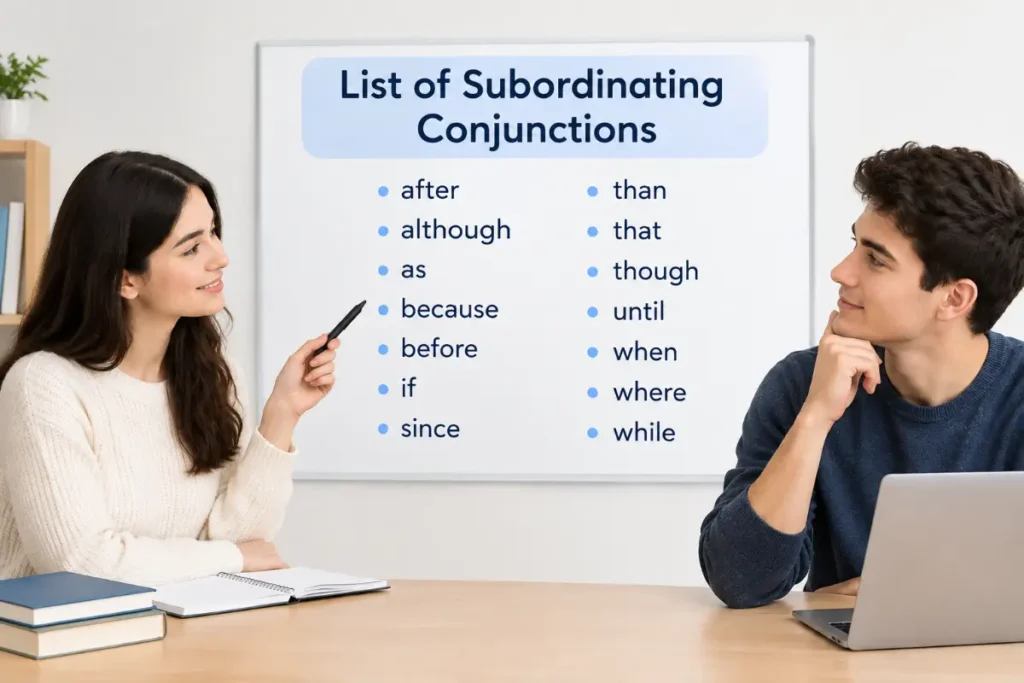
Most guides give you one long alphabetical list of subordinating conjunctions and leave you to sort it out. A more useful way to learn them is by what they do: each one tells the reader how the dependent clause relates to the main clause, whether that’s time, cause, contrast, condition, or place. Once you think in those five relationships, picking the right word gets much easier.
Our earlier guides on how to use conjunctions correctly and what is a conjunction cover the punctuation rules and the three families of conjunctions. This guide is the reference list, sorted by meaning, with an example for every word.
You may also find A Proper Noun? 7 Easy Rules & Examples (2026) helpful if you want to explore this topic further.
Complete List of Subordinating Conjunctions in Alphabetical Order (A–Z)
Although subordinating conjunctions are easier to learn by meaning, an alphabetical list helps readers quickly find a specific word. Use this reference to check common subordinating conjunctions and conjunction phrases without searching through every category.
- A: after, although, as, as if, as long as, as soon as, as though
- B: because, before
- E: even if, even though
- H: how
- I: if, in case, in order that
- L: lest
- N: now that
- O: once
- P: provided that
- R: rather than
- S: since, so that
- T: than, though, till
- U: unless, until
- W: when, whenever, where, wherever, whereas, whether, while
- T: that
This is a practical reference list, not an exhaustive list of every possible subordinating expression. Some words, such as that, than, and how, have different grammatical functions depending on context. Also, some grammar references classify certain expressions differently.
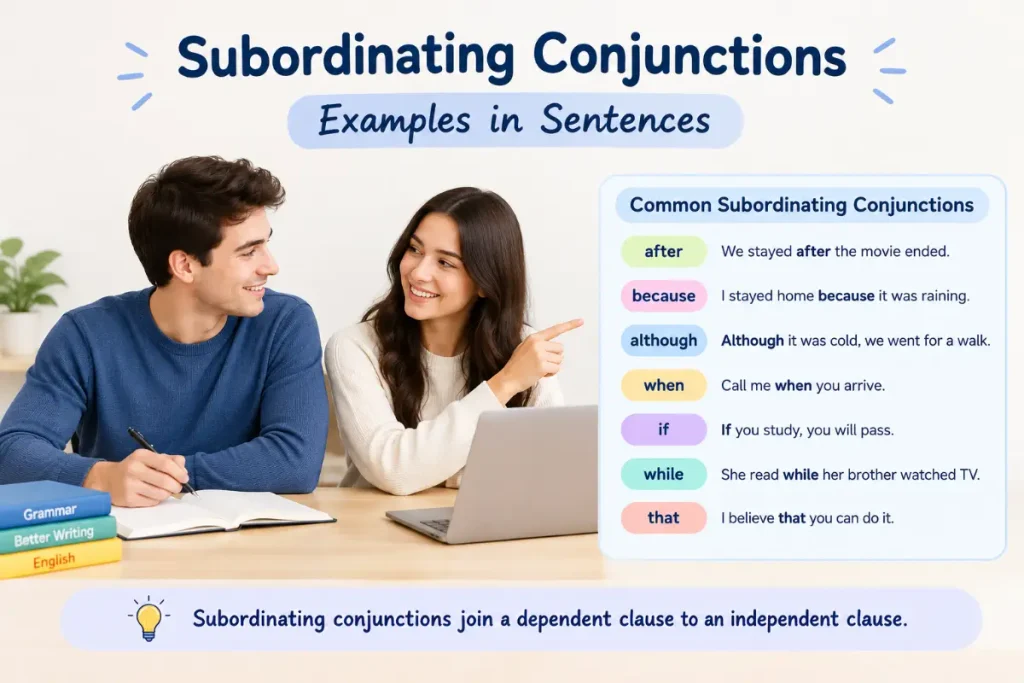
Subordinating Conjunctions Examples in Sentences
Seeing subordinating conjunctions in complete sentences makes it easier to understand how they connect ideas. In each example below, the bold phrase introduces a dependent clause.
- After the guests arrived, we served dinner.
- We stayed indoors because the weather was severe.
- Although he felt nervous, he gave a great presentation.
- You can borrow my laptop if you handle it carefully.
- Before you submit the form, check your answers.
- She practiced every day so that she could improve.
- Even though the road was crowded, we arrived on time.
- I’ll wait here until you return.
- Whenever she visits, she brings homemade cookies.
- Wherever you travel, keep your documents safe.
- He listened carefully while the instructor explained the process.
- Once the meeting ends, we’ll discuss the next steps.
- Unless you leave now, you’ll miss the bus.
- Since everyone is ready, let’s begin.
- Whereas her brother prefers tea, she drinks coffee.
Notice that the dependent clause can appear at the beginning or end of a sentence. When it comes first, a comma generally separates it from the independent clause. When it comes second, a comma is usually unnecessary.
How to Choose the Right Subordinating Conjunction
The easiest way to choose the right subordinating conjunction is to identify the relationship you want to express between two ideas. Instead of memorizing every word, ask yourself what the dependent clause explains.
| Relationship | Conjunctions to consider | Example |
|---|---|---|
| Time | after, before, when, until | Call me when you arrive. |
| Cause or reason | because, since, as | We left because it was late. |
| Contrast | although, though, whereas | Although it rained, we played. |
| Condition | if, unless, provided that | You can go if you finish. |
| Place | where, wherever | Sit wherever you like. |
| Purpose | so that, in order that | She whispered so that nobody would hear. |
Be careful with words that can express more than one relationship. For example, since can refer to time or explain a reason, while while can indicate simultaneous actions or contrast two ideas.
- Time: I have lived here since I graduated.
- Cause: Since you’re already here, let’s start.
- Time: She listened while he spoke.
- Contrast: While I enjoy swimming, my brother prefers running.
The surrounding sentence determines the intended meaning. Once you identify that meaning, choosing an appropriate subordinating conjunction becomes much easier.
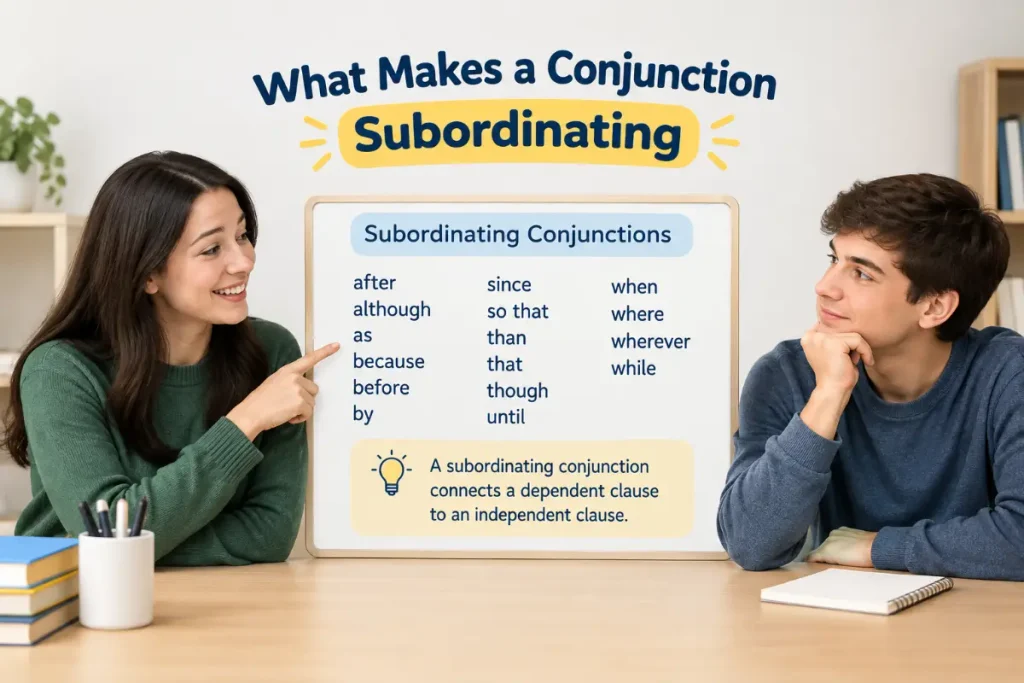
What Makes a Conjunction “Subordinating”
A subordinating conjunction introduces a dependent clause, one that has its own subject and verb but can’t stand alone as a sentence, and ties it to an independent clause. Purdue OWL’s page on commas after introductory elements lists the common starter words for these clauses: after, although, as, because, before, if, since, though, until, when, and while.
- Because it was raining, we stayed home.
“Because it was raining” can’t be a sentence by itself. It needs the main clause to finish the thought, which is exactly the dependence the word “subordinating” refers to.
Time: When Does It Happen?
These words place the dependent clause in time relative to the main clause.
- after — We left after the movie ended.
- before — Call me before you leave.
- when — She smiled when she saw the cake.
- while — He read while the soup simmered.
- as — The crowd cheered as the team entered.
- until — Wait here until I return.
- since — I haven’t eaten since I woke up.
- once — Once the rain stopped, we went outside.
- as soon as — Text me as soon as you arrive.
- whenever — She calls whenever she’s lonely.
Cause: Why Did It Happen?
These explain the reason behind the main clause.
- because — We canceled because the roads were icy.
- since — Since you’re here, let’s start.
- as — As it was late, we went home.
- now that — Now that we’re done, we can relax.
- so that — He spoke slowly so that everyone could follow.
Notice that “since” and “as” appear in both the time and cause groups. The same word can carry either meaning, and the sentence around it tells you which one is in play. “Since Monday” points to time, while “since you asked” points to cause.
Contrast: What Pushes Against It?
These show that the dependent clause is surprising or opposed to the main clause.
- although — Although she was tired, she kept working.
- though — He passed, though he barely studied.
- even though — Even though it was cold, they swam.
- while — While I like cats, I’m allergic to them.
- whereas — She loves hiking, whereas her brother prefers staying in.
Here “while” shows up again, this time expressing contrast rather than time, another reminder that meaning comes from context, not from the word alone.
Condition: Under What Circumstances?
These set up an “if this, then that” relationship.
- if — If it rains, we’ll move indoors.
- unless — Unless something changes, we’ll proceed.
- provided that — You can go provided that you finish your homework.
- as long as — As long as you’re careful, it’s fine.
- in case — Bring a jacket in case it gets cold.
Place: Where?
A small group connects clauses by location.
- where — We stopped where the road splits.
- wherever — She finds trouble wherever she goes.
The Comma Rule in One Line
When the dependent clause comes first, a comma follows it. When it comes second, no comma is usually needed.
- Because it rained, we left. (dependent clause first, so a comma)
- We left because it rained. (dependent clause second, so no comma)
For why this works and where it bends, see our guide to when to use a comma after an introductory phrase.
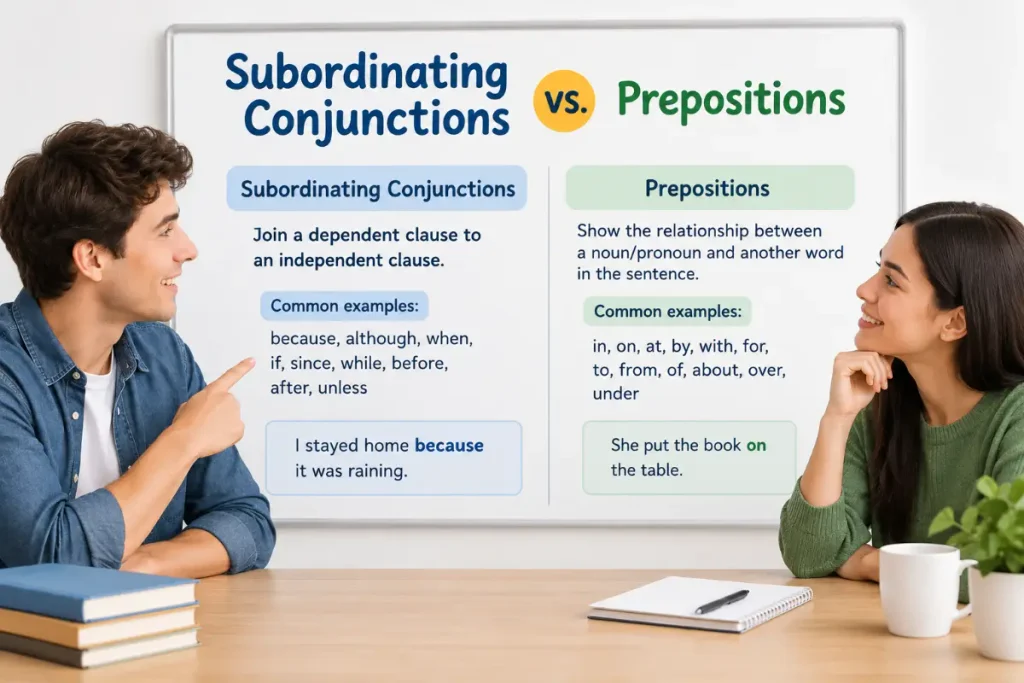
Subordinating Conjunctions vs. Prepositions
Several words on this list, including after, before, since, and until, can also work as prepositions. The difference is what follows. A full clause (subject plus verb) means conjunction; just a noun means preposition.
- We left after dinner. (“after” is a preposition, followed by a noun)
- We left after we ate dinner. (“after” is a conjunction, followed by a clause)
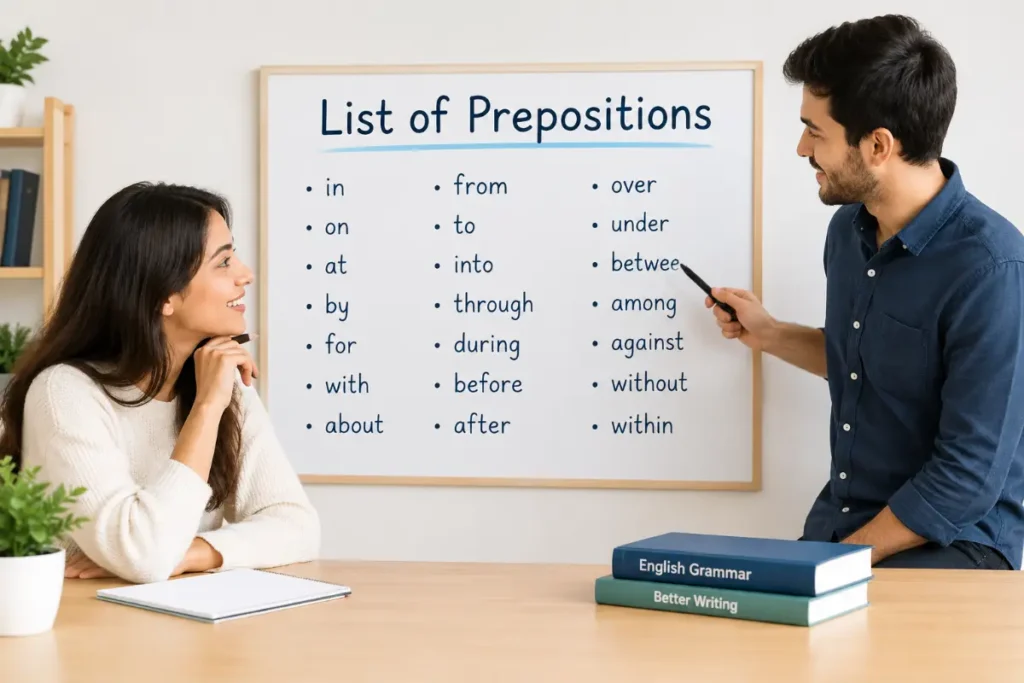
Our list of prepositions covers the other side of this overlap.
Quick Reference Table
| Relationship | Common Words |
|---|---|
| Time | after, before, when, while, as, until, since, once, whenever |
| Cause | because, since, as, now that, so that |
| Contrast | although, though, even though, while, whereas |
| Condition | if, unless, provided that, as long as, in case |
| Place | where, wherever |
Common Mistakes People Make
Mistake 1: Writing a dependent clause as a stand-alone sentence, as in “Although it was late.” This is a fragment, covered in our guide to how to fix a sentence fragment.
Mistake 2: Forgetting the comma after a dependent clause that opens the sentence.
Mistake 3: Adding a comma before a dependent clause that comes second, as in “We left, because it rained,” where no comma is needed.
Mistake 4: Using two conjunctions that say the same thing, such as “Although it was late, but we kept working.” Pick one: “Although it was late, we kept working.”
Mistake 5: Assuming a word like “while” or “since” always means the same thing, when its meaning shifts between time, cause, and contrast depending on the sentence.
For another useful perspective, check out List of Prepositions: 100+ Words You Need to Know (2026).
Practice Exercise
Identify the subordinating conjunction in each sentence and name the relationship it shows: time, cause, contrast, condition, or place. Answers are listed right after, so try each one before checking.
- Although she studied, she felt nervous.
- We’ll leave after the meeting ends.
- He stayed home because he was sick.
- If you need help, just ask.
- She smiled when she saw the surprise.
- Unless it rains, the game will go on.
- I’ll wait here until you finish.
- While I enjoy coffee, I can’t drink it at night.
- We stopped where the trail ends.
- Since you asked, I’ll explain.
- He studied so that he would pass.
- Even though it was late, we kept talking.
- Call me as soon as you land.
- As long as you try, you’ll improve.
- She calls whenever she needs advice.
- Now that we’ve finished, let’s celebrate.
- Whereas she plans carefully, he improvises.
- Bring an umbrella in case it rains.
- Before you leave, lock the door.
- Wherever he goes, he makes friends.
Answer Key
- Although — contrast
- after — time
- because — cause
- If — condition
- when — time
- Unless — condition
- until — time
- While — contrast
- where — place
- Since — cause
- so that — cause (purpose)
- Even though — contrast
- as soon as — time
- As long as — condition
- whenever — time
- Now that — cause
- Whereas — contrast
- in case — condition
- Before — time
- Wherever — place
Frequently Asked Questions
How many subordinating conjunctions are there?
There’s no fixed count, since multi-word forms like “as soon as” and “provided that” blur the total, but most everyday writing relies on a core group of about twenty to thirty.
Can a sentence start with a subordinating conjunction?
Yes. A sentence can open with a dependent clause such as “Although it rained, we went out,” as long as that clause is followed by a main clause that completes the thought.
Why do some words appear in more than one category?
Because words like “since,” “as,” and “while” can express more than one relationship. The surrounding sentence shows whether the meaning is time, cause, or contrast.
What’s the difference between a subordinating and a coordinating conjunction?
Coordinating conjunctions (for, and, nor, but, or, yet, so) join elements of equal weight, while subordinating conjunctions attach a dependent clause to an independent one, making one idea rely on the other.
What’s the fastest way to pick the right subordinating conjunction?
Decide which relationship you want to show, time, cause, contrast, condition, or place, then choose from that group on the list instead of scanning the whole thing alphabetically.
Before moving on, you may also want to read A Predicate in a Sentence? A Simple 2026 Guide for more helpful grammar tips.
Wrapping Up
A list of subordinating conjunctions is easiest to use when it’s sorted by meaning rather than by the alphabet: time words, cause words, contrast words, condition words, and place words each answer a different question about how two clauses connect. Knowing which question you’re answering narrows the choice to a handful of options.
Keep the comma rule and the preposition test in mind and the rest takes care of itself: comma after an opening dependent clause, none before a closing one, and a full clause after the word if it’s functioning as a conjunction.