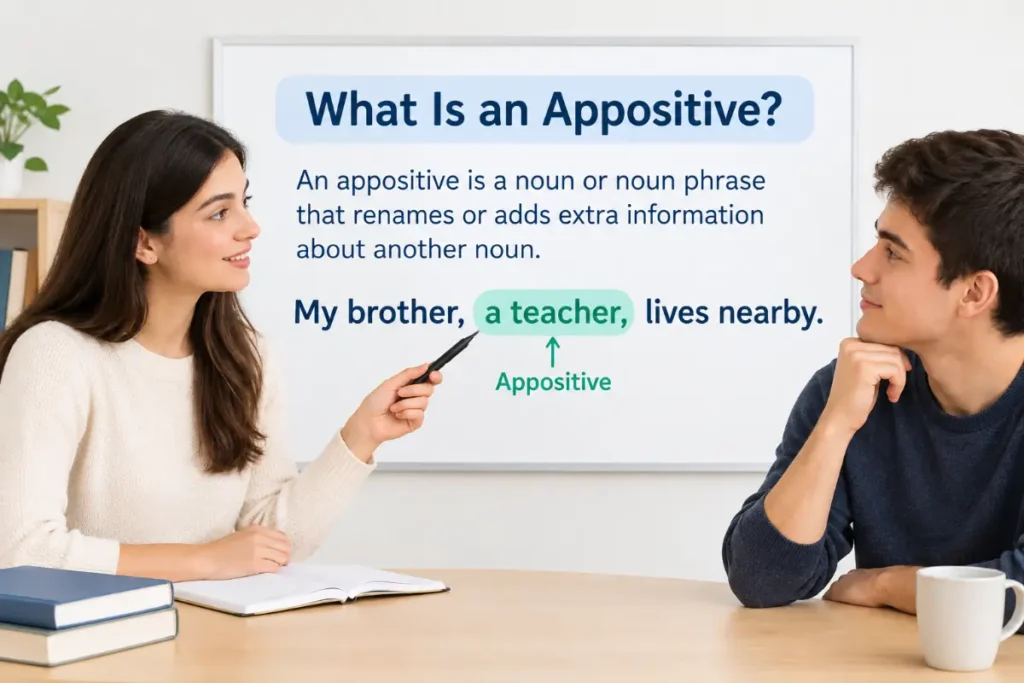
The quickest answer to what is an appositive is a noun or noun phrase that sits right next to another noun and renames it. In “My neighbor, a retired pilot, waters my plants,” the phrase “a retired pilot” is the appositive: it gives a second name for “my neighbor” without adding a new person to the sentence.
Appositives are one of the easiest ways to pack extra information into a sentence without writing a second one, and they come with one punctuation rule that decides almost every comma question about them. This guide covers what an appositive is, the essential-versus-nonessential test that controls its commas, and the common ways writers get it wrong.
You may also find List of Coordinating Conjunctions: 7 FANBOYS Explained (2026) helpful if you want to explore this topic further.
The Core Definition
Purdue OWL describes an appositive as a word that adds explanatory or clarifying information to the noun that precedes it. Its own example shows the pattern clearly:
- John’s truck, a red Chevrolet, needs new tires.
“A red Chevrolet” renames “John’s truck.” Both phrases point at the same object, and you could swap them without changing who or what the sentence is about.
Appositive Examples in Sentences
The easiest way to understand an appositive is to see how it works in everyday sentences. An appositive is a noun or noun phrase that renames another noun, giving the reader more information without introducing a different person, place, or thing.
Here are several appositive examples to help you recognize the pattern.
- My dog, a playful golden retriever, loves swimming. The phrase “a playful golden retriever” renames “my dog.”
- The author Mark Twain wrote The Adventures of Tom Sawyer. The name “Mark Twain” identifies which author the sentence refers to.
- Our teacher, Mrs. Wilson, explained the assignment. “Mrs. Wilson” identifies the teacher and adds her name as extra information.
- The planet Mars has two moons. “Mars” identifies which planet is being discussed.
- My friend Daniel plays the guitar. “Daniel” specifies which friend the sentence means.
- The Grand Canyon, a famous natural landmark, attracts visitors from around the world. The phrase “a famous natural landmark” provides additional information about the Grand Canyon.
Notice that some appositives have commas around them, while others do not. The difference depends on whether the information is necessary to identify the noun. If the appositive provides extra information, use commas. If it identifies which person or thing you mean, leave the commas out.
Learning to recognize appositives in different sentence patterns makes it easier to use them naturally and punctuate them correctly.
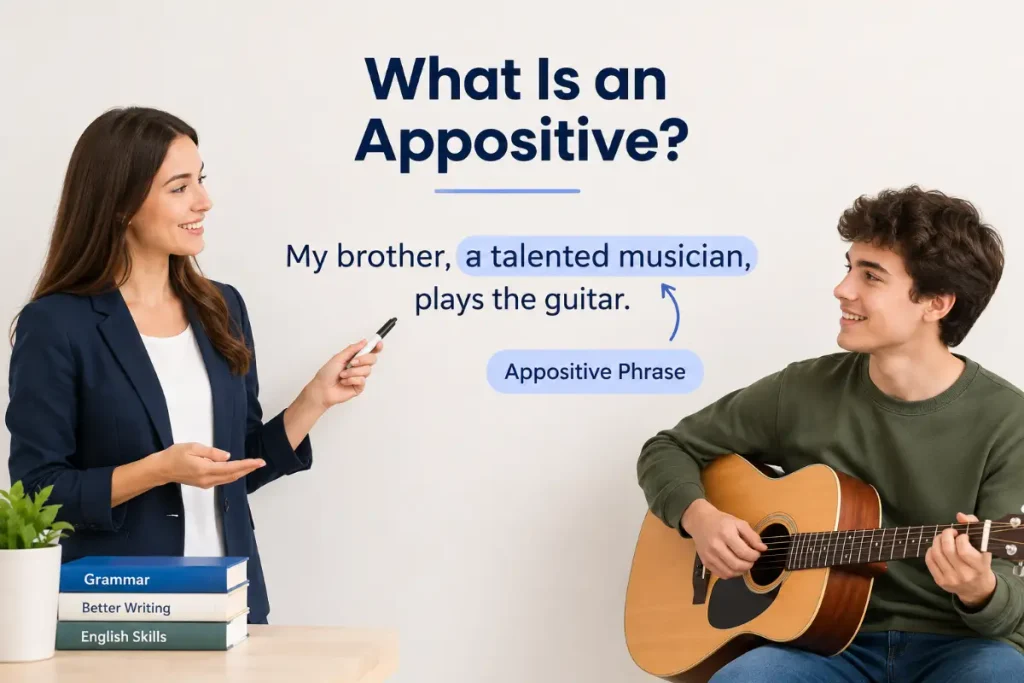
What Is an Appositive Phrase? Definition and Examples
An appositive phrase is a group of words that renames or identifies a noun or pronoun. It contains an appositive noun along with any words that describe or modify it.
For example:
My aunt, an experienced elementary school teacher, lives in Ohio.
The complete appositive phrase is “an experienced elementary school teacher.” Its main noun is “teacher,” while “an,” “experienced,” and “elementary school” help provide more detail. The entire phrase renames “my aunt.”
Here are more examples of appositive phrases:
- The winner, a talented young pianist, received a standing ovation. The phrase “a talented young pianist” renames “the winner.”
- We visited Yellowstone National Park, one of America’s oldest national parks. The phrase “one of America’s oldest national parks” provides additional information about Yellowstone National Park.
- My neighbor Kevin, a professional photographer, took the pictures. The phrase “a professional photographer” tells us more about Kevin.
- The novel To Kill a Mockingbird, a classic of American literature, remains widely read. The phrase “a classic of American literature” describes the novel by renaming it.
An appositive phrase follows the same punctuation rule as a single-word appositive. If the phrase adds nonessential information, separate it with commas. If it identifies the noun, do not use commas around it.
For instance, in “My cousin Emily is visiting,” the name “Emily” identifies which cousin is meant. In “My cousin, Emily, is visiting,” the name is presented as additional information, assuming the context already makes the cousin clear.
Remember that an appositive phrase does not have its own subject-verb combination forming an independent clause. Its job is to rename or explain a noun within the larger sentence.
Appositive vs. Nonessential Phrase: How to Tell the Difference
An appositive and a nonessential phrase are related concepts, but they do not mean exactly the same thing. An appositive is a noun or noun phrase that renames another noun. A nonessential phrase provides information that can be removed without changing the sentence’s basic meaning or leaving the reader unsure about the noun.
An appositive can be essential or nonessential, depending on how it functions in context.
Consider these examples:
Essential appositive:
The writer Toni Morrison won the Nobel Prize in Literature.
Here, “Toni Morrison” identifies which writer the sentence refers to. Because the name is needed to identify the person, no commas are used.
Nonessential appositive:
Toni Morrison, the celebrated American novelist, won the Nobel Prize in Literature.
The phrase “the celebrated American novelist” adds information about Toni Morrison. The name already identifies the person, so the phrase is set off with commas.
For another useful perspective, check out Complete List of Relative Pronouns (2026 Guide).
The same distinction applies to longer phrases:
- Essential: The student sitting by the window asked a question. The phrase identifies which student.
- Nonessential: Liam, the student sitting by the window, asked a question. The phrase adds information about Liam.
A useful way to check the difference is to remove the phrase temporarily. If the sentence still identifies the intended person or thing clearly, the phrase may be nonessential. If removing it makes the reference unclear, it may be essential.
However, context matters. Whether an appositive is essential depends on what the reader already knows and how the sentence identifies its subject. Do not decide based on phrase length or the presence of a person’s name alone.
For more guidance on this punctuation distinction, see our guide to what is a non-restrictive clause.
The Quick Test
If you can replace the first noun with the appositive and the sentence still makes sense, you’ve found an appositive.
- My sister, a nurse, works nights. → A nurse works nights. (still makes sense, so “a nurse” is an appositive)
- She works with a nurse, a doctor, and a pharmacist. → this fails, because “a doctor” and “a pharmacist” are separate items in a list, not renamings of “a nurse”
That second example is worth remembering: a list of nouns separated by commas can look like a string of appositives, but each item in a list names a different thing, while an appositive always names the same thing as the noun beside it.
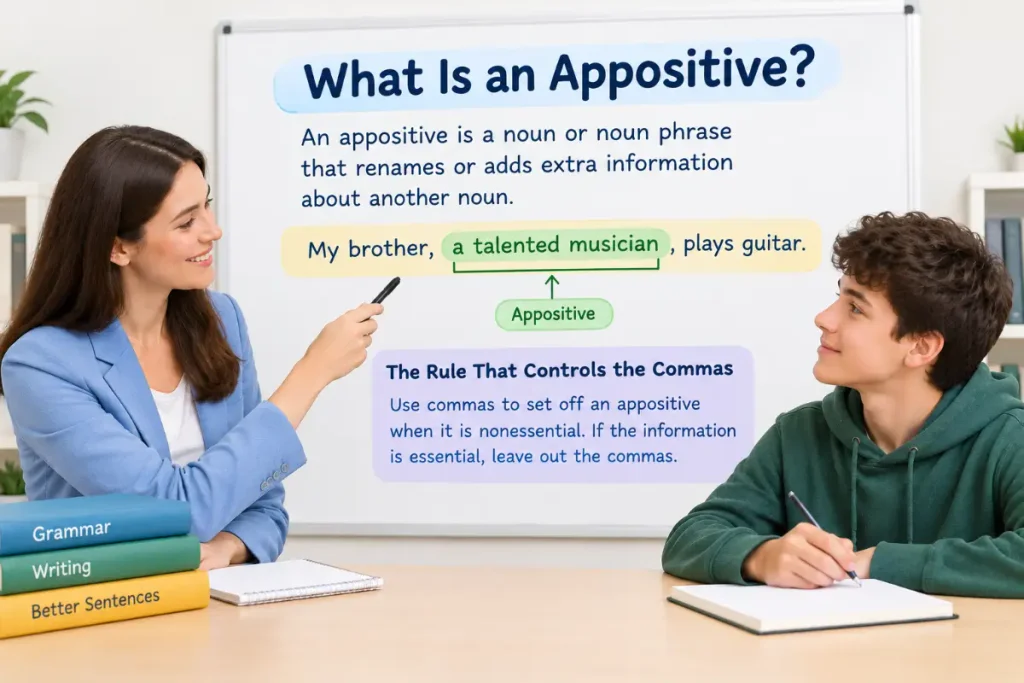
The Rule That Controls the Commas
Purdue OWL’s page on commas with nonessential elements gives the deciding principle: nonessential elements are set off with commas, while essential elements are not. For appositives, that splits into two cases.
Nonessential appositive (commas required). The noun being renamed is already clearly identified, so the appositive is a bonus detail you could delete.
- My uncle, a retired firefighter, lives in Denver.
- Dr. Alvarez, the head of the department, approved the budget.
Delete the appositive and the sentence still identifies exactly who is meant.
Essential appositive (no commas). The appositive is what identifies which person or thing you mean, so removing it would leave the reader unsure.
- The poet Maya Angelou spoke at the ceremony.
- My friend Priya recommended this book.
Purdue OWL’s own illustration of the essential type is “The sixth-century philosopher Boethius was arrested, tortured, and bludgeoned to death.” Without “Boethius,” you wouldn’t know which sixth-century philosopher was meant, so no commas are used.
Why “My Friend Priya” Has No Commas but “My Husband, Sam” Does
This single contrast clears up most appositive comma confusion. The difference comes down to how many people could fit the first noun.
- My friend Priya called. (you have several friends, so “Priya” is needed to identify which one, making it essential, with no commas)
- My husband, Sam, called. (you presumably have one husband, so “Sam” is just extra information, making it nonessential, with commas)
If you have exactly one of the thing being renamed, the appositive is nonessential and gets commas. If there are several possibilities, the appositive picks one out and goes without commas. This is the same removal test covered in our guide to what is a non-restrictive clause, applied to a phrase instead of a clause.
Appositive Phrases: Adding Modifiers
An appositive can grow into a longer phrase when it carries its own modifiers.
- Chicago, a city known for its architecture and deep-dish pizza, hosts the convention.
- The Eiffel Tower, built for the 1889 World’s Fair, still draws millions of visitors.
The comma rule stays the same however long the phrase gets: nonessential appositive phrases are set off with a comma or pair of commas.
Appositives at the Start of a Sentence
An appositive can also open a sentence, in which case it’s followed by a comma before the main clause.
- A skilled negotiator, Maria closed the deal in one afternoon.
- The oldest building on campus, Smith Hall was built in 1887.
Purdue OWL notes that some introductory appositive phrases take a comma after them just as other introductory elements do, a pattern covered in our guide to when to use a comma after an introductory phrase.
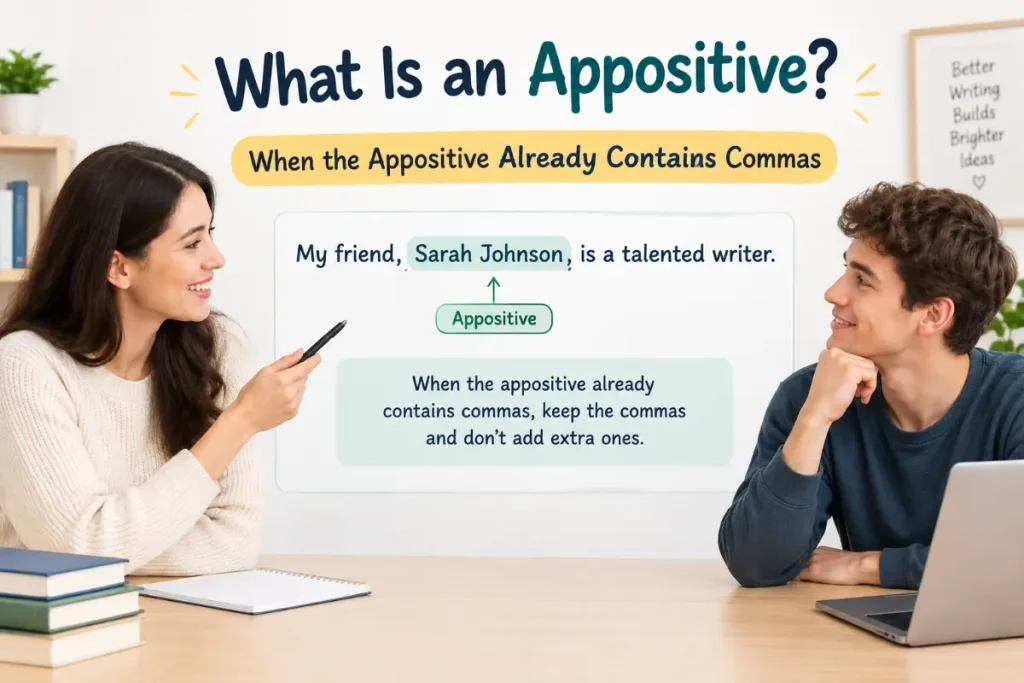
When the Appositive Already Contains Commas
If an appositive phrase has commas inside it, surrounding it with more commas gets confusing. Purdue OWL recommends setting it off with dashes instead.
- Confusing: My three closest friends, Dan, Priya, and Marco, planned the trip.
- Clearer: My three closest friends — Dan, Priya, and Marco — planned the trip.
Our guide to using an em dash covers this and the dash’s other jobs.
Quick Reference Table
| Type | Test | Punctuation | Example |
|---|---|---|---|
| Nonessential | Noun already identified | Commas | My brother, an engineer, called. |
| Essential | Needed to identify which one | No commas | My brother Tom called. |
| Introductory | Opens the sentence | Comma after | A skilled chef, he cooked dinner. |
| Contains commas | Inner commas would clash | Dashes | My friends — Dan, Priya, and Marco — came. |
Common Mistakes People Make
- Mistake 1: Adding commas around an essential appositive, as in “The poet, Maya Angelou, spoke,” which wrongly suggests there is only one poet in the world.
- Mistake 2: Leaving out commas around a nonessential appositive, as in “My husband Sam called” when you have only one husband.
- Mistake 3: Using only one comma, opening a nonessential appositive mid-sentence but never closing it: “My uncle, a retired firefighter lives in Denver.”
- Mistake 4: Mistaking a list for a string of appositives, when each item in a list names a different thing.
- Mistake 5: Stacking commas inside an appositive that already contains commas instead of switching to dashes.
Practice Exercise
Add commas where needed, or write “C” if the sentence is already correct. Answers are listed right after, so try each one before checking.
- My neighbor a retired pilot waters my plants.
- The author Toni Morrison won the Nobel Prize.
- Chicago a city known for its architecture hosts the convention.
- My brother Tom called yesterday.
- Dr. Alvarez the head of the department approved the budget.
- The company’s founder Steve Jobs introduced the iPhone.
- My mother a nurse works nights.
- The movie Titanic won eleven Oscars.
- Paris the capital of France attracts millions of tourists.
- My cousin Sam is visiting next week.
- Our dog Max loves to swim.
- The Eiffel Tower built in 1889 is a famous landmark.
- My boss Linda announced the new policy.
- The novelist Jane Austen wrote Pride and Prejudice.
- A talented writer she published three books by age thirty.
- My only brother Marcus lives in Texas.
- The year 1969 saw the first moon landing.
- Mount Everest the tallest mountain on Earth draws climbers worldwide.
- My friend Priya recommended this book.
- The president of the club Aisha Bello opened the meeting.
Answer Key
- “My neighbor, a retired pilot, waters my plants.”
- C (essential)
- “Chicago, a city known for its architecture, hosts the convention.”
- C (essential, if you have more than one brother)
- “Dr. Alvarez, the head of the department, approved the budget.”
- C (essential)
- “My mother, a nurse, works nights.”
- C (essential)
- “Paris, the capital of France, attracts millions of tourists.”
- C (essential, if you have more than one cousin)
- C (essential, if you have more than one dog)
- “The Eiffel Tower, built in 1889, is a famous landmark.”
- C (essential)
- C (essential)
- “A talented writer, she published three books by age thirty.”
- “My only brother, Marcus, lives in Texas.”
- C (essential)
- “Mount Everest, the tallest mountain on Earth, draws climbers worldwide.”
- C (essential)
- “The president of the club, Aisha Bello, opened the meeting.”
Frequently Asked Questions
How is an appositive different from an adjective?
An appositive is a noun or noun phrase that renames another noun, while an adjective describes it. In “my uncle, a firefighter,” “a firefighter” renames “my uncle,” whereas in “my brave uncle,” “brave” only describes him.
Does an appositive always need commas?
No. Nonessential appositives take commas, but essential appositives, the ones that identify which person or thing you mean, take none, as in “my friend Priya.”
Can an appositive come before the noun it renames?
Yes. Appositives often open a sentence, as in “A skilled negotiator, Maria closed the deal.” In that position the appositive is followed by a comma before the main clause.
What’s the difference between an appositive and a list?
An appositive renames the same thing as the noun beside it, while items in a list name different things. “My sister, a nurse” has one person described twice; “a nurse, a doctor, and a pharmacist” has three people.
What’s the fastest way to decide whether an appositive needs commas?
Ask whether you could delete it and still know exactly who or what is meant. If yes, it’s nonessential and gets commas. If deleting it would leave the reader unsure, it’s essential and takes no commas.
Before moving on, you may also want to read An Adverb? 25 Easy Examples to Understand It (2026) for more helpful grammar tips.
Wrapping Up
Understanding what is an appositive comes down to one idea: a noun that renames the noun next to it. The only real decision after spotting one is whether it’s essential or nonessential, and the deletion test settles that in seconds, with commas for the extras and none for the identifiers.
Once the pattern is familiar, appositives become a handy way to fold a second sentence’s worth of information into the first, keeping your writing compact without losing detail.