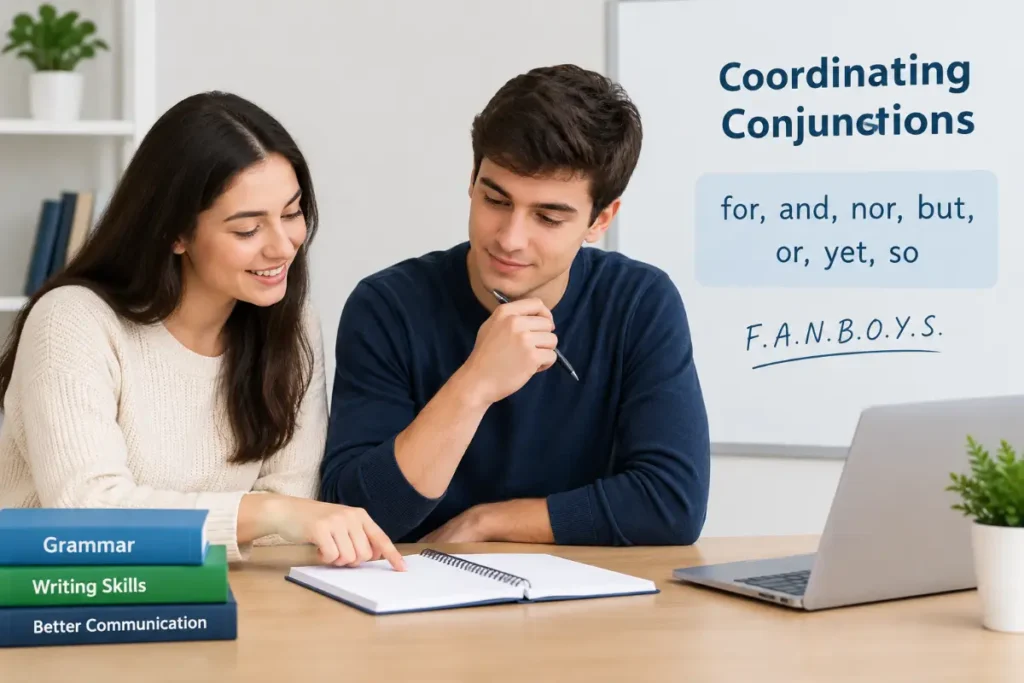
The full list of coordinating conjunctions is short enough to memorize in a minute: for, and, nor, but, or, yet, so, commonly remembered by the acronym FANBOYS. Our earlier guides on how to use conjunctions correctly and what is a conjunction already cover the punctuation rules and the broader category these words belong to. This guide does something different: it takes each of the seven words individually and shows exactly what makes it distinct from its neighbors, since several of them get used interchangeably when they actually carry different shades of meaning.
Knowing all seven by heart is useful, but knowing when “yet” says something “but” doesn’t, or why “for” sounds old-fashioned in casual writing, is what actually improves your sentences. Purdue OWL confirms all seven as the standard set used to separate two independent clauses with a comma, the mechanical rule this guide assumes so it can focus on what each word uniquely contributes.
You may also find A Linking Verb? Easy Guide And 15+ Examples (2026) helpful if you want to explore this topic further.
What Is the List of Coordinating Conjunctions?
The list of coordinating conjunctions in English contains seven words: for, and, nor, but, or, yet, and so. You may know them by the familiar acronym FANBOYS, which makes the list easy to remember. These conjunctions connect words, phrases, or independent clauses that have an equal grammatical role.
Each word, however, communicates a different relationship between ideas. And adds information, but shows contrast, or presents a choice, and so shows a result. For gives a reason, nor continues a negative idea, while yet introduces a contrast that often feels unexpected.
Here is the list at a glance:
| Coordinating Conjunction | Main Relationship |
|---|---|
| For | Reason or cause |
| And | Addition |
| Nor | Continued negative |
| But | Contrast |
| Or | Alternative or choice |
| Yet | Unexpected contrast |
| So | Result or consequence |
Because the list is short, memorizing FANBOYS takes little effort. The more useful skill is understanding why you would choose one conjunction over another. That choice helps your writing sound clearer and makes the relationship between your ideas immediately obvious.
How to Choose the Right Coordinating Conjunction
Choosing a coordinating conjunction becomes easier when you first identify the relationship between the two ideas. Instead of automatically using and, ask what you are actually trying to show.
- Use for when the second clause gives a reason: She stayed home, for she wasn’t feeling well.
- Use and when you simply want to add another idea: She finished her work, and she went home.
- Use nor when you continue a negative statement: He didn’t call, nor did he send a message.
- Use but when the second idea contrasts with the first: The task was difficult, but she completed it.
- Use or when you present an alternative or choice: We can drive, or we can take the train.
- Use yet when the contrast feels surprising or unexpected: He was exhausted, yet he kept working.
- Use so when the second idea is the result of the first: It started raining, so we went inside.
A quick test is to replace the conjunction with its basic meaning. If you mean “also,” choose and. If you mean “in contrast,” choose but. If you mean “as a result,” choose so. If you mean “because,” for may work, although it sounds more formal than because in modern everyday writing.
This approach helps you choose the conjunction based on meaning rather than simply memorizing the FANBOYS list.
Coordinating Conjunctions vs. Subordinating Conjunctions
Coordinating and subordinating conjunctions both connect ideas, but they do not work in exactly the same way. Coordinating conjunctions connect elements that are grammatically equal, while subordinating conjunctions connect a dependent clause to an independent clause.
The seven coordinating conjunctions are for, and, nor, but, or, yet, and so. For example:
- She wanted to leave, but she stayed.
Here, but connects two independent clauses of equal grammatical importance.
Subordinating conjunctions include words such as because, although, since, while, unless, and when:
- She stayed because she had more work to finish.
The clause because she had more work to finish cannot normally stand alone as a complete sentence. It depends on the main clause for its meaning.
The easiest way to remember the difference is this: coordinating conjunctions join equals, while subordinating conjunctions make one idea dependent on another. Understanding that distinction can help you avoid confusing FANBOYS with the much larger group of subordinating conjunctions.
For
“For” introduces a reason or cause, functioning almost like a more formal version of “because” when it connects two independent clauses.
- She left early, for she had an early flight.
This use of “for” has a noticeably literary, formal tone and shows up far more often in older or more polished writing than in casual conversation, where “because” or “since” would be the more natural everyday choice.
And
“And” adds one idea to another, showing simple addition with no implied contrast or consequence.
- He packed his bags, and he left for the airport.
- She likes coffee and tea.
This is by far the most frequently used coordinating conjunction, and it’s the one most people reach for by default even when a more precise word, like “but” or “so,” would better capture the actual relationship between two ideas.
Nor
“Nor” continues a negative thought, used after a clause already containing “not” or “neither” to add a second negative option.
- She didn’t call, nor did she text.
- Neither the manager nor the staff were informed.
Notice the inverted word order that follows “nor” when it starts a new independent clause: “nor did she text,” not “nor she did text.” This inversion is a genuine grammatical requirement, not a stylistic choice, and it’s one of the more commonly dropped rules in casual writing. For a deeper look specifically at this word, see our guide to how to use neither nor correctly.
But
“But” signals contrast or an exception, showing that the second idea pushes against or qualifies the first.
- He studied hard, but he still failed the exam.
- The food was expensive but delicious.
Or
“Or” presents alternatives, whether those alternatives are mutually exclusive or simply options among which a choice can be made.
- We can stay in, or we can go out.
- Would you like tea or coffee?
Yet
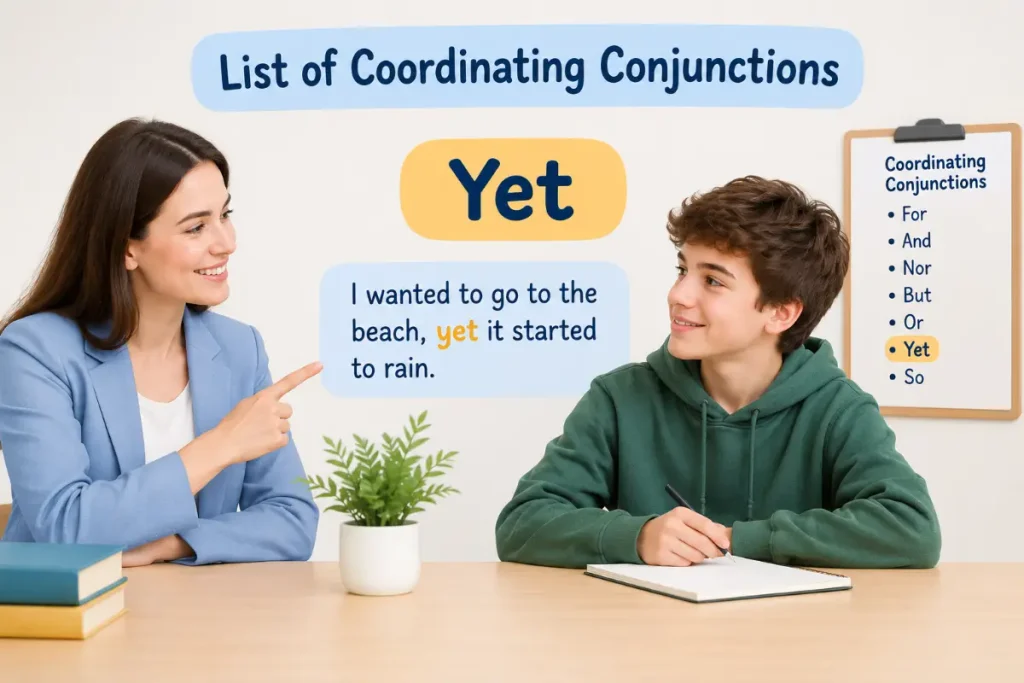
“Yet” also signals contrast, much like “but,” but it carries a slightly stronger sense of surprise or unexpectedness about the contrast being drawn.
- She was exhausted, yet she kept going.
- The plan was risky, yet it worked out perfectly.
The distinction between “but” and “yet” is subtle: “but” simply states a contrast, while “yet” implies the contrast is somewhat surprising or remarkable given what came before it. “She was exhausted, but she kept going” is neutral; “she was exhausted, yet she kept going” suggests her persistence is notable despite the exhaustion.
So
“So” shows result or consequence, connecting a cause to its effect.
- It started raining, so we canceled the picnic.
- He was hungry, so he made a sandwich.
In formal writing, some style guides prefer “therefore” or restructuring with “because” over starting a sentence with “so,” though “so” as a coordinating conjunction joining two clauses within one sentence is entirely standard.
The Punctuation Pattern, Briefly
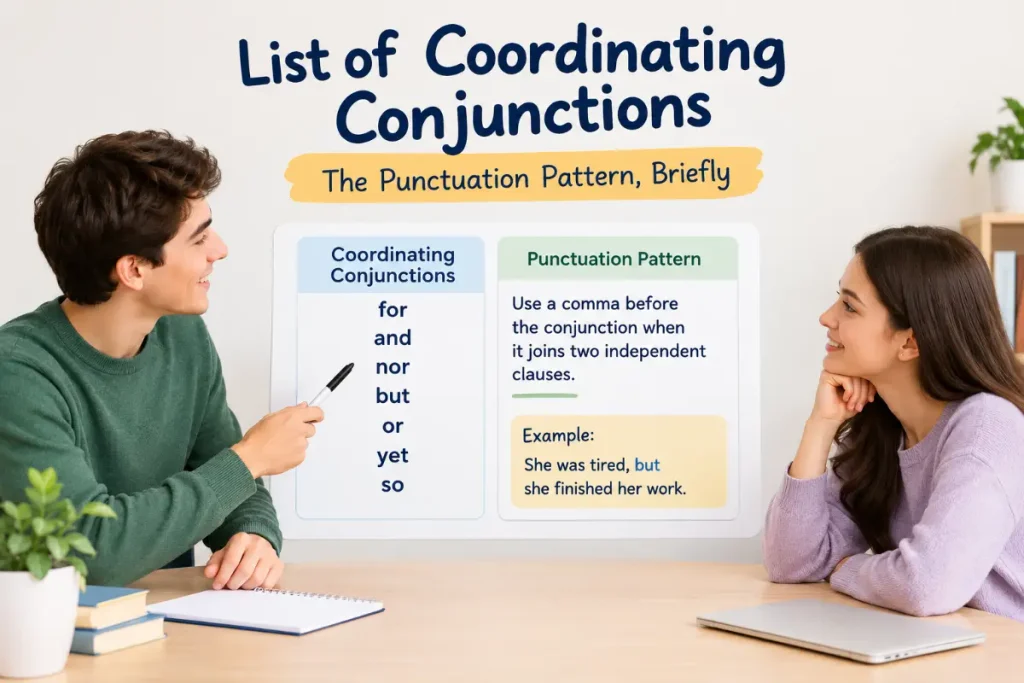
Every one of these seven follows the same core punctuation rule when joining two independent clauses: a comma goes before the conjunction.
- She wanted to stay, but she had to leave.
When joining just two words or short phrases rather than two full clauses, no comma is needed: She wanted tea or coffee. For the complete breakdown of this rule and its exceptions, see our how to use conjunctions correctly guide.
Quick Reference Table
| Word | Relationship Shown | Example |
|---|---|---|
| for | reason or cause | She left, for she was tired. |
| and | addition | He ran and jumped. |
| nor | continued negative | She didn’t call, nor did she text. |
| but | contrast | It was late, but we stayed. |
| or | alternative | Tea or coffee? |
| yet | surprising contrast | Tired, yet still smiling. |
| so | result | It rained, so we left. |
Common Mistakes People Make
Mistake 1: Using “and” by default when “so” or “but” would show the actual relationship between two ideas more precisely.
Mistake 2: Forgetting the inverted word order after “nor,” writing “nor she called” instead of “nor did she call.”
For another useful perspective, check out Types of Adjectives with Examples: 8 Types Explained (2026).
Mistake 3: Treating “but” and “yet” as fully interchangeable, missing the subtle surprise that “yet” adds to a contrast.
Mistake 4: Using “for” as a coordinating conjunction in casual writing, where it tends to sound stiff or old-fashioned compared to “because.”
Mistake 5: Forgetting the comma before a coordinating conjunction that joins two full independent clauses.
Practice Exercise
Choose the coordinating conjunction that best fits each sentence. Answers are listed right after, so try each one before checking.
- She didn’t apologize, ___ did she explain herself.
- He was nervous, ___ he gave a great presentation anyway.
- We can walk, ___ we can take the bus.
- The team practiced all week, ___ they still lost.
- She smiled ___ waved at the crowd.
- He left early, ___ he had a flight to catch.
- It was cold, ___ we stayed inside.
- I like neither coffee ___ tea.
- She trained for months, ___ she finally won the race.
- He was exhausted, ___ he refused to quit.
- They painted the fence ___ mowed the lawn.
- Would you like soup ___ salad?
- The movie was long, ___ it felt too short.
- She didn’t call, ___ she simply forgot.
- He studied hard, ___ he passed with honors.
- We can go now, ___ we can wait until morning.
- She wasn’t tired, ___ was she bored.
- The plan failed, ___ the team learned a lot from it.
- He wanted to leave, ___ he stayed out of respect.
- It was risky, ___ it paid off in the end.
Answer Key
- nor
- but
- or
- but
- and
- for
- so
- nor
- and (or “so,” depending on intended emphasis)
- yet
- and
- or
- yet
- but
- so
- or
- nor
- but
- yet
- yet
Frequently Asked Questions
Why is “for” rarely used as a coordinating conjunction today?
It’s grammatically correct but carries a formal, somewhat literary tone that reads as old-fashioned in everyday writing, which is why “because” or “since” have largely replaced it in casual use.
Is there a real difference between “but” and “yet,” or are they interchangeable?
There’s a subtle difference. “But” states a plain contrast, while “yet” implies the contrast is somewhat surprising or notable, adding a slightly stronger sense of unexpectedness to the same basic relationship.
Why does “nor” require inverted word order?
This follows a long-standing grammatical convention in English for sentences beginning with a negative word, similar to the inversion after words like “never” or “rarely” at the start of a sentence, and it applies specifically when “nor” introduces a new independent clause.
Is it ever correct to start a sentence with a coordinating conjunction?
Yes, despite the old classroom rule against it. Many respected style guides and writers use sentence-initial “and,” “but,” and “so” for emphasis, though some formal contexts still prefer avoiding it out of convention rather than genuine grammatical necessity.
What’s the fastest way to choose the right coordinating conjunction for a sentence?
Identify the actual relationship between your two ideas, addition, contrast, surprising contrast, alternative, result, reason, or continued negative, and match it to the one word on this list built specifically for that relationship.
Before moving on, you may also want to read Complete List of Relative Pronouns (2026 Guide) for more helpful grammar tips.
Wrapping Up
The full list of coordinating conjunctions only has seven entries, but each one carries its own specific shade of meaning: addition, contrast, surprising contrast, alternative, result, reason, and continued negative. Learning to reach for the one that actually fits your sentence’s logic, rather than defaulting to “and” every time, is what separates serviceable writing from genuinely precise writing.
The punctuation rule stays identical across all seven, a comma before the conjunction when joining two full clauses, which means the real skill here is entirely about word choice rather than mechanics once you’ve got the comma pattern down.