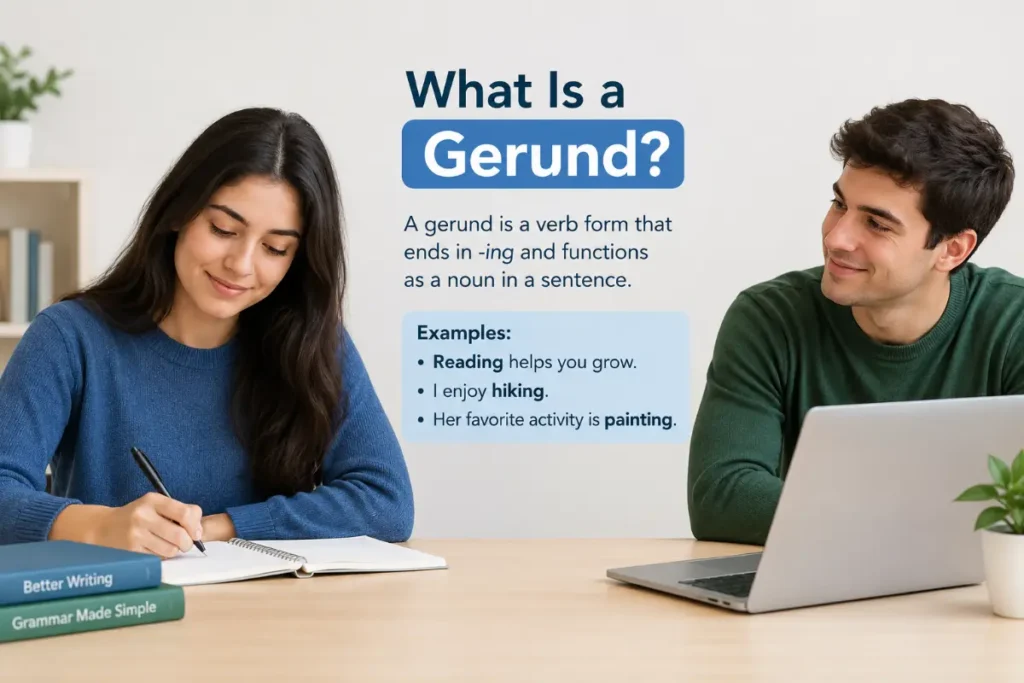
Here’s the short answer to what is a gerund: it’s a verb form ending in -ing that does a noun’s job in a sentence. In “Swimming keeps me fit,” the word “swimming” comes from the verb “swim,” but it sits where a noun would sit, as the subject of the sentence.
The tricky part isn’t the definition. It’s telling gerunds apart from the other -ing words in English, like the present participle and the progressive verb, since they all look identical on the page. This guide gives you a quick test for spotting a gerund, shows the four jobs it can do, and clears up the possessive and verb-pairing rules that trip people up most often.
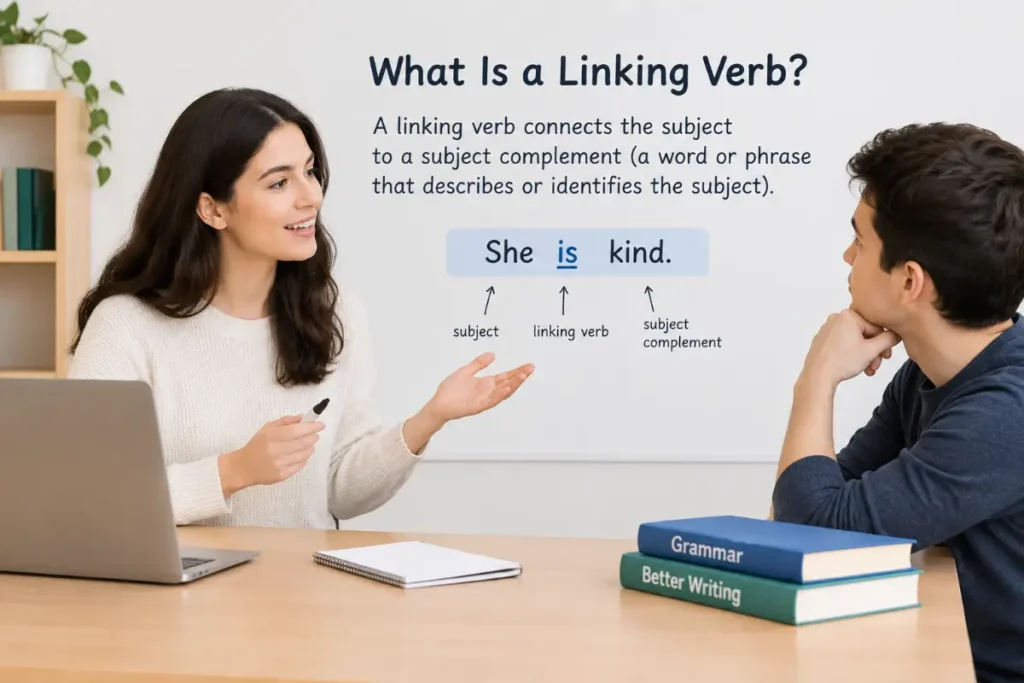
You may also find A Linking Verb? Easy Guide And 15+ Examples (2026) helpful if you want to explore this topic further.
The One-Second Test
To check whether an -ing word is a gerund, try swapping it for “it” or a plain noun. If the sentence still works grammatically, you’ve found a gerund.
- Swimming keeps me fit. → It keeps me fit. (works, so “swimming” is a gerund)
- She is swimming laps. → She is it laps. (fails, so “swimming” is part of the verb, not a gerund)
Purdue OWL uses the same idea in its gerund handout, showing each example twice: once with the gerund and once with the gerund replaced by an ordinary noun phrase. If a noun can take its place, the -ing word was acting as a noun all along.
Four Jobs a Gerund Can Do
Because a gerund is a noun in disguise, it can appear anywhere a noun can. Purdue OWL sorts these into four roles.
Subject of the sentence
- Traveling broadens your perspective.
Direct object of a verb
- She enjoys painting.
- They finished eating an hour ago.
Subject complement (renaming the subject after a linking verb)
- His hobby is collecting stamps.
Object of a preposition
- He apologized for being late.
- We talked about moving to Denver.
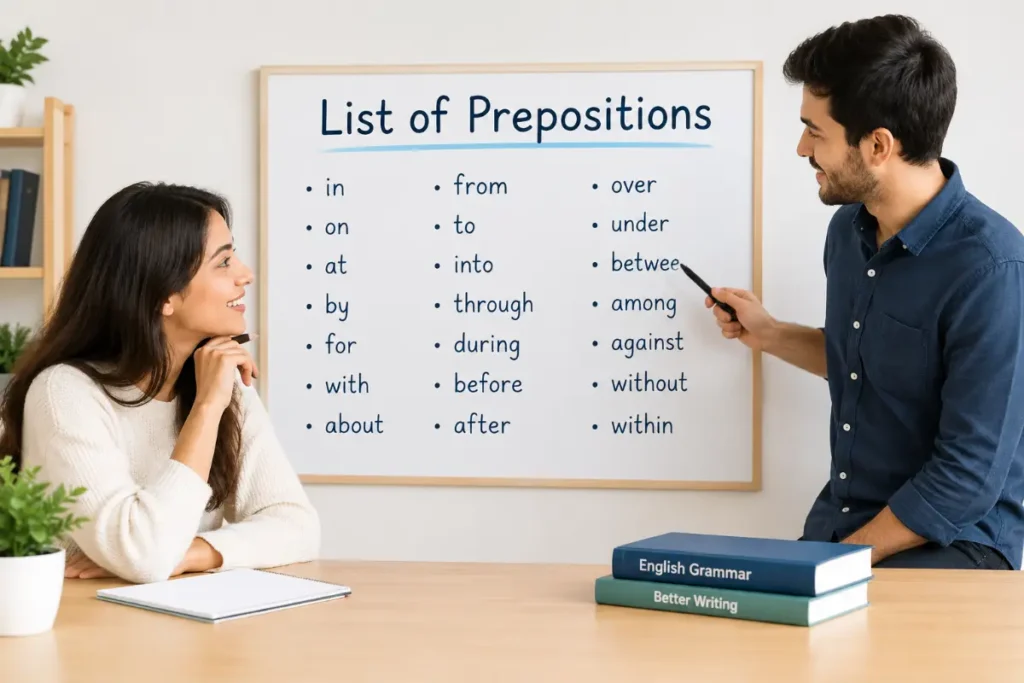
That last role is worth remembering, because any word that follows a preposition like “for,” “about,” “by,” or “without” can turn into a gerund. Our list of prepositions shows just how many words open that door.
Gerund Phrases: The Gerund Plus Its Companions
A gerund often travels with other words that complete its meaning, such as an object or a modifier. Together they form a gerund phrase, and the whole phrase acts as a single noun.
- Learning a new language takes patience. (the phrase “learning a new language” is the subject)
- She dreams of running a marathon. (the phrase “running a marathon” follows the preposition “of”)
- Finding a needle in a haystack is hard.
Purdue OWL also notes that gerunds and gerund phrases almost never need any special punctuation, so you won’t need a comma just because a gerund phrase appears in a sentence.
Gerund or Participle? The Confusion That Matters
Both gerunds and present participles end in -ing, but they work differently. A gerund functions as a noun. A participle functions as an adjective, describing another word.
- Gerund: Running is good exercise. (noun, the subject)
- Participle: The running water was icy. (adjective, describing “water”)
- Participle phrase: Running across the field, he tripped. (adjective phrase describing “he”)
The same word can be either, depending on the job it does in that sentence. When an -ing phrase opens a sentence and describes the subject, you’re dealing with a participle, and that’s where errors like the ones in our guide on how to identify a dangling participle come from.
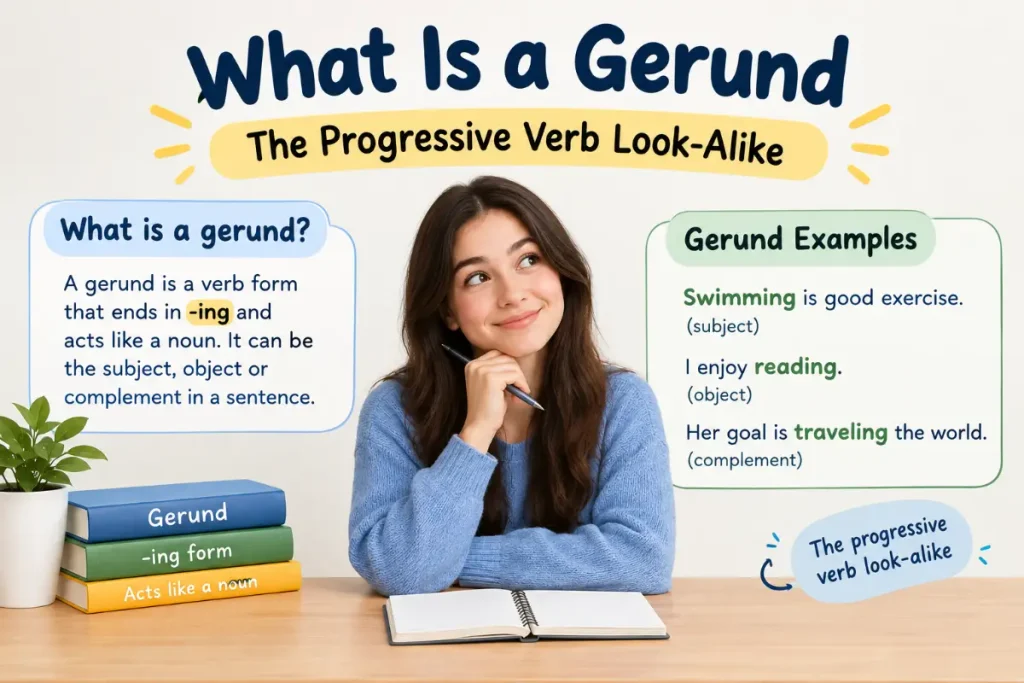
The Progressive Verb Look-Alike
A third look-alike is the progressive verb form, where -ing follows a form of “be” as part of the verb itself.
- She is reading a novel. (progressive verb, not a gerund)
- Reading a novel relaxes her. (gerund, the subject)
If “is,” “was,” “are,” or “were” sits right before the -ing word and the pair works together as the verb, it’s a progressive verb rather than a gerund.
Possessives Before Gerunds
The traditional rule in formal writing is that a noun or pronoun directly before a gerund takes the possessive form.
- The principal banned John’s singing in the halls. (not “John singing”)
- We were delighted by her winning the award. (not “she winning”)
Since the gerund is a noun, it makes sense that whatever modifies it takes the same possessive form any noun would. In casual speech, people often drop the possessive (“I don’t like him leaving early”), but edited writing generally keeps it.
Verbs That Take Gerunds, Not Infinitives
Some verbs must be followed by a gerund rather than an infinitive (“to” plus a verb). Common ones include enjoy, avoid, finish, consider, deny, delay, postpone, practice, suggest, and appreciate.
- He avoided answering the question. (not “avoided to answer”)
- She considered moving abroad. (not “considered to move”)
Other verbs go the opposite way and take only infinitives: hope, promise, agree, and attempt.
- They agreed to sign the treaty. (not “agreed signing”)
Purdue OWL’s comparison handout lists many more in each group, and it’s worth learning the ones you use most often. When you’re listing gerunds and infinitives together, keep them matched, as covered in our guide to parallel structure in writing.
Gerunds vs. Infinitives: What’s the Difference?
Gerunds and infinitives can both function like nouns, which is why they are easy to confuse. A gerund is an -ing form that acts as a noun, while an infinitive usually consists of to + the base form of a verb.
For example:
- Swimming is good exercise. → Gerund
- To swim is good exercise. → Infinitive
Both swimming and to swim function as the subject of the sentence, but they are different grammatical forms.
The bigger difference appears after certain verbs. Some verbs naturally take a gerund:
- I enjoy reading.
- She avoided driving at night.
- They finished cleaning the kitchen.
Others normally take an infinitive:
- I hope to travel soon.
- She agreed to help us.
- They decided to leave early.
Some verbs can take either form, but the meaning may change:
- I stopped smoking. → I quit the activity.
- I stopped to smoke. → I stopped another activity in order to smoke.
So, when deciding whether an -ing word is a gerund, first ask what job it performs in the sentence. If it functions as a noun, it is a gerund. Then consider whether the word before it is a verb or expression that specifically requires a gerund.
This distinction is especially useful because not every verb can be followed by both a gerund and an infinitive interchangeably. Learning common verb patterns helps you avoid sentences such as “I enjoy to read” when standard usage calls for “I enjoy reading.”
Quick Reference Table
| Role | Example | The Gerund |
|---|---|---|
| Subject | Swimming keeps me fit. | Swimming |
| Direct object | She enjoys painting. | painting |
| Subject complement | His hobby is collecting stamps. | collecting |
| Object of a preposition | He apologized for being late. | being |
| Not a gerund (participle) | The running water was icy. | (adjective) |
| Not a gerund (progressive) | She is reading a novel. | (part of the verb) |
Common Mistakes People Make
- Mistake 1: Calling every -ing word a gerund. Only -ing words that act as nouns count.
- Mistake 2: Using an infinitive after a verb that requires a gerund, like “I enjoy to swim” instead of “I enjoy swimming.”
- Mistake 3: Skipping the possessive before a gerund in formal writing, as in “I appreciate you helping” instead of “I appreciate your helping.”
- Mistake 4: Mixing gerunds and infinitives in a list, as in “She likes hiking, swimming, and to ride a bike.”
- Mistake 5: Confusing a gerund phrase with a participial phrase, especially at the start of a sentence, where the participle needs a logical subject to describe.
How to Use Gerunds in Everyday Sentences
Gerunds appear constantly in everyday English, often without sounding like a grammar rule at all. Once you know what to look for, you’ll notice them in conversations, emails, school writing, and ordinary statements.
Here are some common examples:
- Reading before bed helps me relax.
- I enjoy cooking for my family.
- She is interested in learning Spanish.
- He apologized for arriving late.
- Walking every morning gives me more energy.
- We talked about moving to a new apartment.
- They finished cleaning the kitchen.
Notice that the -ing word isn’t simply showing an action happening right now. In each example, it performs a noun-like role. Reading is the subject, cooking is the object of enjoy, and arriving is the object of the preposition for.
A simple way to spot this pattern is to ask, “What is the -ing word doing in the sentence?” If it names an activity or idea and occupies a position normally held by a noun, you’re likely looking at a gerund.
This is why understanding what is a gerund matters beyond memorizing a definition. Once you recognize gerunds in everyday sentences, choosing the correct verb pattern and distinguishing gerunds from participles becomes much easier.
For another useful perspective, check out List of Prepositions: 100+ Words You Need to Know (2026).
Practice Exercise
Decide whether the -ing word (or phrase) in each sentence is a gerund, a participle, or part of a progressive verb. If it’s a gerund, name its role. Answers are listed right after, so try each one before checking.
- Reading improves vocabulary.
- She is reading a novel.
- He enjoys painting.
- The crying baby needed a nap.
- Her hobby is knitting.
- They were arguing loudly.
- She apologized for being late.
- Running across the field, he tripped.
- I don’t mind waiting.
- The barking dog woke us.
- Learning a language takes patience.
- He is thinking about the offer.
- We talked about moving to Denver.
- My sister’s singing impressed everyone.
- She kept talking during the movie.
- The smiling child waved.
- His biggest fear is failing the exam.
- They finished eating at nine.
- Eating slowly aids digestion.
- The band is playing tonight.
Answer Key
- Gerund (subject)
- Progressive verb
- Gerund (direct object)
- Participle (adjective)
- Gerund (subject complement)
- Progressive verb
- Gerund (object of the preposition “for”)
- Participle (participial phrase describing “he”)
- Gerund (direct object of “mind”)
- Participle (adjective)
- Gerund phrase (subject)
- Progressive verb
- Gerund phrase (object of the preposition “about”)
- Gerund (subject), with the possessive “sister’s”
- Gerund (direct object of “kept”)
- Participle (adjective)
- Gerund phrase (subject complement)
- Gerund (direct object of “finished”)
- Gerund phrase (subject)
- Progressive verb
Frequently Asked Questions
Is every word ending in -ing a gerund?
No. Many -ing words are participles (adjectives) or part of a progressive verb. A word is only a gerund when it functions as a noun, which you can check by seeing whether “it” or another noun could replace it.
Can a gerund have an object?
Yes. When a gerund takes an object or modifiers, the whole group becomes a gerund phrase, such as “finding a needle in a haystack,” which then works as a single noun.
Do I need a comma with a gerund phrase?
Generally no. Purdue OWL notes that gerunds and gerund phrases almost never require punctuation, unlike participial phrases that open a sentence.
Why do some verbs take gerunds while others take infinitives?
It’s a matter of established usage rather than a single logical rule, which is why writers learn the common groups. Verbs like enjoy, avoid, and finish take gerunds, while hope, promise, and agree take infinitives.
What’s the fastest way to check whether an -ing word is a gerund?
Try replacing it with “it” or a simple noun. If the sentence still works, it’s a gerund. If a form of “be” sits directly before it as part of the verb, it’s a progressive verb instead.
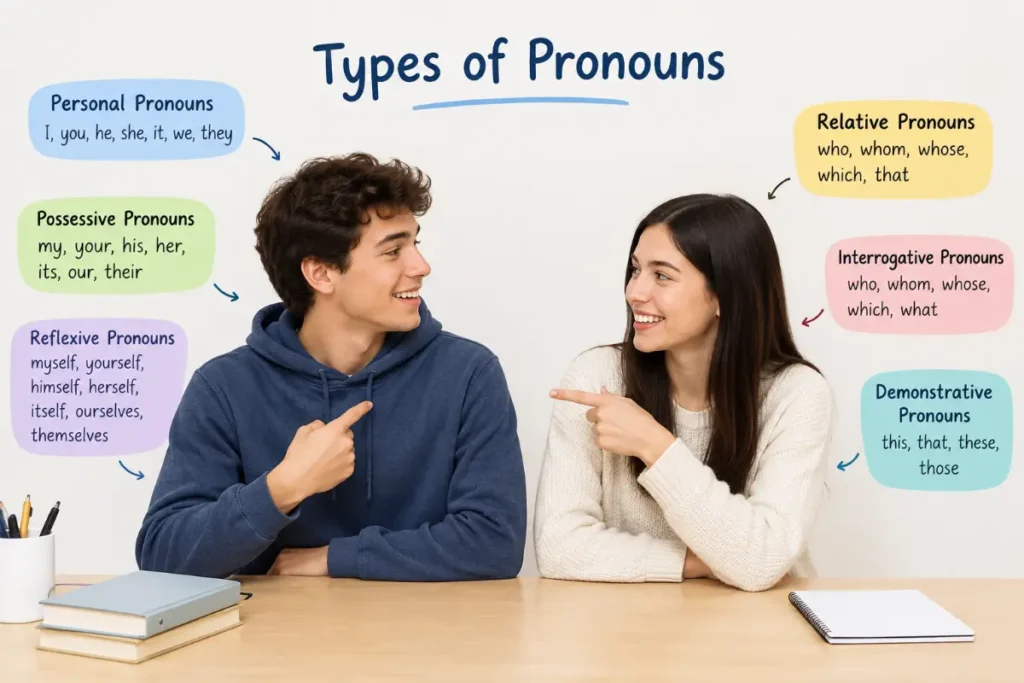
Before moving on, you may also want to read Types of Pronouns: 9 Essential Types With Easy Examples (2026) for more helpful grammar tips.
Wrapping Up
If you’ve ever wondered what is a gerund in practical terms, the answer is short: a verb’s -ing form doing a noun’s job, whether that’s the subject, an object, a subject complement, or the object of a preposition. The replacement test settles most doubtful cases in seconds, and it keeps gerunds from getting mixed up with participles and progressive verbs.
The finer points, such as possessives before gerunds and verbs that require them, are worth learning gradually as you write. Once you can spot a gerund on sight, related skills like keeping lists parallel and avoiding dangling modifiers become noticeably easier.