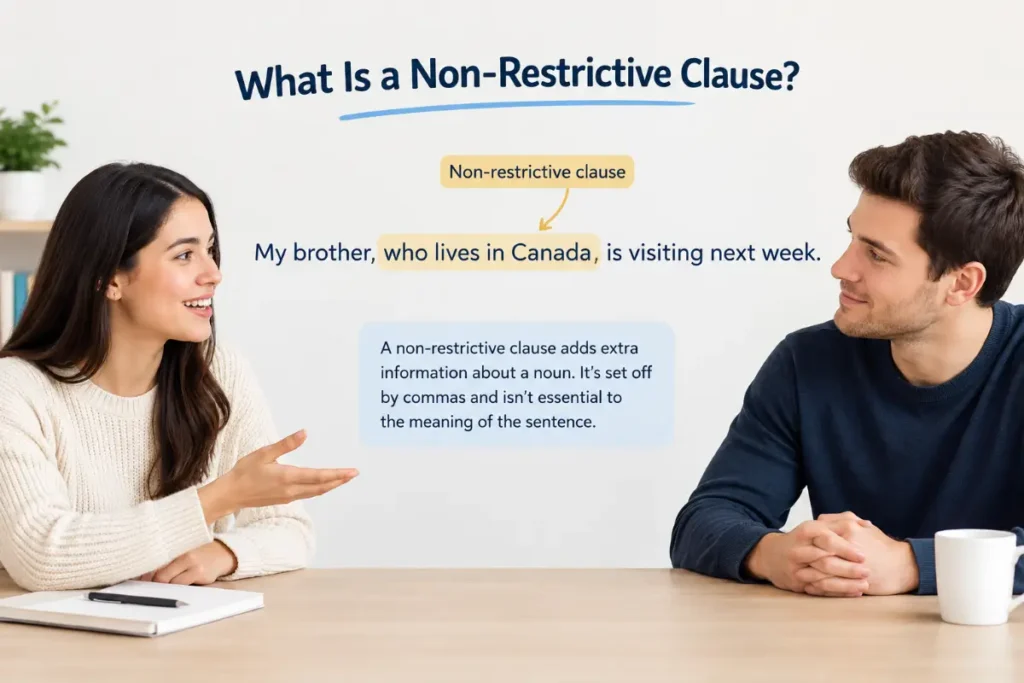
Here’s a single question that resolves what is a non-restrictive clause faster than any technical definition: if you deleted this clause, would the sentence still clearly identify the same person or thing? If yes, it’s non-restrictive, and it needs commas. If deleting it would leave the reader unsure who or what you’re talking about, it’s restrictive instead, and it should never have commas at all.
This one test — sometimes called the “essential versus nonessential” distinction — quietly governs one of the more consequential comma decisions in English, since getting it wrong doesn’t just look sloppy, it can genuinely change what a sentence means.
You may also find Avoid Run-On Sentences: The 2026 Quick Guide helpful if you want to explore this topic further.
The Core Definition
Purdue OWL defines the underlying principle directly: “some modifying elements of a sentence are essential, restricting the meaning of a modified term, while others are nonessential and don’t restrict the modified term’s meaning.” A non-restrictive clause is nonessential — it adds extra, interesting, but ultimately removable information about something the reader can already identify without it.
- My uncle, who is eighty years old, walks three miles every day.
Remove the clause: “My uncle walks three miles every day.” The sentence still clearly identifies exactly who’s being discussed — you have one uncle, and the age detail was just a bonus fact, not something needed to pick him out from other possible uncles.
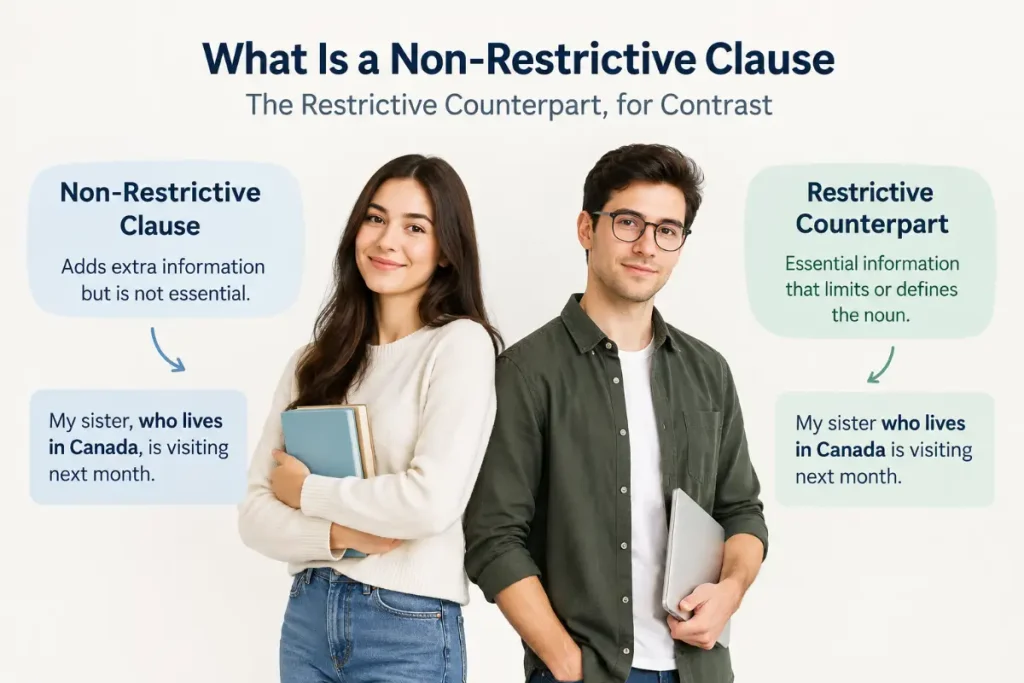
The Restrictive Counterpart, for Contrast
A restrictive (essential) clause does the opposite job — it’s the information that identifies which specific person or thing you mean, and removing it would leave the sentence vague or would change its meaning entirely.
- The woman who interviewed you is my sister.
Remove the clause here: “The woman is my sister.” Now the sentence is suddenly unclear — which woman? The restrictive clause “who interviewed you” isn’t a bonus detail; it’s doing the essential work of specifying exactly which woman is being discussed.
The Punctuation Rule That Follows From This
Once you know which type you’re dealing with, the punctuation rule is completely fixed: non-restrictive clauses always get set off with commas (or, in the middle of a sentence, with a pair of commas). Restrictive clauses never get commas at all.
- Non-restrictive: Company managers, seeking higher profits, hired temporary workers.
- Restrictive: Employees who arrive late must sign in at the front desk.
Notice the second sentence has no commas — “who arrive late” is essential to identifying which employees the sentence is actually about.
Which vs. That: The Word Choice That Often Signals the Type
Purdue OWL confirms a widely followed convention in American English: “which” is the preferred relative pronoun for non-restrictive clauses, while “that” is generally reserved for restrictive ones. This isn’t an absolute law, but it’s a strong, useful pattern.
- Restrictive: The car that has a dent in the door is mine. (identifies which specific car)
- Non-restrictive: My car, which has a dent in the door, is parked outside. (adds extra detail about a car already identified as “my car”)
Following this “that for restrictive, which for non-restrictive” pattern consistently makes your writing’s intent clearer to careful readers, even in the cases where the comma alone would technically be enough to signal the distinction.
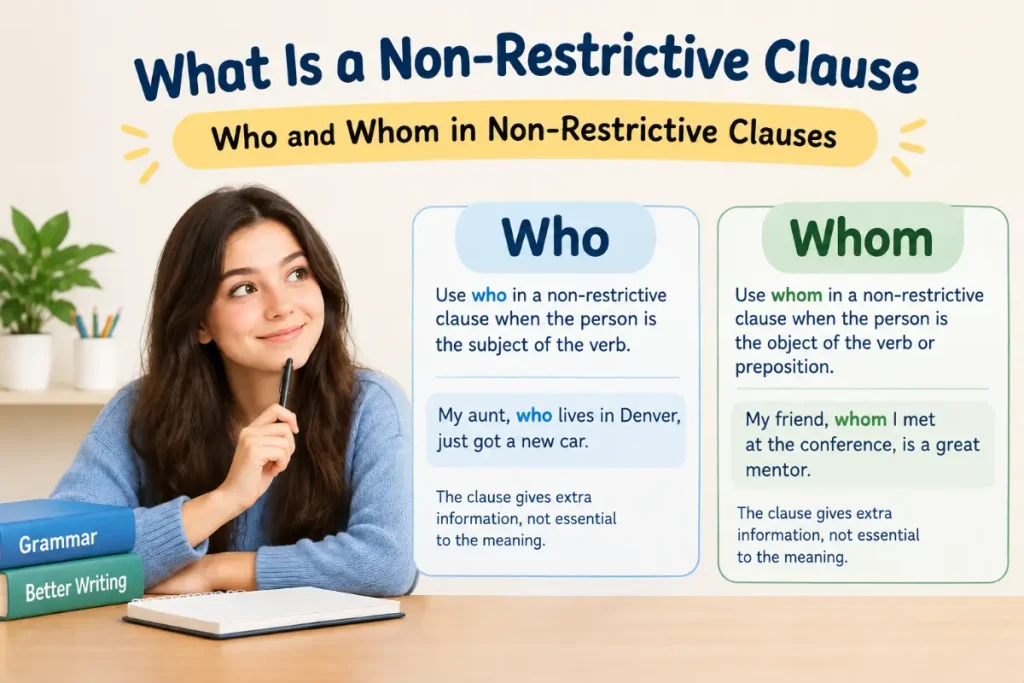
Who and Whom in Non-Restrictive Clauses
The same essential/nonessential logic applies to clauses built around “who” and “whom,” not just “which” and “that.”
- Restrictive: The professor who taught this course retired last year. (identifies which professor)
- Non-restrictive: Dr. Alvarez, who taught this course for twenty years, retired last spring. (Dr. Alvarez is already identified by name; the clause just adds detail)
Why the Distinction Actually Matters for Meaning
This isn’t purely a stylistic nicety — the presence or absence of commas can genuinely change a sentence’s meaning, which is exactly why the distinction deserves real attention rather than being treated as a minor formatting choice.
- The students who finished early left the classroom. (restrictive — implies only some students finished early, and only those specific students left)
- The students, who finished early, left the classroom. (non-restrictive — implies all the students finished early, and this fact is simply extra information about the whole group leaving)
These two versions describe genuinely different scenarios, and a reader relies entirely on the commas to know which one you mean.
A Useful Two-Question Test
Question 1: If I deleted this clause, would the sentence still clearly identify the same specific person or thing? If yes, it’s non-restrictive — add the commas.
Question 2: Does this clause interrupt the sentence’s flow, feeling like an aside rather than a core identifying detail? If yes, that’s another signal it’s non-restrictive.
If both answers point the same direction, you can commit to your punctuation choice with confidence.
Quick Reference Table
| Feature | Restrictive (Essential) | Non-Restrictive (Nonessential) |
|---|---|---|
| Commas? | No | Yes |
| Removable without changing meaning? | No | Yes |
| Preferred pronoun | that, who, whom | which, who, whom |
| Function | Identifies which specific one | Adds extra detail about an already-identified one |
| Example | The book that you lent me was great. | This book, which you lent me, was great. |
How to Identify a Non-Restrictive Clause in a Sentence
If you’re still asking what is a non-restrictive clause when you encounter one in a real sentence, use a simple three-step check. The goal is to determine whether the clause identifies the noun or simply adds information about a noun that is already clear.
1. Find the Descriptive Clause
Look for a clause that gives additional information about a person, place, thing, or group. Non-restrictive clauses often begin with who, whom, or which.
- Maria, who works at the library, is moving next month.
- The laptop, which I bought last year, still works perfectly.
In both sentences, the clause adds information about a noun that has already been identified.
2. Remove the Clause
Temporarily take the clause out of the sentence and read what remains.
- Maria, who works at the library, is moving next month.
- Maria is moving next month.
The remaining sentence is still clear. We know exactly who “Maria” refers to, so the clause is non-restrictive.
Try the same test with a restrictive clause:
- The employees who completed the training received certificates.
- The employees received certificates.
The second version changes the meaning because the original sentence specifically refers to the employees who completed the training. That clause is therefore restrictive, not non-restrictive.
3. Check the Commas
Once the clause passes the removal test, check the punctuation. A non-restrictive clause should be separated from the rest of the sentence with commas.
- Correct: My brother, who lives in Chicago, is visiting this weekend.
- Correct: The new office, which opened in June, is already busy.
- Incorrect: My brother who lives in Chicago is visiting this weekend. (if “who lives in Chicago” is only extra information)
For a clause in the middle of a sentence, you normally need a comma before and after it. When the clause comes at the end, one comma can separate it from the main clause.
A Quick Before-and-After Test
When you’re unsure, compare the sentence with and without the clause:
Original:
The museum, which opened in 1925, attracts thousands of visitors each year.
Without the clause:
The museum attracts thousands of visitors each year.
The identity of “the museum” remains clear, so which opened in 1925 is non-restrictive and should be set off with commas.
Now compare:
Original:
The museum that opened in 1925 attracts thousands of visitors each year.
Without the clause:
The museum attracts thousands of visitors each year.
Here, that opened in 1925 helps identify which museum the writer means. Removing it can change the intended reference, so the clause is restrictive and does not take commas.
For another useful perspective, check out Use Conjunctions Correctly: A Practical Walkthrough (2026).
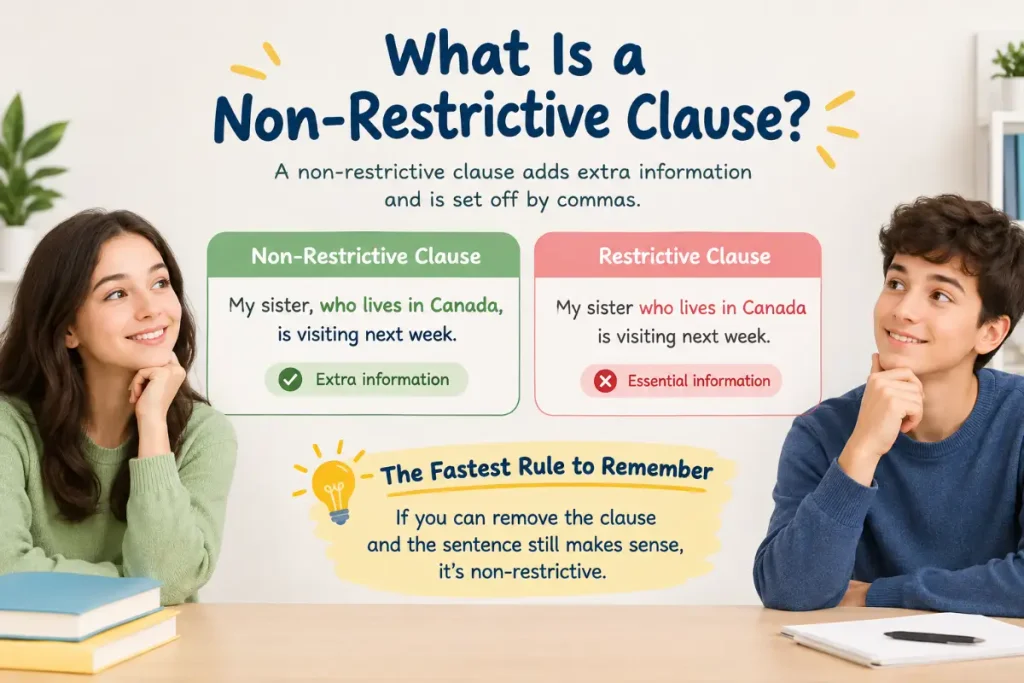
The Fastest Rule to Remember
For everyday American English, remember this sequence:
Identify the noun → remove the clause → check the meaning → add commas if the noun remains clearly identified.
This makes the what is a non-restrictive clause question much easier to answer without relying on memorized terminology. If the information is merely extra and the reader already knows exactly which person or thing you mean, treat the clause as non-restrictive and set it off with commas.
Common Mistakes People Make
- Mistake 1: “My sister, who lives in Denver, is visiting.” when the writer actually has multiple sisters and needs to specify which one. If the clause is truly identifying which sister (out of several), it should be restrictive, with no commas: “My sister who lives in Denver is visiting.”
- Mistake 2: “The employees who work hard, deserve recognition.” A stray, unnecessary comma before a restrictive clause — this should have no comma at all: “The employees who work hard deserve recognition.”
- Mistake 3: Using “which” for a clearly restrictive clause: “The car which has a dent is mine” reads more naturally as “The car that has a dent is mine,” following the standard American convention.
- Mistake 4: Leaving out commas around a genuinely non-restrictive clause, making the sentence briefly ambiguous about whether the detail is essential or just additional.
- Mistake 5: Assuming this distinction is purely a stylistic nicety rather than something that can change a sentence’s actual meaning, as shown in the “students who finished early” example above.
Practice Exercise
Decide whether each sentence needs commas around its clause (non-restrictive) or no commas at all (restrictive). Answers are listed right after — try each one before checking.
- The book that I borrowed from you was fantastic.
- My mother who taught high school for thirty years just retired.
- Students who miss the deadline will receive a penalty.
- This restaurant which just opened last month is already popular.
- The employee who was late three times was let go.
- Our house which we bought last year needs a new roof.
- The candidates who passed the exam will move to round two.
- My car which I’ve had for ten years finally broke down.
- Anyone who arrives late must wait outside.
- The report that was submitted yesterday contained errors.
- Dr. Kim who has been my doctor for years recommended this treatment.
- The photo that won the contest is on display.
- Sarah who just moved here doesn’t know anyone yet.
- Employees who complete the training will get a raise.
- This painting which took years to complete sold for millions.
- The teacher who assigned homework every night was strict.
- My best friend who lives across the country called me today.
- The dog that barks all night belongs to my neighbor.
- Our CEO who founded the company decided to retire.
- Applicants who don’t submit references will be disqualified.
Answer Key
- Restrictive — no commas.
- Non-restrictive — “My mother, who taught high school for thirty years, just retired.”
- Restrictive — no commas.
- Non-restrictive — “This restaurant, which just opened last month, is already popular.”
- Restrictive — no commas.
- Non-restrictive — “Our house, which we bought last year, needs a new roof.”
- Restrictive — no commas.
- Non-restrictive — “My car, which I’ve had for ten years, finally broke down.”
- Restrictive — no commas.
- Restrictive — no commas.
- Non-restrictive — “Dr. Kim, who has been my doctor for years, recommended this treatment.”
- Restrictive — no commas.
- Non-restrictive — “Sarah, who just moved here, doesn’t know anyone yet.”
- Restrictive — no commas.
- Non-restrictive — “This painting, which took years to complete, sold for millions.”
- Restrictive — no commas.
- Non-restrictive — “My best friend, who lives across the country, called me today.”
- Restrictive — no commas.
- Non-restrictive — “Our CEO, who founded the company, decided to retire.”
- Restrictive — no commas.
If you got sixteen or more correct, the essential-versus-nonessential test has already become second nature. For any you missed, ask again: would removing the clause leave the reader unsure who or what is being discussed?
Frequently Asked Questions
Is the “that for restrictive, which for non-restrictive” rule strictly enforced?
It’s a strong American English convention rather than an absolute law — some writers and British English speakers use “which” for restrictive clauses too. Following the convention consistently, though, makes your intended meaning clearer to careful readers and is expected in most American style guides.
Can a non-restrictive clause appear at the very start of a sentence?
Non-restrictive clauses typically follow the noun they describe, so they’re more commonly found mid-sentence or at the end, set off by one or two commas depending on their position, rather than opening a sentence.
Does this distinction apply to phrases as well as clauses?
Yes — the same essential/nonessential logic applies to appositive phrases and participial phrases, not just relative clauses built with “who,” “which,” or “that.” Any modifying element can be evaluated with the same removability test.
Why does this distinction sometimes get called “defining” versus “non-defining” instead?
These are simply alternate names for the same concept — restrictive clauses “define” or narrow down which specific thing is meant, while non-restrictive (non-defining) clauses add extra detail about something already identified.
What’s the fastest way to catch restrictive/non-restrictive comma errors before publishing something?
For every clause beginning with “who,” “which,” or “that,” ask whether removing it would leave the sentence’s meaning intact and its subject clearly identified. If yes, add commas; if removing it would create ambiguity, leave the commas out entirely.
Before moving on, you may also want to read The Singular They Grammar Rule: A Simple 2026 Guide for more helpful grammar tips.
Wrapping Up
Understanding what is a non-restrictive clause comes down to a simple, repeatable removal test: if the clause could disappear without leaving the reader unsure who or what is being discussed, it’s non-restrictive and needs commas; if removing it would create genuine ambiguity, it’s restrictive and should never have commas around it at all.
This distinction is worth taking seriously precisely because it isn’t just about tidiness — as the “students who finished early” example shows, the presence or absence of commas can change what a sentence actually claims, which makes this one of the more consequential comma decisions you’ll make in everyday writing.