Every discussion of double negatives in English grammar eventually runs into the same surprising fact: this “error” has been used by some of the most celebrated writers in the English language, including Chaucer and Shakespeare, and the rule against it is far younger and far shakier than most people assume. Understanding where the rule actually came from changes how you think about it — not as an eternal law of logic, but as an 18th-century style preference that hardened into dogma.
This guide covers what a double negative actually is, traces its surprising history, and works through the specific modern cases — including the deliberate, sophisticated version called litotes — where using two negatives together is not just acceptable but stylistically effective.
You may also find The Split Infinitive Rule: 13 Common Mistakes to Avoid (2026) helpful if you want to explore this topic further.
What a Double Negative Actually Is
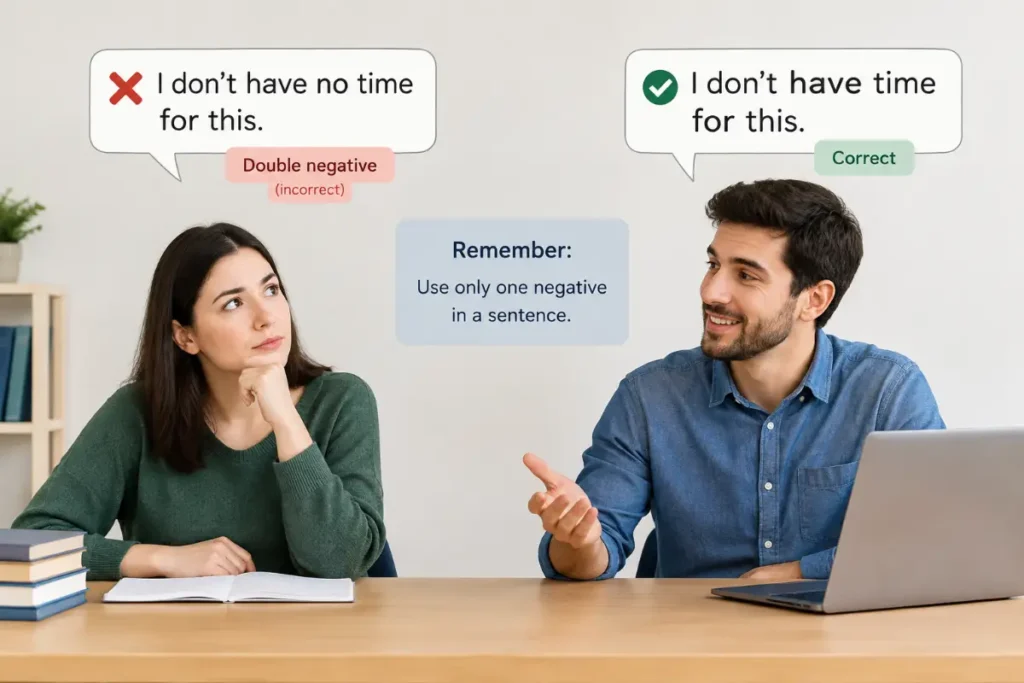
Merriam-Webster defines it plainly: “a now nonstandard syntactic construction containing two negatives and having a negative meaning.” The classic example: “I didn’t hear nothing.” In Standard American English today, this construction is considered nonstandard — not because the meaning is genuinely unclear, but because 18th-century grammarians decided negatives should behave like mathematical signs, canceling each other out.
- Nonstandard: I didn’t hear nothing.
- Standard: I didn’t hear anything.
Where the “Two Negatives Make a Positive” Rule Actually Came From
Here’s the historical surprise: double and even triple negatives were completely normal in English for centuries. Old English, Middle English, and early Modern English writers used multiple negation freely to intensify a negative statement, not cancel it out. Chaucer packed multiple negatives into a single line of the Canterbury Tales without anyone batting an eye, and Shakespeare did the same — in Twelfth Night, he wrote “nor never none / Shall mistress be of it,” stacking three negative words together for emphasis, not confusion.
The shift arrived in the 18th century, when Bishop Robert Lowth’s 1762 grammar guide, and later Lindley Murray’s widely used 1795 grammar text, imported a mathematical logic into English: if two negatives cancel out in arithmetic, they should cancel out in language too. This borrowed logic never actually reflected how English speakers used negation, but it caught on among educators and became entrenched as a mark of “proper” speech — meanwhile, double and multiple negation simply continued (and still continues) as a completely grammatical, meaningful feature of many English dialects.
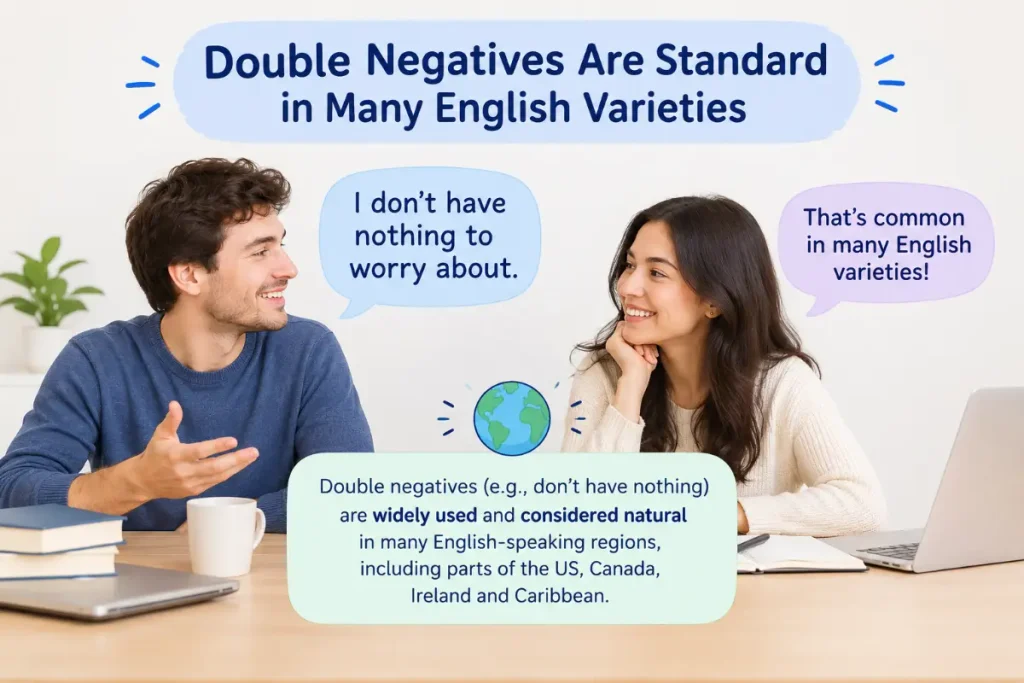
Double Negatives Are Standard in Many English Varieties
This is worth stating plainly, since it directly affects how this topic should be discussed: Merriam-Webster’s own usage note confirms that constructions like “she ain’t never lost a race” and “we didn’t have no dog then” are “common and grammatical in other varieties of English, including African American English, Southern, and Appalachian English.” In these dialects, the two negatives don’t cancel each other — they amplify one another, functioning as intensifiers rather than as a logical cancellation. This isn’t an error within those dialects; it’s a different, internally consistent grammatical system with its own long history, entirely separate from Standard American English’s more recent, narrower convention.
The Sophisticated Exception: Litotes
Here’s where the modern rule gets genuinely interesting rather than purely restrictive. Merriam-Webster’s own grammar notes describe a specific, celebrated use of double negation called litotes — deliberate understatement where an affirmative is expressed through the negation of its opposite.
- She is not unattractive. (implies she’s attractive, but with a note of understatement or hedging)
- He is not unfamiliar with the subject. (implies real familiarity, delivered with restraint)
- That is not an insignificant achievement. (implies genuine significance, softened by the phrasing)
These aren’t errors at all — they’re a recognized, sophisticated rhetorical device, and Merriam-Webster specifically notes that this kind of double negative “expresses something slightly different from what the sentence would mean without the negatives.” Simply canceling the two negatives out mathematically (“she is attractive”) loses the subtle, understated flavor litotes intentionally adds.
Standard American English: What to Avoid in Formal Writing
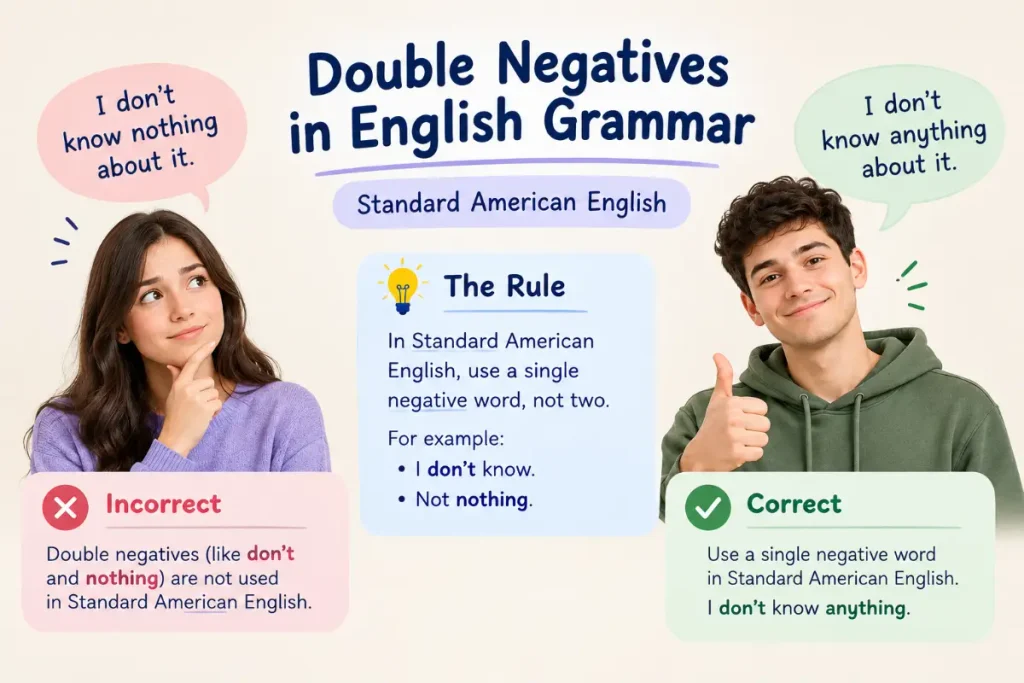
Despite the rich, legitimate history above, Standard American English — the dialect expected in most academic, professional, and formal writing contexts — treats stacked negatives (outside of deliberate litotes) as nonstandard.
- Nonstandard: I can’t get no satisfaction.
- Standard: I can’t get any satisfaction.
- Nonstandard: She doesn’t know nothing about it.
- Standard: She doesn’t know anything about it.
- Nonstandard: We didn’t see nobody at the store.
- Standard: We didn’t see anybody at the store.
The fix in each case follows the same pattern: keep one negative word (don’t, can’t, doesn’t) and change the second negative-sounding word (no, nothing, nobody) into its neutral, “any” equivalent (any, anything, anybody).
How to Identify Double Negatives in English Grammar
The easiest way to identify double negatives in English grammar is to look for two negative words or expressions working within the same clause. Common negatives include not, don’t, doesn’t, didn’t, can’t, won’t, never, no, nobody, nothing, hardly, barely, and rarely. When two of these appear together, check whether they are creating an unintended negative construction or serving a deliberate purpose such as litotes.
For example:
- I don’t have no money. → Two negatives create a nonstandard construction in Standard American English.
- I don’t have any money. → Standard American English.
- She is not unattractive. → Deliberate litotes, expressing an understated positive meaning.
- He can hardly see. → Standard construction because hardly already carries a near-negative meaning.
A Simple Three-Step Check
1. Find the negative words.
Look for words such as not, never, no, nothing, nobody, hardly, and barely.
2. Check whether two negatives appear in the same clause.
For example, didn’t + nothing and can’t + hardly deserve a closer look.
3. Decide what the sentence is trying to do.
If the two negatives are simply being used to express one negative idea in Standard American English, rewrite the sentence. If the combination deliberately creates understatement, as in not uncommon or not insignificant, it may be litotes.
For another useful perspective, check out Avoid Passive Voice in Writing: 7 Easy Rules (2026).
Compare the Difference
- Nonstandard: I didn’t see nobody there.
- Standard: I didn’t see anybody there.
- Litotes: The result was not unexpected.
The key is not to assume that every sentence containing two negative words is automatically an error. Double negatives in English grammar can serve different functions depending on the variety of English and the writer’s purpose. For Standard American English, the practical editing question is whether the construction is an unintended stacked negative or an intentional rhetorical choice.
Quick Reference Table
| Nonstandard (in Standard American English) | Standard Equivalent |
|---|---|
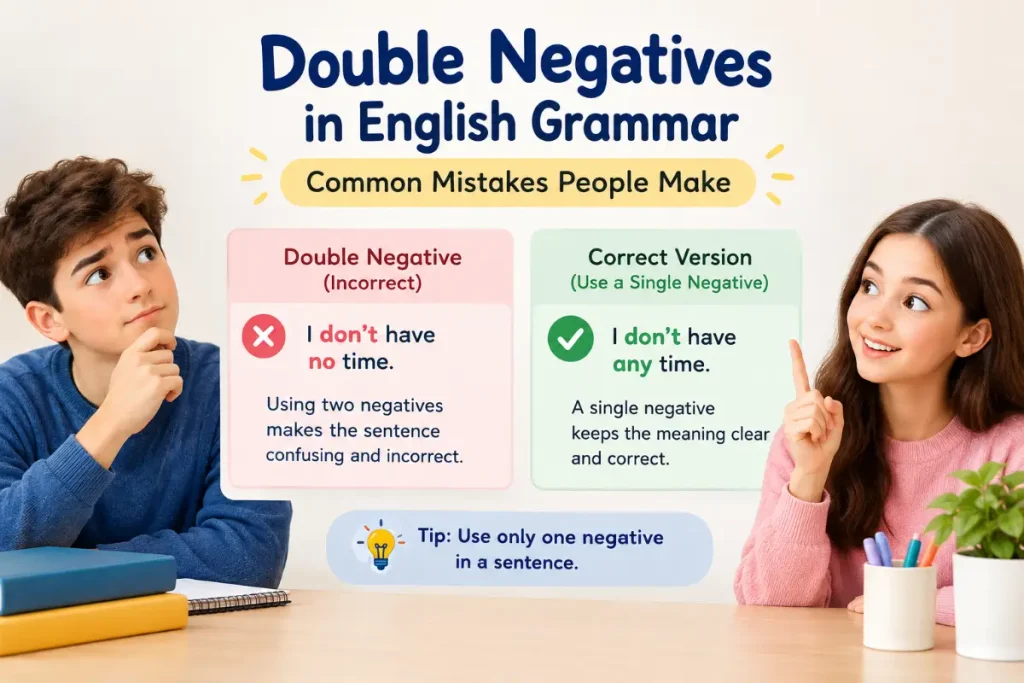
| I don’t have no money. | I don’t have any money. |
| She can’t hardly see. | She can hardly see. |
| We didn’t do nothing wrong. | We didn’t do anything wrong. |
| He won’t never agree. | He will never agree. |
| Nobody don’t like that. | Nobody likes that. |
Common Mistakes People Make
- Mistake 1: “I can’t hardly wait.” “Hardly” already functions as a near-negative, so pairing it with “can’t” creates an unintended double negative in Standard usage: “I can hardly wait.”
- Mistake 2: Assuming litotes and accidental double negatives are the same thing. “Not unattractive” is a deliberate rhetorical choice; “don’t have no money” in formal writing is typically an unintended nonstandard construction, not a stylistic device.
- Mistake 3: Correcting someone’s dialect as though it contains a grammar error, without recognizing that many English varieties use double negation as a standard, rule-governed feature rather than a mistake.
- Mistake 4: Overusing litotes to the point of obscuring meaning — “not un-uncommon” or similarly stacked understatements become genuinely hard to parse rather than stylistically effective.
- Mistake 5: Believing the “two negatives make a positive” explanation is an eternal, universal law of language, when it’s actually a relatively recent, English-specific convention that many other languages — and many English dialects — don’t follow at all.
Practice Exercise
Identify whether each sentence is a nonstandard double negative (needing correction for Standard American English) or an intentional, acceptable use of litotes. Answers are listed right after — try each one before checking.
- I don’t want no trouble.
- She is not incapable of finishing the project.
- We didn’t see nothing unusual.
- He is not unaware of the risks.
- They can’t hardly believe the news.
- That’s not a bad idea at all.
- Nobody don’t want to go first.
- His approach is not unlike mine.
- She won’t never change her mind.
- That outcome was not unexpected.
- I haven’t got no time for this.
- This is not an insignificant problem.
- We didn’t do nothing about it.
- He’s not unfamiliar with the process.
- There isn’t nobody in the office.
- It’s not uncommon to feel nervous.
- I don’t have no idea what happened.
- She is not unkind, just reserved.
- They didn’t want no part of it.
- The results were not inconclusive.
Answer Key
- Nonstandard — “I don’t want any trouble.”
- Litotes (acceptable)
- Nonstandard — “We didn’t see anything unusual.”
- Litotes (acceptable)
- Nonstandard — “They can hardly believe the news.”
- Litotes (acceptable)
- Nonstandard — “Nobody wants to go first.”
- Litotes (acceptable)
- Nonstandard — “She will never change her mind.”
- Litotes (acceptable)
- Nonstandard — “I haven’t got any time for this.”
- Litotes (acceptable)
- Nonstandard — “We didn’t do anything about it.”
- Litotes (acceptable)
- Nonstandard — “There isn’t anybody in the office.”
- Litotes (acceptable)
- Nonstandard — “I don’t have any idea what happened.”
- Litotes (acceptable)
- Nonstandard — “They didn’t want any part of it.”
- Litotes (acceptable — implies the results were fairly conclusive)
If you got sixteen or more correct, you’ve internalized the real distinction: unintentional double negatives to fix in formal writing versus deliberate litotes that add stylistic nuance.
Frequently Asked Questions
Are double negatives grammatically wrong in every form of English?
No — Merriam-Webster explicitly notes they’re standard and grammatical in dialects like African American English, Southern English, and Appalachian English, where they function as intensifiers rather than cancellations. The “nonstandard” label applies specifically to Standard American English, the dialect typically expected in formal and academic writing.
What is litotes, and why is it considered acceptable?
Litotes is a deliberate rhetorical device using double negation to express an understated affirmative, such as “not unattractive” or “not uncommon.” Unlike accidental double negatives, litotes is a recognized, sophisticated stylistic choice with a long history in formal and literary English.
Did double negatives used to be considered correct in English?
Yes — multiple negation was standard in Old English, Middle English, and early Modern English, used by writers including Chaucer and Shakespeare specifically to intensify negative statements. The prohibition against it only emerged in the 18th century, based on an analogy to mathematics rather than any observation of how English actually worked.
How can I quickly fix a nonstandard double negative in my own writing?
Keep one negative word and convert the other negative-sounding word into its neutral “any” equivalent: “no” becomes “any,” “nothing” becomes “anything,” “nobody” becomes “anybody,” and “never” often becomes “ever” or the sentence is restructured to remove the redundant negative entirely.
What’s the fastest way to catch double negative errors before publishing something?
Scan for pairs of negative words (not, don’t, can’t, won’t, never, no, nothing, nobody, hardly, barely) appearing close together in the same clause, and check whether the sentence is using deliberate litotes or simply needs one of the two negatives converted to its neutral equivalent.
Before moving on, you may also want to read Parallel Structure in Writing: 15 Common Mistakes to Avoid (2026) for more helpful grammar tips.
Wrapping Up
Understanding the real story behind double negatives in English grammar reframes what might seem like a simple error into something more nuanced: a centuries-old, perfectly grammatical feature of English that got overwritten by an 18th-century mathematical analogy, and one that still thrives today both in numerous English dialects and in the deliberate, sophisticated form known as litotes.
For formal Standard American English writing, avoiding unintentional stacked negatives remains the expected convention — but knowing the history means you can use litotes confidently as a genuine stylistic tool, rather than avoiding every double negative out of a fear that isn’t fully justified by the language’s own past.