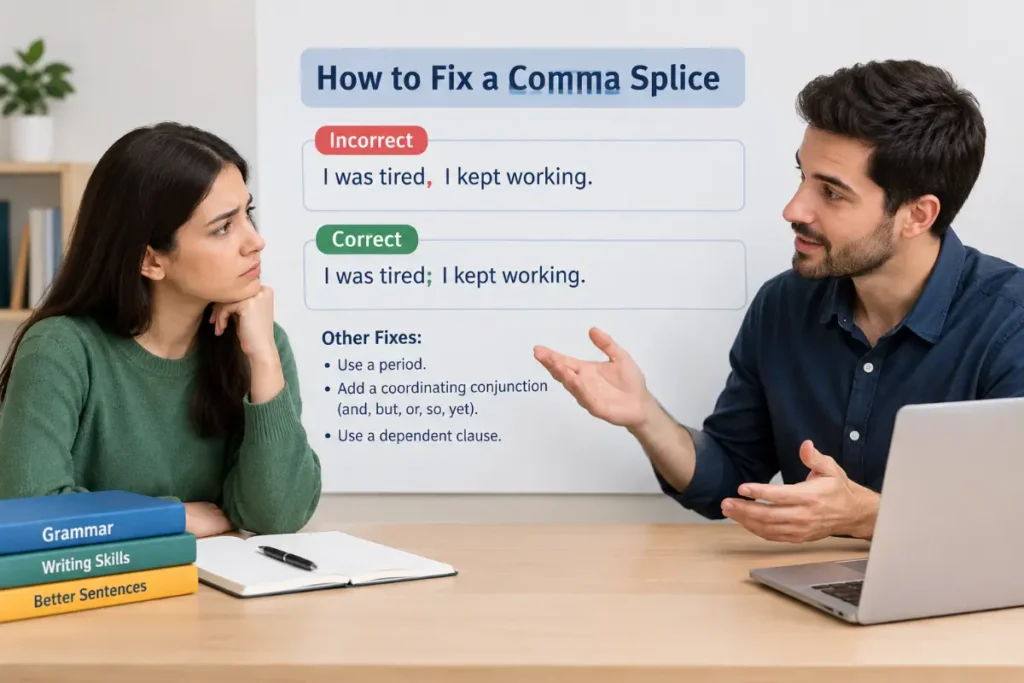
Knowing how to fix a comma splice is really two separate skills stacked together: first spotting that the error exists, and second — the part most guides skip — actually deciding which of the four standard fixes fits a given sentence best. Our earlier comma splice examples and fixes guide catalogued the error and its solutions side by side; this guide walks through the decision-making process itself, plus how that process scales up to editing a full paragraph rather than just one isolated sentence at a time.
Most comma splice guides stop at “here are four ways to fix it,” which is true but incomplete — in real writing, the four fixes aren’t interchangeable. Purdue OWL confirms the four standard corrections (splitting into two sentences, adding a coordinating conjunction, using a semicolon, or subordinating one clause), but picking the wrong one for a given sentence can leave a technically correct result that still doesn’t sound quite right for its context.
You may also find The Singular They Grammar Rule: A Simple 2026 Guide helpful if you want to explore this topic further.
Step One: Confirm It’s Actually a Comma Splice
Before choosing a fix, verify the error is real. Read each half of the sentence separately: could both sides stand alone as a complete sentence? If yes, and only a bare comma connects them, you have a genuine comma splice.
- The meeting ran long, everyone left frustrated. — “The meeting ran long” and “everyone left frustrated” are both complete on their own, confirming this is a comma splice.
Step Two: Ask What Relationship the Two Ideas Actually Have
This is the step most people skip, and it’s the key to choosing the right fix rather than just any fix. Four relationships cover almost every comma splice you’ll encounter:
Simple addition — the two ideas are related but don’t depend on each other. Contrast — the second idea pushes against the first. Cause and effect — one idea directly causes or explains the other. Two separate, roughly unrelated statements that happen to be adjacent.
Identifying which of these four patterns you’re dealing with points you toward the fix that will read most naturally.
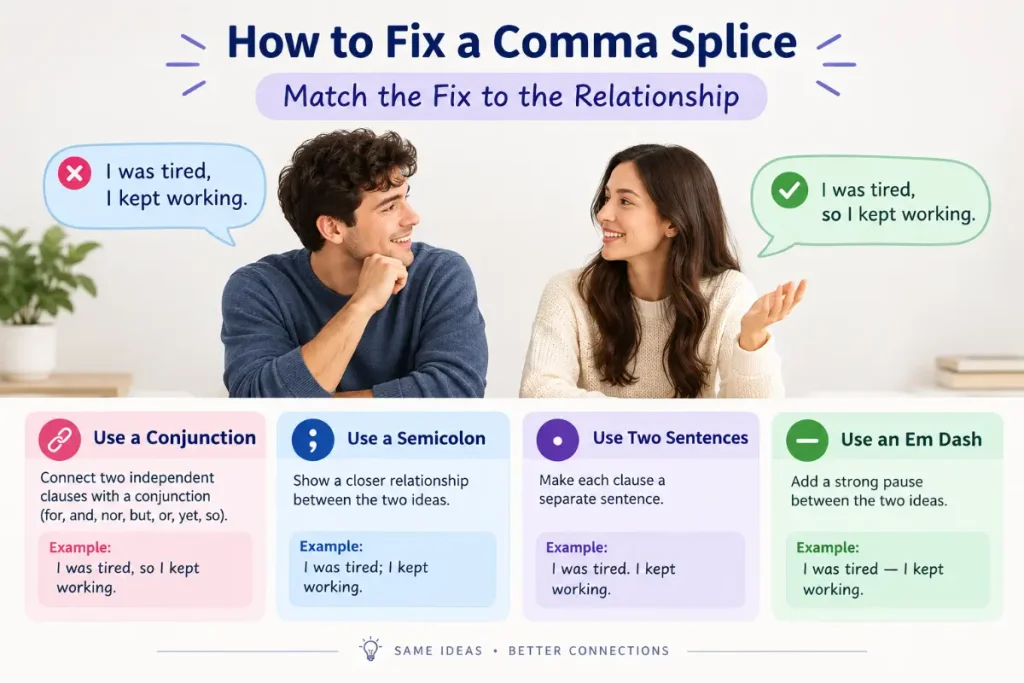
Step Three: Match the Fix to the Relationship
If the relationship is addition, a coordinating conjunction (“and”) or a semicolon both work well:
- The meeting ran long, and everyone left frustrated.
- The meeting ran long; everyone left frustrated.
If the relationship is contrast, “but” or “yet” usually fits better than a plain semicolon, since the conjunction actively signals the pushback:
- The proposal looked strong, but the numbers didn’t add up.
If the relationship is cause and effect, a dependent clause (using “because,” “since,” “so”) often produces the smoothest result, since it explicitly names the logical connection:
- Because the meeting ran long, everyone left frustrated.
- The meeting ran long, so everyone left frustrated.
If the two statements are genuinely separate and don’t need to feel tightly connected, a period is often the cleanest choice:
- The meeting ran long. Everyone left frustrated.
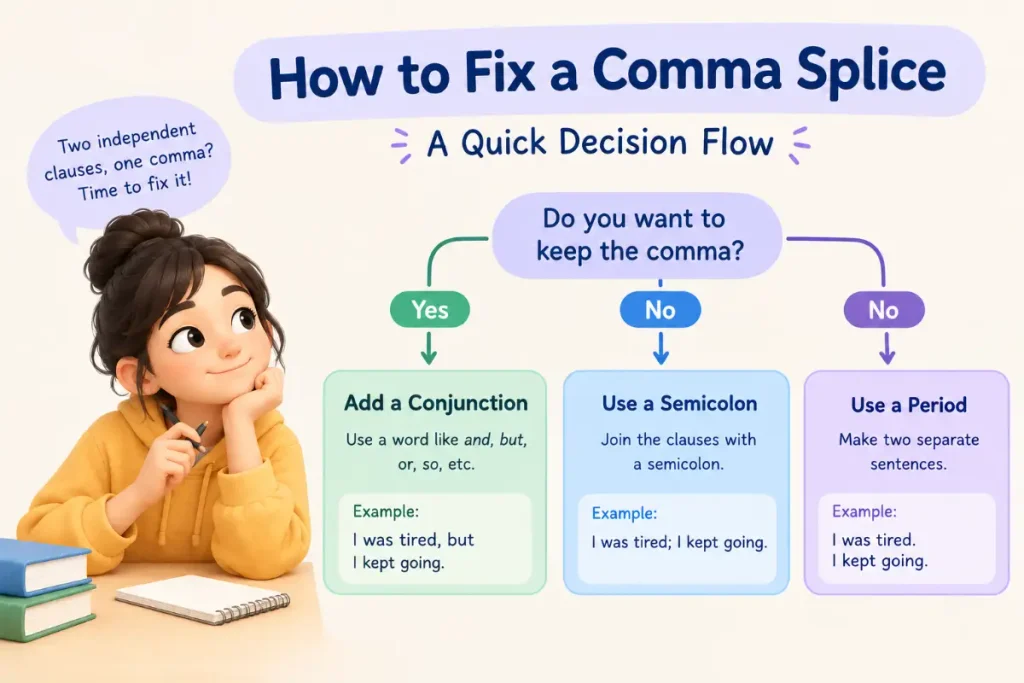
11 Easy Ways to Fix a Comma Splice
Once you know you have a comma splice, how to fix a comma splice depends on the relationship between the two independent clauses. You do not always need the same correction. Use the option that makes the sentence grammatically correct while preserving the meaning and flow.
1. Use a Period
Use a period when the two ideas can stand alone as separate sentences.
Incorrect: The store closed early, we went home.
Correct: The store closed early. We went home.
2. Add “And”
Use and when the second clause adds information to the first.
Incorrect: She finished the report, she sent it to her manager.
Correct: She finished the report, and she sent it to her manager.
3. Use “But” for Contrast
When the second idea contrasts with the first, but often provides the clearest connection.
Incorrect: He studied hard, he didn’t pass the test.
Correct: He studied hard, but he didn’t pass the test.
4. Use “So” for Cause and Effect
Use so when the first clause leads directly to the second.
Incorrect: The roads were flooded, we stayed home.
Correct: The roads were flooded, so we stayed home.
5. Use “Because” to Show a Reason
If the second idea explains why the first happened, or vice versa, because can turn one clause into a dependent clause.
Incorrect: I left early, I had an important appointment.
Correct: I left early because I had an important appointment.
6. Join the Clauses With a Semicolon
A semicolon works when two independent clauses are closely related and you want to keep them together.
Incorrect: The deadline was approaching, everyone worked late.
Correct: The deadline was approaching; everyone worked late.
7. Use “Although” for a Strong Contrast
For a contrast that needs more emphasis, although can create a dependent clause.
Incorrect: She was tired, she finished the project.
Correct: Although she was tired, she finished the project.
8. Make One Clause Dependent
Sometimes the cleanest fix is to change one independent clause into a dependent clause using words such as when, while, since, although, because, or after.
Incorrect: The meeting ended, everyone returned to work.
Correct: After the meeting ended, everyone returned to work.
For another useful perspective, check out The Split Infinitive Rule: 13 Common Mistakes to Avoid (2026).
9. Use a Conjunctive Adverb Correctly
Words such as however, therefore, consequently, and nevertheless cannot normally join two independent clauses with just a comma. Use a semicolon before the conjunctive adverb and a comma after it.
Incorrect: The plan looked promising, however, the costs were too high.
Correct: The plan looked promising; however, the costs were too high.
10. Split a Long Sentence Into Two
If the connection between the clauses is weak or the sentence feels crowded, simply separating the ideas can improve readability.
Incorrect: The presentation lasted two hours, everyone looked exhausted.
Correct: The presentation lasted two hours. Everyone looked exhausted.
11. Rewrite the Sentence Completely
Sometimes the best way to fix a comma splice is not to preserve the original structure at all. Rewriting can make the relationship between ideas clearer and produce a more natural sentence.
Incorrect: The weather changed suddenly, the outdoor event was canceled.
Better: Because the weather changed suddenly, organizers canceled the outdoor event.
The main takeaway is simple: how to fix a comma splice is not about automatically replacing every comma with a semicolon. First identify how the two ideas relate, then choose a period, conjunction, semicolon, dependent clause, or complete rewrite that communicates that relationship clearly.
Applying the Process to a Full Paragraph
Here’s where this approach pays off — real writing rarely hands you one isolated comma splice; it usually hands you a paragraph with several, each needing its own judgment call rather than the same generic fix repeated four times.
Before, with three comma splices:
The report was finally finished, it had taken three weeks longer than planned. The client seemed satisfied, she still asked for a few revisions. The team was exhausted, they still managed to celebrate that evening.
After, applying the decision process to each:
The report was finally finished, though it had taken three weeks longer than planned. The client seemed satisfied; she still asked for a few revisions. The team was exhausted, but they still managed to celebrate that evening.
Notice that all three splices got different fixes — a dependent clause reframing for the first (cause/timing relationship), a semicolon for the second (closely related, roughly equal ideas), and a contrast conjunction for the third. Applying the same fix to all three (“and” everywhere, say) would have technically corrected the grammar while flattening the actual relationships between the ideas.
When “However” and Similar Words Are Involved
A special case worth calling out: if your comma splice already includes a conjunctive adverb like “however,” “therefore,” or “consequently,” the fix is fixed for you — these words specifically require a semicolon before them and a comma after, regardless of which relationship type you’re dealing with.
- Incorrect: The plan failed, however the team regrouped.
- Correct: The plan failed; however, the team regrouped.
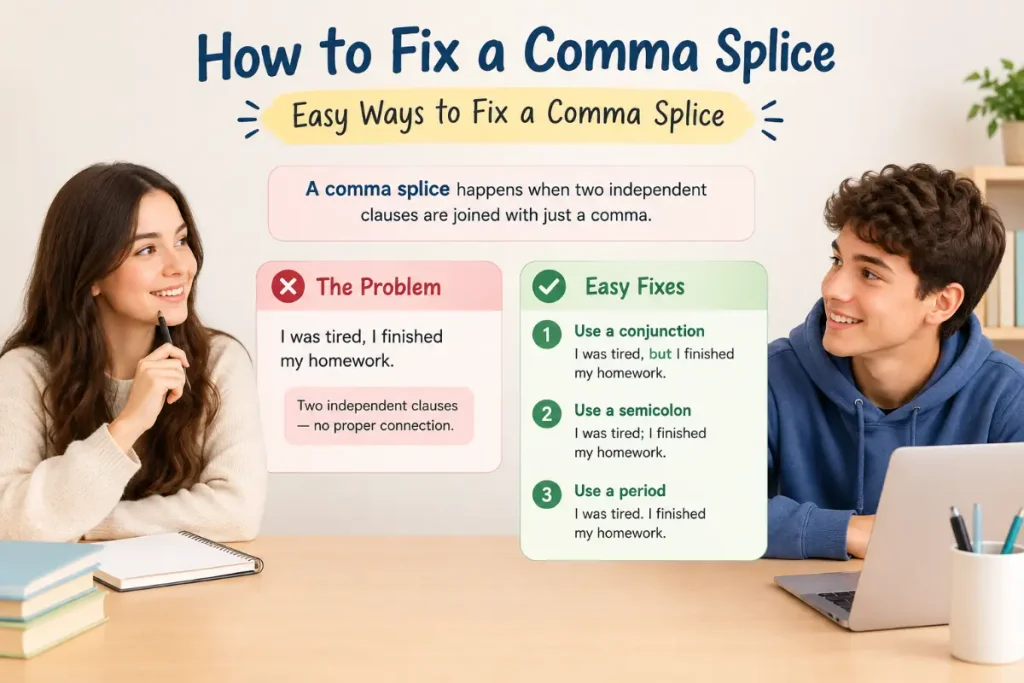
A Quick Decision Flow
Ask: is the relationship addition, contrast, cause/effect, or unrelated?
- Addition → semicolon or “and”
- Contrast → “but,” “yet,” or “although” (as a dependent clause)
- Cause/effect → “because,” “since,” or “so”
- Unrelated → period, splitting into two sentences
Ask: does a conjunctive adverb like “however” already appear? If so, semicolon before it, comma after — no further decision needed.
Quick Reference Table
| Relationship | Best Fix | Example |
|---|---|---|
| Addition | Semicolon or “and” | She smiled; he nodded. |
| Contrast | “But” or “although” | He tried hard, but he failed. |
| Cause/effect | Dependent clause or “so” | It rained, so we left early. |
| Unrelated | Period | He left. She stayed behind. |
| Contains “however”/”therefore” | Semicolon before, comma after | It rained; however, we stayed. |
Common Mistakes People Make
- Mistake 1: Applying the exact same fix to every comma splice in a document, regardless of the actual relationship between ideas, producing technically correct but monotonous prose.
- Mistake 2: Choosing a period when a cause-and-effect relationship would read more smoothly as a dependent clause, losing the logical connection between the two ideas.
- Mistake 3: Adding “however” after a comma without upgrading that comma to a semicolon, effectively creating a new comma splice while trying to fix the original one.
- Mistake 4: Skipping step one entirely and assuming any sentence with a comma and two verbs is automatically a splice, when sometimes the comma is doing a completely different, correct job (like separating list items or setting off an introductory phrase).
- Mistake 5: Over-relying on semicolons because they feel like the “safe” default fix, even in cases where a period or conjunction would read more naturally for that specific relationship.
Practice Exercise
For each comma splice, identify the relationship (addition, contrast, cause/effect, or unrelated) and apply the fix that suits it best. Answers are listed right after — try each one before checking.
- She finished her degree, she started her own business right away.
- He studied all night, he still failed the exam.
- The store closed early, we had to find another place to shop.
- I called twice, nobody answered either time.
- The weather improved, the game continued as planned.
- She wanted the promotion, she didn’t get it.
- He forgot his umbrella, it started raining immediately.
- The team practiced daily, they still lost the championship.
- We finished dinner, we went for a walk afterward.
- The flight was delayed, passengers grew increasingly impatient.
- She loves hiking, she’s climbed twelve mountains.
- He apologized sincerely, she wasn’t ready to forgive him.
- The proposal was rejected, the team started over.
- I left early, I had an early meeting the next day.
- The movie got great reviews, it flopped at the box office.
- They renovated the kitchen, the house sold quickly.
- She practiced every day, her performance still had flaws.
- The road was closed, drivers had to find another route.
- He loves coffee, he rarely drinks tea.
- The company cut costs, profits still declined.
Answer Key (relationship identified; one valid fix shown)
- Addition — “She finished her degree, and she started her own business right away.”
- Contrast — “He studied all night, but he still failed the exam.”
- Cause/effect — “Because the store closed early, we had to find another place to shop.”
- Unrelated/addition — “I called twice. Nobody answered either time.”
- Cause/effect — “The weather improved, so the game continued as planned.”
- Contrast — “She wanted the promotion, but she didn’t get it.”
- Cause/effect — “He forgot his umbrella, and it started raining immediately.” (or: “Because he forgot his umbrella, it started raining immediately” if reversing logic for emphasis)
- Contrast — “The team practiced daily, but they still lost the championship.”
- Addition — “We finished dinner; we went for a walk afterward.”
- Cause/effect — “The flight was delayed, so passengers grew increasingly impatient.”
- Addition — “She loves hiking; she’s climbed twelve mountains.”
- Contrast — “He apologized sincerely, but she wasn’t ready to forgive him.”
- Cause/effect — “Because the proposal was rejected, the team started over.”
- Cause/effect — “I left early because I had an early meeting the next day.”
- Contrast — “The movie got great reviews, but it flopped at the box office.”
- Addition — “They renovated the kitchen, and the house sold quickly.”
- Contrast — “She practiced every day, but her performance still had flaws.”
- Cause/effect — “Because the road was closed, drivers had to find another route.”
- Addition — “He loves coffee; he rarely drinks tea.”
- Contrast — “The company cut costs, but profits still declined.”
Frequently Asked Questions
Is there ever a single “correct” fix for a given comma splice, or is it always a judgment call?
There’s rarely just one right answer — several fixes are usually grammatically valid for the same sentence. The judgment call is about which fix best conveys the actual relationship between the two ideas, not about finding the one technically permissible option.
Why does matching the fix to the relationship matter if all four options are grammatically correct?
Because grammatical correctness and clarity of meaning aren’t the same thing — a period between two ideas that are actually cause and effect is technically fine but strips out a logical connection a reader would benefit from seeing made explicit.
Should I fix every comma splice in a long document the same way for consistency?
No — consistency in this case would actually hurt the writing, since different sentences carry different logical relationships. Varying your fix based on each sentence’s specific relationship produces more natural, engaging prose than uniformly applying one method throughout.
What’s the single most common relationship type behind real-world comma splices?
Cause and effect tends to be extremely common, since writers often want to connect two closely linked ideas quickly and default to a comma instead of pausing to choose “because,” “so,” or a semicolon.
What’s the fastest way to catch comma splices before publishing something, using this process?
For every comma joining two independent clauses, first confirm it’s genuinely a splice, then identify the relationship between the ideas, and apply whichever fix — conjunction, semicolon, dependent clause, or period — matches that specific relationship rather than defaulting to the same fix every time.
Before moving on, you may also want to read A Dangling Modifier? Learn It in 9 Easy Steps (2026 Guide) for more helpful grammar tips.
Wrapping Up
Understanding how to fix a comma splice goes further than memorizing four possible corrections — the real skill is diagnosing the relationship between the two ideas first, then choosing the fix that actually reflects that relationship, whether it’s addition, contrast, cause and effect, or two genuinely separate statements. Applied sentence by sentence across a full paragraph, this process produces writing that reads naturally varied rather than mechanically corrected.
The four fixes themselves haven’t changed from what’s covered in our companion guide — what’s different here is the thinking that should happen before you pick one, so that the sentence you end up with doesn’t just avoid an error, but actually communicates your intended meaning as clearly as possible.