Getting subject verb agreement right is one of those grammar skills that seems simple until a sentence gets a little more complicated. At first, the rule feels straightforward: the subject and verb need to match. But once sentences become longer or include phrases, unusual subjects, or more than one noun, it’s easy to second-guess which verb form belongs there. Learning the key subject verb agreement rules makes these choices much easier and helps your writing sound clear, natural, and grammatically correct.
Most people know the basic idea behind SV agreement rules without ever needing it explained — singular subjects take singular verbs, plural subjects take plural verbs. The real challenge shows up in the trickier cases: compound subjects, words that sneak between the subject and verb, and collective nouns that look plural but act singular. Purdue OWL lays out a full set of guidelines that cover exactly these edge cases.
You may also find Use Commas in a List: 7 Easy Rules (2026) helpful if you want to explore this topic further.
The Quick Answer
- Two subjects joined by “and” → plural verb: She and her friends are at the fair.
- Two singular subjects joined by “or”/”nor” → singular verb: The book or the pen is in the drawer.
- Mixed subjects joined by “or”/”nor” → verb agrees with the closer subject: The boy or his friends run every day.
- Collective nouns (team, family, committee) → usually singular: The team wins every game.
- Words between subject and verb don’t change agreement: One of my favorite books is missing.
Rule 1: Subjects Joined by “And” Take a Plural Verb
When two or more nouns or pronouns are connected by “and,” the resulting compound subject takes a plural verb, since together they represent more than one thing.
- She and her friends are at the fair.
- My sister and I are going hiking this weekend.
- The manager and the client have agreed on the terms.
Rule 2: Subjects Joined by “Or” or “Nor” Take a Singular Verb (If Both Are Singular)
Unlike “and,” which combines subjects into a plural unit, “or” and “nor” present alternatives — so if both connected subjects are singular, the verb stays singular too.
- The book or the pen is in the drawer.
- Neither the manager nor the assistant was available.
- Either my mother or my father is picking me up.
Rule 3: Mixed Singular and Plural Subjects — The Verb Agrees With the Closer One
This is one of the more genuinely useful rules to memorize, since it resolves an otherwise confusing situation: when a compound subject joined by “or” or “nor” mixes a singular and a plural noun, the verb agrees with whichever part sits closer to it.
- The boy or his friends run every day. (plural “friends” is closer, so the verb is plural)
- His friends or the boy runs every day. (singular “boy” is closer, so the verb is singular)
Notice that swapping the order of the same two subjects changes which verb form is correct — a detail that trips up even careful writers.

Rule 4: Don’t Be Misled by Words Between the Subject and Verb
Purdue OWL specifically warns about this case: a phrase sitting between the subject and the verb doesn’t change what the verb should agree with — the verb always agrees with the true subject, not with a nearby noun in an inserted phrase.
- One of my favorite books is missing. (the subject is “one,” not “books,” so the verb stays singular)
- The people who listen to that music are few. (the subject is “people,” so the verb is plural, despite “music” sitting closer to the verb)
This same logic extends to expressions like “together with,” “as well as,” “including,” and “accompanied by,” which don’t change the number of the subject at all, even though they might seem to add to it.
- The president, accompanied by his advisors, is traveling to India. (singular “president” stays the subject; “accompanied by his advisors” doesn’t make it plural)
Rule 5: Collective Nouns Are Usually Singular
Words like team, family, committee, class, and group imply more than one person but are typically treated as a single unit and take a singular verb.
- The team wins every game.
- The committee has made its decision.
- Her family is coming to visit next month.
In rarer cases, a plural verb is used specifically when a sentence emphasizes the individual members of the group acting separately, rather than the group as a single unit — though this usage is far less common in standard American English than the singular default.
Rule 6: “Doesn’t” vs. “Don’t”
Purdue OWL flags this specific contraction pair as a common source of agreement errors: “doesn’t” is the contraction of “does not” and pairs with singular subjects; “don’t” is the contraction of “do not” and pairs with plural subjects — with one notable exception for the pronouns “I” and “you,” which always use “don’t” regardless of the general singular/plural pattern.
- He doesn’t like it. (singular subject)
- They don’t like it. (plural subject)
- I don’t like it. (exception — “I” always uses “don’t”)
Rule 7: “There Is” and “There Are” — The Subject Follows the Verb
In sentences beginning with “there is” or “there are,” the word “there” isn’t the actual subject — the real subject comes after the verb, and the verb must agree with that later subject.
- There is one solution to this problem. (singular subject “solution” follows)
- There are several solutions to this problem. (plural subject “solutions” follows)
Rule 8: Some Nouns Look Plural but Are Actually Singular (and Vice Versa)
Certain nouns ending in “s” — like mathematics, news, and physics — are treated as singular. Meanwhile, nouns like scissors, tweezers, trousers, and shears (things that inherently have two connected parts) take plural verbs, even without an obvious plural-sounding subject preceding them.
- Mathematics is my favorite subject.
- The news was surprising.
- These scissors are dull.
Rule 9: Indefinite Pronouns Usually Take Singular Verbs
Indefinite pronouns such as everyone, everybody, someone, somebody, anyone, and each refer to people or things in a general way, but they are grammatically singular. That means they take singular verbs, even when they seem to refer to a group of people.
- Everyone in the class is ready.
- Someone has left their phone on the table.
- Each of the students has a notebook.
- Nobody knows the answer.
A common mistake is to use a plural verb simply because these words refer to multiple people. Remember that the grammatical subject is still singular.
Rule 10: “Each” and “Every” Take Singular Verbs
When each or every comes before a singular noun, the verb should also be singular. Although these words may describe several people or things, they focus on members individually rather than treating them as a group.
- Every student needs a textbook.
- Each player has a locker.
- Every room in the hotel is clean.
- Each of the answers is correct.
The phrase each of can be especially confusing because the noun after of is usually plural. However, the subject is still each, so the verb remains singular.
Rule 11: Amounts of Time, Money, Distance, and Weight Can Take a Singular Verb
When an expression refers to a single total amount of time, money, distance, weight, or another measurement, it is generally treated as one unit and takes a singular verb.
- Ten dollars is enough for lunch.
- Five years is a long time to wait.
- Twenty miles is too far to walk.
- Three kilograms is the maximum weight allowed.
The nouns dollars, years, miles, and kilograms are plural in form, but the entire expression represents one amount or measurement.
Rule 12: Titles of Books, Movies, and Other Works Take Singular Verbs
A title may contain several words or even appear to refer to multiple people or things, but when it names one book, movie, song, newspaper, or other work, it is treated as a singular subject.
- “The Lord of the Rings” is a popular fantasy series.
- “Friends” is still widely watched.
- “Great Expectations” is a classic novel.
- “The Chronicles of Narnia” is on my reading list.
The key is to focus on what the title represents: one work, not the individual words inside the title.
Rule 13: Fractions and Percentages Agree With the Noun They Refer To
With fractions and percentages, the verb depends on the noun that follows of. If that noun is singular or uncountable, use a singular verb; if it is plural, use a plural verb.
- Half of the cake is gone.
- Half of the students are absent.
- Seventy percent of the work is finished.
- Seventy percent of the employees are satisfied.
This rule is easier to remember if you look past the fraction or percentage and identify the noun that actually determines whether the verb should be singular or plural.
Rule 14: “Some,” “All,” “Most,” and “None” Can Take Singular or Plural Verbs
Words such as some, all, most, more, and none do not have a fixed singular or plural form. Their verb depends on the noun they refer to.
- Some of the cake is left.
- Some of the cookies are left.
- Most of the information is accurate.
- Most of the students are present.
- All of the water is gone.
- All of the books are on the shelf.
So instead of memorising one verb for these words, look at the noun following of and let that noun determine the agreement.
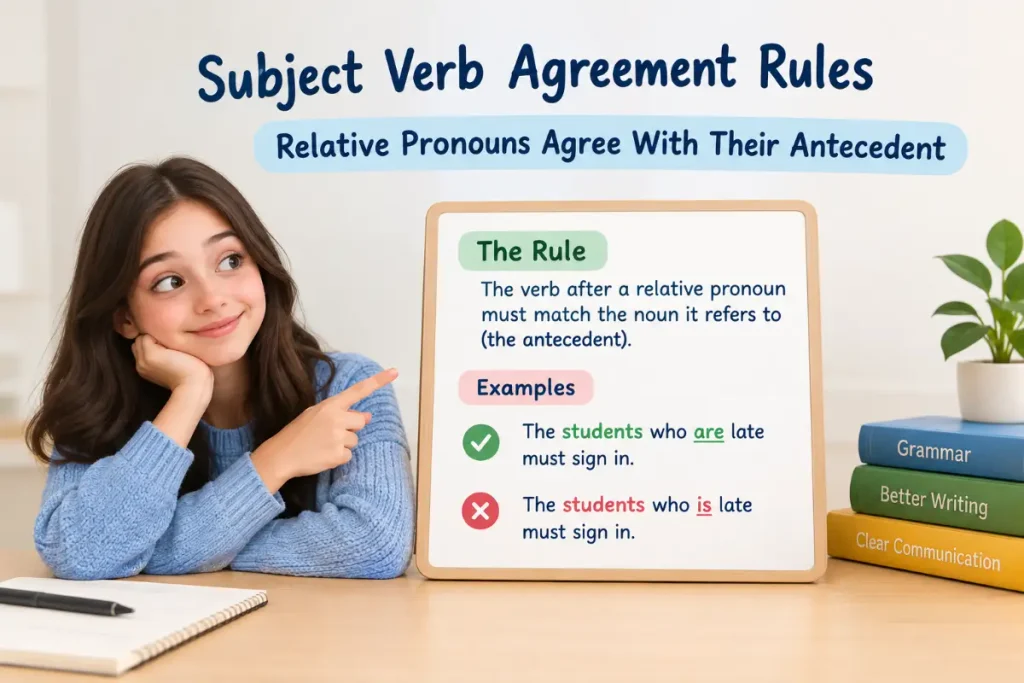
Rule 15: Relative Pronouns Agree With Their Antecedent
When a sentence uses who, which, or that, the verb in the relative clause should agree with the noun the pronoun refers to, known as its antecedent.
- She is one of the students who work hard.
- He is the teacher who teaches English.
- The books that are on the desk belong to me.
- The car that is parked outside is mine.
The important thing is to identify what who, which, or that refers to. In “The books that are on the desk,” that refers to books, so the verb is plural: are. In “The car that is parked outside,” it refers to car, so the verb is singular: is.
The Fastest Way to Check Yourself
Step 1: Identify the true subject of the sentence, ignoring any descriptive phrases or clauses sitting between the subject and the verb.
Step 2: Is the subject singular or plural? Match the verb accordingly.
Step 3: If it’s a compound subject, check the connecting word. “And” makes it plural; “or”/”nor” keeps agreement with the nearer part if the two halves differ in number.
Step 4: If it’s a collective noun, default to singular unless the sentence is specifically emphasizing individual members acting separately.
Subject Verb Agreement Rules: Quick Reference
| Situation | Verb Form | Example |
|---|---|---|
| Subjects joined by “and” | Plural | Tom and Jerry are friends. |
| Singular subjects joined by “or”/”nor” | Singular | The cat or the dog is hiding. |
| Mixed subjects joined by “or”/”nor” | Agrees with nearer subject | The cats or the dog is hiding. |
| Phrase between subject and verb | Verb agrees with true subject | One of the books is missing. |
| Collective noun | Usually singular | The team is winning. |
| “There is” / “there are” | Agrees with the subject that follows | There are three options. |
Common Mistakes People Make
Mistake 1: “The list of items are on the table.” Should be “is on the table” — the true subject is “list” (singular), not “items,” which is part of a prepositional phrase.
Mistake 2: “Neither of the answers are correct.” Should be “is correct” — “neither” functions as a singular subject, regardless of the plural noun that follows it.
Mistake 3: “The committee are meeting tomorrow.” In standard American English, this should be “is meeting” — collective nouns default to singular unless emphasizing individual members.
Mistake 4: “Everybody have their own opinion.” Should be “has their own opinion” — “everybody,” like other indefinite pronouns such as everyone, someone, and nobody, is treated as singular.
For another useful perspective, check out Use Semicolons in a Sentence: The Easy 2026 Guide.
Mistake 5: “The manager, along with her team, are attending the conference.” Should be “is attending” — “along with her team” doesn’t change the subject’s number; “manager” remains singular.
More Examples to Lock It In
- Each of the students has submitted their assignment.
- The jury has reached a verdict.
- Neither the coach nor the players were satisfied with the result.
- The number of applicants has increased this year.
- A number of applicants have already been interviewed.
Frequently Asked Questions
What’s the difference between “the number of” and “a number of” for subject-verb agreement?
“The number of” is treated as singular, since it refers to a specific total: “The number of applicants has increased.” “A number of” is treated as plural, since it functions more like “several”: “A number of applicants have applied.”
Do indefinite pronouns like “everyone” and “everybody” always take singular verbs?
Yes — words like everyone, everybody, someone, anybody, and nobody are grammatically singular in standard usage, even though they refer to groups of people, and they take singular verbs accordingly.
How do I handle subject-verb agreement with titles of creative works?
Titles of books, movies, or other works are treated as singular, even if the title itself contains plural words: “Great Expectations is a classic novel,” not “are a classic novel.”
Does subject-verb agreement change between American and British English?
Slightly, yes — British English is somewhat more likely to treat collective nouns as plural when emphasizing individual members (“The team are arguing among themselves”), while American English defaults more consistently to singular treatment of collective nouns.
What’s the fastest way to catch subject-verb agreement errors before publishing something?
Identify the true subject of each sentence by ignoring any inserted phrases or clauses, then check whether that subject is singular or plural and confirm the verb matches — paying special attention to compound subjects, collective nouns, and indefinite pronouns.
Practice Exercise
Choose the correct verb form for each sentence. Try to answer all 20 before checking the answer key.
- The teacher and her students (is/are) preparing for the presentation.
- Either the coach or the players (is/are) responsible for bringing the equipment.
- Neither the students nor the teacher (was/were) aware of the schedule change.
- The box of old photographs (was/were) found in the attic.
- My brother, along with his friends, (is/are) visiting us this weekend.
- The committee (has/have) reached a final decision.
- Everyone in the office (needs/need) to complete the form.
- Each of the applicants (has/have) submitted an application.
- There (is/are) several reasons for the change.
- The news (was/were) announced earlier this morning.
- Five years (is/are) a long time to wait.
- Mathematics (is/are) one of her favorite subjects.
- Half of the cake (has/have) already been eaten.
- Half of the students (has/have) finished the assignment.
- Most of the information (is/are) available online.
- Most of the books (is/are) already packed.
- The list of ingredients (includes/include) everything we need.
- She is one of the students who (works/work) hard every day.
- The book that (is/are) on the table belongs to Sarah.
- He doesn’t/don’t understand the instructions.
Answer Key
- are
- are
- was
- was
- is
- has
- needs
- has
- are
- was
- is
- is
- has
- have
- is
- are
- includes
- work
- is
- doesn’t
If you got 16 or more correct, you have a solid understanding of subject-verb agreement rules, including compound subjects, indefinite pronouns, collective nouns, quantities, and relative clauses.
Before moving on, you may also want to read Use Conjunctions Correctly: A Practical Walkthrough (2026) for more helpful grammar tips.
The Bottom Line
Mastering subject verb agreement rules comes down to always identifying the true subject of a sentence — not a nearby noun in an inserted phrase — and matching the verb to that subject’s actual number. Compound subjects, collective nouns, and indefinite pronouns each have their own specific pattern, but once you know to look past the words sitting between subject and verb, the vast majority of agreement errors become easy to catch and fix.
For more on how commas interact with lists and compound sentence structures that often involve these same subjects, see our guide on how to use commas in a list — and if comma splices are also tripping up your sentence structure, our comma splice examples and fixes guide covers that closely related ground.