Comma Splice Examples and Fixes can be surprisingly easy to miss, especially when two complete thoughts seem to fit naturally together with just a comma. The good news? Once you know what a comma splice looks like and how to fix it, you can spot and correct one in seconds.
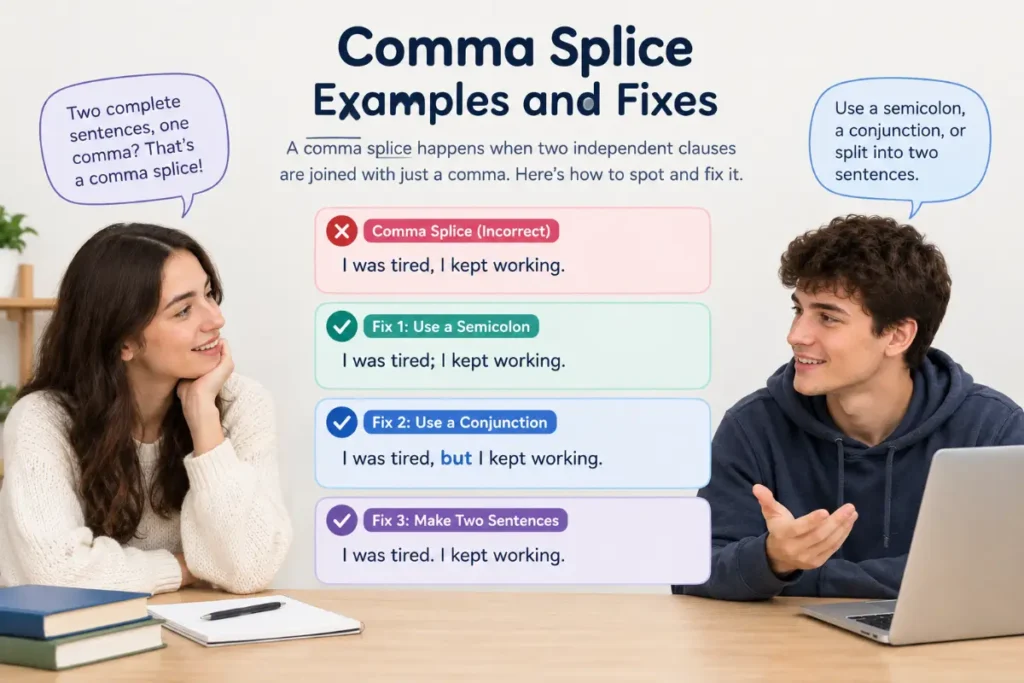
Looking at real comma splice examples is genuinely the fastest way to learn this rule, since the error itself is subtle enough that most writers make it regularly without realizing anything’s wrong. Purdue OWL defines it precisely: a comma splice happens when two independent clauses — each capable of standing alone as a complete sentence — are joined with only a comma and no connecting word.
You may also find Quotation Marks Inside Quotation Marks Rules: 7 Mistakes to Avoid helpful if you want to explore this topic further.
The Quick Answer
A comma splice looks like this:
- The meeting ran long, everyone was frustrated. (incorrect — comma splice)
The same idea, fixed four different ways:
- Split into two sentences: The meeting ran long. Everyone was frustrated.
- Add a coordinating conjunction: The meeting ran long, and everyone was frustrated.
- Use a semicolon: The meeting ran long; everyone was frustrated.
- Make one clause dependent: Because the meeting ran long, everyone was frustrated.
What a Comma Splice Actually Is
The core issue behind every comma splice is that a comma alone isn’t strong enough to join two complete, independent sentences. A comma is designed for lighter connective jobs — separating list items, setting off an introductory phrase, joining a short phrase to a sentence. It was never built to carry the weight of joining two full, complete thoughts by itself.
More comma splice examples to recognize the pattern:
- She loves to travel, she’s been to twelve countries.
- He finished his homework, then he watched television.
- The store closed early, we had to shop somewhere else.
- I wanted to leave, my ride hadn’t arrived yet.
In every one of these, both halves of the sentence could stand completely on their own: “She loves to travel.” “She’s been to twelve countries.” Since both are complete, independent sentences, a comma by itself isn’t sufficient to connect them.
Fix 1: Split Into Two Separate Sentences
The simplest fix is often the clearest — just use a period and start a new sentence.
- She loves to travel. She’s been to twelve countries.
- He finished his homework. Then he watched television.
This works especially well when the two ideas, while related, don’t need to feel tightly connected. The downside: using this fix repeatedly throughout a piece of writing can make the prose feel choppy, especially if every sentence ends up short.
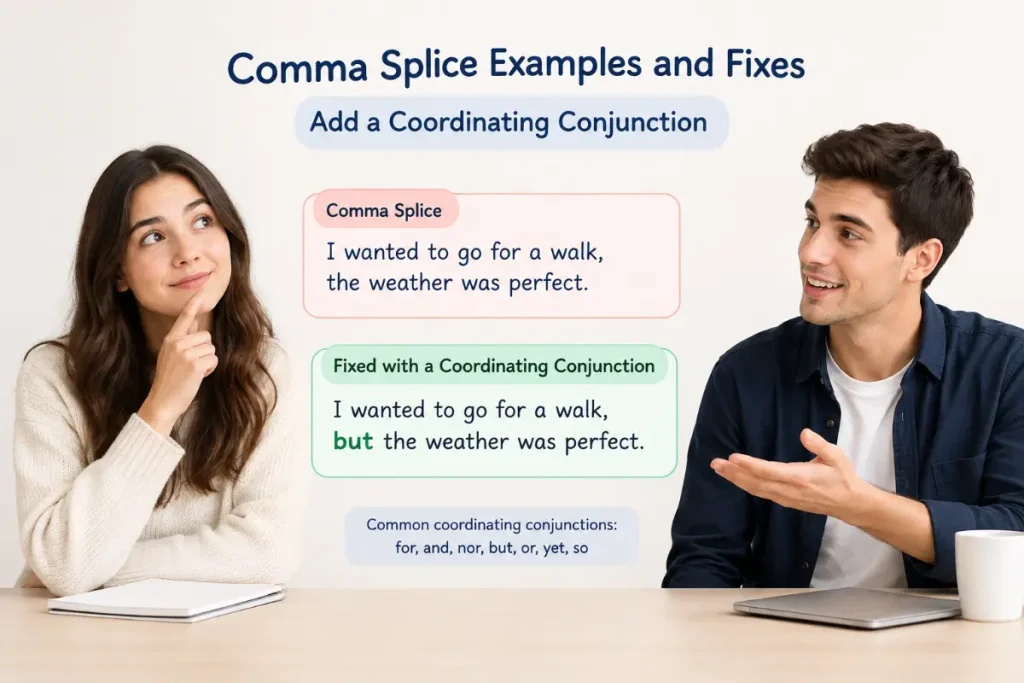
Fix 2: Add a Coordinating Conjunction
Adding one of the seven coordinating conjunctions — and, but, for, or, nor, so, yet (sometimes remembered by the acronym FANBOYS) — after the comma turns the comma splice into a properly joined compound sentence.
- She loves to travel, and she’s been to twelve countries.
- The store closed early, so we had to shop somewhere else.
- I wanted to leave, but my ride hadn’t arrived yet.
This fix works well when you want to preserve the close relationship between the two ideas without splitting them into separate sentences, and it’s often the most natural-sounding solution among the four options.
Fix 3: Replace the Comma With a Semicolon
A semicolon is specifically designed to join two closely related independent clauses without needing a conjunction at all — making it a clean, direct fix for many comma splices.
- She loves to travel; she’s been to twelve countries.
- The store closed early; we had to shop somewhere else.
This fix works best when the two clauses are closely related in meaning and roughly equal in weight — exactly the kind of relationship a semicolon is built to express. For the complete breakdown of every job a semicolon can do, see our full guide to semicolon usage.
Fix 4: Make One Clause Dependent
Turning one of the two independent clauses into a dependent clause — by adding a subordinating word like “because,” “although,” “since,” “when,” or “while” — resolves the comma splice by making the sentence’s structure clearly unequal, with one idea now supporting the other rather than standing beside it.
- Because the store closed early, we had to shop somewhere else.
- Although she loves to travel, she hasn’t visited South America yet.
- When the meeting ran long, everyone grew frustrated.
This fix often produces the smoothest, most sophisticated-sounding sentences among the four, since it explicitly signals the logical relationship between the two ideas (cause and effect, contrast, timing) rather than just placing them side by side.
When a Comma Splice Might Be a Stylistic Choice (Use With Caution)
It’s worth knowing that some celebrated writers occasionally use comma splices deliberately for stylistic rhythm or effect, particularly in literary fiction — “I came, I saw, I conquered” is a famous example of very short, punchy independent clauses linked only by commas. This is a deliberate stylistic device used sparingly by experienced writers who understand the rule they’re breaking, not a loophole for everyday or professional writing. In academic, business, and most published writing, a comma splice will be read as a genuine grammatical error, not a stylistic flourish, unless you’re operating in a specific literary context where the convention is well established.
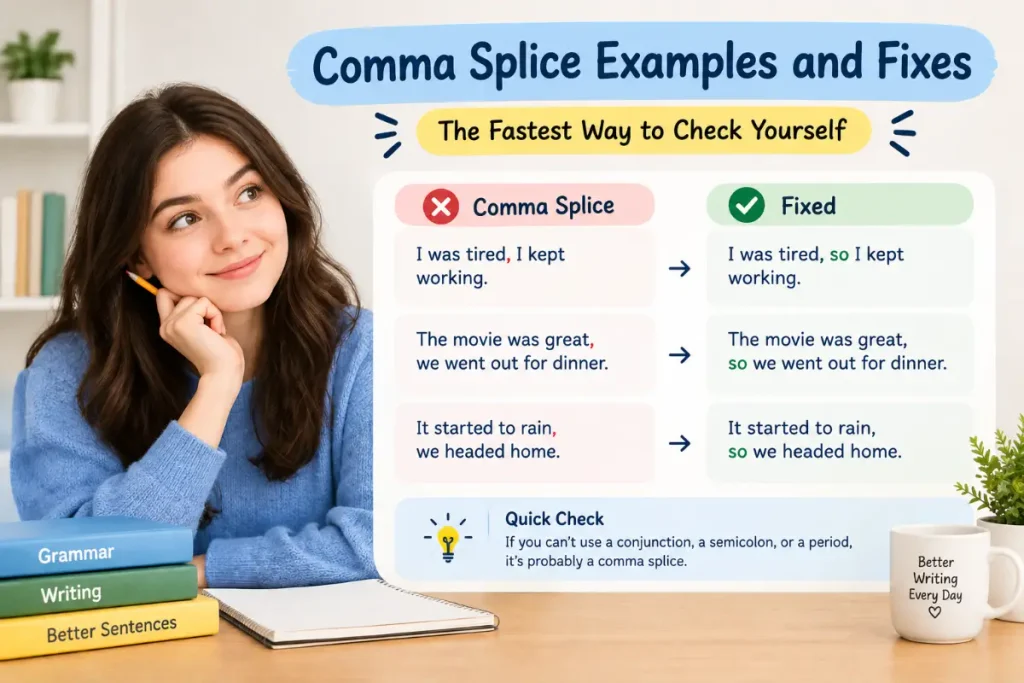
The Fastest Way to Check Yourself
Step 1: Read each half of the sentence separately. Could both halves stand alone as complete, grammatically correct sentences?
Step 2: If yes, is there only a comma joining them, with no coordinating conjunction? That’s a comma splice.
Step 3: Choose your fix based on the relationship between the two ideas — a period for a clean break, a conjunction for a natural connection, a semicolon for closely related equal ideas, or a dependent clause for cause-and-effect or contrast.
Comma Splice Examples and Fixes: Quick Reference
| Comma Splice | Fixed Version | Method Used |
|---|---|---|
| She smiled, she was proud. | She smiled. She was proud. | Split into two sentences |
| He ran fast, he still lost. | He ran fast, but he still lost. | Added conjunction |
| The team practiced hard, they won the game. | The team practiced hard; they won the game. | Semicolon |
| It started raining, we went inside. | When it started raining, we went inside. | Dependent clause |
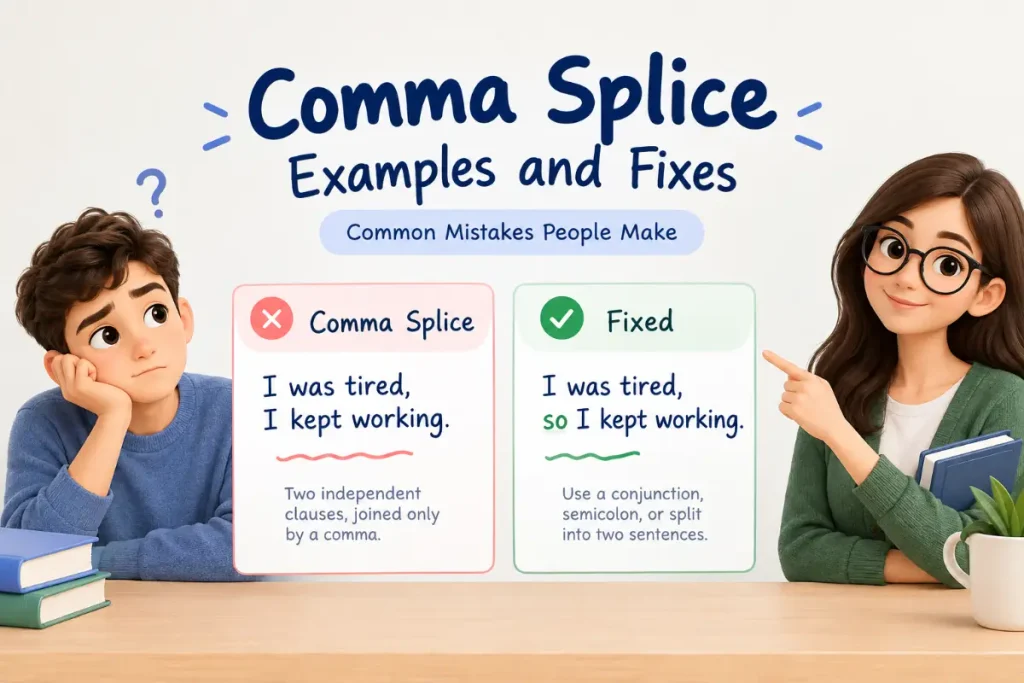
Common Mistakes People Make
Mistake 1: “He was tired, however he kept working.” This is actually a comma splice masquerading as a fixed sentence — “however” is a conjunctive adverb, not a coordinating conjunction, so it needs a semicolon before it, not a comma: “He was tired; however, he kept working.”
Mistake 2: Assuming any comma between two clauses is automatically wrong. A comma is correct when paired with a coordinating conjunction (“He was tired, but he kept working”) — the error only occurs when the comma stands completely alone with no connecting word at all.
Mistake 3: Overcorrecting into a run-on sentence by removing the comma but adding nothing else. “He was tired he kept working” (with the comma simply deleted) creates a fused sentence, which is a related but distinct error — removing the comma without adding a period, conjunction, or connecting word doesn’t fix anything.
Mistake 4: Using a comma splice in formal writing, mistaking it for a stylistic choice. Outside of clearly literary or intentionally stylistic writing, comma splices in professional, academic, or business writing will generally be read as errors, not as deliberate artistic choices.
Mistake 5: Fixing every comma splice the same way throughout a document. Relying exclusively on periods (or exclusively on semicolons) to fix every instance can make writing feel monotonous. Varying your fix based on the relationship between ideas produces more natural, engaging prose.
Mistake 6: Confusing a comma splice with a sentence containing a dependent clause. Not every sentence with multiple clauses needs a semicolon or period. For example, “Because it was raining, we stayed inside” is correct because “Because it was raining” cannot stand alone as a complete sentence.
For another useful perspective, check out Punctuate an Interrupted Sentence: 7 Easy Rules (2026).
Mistake 7: Adding a comma before every coordinating conjunction. The presence of and, but, or, or so doesn’t automatically require a comma. When the conjunction joins words or phrases rather than two independent clauses, a comma may be unnecessary: “She bought apples and oranges.”
Mistake 8: Using a semicolon when the two clauses aren’t closely related. A semicolon can join two independent clauses, but the ideas should have a clear connection. If the thoughts are unrelated, separate sentences may be clearer: “The meeting ended; I bought a new jacket” is grammatically possible but stylistically awkward.
Mistake 9: Treating “however” like “but.” Because however often expresses a similar contrast to but, writers sometimes punctuate it the same way. “I wanted to go, however I was busy” is incorrect. Write “I wanted to go; however, I was busy” or simply “I wanted to go, but I was busy.”
Mistake 10: Thinking comma splices are always obvious. A comma splice can look perfectly natural because the two ideas flow smoothly together. Reading the sentence aloud isn’t enough to catch every one — check whether both sides of the comma could stand alone as complete sentences. If they can, you’ll usually need a conjunction, semicolon, or period.
More Examples to Lock It In
- The presentation went well, the client seemed impressed. → The presentation went well, and the client seemed impressed.
- She studied for weeks, the exam was still difficult. → Although she studied for weeks, the exam was still difficult.
- He forgot his umbrella, it started pouring rain. → He forgot his umbrella; it started pouring rain.
- The flight was delayed, passengers grew restless. → The flight was delayed. Passengers grew restless.
Frequently Asked Questions
Is a comma splice always grammatically wrong, or is it sometimes acceptable?
In standard academic, professional, and business writing, it’s considered a genuine grammatical error. In literary or creative writing, some authors use it deliberately and sparingly for stylistic rhythm, but this is a conscious choice made by writers who understand the convention, not a general exception to the rule.
What’s the difference between a comma splice and a run-on sentence?
A comma splice joins two independent clauses with only a comma. A run-on (or “fused”) sentence joins them with no punctuation at all. Both errors stem from the same root problem — failing to properly separate or connect two complete, independent thoughts — and both are fixed using the same four methods covered in this guide.
Can I use “however” or “therefore” with just a comma to fix a comma splice?
No — this actually creates a comma splice of its own, since “however” and “therefore” are conjunctive adverbs, not coordinating conjunctions. They need a semicolon before them when joining two independent clauses: “He was late; therefore, we started without him.”
Do all comma splice examples and fixes require the same solution?
No — the best fix depends on the relationship between the two ideas. Closely related, equally weighted ideas often suit a semicolon; a cause-and-effect relationship often suits a dependent clause; two ideas that don’t need tight connection often work fine simply split into separate sentences.
What’s the fastest way to catch comma splices before publishing something?
For every comma in your document that joins two clauses, check whether both sides could stand alone as complete sentences. If they can, and there’s no coordinating conjunction after the comma, you’ve found a comma splice that needs one of the four fixes.
Practice Exercise
Identify and fix the comma splice in each sentence, using any appropriate method. Answers are listed right after — try each one before checking.
- She finished the race, her legs were shaking.
- He loves cooking, he rarely eats out.
- The lights went out, we lit some candles.
- They arrived early, the doors were still locked.
- I called twice, no one answered.
Answer Key (fixes may vary; one valid option shown for each)
- She finished the race; her legs were shaking.
- He loves cooking, so he rarely eats out.
- When the lights went out, we lit some candles.
- They arrived early, but the doors were still locked.
- I called twice. No one answered.
If you identified and fixed four or more correctly, you’ve got a solid handle on spotting and correcting this error using whichever method fits the sentence best.
Before moving on, you may also want to read Punctuate Dialogue: Master 4 Rules Like a Pro (2026) for more helpful grammar tips.
The Bottom Line
Working through real comma splice examples and fixes makes the pattern click faster than any abstract rule alone: whenever two independent clauses are joined by nothing but a comma, that’s a comma splice, and it needs one of four fixes — a period, a coordinating conjunction, a semicolon, or a dependent clause. Which fix you choose should depend on how tightly connected the two ideas actually are, not just on picking whichever method comes to mind first.
For the semicolon fix covered in this guide, see our complete guide to semicolon usage for the full range of its other jobs — and if you’re also unsure when a comma belongs before “and” in a properly joined compound sentence, our comma before and guide covers that related rule in depth.