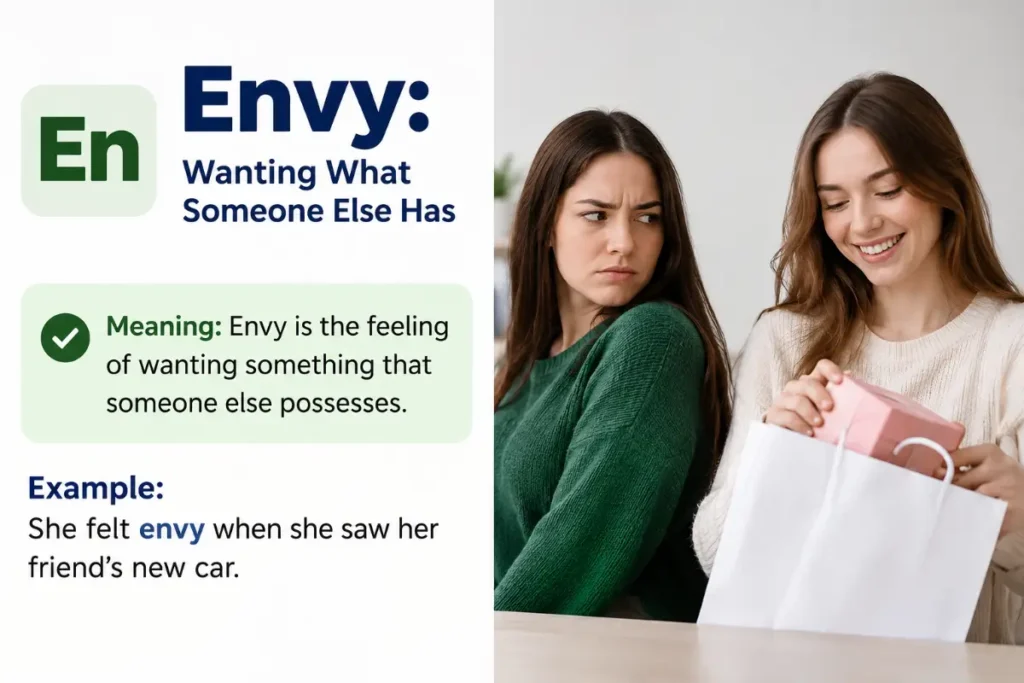
When it comes to Envy vs Jealousy, the distinction isn’t always as clear-cut as grammar guides make it seem. These words can overlap in everyday use, and even language experts don’t fully agree on how strict the difference should be. Still, there is a widely useful distinction worth knowing that can help you choose the right word with confidence.
Envy is wanting something someone else has. Jealousy is the fear of losing something you already have, especially to a rival — and it carries a stronger emotional charge, particularly in romantic contexts. Wanting versus fearing to lose: that’s the core distinction worth holding onto.
You may also find Who vs Whom: The Simple Test That Ends the Confusion (2026 Guide) helpful if you want to explore this topic further.
The Quick Answer
- Envy = wanting what someone else has
- I envy her ability to stay so calm under pressure.
- Jealousy = fear of losing something (or someone) you have, especially to a rival
- His jealousy flared up when she mentioned her old friend.
The test: are you wanting something someone else possesses? Use envy. Are you afraid of losing something — or someone — you already have? Use jealousy, especially in romantic or possessive contexts.
Try it: “I ___ my coworker’s promotion.” Is this about wanting something she has? Yes — so it’s envy: “I envy my coworker’s promotion.”
Now try: “His ___ made him check her phone constantly.” Is this about fear of losing someone to a rival? Yes — so it’s jealousy: “His jealousy made him check her phone constantly.”
The Homer Simpson Rule (and Why It’s Not the Whole Story)
Merriam-Webster actually cites a genuinely popular pop-culture summary of this distinction: Homer Simpson once said, “I’m not jealous, I’m envious! Jealousy is when you worry someone will take what you have. Envy is wanting what someone else has.” It’s a surprisingly accurate, quotable version of the modern distinction most people intuitively reach for.
But Merriam-Webster’s own deeper usage notes complicate this a bit: historically, “jealous” has been used to mean “envious” since the 14th century, and both words have overlapping senses around being “covetous” of someone else’s possessions. The dictionary notes that “jealous” carries an added sense of “zealous vigilance,” tending to apply more specifically to feelings of protectiveness over one’s own advantages or attachments — which is exactly why jealousy shows up so much more often in romantic contexts than envy does. If a flirtatious comment is made to your partner, you’d say it caused you jealousy, not envy — because there’s a specific, personal threat to something you already possess (the relationship), not simply a desire for something you lack.
Envy: Wanting What Someone Else Has
Envy describes a longing or desire for something — a possession, quality, achievement, or circumstance — that belongs to someone else.
Examples:
- I envy their ability to travel so often.
- She felt a pang of envy watching her friend’s book launch.
- He envied his brother’s easy confidence in social situations.
- Their success is the envy of the entire industry.
- I don’t envy the amount of work she has on her plate this month.
Notice that last example — envy can also apply to something undesirable, used somewhat ironically (“I don’t envy her workload” meaning “I’m glad that’s not my situation”). This flexible, slightly broader application is one of envy’s distinguishing features compared to jealousy.
Jealousy: Fear of Losing What You Have
Jealousy describes a feeling of apprehension, suspicion, or resentment tied to protecting something — often a relationship — you already possess, especially against a perceived rival or threat.
Examples:
- Her jealousy grew every time he mentioned his ex.
- He couldn’t hide his jealousy when she got more attention at the party.
- Sibling jealousy is common when a new baby arrives.
- The team’s jealousy over the new hire’s quick success created tension.
- Jealousy nearly ruined their friendship after she got the promotion he wanted.
Notice how many of these examples involve relationships, rivalry, or a sense of personal threat — jealousy tends to carry sharper, more possessive, and often more destructive emotional weight than envy, especially in matters of romance and close relationships.
The Fastest Way to Check Yourself
Step 1: Are you wanting something someone else has, without any element of losing something yourself? If yes, it’s envy.
Step 2: Are you afraid of losing something — especially a relationship or status — to a rival? If yes, it’s jealousy.
Step 3: If romance, possessiveness, or a specific rival is involved, jealousy is almost always the more precise and natural word. Merriam-Webster specifically notes jealousy is “more commonly found than envy” in the domain of romance.
A widely used memory trick: envy relates to “want” — you envy something you don’t have. Jealousy relates to “guard” — you’re jealously guarding something you already possess. If the emotion involves defending or protecting something from a threat, it’s jealousy; if it’s purely about desiring something you lack, it’s envy.
This is one of several pairs on this site where the historical record is genuinely messier than the tidy modern rule suggests — similar in spirit to the flaunt and flout situation, where usage has shifted enough over time that even dictionaries hedge on how strict the distinction really is.
Envy vs. Jealousy: Side-by-Side Comparison
| Envy | Jealousy | |
|---|---|---|
| Core feeling | Wanting what someone else has | Fear of losing what you have |
| Involves a rival? | Not necessarily | Often, especially in romance |
| Intensity | Generally milder | Often stronger, more possessive |
| Common domain | Achievements, possessions, qualities | Relationships, romantic contexts |
| Part of speech | Noun and verb | Noun only |
| Example | I envy her talent. | His jealousy consumed him. |
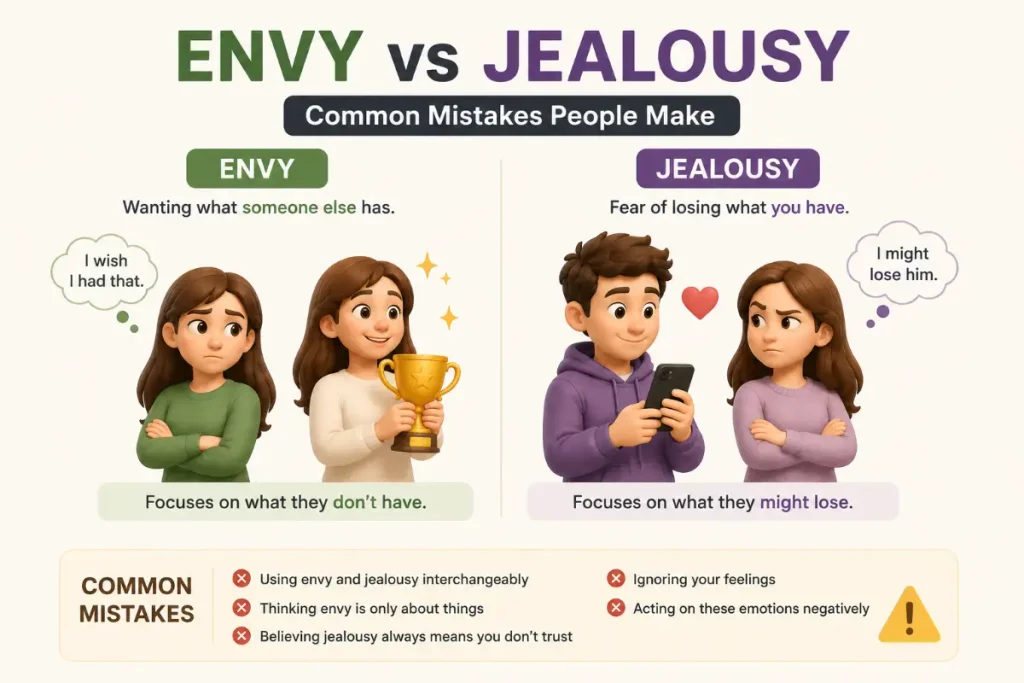
Common Mistakes People Make
Mistake 1: “She was so envious when she caught him talking to his ex.” In careful usage, this should be “jealous” — this describes fear tied to a relationship and a perceived rival, which is jealousy’s more precise territory, even though Merriam-Webster notes “envious” wouldn’t be flatly wrong given the historical overlap.
Mistake 2: “I’m jealous of your new house.” This is actually widely accepted and common — Merriam-Webster confirms “jealous” has been used to mean “envious” of possessions since the 14th century. That said, “I’m envious of your new house” is the more precise choice if you want to emphasize desire rather than any hint of rivalry or threat.
Mistake 3: Assuming these words are always strictly interchangeable. While there’s genuine historical overlap, using “envy” in a clearly romantic, possessive, rival-driven context (“he felt intense envy when she talked to other men”) reads as slightly imprecise to careful readers — “jealousy” captures that specific emotional territory more naturally.
Mistake 4: “New colonies were enviously guarding their independence.” Should be “jealously guarding” — you can jealously guard something you already possess, but you cannot enviously guard something, since envy is about wanting, not protecting.
Mistake 5: Treating the distinction as an absolute rule rather than a strong tendency. Given how much historical and dictionary-level overlap exists between these words, treating any use of “envy” for a relationship-related feeling as an outright error goes further than the actual, more nuanced usage guidance supports.
For another useful perspective, check out Principal vs Principle: The “Pal” Trick That Actually Works (2026).
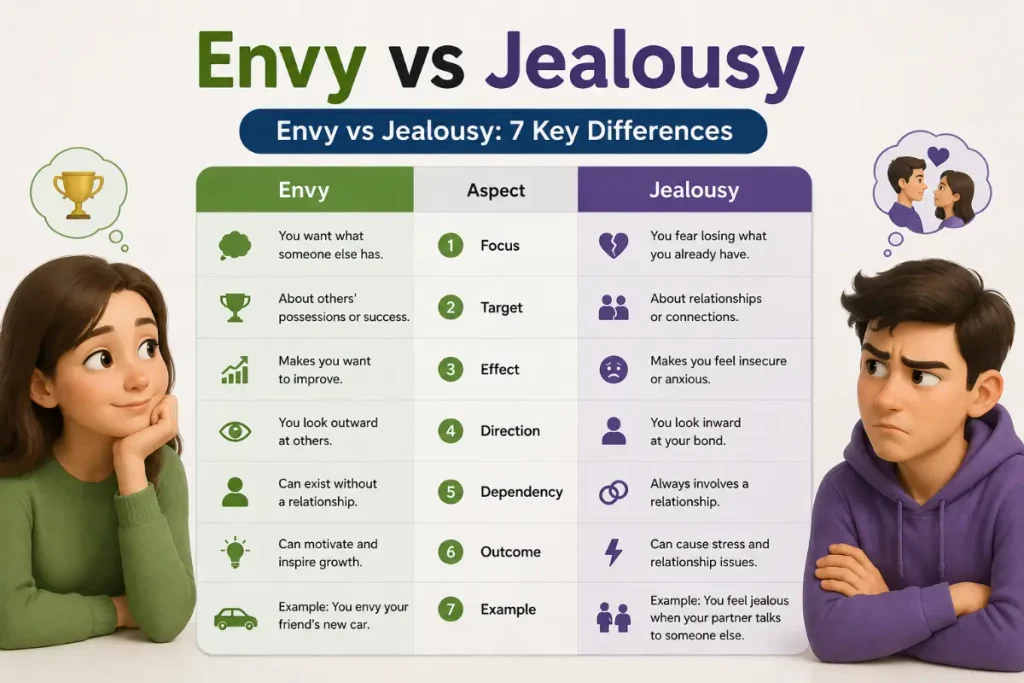
Envy vs Jealousy: 7 Key Differences
Although envy vs jealousy can overlap in everyday conversation, the two words usually describe different emotional experiences. Envy centers on wanting something another person has, while jealousy typically involves protecting something you already have from a perceived threat.
| Difference | Envy | Jealousy |
|---|---|---|
| 1. Main feeling | Wanting what someone else has | Fear of losing what you have |
| 2. Focus | Another person’s advantage | Your own relationship, possession, or advantage |
| 3. Typical situation | Someone gets a promotion you wanted | Someone threatens your position or relationship |
| 4. People involved | Often two people | Often involves three people or a perceived rival |
| 5. Emotional tone | Desire, longing, or resentment | Suspicion, insecurity, fear, or protectiveness |
| 6. Common context | Success, money, appearance, skills, possessions | Romantic relationships, friendships, status, or possessions |
| 7. Simple memory trick | Envy = I want what you have | Jealousy = I don’t want you to take what I have |
1. Envy is about wanting
When you envy someone, you want something they possess or enjoy. It could be their career, confidence, lifestyle, talent, appearance, or even a particular opportunity.
Example:
“I envy her ability to stay calm under pressure.”
Here, the speaker wants the quality that the other person has.
2. Jealousy is about protecting
Jealousy usually appears when you feel that someone or something could take away what you already have. This is why the word commonly appears in romantic situations.
Example:
“He felt jealous when his partner started spending more time with a coworker.”
The concern isn’t simply wanting the coworker’s relationship. It’s the fear of losing an existing relationship to a rival.
3. Envy usually looks outward
With envy, your attention is directed toward another person’s advantage. You see what they have and wish you had it too.
Example:
“She envied her friend’s new house.”
The focus is on the house and the desire to have something similar.
4. Jealousy often involves a threat
Jealousy tends to involve a perceived threat to something valuable. That threat might be another person, a competitor, or a situation that makes you feel insecure.
Example:
“The athlete became jealous when a younger competitor started receiving more attention.”
The emotion comes from feeling that someone else might take away recognition, status, or opportunity.
5. Envy can exist without a rival
You don’t necessarily need a third person for envy. You can envy someone simply because they have something you wish you had.
Example:
“I envy his ability to travel whenever he wants.”
There’s no rival involved. The emotion is based on wanting another person’s circumstances.
6. Jealousy is especially common in relationships
While jealousy can occur outside romance, it’s strongly associated with relationships. A person may feel jealous when they believe a rival could receive the attention, affection, trust, or loyalty they currently have.
Example:
“She felt jealous when her best friend began spending every weekend with someone new.”
The underlying concern is losing an important relationship or becoming less important to that person.
7. A simple way to remember the difference
The easiest way to remember Envy vs Jealousy is:
- Envy = “I want what you have.”
- Jealousy = “I don’t want to lose what I have.”
This isn’t a perfect rule for every use of the words, because their meanings have overlapped throughout English history. Still, the wanting vs. guarding distinction is a useful shortcut for choosing the right word in most everyday situations.
More Examples to Lock It In
- He envied his friend’s new car, but it was jealousy, not envy, that flared when she started spending more time with her old college friends.
- Their success became the envy of the whole office, though jealousy quietly simmered among a few team members who felt overlooked.
- She admitted to feeling a twinge of envy over her sister’s effortless style, though she’d never felt true jealousy toward her.
- His jealousy over his brother’s engagement wasn’t really about love — it was closer to envy over reaching that milestone first.
- The colonies jealously guarded their independence, a possessiveness quite different from simple envy of another nation’s resources.
Frequently Asked Questions
Is it actually wrong to use “jealous” to mean “envious” of a possession?
No — Merriam-Webster confirms this usage has been standard since the 14th century and is recognized by dictionaries as legitimate. “I’m jealous of your vacation” is completely acceptable, even though “envious” would be the more historically “precise” word in that specific sentence.
Why does jealousy show up so much more often in romantic contexts than envy does?
Because jealousy carries a specific sense of “zealous vigilance” and protectiveness over something you already have or feel entitled to, which maps naturally onto guarding a romantic relationship against a perceived rival — a sense envy simply doesn’t carry, since envy is fundamentally about desiring something you lack, not protecting something you possess.
Can you be “jealous” of something you don’t currently have?
Yes, informally and historically — this is exactly the overlapping usage Merriam-Webster documents, where jealous functions as a rough synonym for envious regarding possessions. However, jealousy’s core, most precise sense involves protecting or fearing the loss of something already held, which is the distinction worth defaulting to in more careful or formal writing.
Is there a meaningful difference between “envious” and “jealous” as adjectives, compared to “envy” and “jealousy” as nouns?
The adjectives follow the same distinction as their noun forms — envious describes wanting what someone else has, jealous describes fear of losing something (often with a possessive or romantic edge). The part-of-speech shift doesn’t change the underlying meaning difference.
What’s the fastest way to catch this error before publishing something?
Ask whether the emotion is about desiring something you lack (envy) or fearing the loss of something you already have, especially involving a rival (jealousy). Given the genuine historical overlap between these words, this is one of the pairs where “getting it exactly right” matters more for precision and nuance than for avoiding an outright grammatical error.
Practice Exercise
Fill in the blank with either “envy” or “jealousy” (or their adjective forms). Answers are listed right after — try each one before checking.
- I ______ her ability to speak four languages fluently.
- His ______ flared when she danced with someone else.
- Their vacation photos filled me with ______.
- She couldn’t hide her ______ when he mentioned his ex.
- He ______ his friend’s promotion at work.
- ______ nearly destroyed their friendship after the award ceremony.
- I don’t ______ the stress that comes with that job.
- Sibling ______ is common after a new baby arrives.
- She felt a quiet ______ watching her sister’s wedding.
- His ______ made him suspicious of every text she received.
- Their success became the ______ of the entire industry.
- The colonies ______ly guarded their newfound independence.
- I ______ people who can wake up early without an alarm.
- ______ crept in when he saw her laughing with a coworker.
- She admitted feeling ______ over her friend’s new house.
- His ______ over the attention she gave others grew unbearable.
- I ______ the confidence he has in front of a crowd.
- ______ is often stronger than envy in romantic relationships.
- She felt ______ watching her old friend’s career take off.
- His ______ turned into resentment when he wasn’t chosen for the role.
Answer Key
- envy
- jealousy
- envy
- jealousy
- envied
- Jealousy
- envy
- jealousy
- envy
- jealousy
- envy
- jealous
- envy
- Jealousy
- envious
- jealousy
- envy
- Jealousy
- envious
- jealousy
If you got sixteen or more correct, you’ve got a solid handle on this genuinely nuanced pair. For any you missed, ask again: wanting something (envy), or fearing to lose something to a rival (jealousy)?
Before moving on, you may also want to read Than vs Then: The Simple Rule That Ends the Confusion (2026) for more helpful grammar tips.
The Bottom Line
Envy is wanting something someone else has. Jealousy is the fear of losing something you already have, especially to a rival, and it carries a sharper edge, particularly in romantic contexts. There’s genuine historical overlap between the two, so this isn’t a strict, unbreakable rule — but knowing the distinction (wanting versus guarding) makes your writing more precise when the emotional nuance actually matters.
Think of Envy vs Jealousy as the difference between wanting and guarding. Envy is wanting something someone else has, while jealousy is usually the fear of losing something you already have, especially to a rival. The two words have genuine historical overlap, so this isn’t an absolute rule, but understanding the distinction can make your writing more precise when emotional nuance matters.