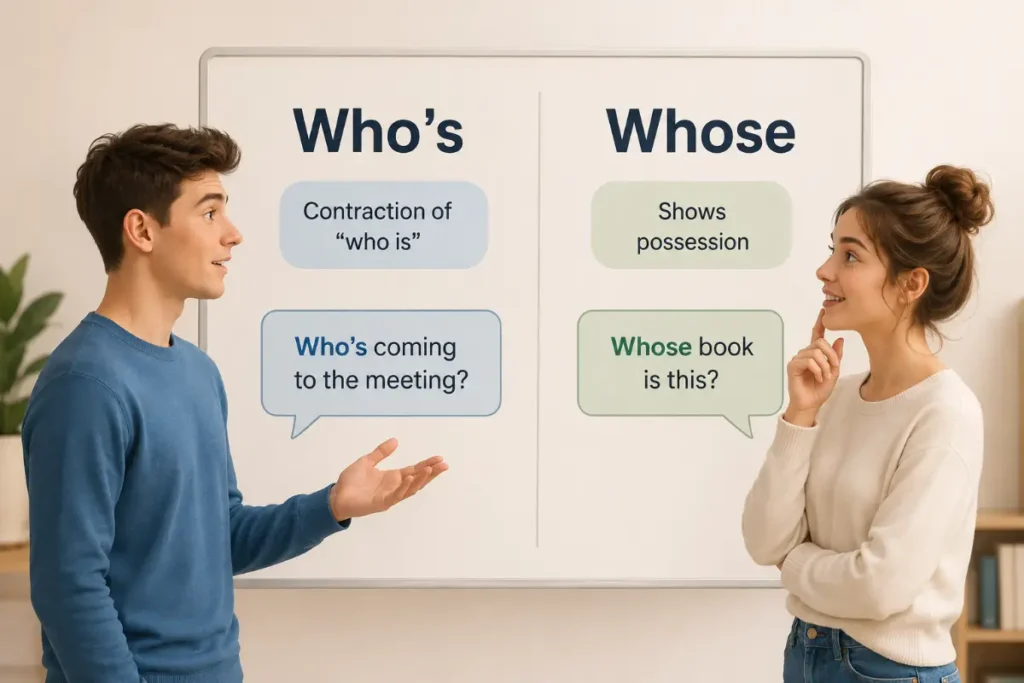
If you’ve already mastered its and it’s, you’ll find who’s vs whose almost suspiciously familiar because it follows the same basic logic. Who’s and whose sound identical, but the apostrophe version is actually a contraction, not the possessive form.
Who’s is a contraction of “who is” or “who has.” Whose is the possessive form of “who,” showing ownership. Same trap as its/it’s, same fix.
You may also find Loose vs Lose: The Missing-Letter Trick That Fixes This Forever (2026) helpful if you want to explore this topic further.
The Quick Answer
- Who’s = “who is” or “who has”
- Who’s coming to the party?
- Whose = belonging to whom (possession)
- Whose jacket is this?
The test: try replacing the word with “who is” or “who has.” If it makes sense, use who’s. If it sounds wrong, use whose.
Try it: “___ turn is it?” Substitute “who is” — “who is turn is it?” That’s nonsense, so it’s whose: “Whose turn is it?”
Now try: “___ bringing the drinks tonight?” Substitute “who is” — “who is bringing the drinks tonight?” That works, so it’s who’s: “Who’s bringing the drinks tonight?”
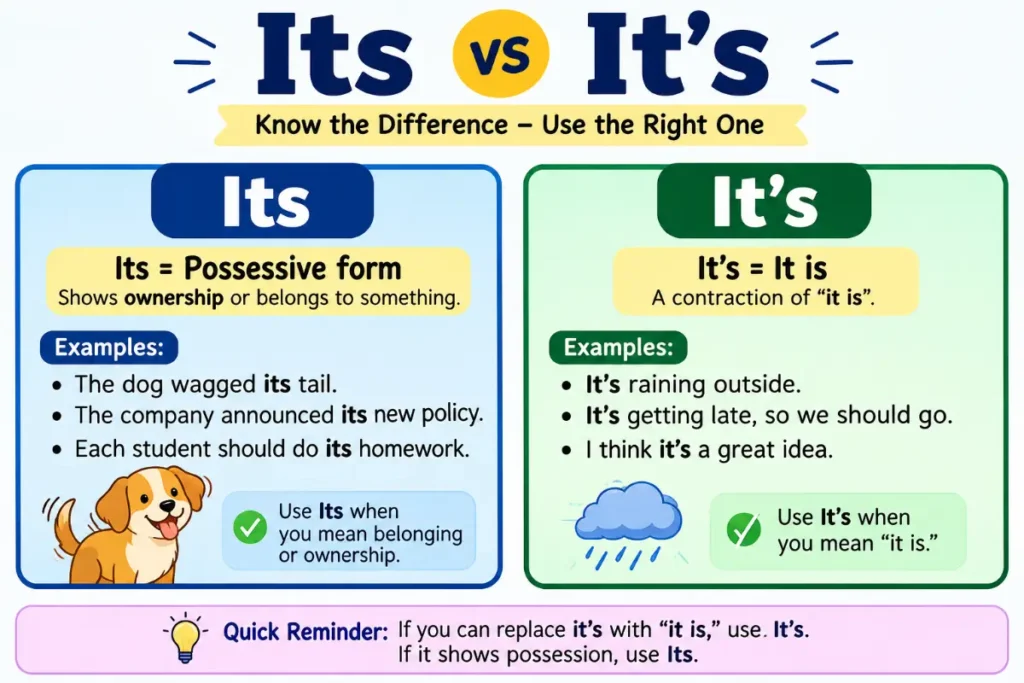
Why This Is Basically the Its/It’s Problem All Over Again
Merriam-Webster draws this exact comparison directly, noting that “the confusion between whose and who’s is very similar to the confusion that occurs between it’s and its” — in both pairs, the apostrophe version is the contraction, and the no-apostrophe version is the possessive, which runs opposite to how apostrophes work with regular nouns (like “Sarah’s car”).
The underlying reason is the same one covered in the its/it’s guide: pronouns don’t use apostrophes to show possession. “His,” “hers,” “ours,” “theirs,” “its,” and “whose” all show ownership without an apostrophe, because that’s simply how English handles possessive pronouns across the board. The apostrophe in “who’s,” just like the apostrophe in “it’s,” is standing in for a missing letter in a contraction — not marking possession at all.
Who’s: “Who Is” or “Who Has”
Who’s only ever means one of two things: “who is” or “who has.” If you can’t expand it into one of those, it’s the wrong word.
Examples using “who is”:
- Who’s responsible for this decision?
- I don’t know who’s calling.
- Who’s ready for lunch?
Examples using “who has”:
- Who’s been using my charger?
- She’s the one who’s always on time.
- Who’s finished the assignment already?
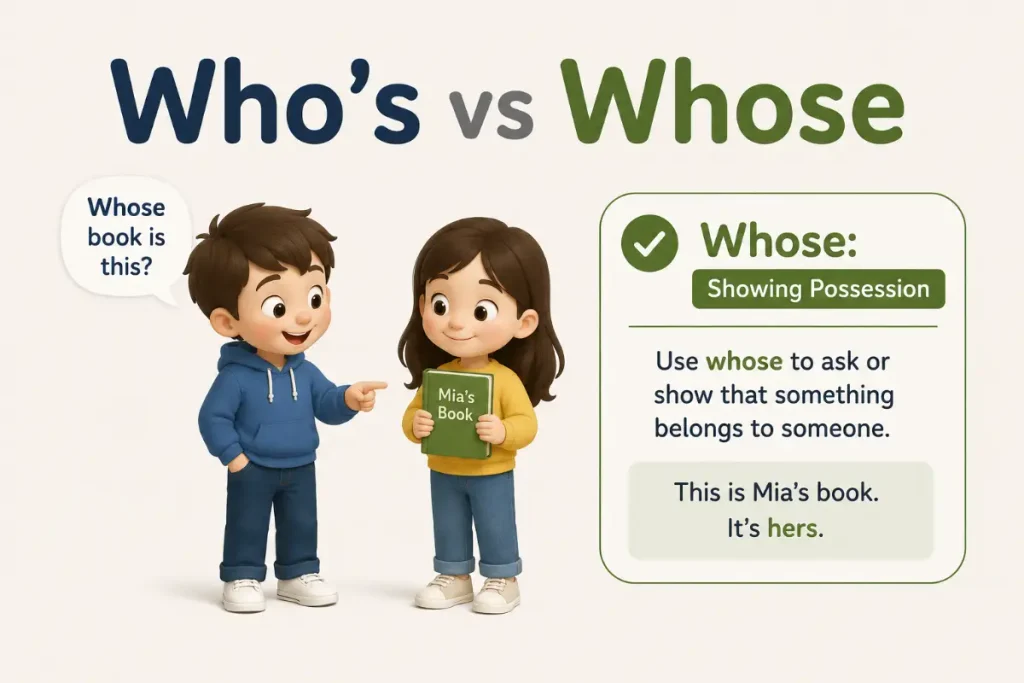
Whose: Showing Possession
Whose is the possessive form of “who,” used to ask or state who something belongs to.
Examples:
- Whose phone keeps buzzing?
- I found a jacket, but I don’t know whose it is.
- The author, whose book just topped the bestseller list, is doing a signing tonight.
- Whose idea was this, originally?
- The company whose stock rose the most this quarter surprised analysts.
Notice that whose isn’t limited to people, even though it’s built from “who” — it regularly refers to companies, countries, books, and other non-human nouns too, exactly as shown in the last two examples. This is worth knowing, since some writers assume whose can only apply to people and awkwardly substitute “of which” instead, when whose works perfectly well.
The Fastest Way to Check Yourself
Step 1: Try the “who is” / “who has” substitution. If either expansion makes sense, you want who’s.
Step 2: If the sentence is about ownership — asking or stating who something belongs to — you want whose.
Step 3: Remember the its/it’s parallel. If you’ve already internalized that “it’s” always expands to “it is” or “it has,” you can apply the exact same logic here without learning a new mental model from scratch.
A simple memory trick: who’s contains an apostrophe, just like it’s — and in both cases, that apostrophe signals a contraction, not possession. Whose, with no apostrophe, joins the same family as “his,” “hers,” and “its” — all possessive pronouns that skip the apostrophe entirely.
This whole “who” family causes its share of trouble — if you’re also unsure about who versus whom, that’s a related but separate rule worth reviewing too, since it deals with subject versus object rather than possession versus contraction.
Who’s vs. Whose: Side-by-Side Comparison
| Who’s | Whose | |
|---|---|---|
| Type | Contraction | Possessive pronoun |
| Meaning | Who is / who has | Belonging to whom |
| Example | Who’s at the door? | Whose coat is this? |
| Test | Expand to “who is” or “who has” | Ask “who does this belong to?” |
| Apostrophe | Always | Never |
| Applies to | People (via “who”) | People, companies, objects, ideas |
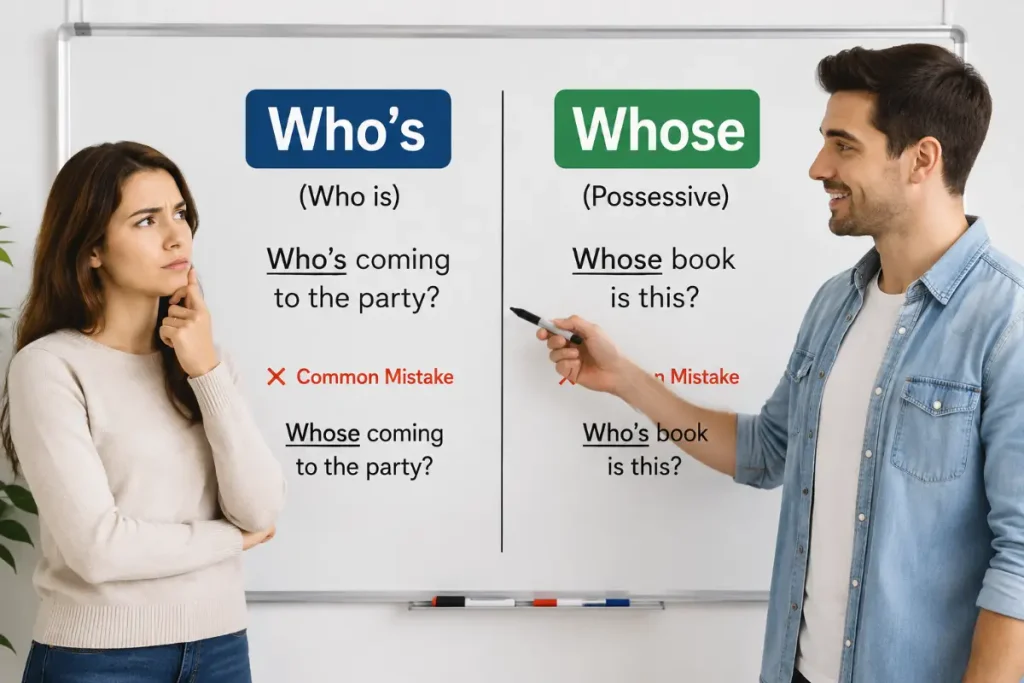
Common Mistakes People Make
Mistake 1: “Who’s book is this?” Should be “whose book” — this is asking about ownership, not saying “who is book,” which makes no sense.
Mistake 2: “I don’t know who’s turn it is.” Should be “whose turn” — again, this is possession (whose turn belongs to whom), not a contraction.
Mistake 3: “The employee whose always early left a note.” Should be “who’s always early” — this expands correctly to “who is always early,” so it needs the contraction, not the possessive.
For another useful perspective, check out Among vs Between: 5 Common Mistakes to Avoid in 2026.
Mistake 4: “Whose coming to the meeting?” Should be “who’s coming” — this expands to “who is coming,” so it needs the contraction.
Mistake 5: Assuming “whose” only applies to people. “The company whose profits doubled” is completely correct — whose can refer to companies, objects, countries, and ideas, not just people, even though it’s built from the pronoun “who.” Avoiding whose in these cases and awkwardly writing “the company of which the profits doubled” isn’t more correct; it’s just more cumbersome.
More Examples to Lock It In
- Who’s going to tell the manager whose parking spot got taken?
- I need to find out whose car is blocking the driveway before I know who’s calling a tow truck.
- The scientist, whose research changed the field, is finally getting recognition — and everyone’s asking who’s writing her biography.
- Whose idea was it to reschedule, and who’s in charge of notifying everyone?
- The team whose funding got cut is the one who’s been struggling the most this quarter.
What the Style Guides Say
Merriam-Webster directly frames who’s/whose as a near-identical problem to its/it’s, and specifically notes that whose functions as a possessive determiner that can apply broadly — to people, places, things, and ideas — despite being built from “who,” which people typically associate only with human subjects. The AP Stylebook and Chicago Manual of Style both treat this as a fixed, uncontested distinction, with the standard possessive-pronoun rule (no apostrophe) applying without exception.
Because this pair shares its underlying logic so closely with its/it’s, most usage guides recommend learning them together — once one clicks, the other tends to follow almost automatically, since the apostrophe-equals-contraction rule is identical in both cases.
Who’s and Whose in Different Writing Contexts
In casual writing, this mix-up is extremely common and usually understood from context, but it’s still one of the more noticeable errors to readers who’ve internalized the its/it’s rule and expect the same logic here.
In journalism and formal writing, “whose” appears constantly in descriptive clauses (“the senator, whose bill passed yesterday…”) since it allows writers to attach ownership or association to a subject smoothly, without an awkward “of which” workaround.
In business writing, both words show up regularly — “who’s responsible for this” in emails and meetings, “whose department” in organizational discussions — and getting the apostrophe right in each case is a small but real marker of careful proofreading.
In creative and narrative writing, “whose” often extends naturally to inanimate or abstract subjects (a house whose windows were boarded up, a plan whose details were still unclear), which is a stylistically smooth and grammatically correct use worth embracing rather than avoiding.
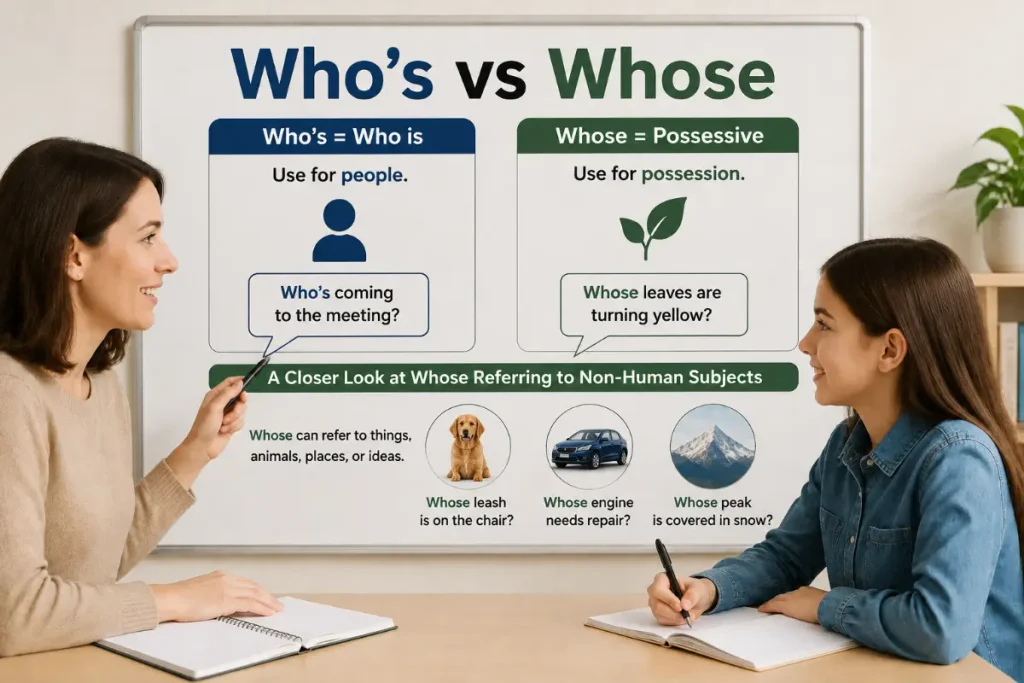
A Closer Look at Whose Referring to Non-Human Subjects
This is worth its own section because it’s genuinely one of the more underused correct constructions in English — many writers instinctively avoid “whose” for anything other than a person, even though it’s been standard usage for centuries.
- The novel, whose plot twists surprised even longtime fans, became an instant bestseller.
- We toured a city whose history dates back over a thousand years.
- The organization, whose funding comes primarily from grants, expanded its programs this year.
- I bought a laptop whose battery life turned out to be disappointing.
- The bridge, whose construction took nearly a decade, finally opened to traffic.
In every one of these, the alternative — using “of which” instead — would technically also work but reads as noticeably stiffer and more formal: “a novel the plot twists of which surprised fans” versus the far more natural “a novel whose plot twists surprised fans.” Merriam-Webster and most modern style guides agree that “whose” is not just acceptable but preferable for non-human subjects in the vast majority of everyday and professional writing, reserving the “of which” construction for only the most formal or legalistic contexts, if at all.
Frequently Asked Questions
Is “whose” only used for people, since it’s built from “who”?
No — despite its connection to “who,” whose is regularly and correctly used for companies, objects, countries, and abstract ideas (“a company whose profits grew,” “a plan whose success depends on timing”). Avoiding it in favor of an “of which” construction isn’t more correct, just more awkward.
Why does the apostrophe in “who’s” work the same way as in “it’s”?
In both cases, the apostrophe signals a contraction (who is/who has, it is/it has), not possession — even though apostrophes usually do indicate possession with regular nouns. Pronouns are the consistent exception to that pattern across English, which is why neither “who’s” nor “it’s” fits the ownership role its apostrophe might suggest.
Can “who’s” ever function as a possessive, in any context?
No — this is one of the cleaner distinctions in English, without crossover exceptions. Who’s always means “who is” or “who has,” full stop; whose is always the possessive form, with no apostrophe, ever.
Is there a quick way to double-check this in a long document?
Search for every instance of “who’s” and “whose,” and for each one, try expanding to “who is” or “who has.” If the expansion works, who’s is correct. If it sounds like nonsense, you want whose instead — this test resolves nearly every case within seconds.
Does autocorrect reliably catch this error?
Not reliably. Since both are correctly spelled, real words, most spell-checkers won’t flag a wrong-but-valid choice. Some context-aware grammar tools catch it more often now, but a manual check remains the most dependable method, especially in anything formal or public-facing.
Practice Exercise
Fill in the blank with either “who’s” or “whose.” Answers are listed right after — try each one before checking.
- ______ responsible for locking up tonight?
- I don’t know ______ umbrella this is.
- The author, ______ new book just launched, is on tour.
- ______ been eating all the snacks?
- Do you know ______ turn it is next?
- ______ coming to the reunion this year?
- The teacher ______ class won the award was thrilled.
- ______ got the keys to the storage unit?
- I need to know ______ idea this was originally.
- ______ ready to order?
- The company ______ stock dropped is under investigation.
- ______ going to explain this to the client?
- Find out ______ car alarm keeps going off.
- ______ been working on this project the longest?
- The dog, ______ owner just moved in, is very friendly.
- ______ bringing dessert to the potluck?
- I wonder ______ signature is on this document.
- ______ heard the news about the merger?
- The house ______ roof was damaged is finally getting repaired.
- ______ turn is it to present first?
Answer Key
- Who’s
- whose
- whose
- Who’s
- whose
- Who’s
- whose
- Who’s
- whose
- Who’s
- whose
- Who’s
- whose
- Who’s
- whose
- Who’s
- whose
- Who’s
- whose
- Whose
If you got sixteen or more correct, the who-is/who-has expansion test has already become instinct. For any you missed, go back and try the substitution again — if it sounds wrong, whose is your answer.
Before moving on, you may also want to read Bring vs Take: The Perspective Trick That Makes This Simple for more helpful grammar tips.
The Bottom Line
Who’s is short for “who is” or “who has” — always a contraction. Whose shows possession — belonging to whom, whether that’s a person, a company, or an object. If you’ve already got its versus it’s down, you’ve already got the logic for this pair too: apostrophe means contraction, no apostrophe means possession.
The Who’s vs Whose distinction is simple once you know what each form stands for. If you can replace “who’s” with “who is” or “who has,” use the apostrophe. If you’re showing ownership or association, use “whose.” A quick substitution check can help you choose the right word every time.