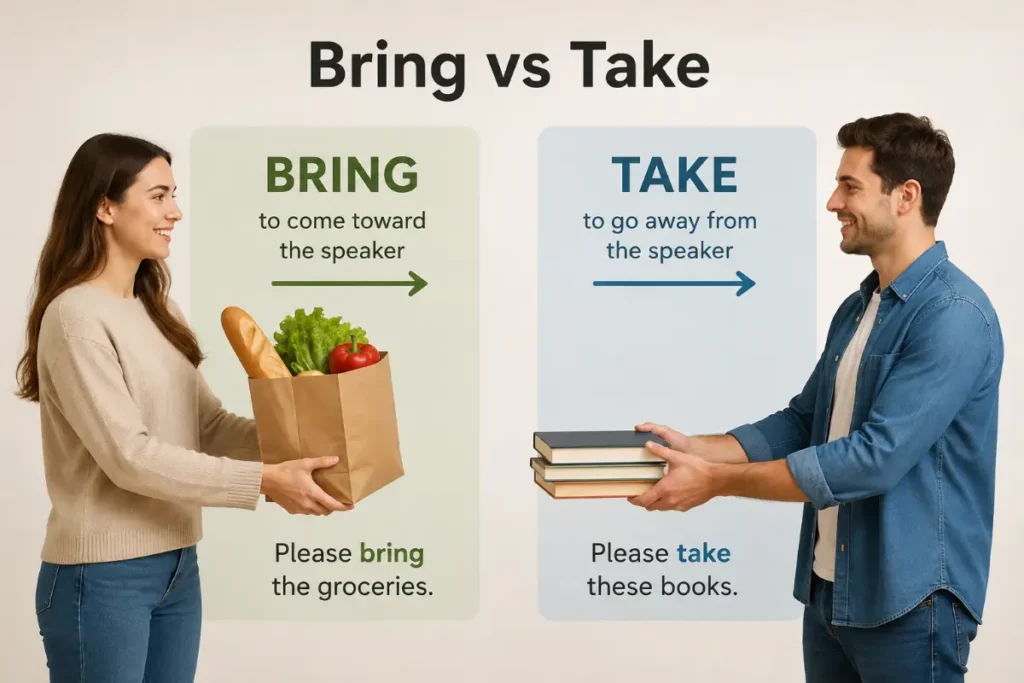
Here’s a rule most people never had explicitly explained to them, even though native speakers usually get it right by instinct: bring vs take both describe carrying something, but they depend entirely on where the speaker is standing—literally or figuratively. Once you see the logic behind it, the rule becomes easy to apply consistently, even in tricky cases.
Bring describes movement toward the speaker or the place being discussed. Take describes movement away from the speaker or that place. Same basic action, opposite direction.
You may also find Principal vs Principle: The “Pal” Trick That Actually Works (2026) helpful if you want to explore this topic further.
The Quick Answer
- Bring = movement toward the speaker’s location (here)
- Bring your laptop to the meeting. (the meeting is where the speaker is)
- Take = movement away from the speaker’s location (there)
- Take these files to the archive. (the archive is away from the speaker)
The test: think of “bring” as paired with “come,” and “take” as paired with “go.” If the sentence would naturally use “come,” use bring. If it would naturally use “go,” use take.
Try it: “___ your umbrella when you leave the house.” Would you say “go get your umbrella,” moving away from where you are? Yes — so it’s take: “Take your umbrella when you leave the house.”
Now try: “Please ___ me the salt.” Would you say “come here with the salt,” moving toward you? Yes — so it’s bring: “Please bring me the salt.”
The Real Logic Behind the Rule
Merriam-Webster defines bring specifically as movement “toward the place from which the action is being regarded” — meaning toward the speaker’s point of view, whether that’s their physical location right now or the location they’re mentally focused on in the conversation. Take covers the opposite: movement away from that reference point.
This is why the come/go pairing works so well as a mental shortcut. “Come” and “bring” both involve movement toward the speaker; “go” and “take” both involve movement away. If a sentence sounds natural with “come,” it’ll sound natural with “bring.” If it sounds natural with “go,” it’ll sound natural with “take.”
Bring: Toward the Speaker
Examples where the action moves toward where the speaker is (or will be):
- Bring your ID when you come to the office. (the office is where the speaker is)
- Can you bring me a glass of water? (toward the speaker, right here)
- We’re having a party — bring a dish to share. (the speaker is imagining themselves already at the party)
- Please bring the documents to my desk. (toward the speaker’s location)
- I’ll bring the kids home after practice. (toward “home,” where the speaker’s focus is)
Notice the third example especially — even though the party hasn’t happened yet, the speaker is mentally placing themselves at the party as the reference point, which is exactly why “bring” works there instead of “take.”
Take: Away from the Speaker
Examples where the action moves away from where the speaker is:
- Take this letter to the post office. (away from the speaker, toward the post office)
- Don’t forget to take your umbrella when you leave. (moving away from the current location)
- She’s going to take the kids to school. (away from home, toward school)
- Take these boxes down to the basement. (away from the speaker’s current spot)
- He took the report to his manager’s office. (away from where he started)
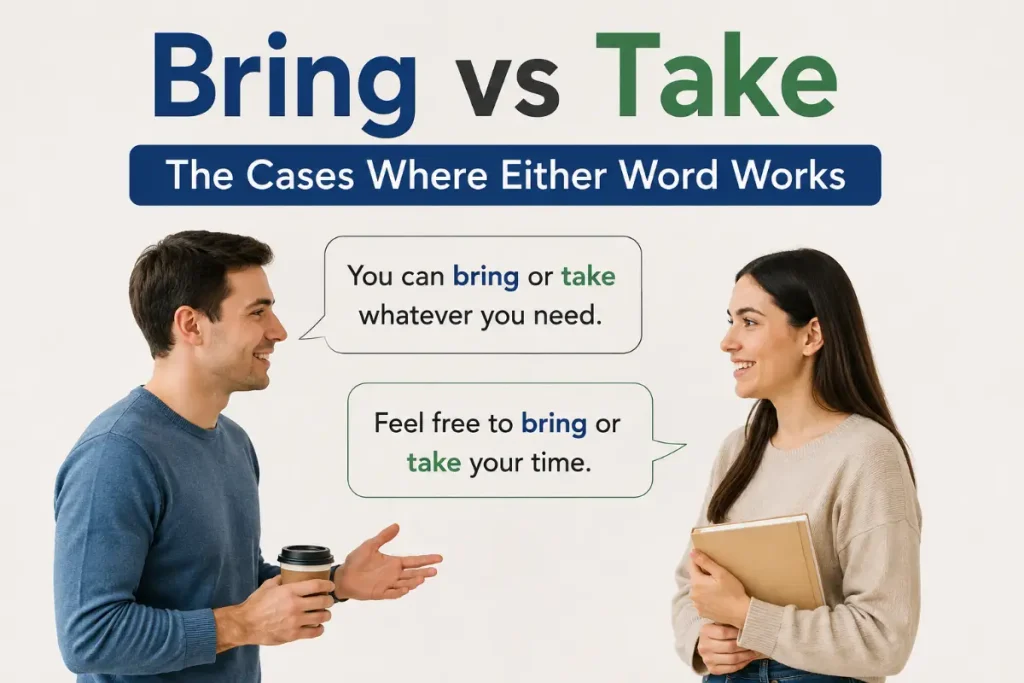
The Cases Where Either Word Works
This is worth knowing because it explains why bring and take sometimes feel interchangeable, and it’s not actually a mistake when that happens. Merriam-Webster notes directly that when the direction of movement doesn’t matter to the listener, or isn’t clearly defined, either word is acceptable.
- Bring the dictionary with you to the pub.
- Take the dictionary with you to the pub.
Both of these work because the sentence doesn’t clearly establish where the speaker’s reference point is relative to “the pub.” This flexibility is completely normal and isn’t a case of one being right and one being wrong — it’s a case where the direction genuinely isn’t fixed by the context.
The Perspective Shift That Confuses People
Here’s where things get genuinely tricky, and it’s worth walking through carefully: the correct word can change depending on whose perspective you’re adopting in a conversation, even when describing the exact same physical action.
If you’re talking to a friend about a party they’re hosting, you’d naturally say “I’ll bring chips” — because you’re mentally placing yourself at their party as the reference point, even though you haven’t left your own house yet. But if you’re talking to a different friend who isn’t going to that party, describing your plans, you might say “I’m going to take chips to the party” — because now your reference point is your current location, and the party is a separate place you’re moving toward.
This perspective-shifting is exactly why some regional and international variations exist too — in American English, “bring” tends to be used a bit more flexibly and broadly than the strict rule technically calls for, while British English tends to hold the distinction slightly more rigidly. Neither is “wrong”; they reflect slightly different conventions about how loosely the core rule gets applied in casual speech.
The Fastest Way to Check Yourself
Step 1: Identify the speaker’s reference point — where are they standing, mentally or physically, when they say this sentence?
Step 2: Is the movement toward that point, or away from it? Toward means bring; away means take.
Step 3: Try the come/go substitution. “Come” pairs with bring; “go” pairs with take. If one sounds natural and the other sounds off, that tells you which verb you need.
Step 4: If the direction genuinely isn’t clear or doesn’t matter, either word is fine — this isn’t a loophole, it’s a genuinely accepted part of the rule.
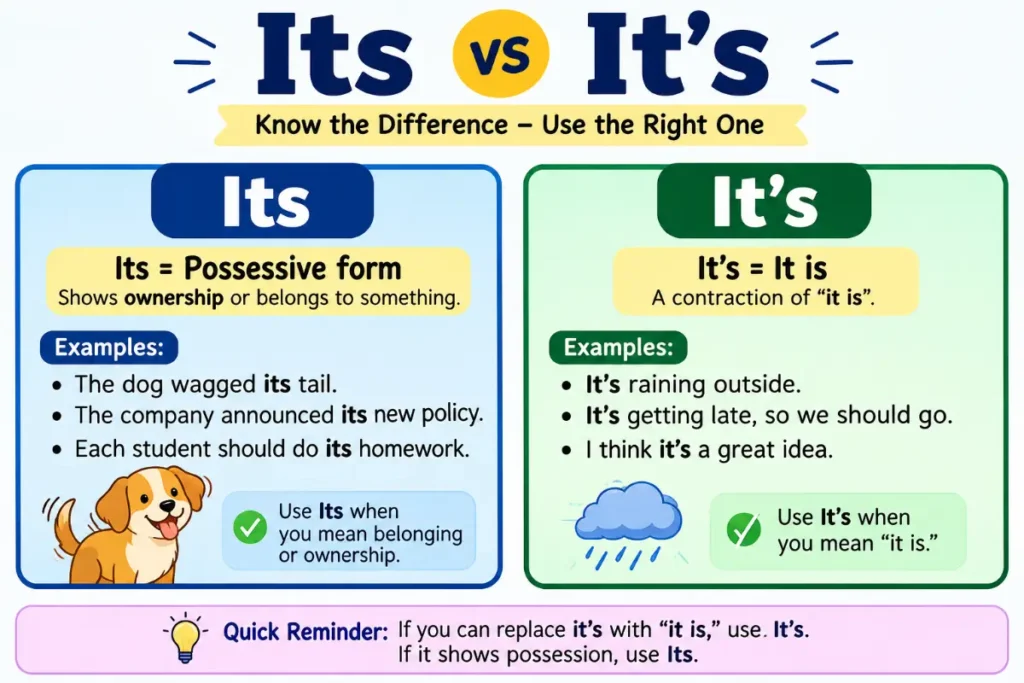
Unlike the rigid, exception-free logic behind its and it’s, bring and take is one of the more forgiving pairs on this list — a rule with real, documented flexibility built in, rather than a strict binary choice.
Bring vs. Take: Side-by-Side Comparison
| Bring | Take | |
|---|---|---|
| Direction | Toward the speaker’s reference point | Away from the speaker’s reference point |
| Paired verb | Come | Go |
| Example | Bring it here. | Take it there. |
| Flexible cases | When direction is unclear or irrelevant | Same |
| Common phrase | Bring me… | Take this to… |
Common Mistakes People Make
Mistake 1: “Take me the phone, it’s ringing.” Should be “bring me the phone” — the phone is moving toward the speaker, and you’d never naturally say “go me the phone,” which confirms bring is correct.
Mistake 2: “I’ll take some snacks to your party” when speaking directly to the host about their own event. While not strictly “wrong,” “I’ll bring some snacks” is the more natural choice here, since the speaker is mentally placing themselves at the host’s party as the reference point during this conversation.
For another useful perspective, check out Good vs Well: Why “I Feel Good” Isn’t Actually Wrong in 2026.
Mistake 3: “Bring this box to the storage unit across town.” If the speaker isn’t currently at or heading to the storage unit, and it’s clearly a location away from where they are, “take this box to the storage unit” is generally the more natural, expected phrasing.
Mistake 4: Assuming the rule is always rigid. Some writers over-correct every instance of “bring” that doesn’t perfectly match the strict toward/away rule, without accounting for the legitimate flexibility that exists when direction is genuinely unclear or unimportant to the listener.
Mistake 5: Not adjusting for a shift in conversational perspective. “I’m bringing my resume to the interview” (said to the interviewer or while imagining being there) versus “I’m taking my resume to the interview” (said to a friend, describing your own plans from your own current location) — both can be correct, but for different listeners and different reference points, and mixing this up mid-conversation can sound subtly off.
More Examples to Lock It In
- Bring your laptop when you come over, and don’t forget to take your charger home afterward.
- She’s bringing dessert to the dinner party, while he’s taking the leftovers home at the end of the night.
- Can you bring me the mail? I’ll take it to the office later.
- We’re going to take the tent camping this weekend — remember to bring extra batteries when you join us there.
- He brought flowers to the hospital, then took his mother home once she was discharged.
What the Style Guides Say
Merriam-Webster provides the clearest modern breakdown of this pair, explicitly defining the distinction around the speaker’s reference point and noting that when direction is unclear or irrelevant to the listener, both words are genuinely acceptable — this isn’t sloppy usage, it’s a documented, legitimate flexibility in the rule. The AP Stylebook and Chicago Manual of Style both generally follow the same toward/away distinction for formal and published writing, while acknowledging that American English tends to apply “bring” a bit more loosely than the strictest version of the rule technically requires.
Unlike some of the pairs on this site where the “rule” turns out to be a stricter modern invention than historical usage supports, bring and take reflect a genuinely consistent, logic-based distinction across every major English-language authority — the flexibility that exists is a documented, intentional part of the rule itself, not an exception to it.
Bring and Take in Different Writing Contexts
In event planning and hospitality writing, “bring” dominates when addressing guests directly about an event (“please bring a dish to share”), since the writer is typically speaking from the perspective of someone already at the event.
In instructional and logistics writing, “take” is more common when describing moving items to a separate destination (“take the documents to the front desk”), since these instructions usually describe movement away from the reader’s current position.
In casual conversation and informal writing, the rule loosens considerably, and native speakers often use “bring” in situations that would technically call for “take” under the strict rule, without this reading as an error to most listeners.
In formal and international English writing, particularly British English, the distinction tends to be observed more strictly, so it’s worth being more careful with this pair in formal writing intended for a broader or international audience.
Frequently Asked Questions
Is it ever actually wrong to use “bring” instead of “take,” or is this mostly a soft guideline?
There are genuine cases where one is clearly correct and the other sounds distinctly off to native speakers — “bring me that book” versus the incorrect “take me that book” is a clear example. But there’s also legitimate, documented flexibility when the direction of movement is unclear or doesn’t matter to the listener, which isn’t the same as the rule being optional across the board.
Why does American English seem more relaxed about this rule than British English?
This reflects a genuine, documented regional difference in how strictly the toward/away distinction gets applied in casual speech — it’s not that American English is “wrong,” just that it tolerates a wider range of acceptable uses for “bring” specifically.
What’s the easiest mental shortcut for this rule?
Pair bring with come, and take with go. If the sentence would naturally use “come” to describe the same movement, use bring. If it would naturally use “go,” use take.
Does this rule apply to phrasal verbs too, like “bring up” or “take apart”?
Not really — phrasal verbs built from bring and take (bring up a topic, take apart a machine, bring about a change, take over a project) often carry idiomatic meanings that have drifted from the literal toward/away logic, so they’re best learned individually rather than through the core movement rule.
What’s the fastest way to catch this error before publishing something?
For each instance of bring or take, identify the speaker’s reference point in that sentence, then check whether the movement is toward or away from it. If you’re unsure, try substituting “come” or “go” into the sentence and see which one sounds natural — that usually resolves it immediately.
Practice Exercise
Fill in the blank with either “bring” or “take.” Answers are listed right after — try each one before checking.
- Please ______ me a glass of water.
- Don’t forget to ______ your jacket when you leave.
- I’ll ______ a dessert to the party tonight (speaking to the host).
- Can you ______ these files to the records office?
- ______ your ID when you come to the interview.
- She’s going to ______ the kids to school this morning.
- Could you ______ me the remote? It’s right next to you.
- He’ll ______ the boxes down to the basement.
- We should ______ snacks when we go hiking.
- ______ this package to the front desk, please.
- I’m ______ my laptop to the coffee shop to work.
- She always ______s flowers when she visits her grandmother.
- He needs to ______ the trash out to the curb.
- Please ______ the report to my office when it’s ready.
- They ______ their dog whenever they travel.
- Can I ______ a plus-one to the wedding?
- She’ll ______ the paperwork to the lawyer’s office.
- ______ me some good news when you get back.
- He ______s his lunch to work every day.
- Would you ______ this note to your teacher tomorrow?
Answer Key
- bring
- take
- bring
- take
- Bring
- take
- bring
- take
- bring
- Take
- taking
- brings
- take
- bring
- take
- bring
- take
- Bring
- takes
- take
If you got sixteen or more correct, the come/go substitution has already become instinct. For any you missed, go back and identify where the speaker is standing, mentally or physically, in that sentence.
Before moving on, you may also want to read Adverse vs Averse: 5 Common Mistakes to Avoid (2026 Guide) for more helpful grammar tips.
The Bottom Line
Bring means movement toward the speaker’s reference point; take means movement away from it. The come/go pairing (bring pairs with come, take pairs with go) resolves nearly every case, and when the direction genuinely isn’t clear or doesn’t matter, both words are legitimately acceptable — that’s documented flexibility, not a mistake.
Once you understand the direction behind each word, Bring vs Take becomes much easier to use correctly. Think about where the object is going in relation to the speaker or reference point, and most everyday situations become straightforward.