These two words are true homophones—pronounced exactly the same way—and they even share the same Latin ancestor, which is why Principal vs principle has confused English speakers for generations. The good news: a simple, reliable trick can help you tell them apart every time.
Principal refers to a person (like a school principal) or something ranked as the most important. Principle refers to a rule, law, or fundamental truth. Different words entirely, despite sounding identical.
You may also find Who’s vs Whose: 7 Easy Rules to Get It Right (2026 Guide) helpful if you want to explore this topic further.
The Quick Answer
- Principal = a person in charge, or “most important”
- The principal called an assembly. / The principal reason for the delay was weather.
- Principle = a rule, law, or fundamental belief
- She acted on principle, not convenience.
The test: try substituting “main” or “most important” for the word. If that works, or if you’re referring to a specific person in charge, use principal. Try substituting “rule” or “fundamental truth.” If that fits instead, use principle.
Try it: “The ___ concern was safety.” Substitute “main” — “the main concern was safety.” That works, so it’s principal: “The principal concern was safety.”
Now try: “She refused on ___.” Substitute “rule” or “fundamental belief” — “she refused on a matter of belief.” That works, so it’s principle: “She refused on principle.”
The Memory Trick Everyone Recommends (Because It Works)
Merriam-Webster itself points to the most widely used mnemonic for this pair, and it’s genuinely effective: the principal is your pal. Both “principal” and “pal” end in the same letters, and both refer to a person — specifically, the person in charge, like a school principal. If the word you’re choosing refers to a person, you want the one that ends like “pal.”
A second, equally reliable trick covers the other meaning: principle ends in “-le,” just like rule. If the word you’re choosing refers to a rule, law, or fundamental belief, you want the one that ends like “rule.” Between these two tricks — pal for people, rule for rules — you have a complete, foolproof system for this entire word pair.
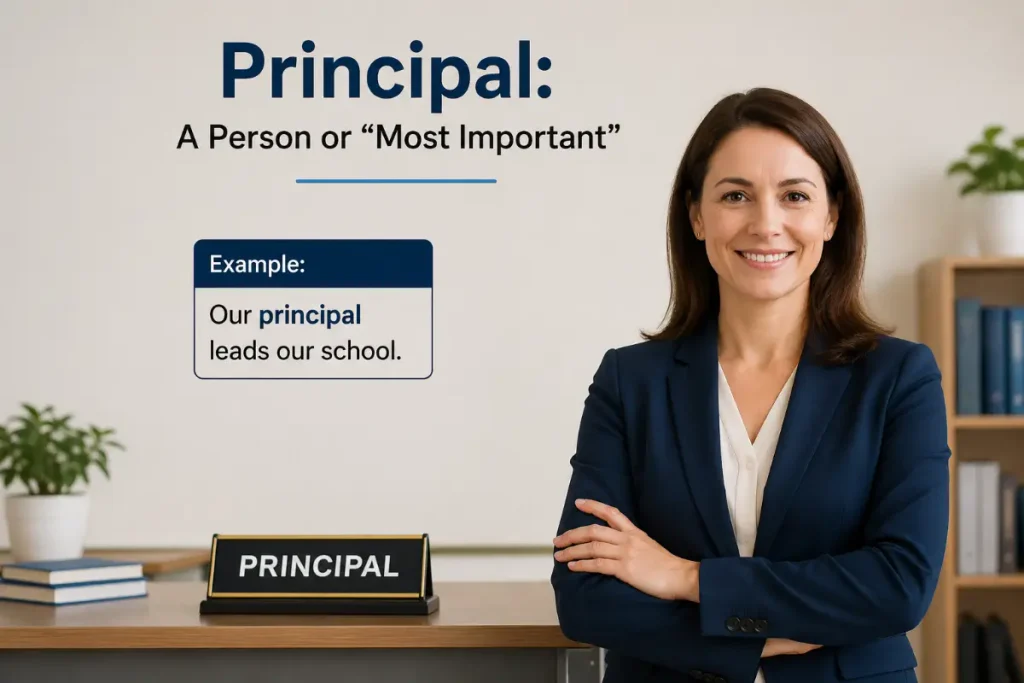
Principal: A Person or “Most Important”
Principal functions as both a noun and an adjective, and both uses connect back to the core idea of “first” or “most important.”
As an adjective, meaning “main” or “most important”:
- The principal reason for the merger was cost savings.
- New York is one of the principal cities in the United States.
- Our principal concern is customer safety.
- The principal ingredient in the recipe is butter.
As a noun, referring to a person in a leading role:
- The principal called a meeting with the teachers.
- She’s a principal at the law firm.
- He met with the school principal about his son’s grades.
- The principal of the consulting firm reviewed the proposal.
As a noun, referring to a sum of money (a specific financial meaning worth knowing):
- The principal on the loan was $200,000, not counting interest.
- She paid down the principal faster than required.
Principle: A Rule, Law, or Fundamental Truth
Principle functions only as a noun, and it’s always about a rule, law, standard, or foundational belief — never about a person or a ranking of importance.
Examples:
- Honesty is one of her core principles.
- The scientific principle behind this experiment is well established.
- He refused to compromise his principles, even under pressure.
- The company operates on the principle of transparency.
- This is a basic principle of economics.
Note that if you need an adjective form related to “principle,” you use “principled” (not “principal”) — as in “a principled stand” or “a principled decision,” meaning one guided by strong moral standards.
The Fastest Way to Check Yourself
Step 1: Does the word refer to a specific person, or does it mean “most important”? If either applies, use principal — remember, the principal is your pal.
Step 2: Does the word refer to a rule, law, or belief? If so, use principle — it rhymes with rule, and both end in “-le.”
Step 3: If you need an adjective describing a moral stance, it’s “principled,” not “principaled” — that word doesn’t exist.
The pal/rule trick genuinely resolves nearly every case. The only spot where it takes a bit more thought is the financial sense of “principal” (the sum of money on a loan) — but that’s still a noun referring to a specific, identifiable thing, similar in spirit to how “principal” refers to a specific person, which keeps it consistent with the same word.
This kind of true-homophone confusion is the same category as stationary and stationery — identical sound, unrelated modern meanings, resolved reliably with a solid letter-matching trick rather than trying to reason through grammar logic.
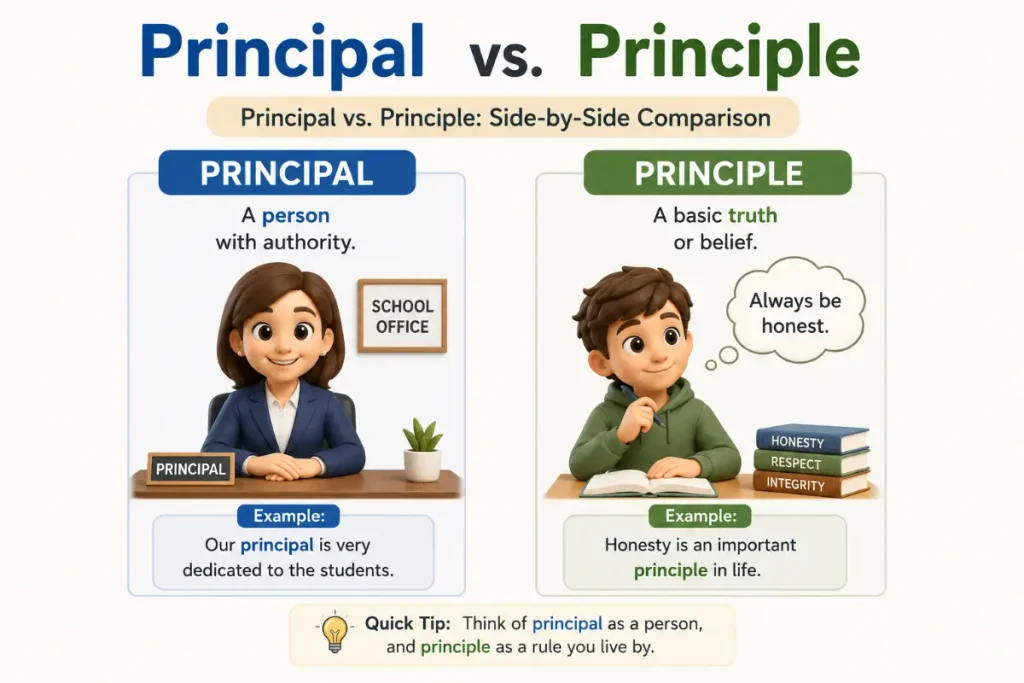
Principal vs. Principle: Side-by-Side Comparison
| Principal | Principle | |
|---|---|---|
| Part of speech | Noun and adjective | Noun only |
| Meaning | A person in charge, or “most important” | A rule, law, or fundamental belief |
| Memory trick | Ends like “pal” — refers to a person | Ends like “rule” — refers to a rule |
| Example | the school principal | a guiding principle |
| Adjective form | Principal itself functions as an adjective | Principled (different word entirely) |
| Financial meaning | Yes — the sum on a loan | No |
Common Mistakes People Make
Mistake 1: “She stood by her principals throughout the negotiation.” Should be “principles” — this refers to her fundamental beliefs or standards, not a person or a ranking of importance.
Mistake 2: “The principle of the school gave a speech.” Should be “principal” — this refers to a specific person, the head of the school.
Mistake 3: “The main principal of good design is simplicity.” Should be “principle” — this refers to a foundational rule or truth about design, not a person or a “most important” ranking.
Mistake 4: “I paid off most of the principle on my mortgage.” Should be “principal” — this refers to the sum of money borrowed, a specific financial meaning of “principal” as a noun.
Mistake 5: Using “principal” as an adjective when “principled” is needed. “A principal person” doesn’t mean what people sometimes intend — if you want to describe someone as guided by strong moral standards, you need “a principled person,” not “a principal person,” which would actually suggest they’re the main or most important person instead.
More Examples to Lock It In
- The principal explained the school’s core principles to the incoming students.
- Her principal objection was based on a matter of principle, not personal preference.
- The firm’s senior principal built the company on the principle of client-first service.
- He made a principled decision to pay off the loan’s principal ahead of schedule.
- The principal reason for her promotion was her unwavering commitment to ethical principles.
What the Style Guides Say
Merriam-Webster traces both words to related Latin roots and specifically recommends the “principal is your pal” mnemonic as the most reliable memory device, noting that this particular pair generates an unusually large number of usage guides and mnemonics precisely because the confusion is so persistent, even among careful writers. The AP Stylebook and Chicago Manual of Style both treat this as a standard, non-debated distinction — there’s no gray area or usage controversy here, just a spelling and meaning distinction worth memorizing permanently.
Because principal and principle share no overlapping modern meanings despite their common origin, every major English-language authority treats the distinction identically, making the mnemonic tricks (pal for people, rule for rules) a reliably permanent fix once they’re internalized.
For another useful perspective, check out Flaunt vs Flout: Which Is Correct? 20 Easy Examples (2026 Guide).
Principal and Principle in Different Writing Contexts
In education writing, “principal” as a noun (the school leader) is extremely common, appearing constantly in parent communications, school policies, and news coverage of education — getting this wrong in a formal school document looks especially careless given how central the role is to the institution.
In financial and banking writing, “principal” (the sum of money) is a precise, technical term that shows up throughout loan documents, mortgage statements, and investment materials — confusing it with “principle” in this context can create genuine confusion about what a document is describing.
In business, ethics, and philosophy writing, “principle” (a fundamental rule or belief) is the dominant word — guiding principles, core principles, ethical principles — and it’s one of the more frequently used abstract nouns in that kind of writing.
In legal and professional writing, “principal” as a noun can also refer to the main party in a transaction or agreement (as opposed to an agent acting on their behalf), a more specialized usage worth knowing if you work in or write about business or law.
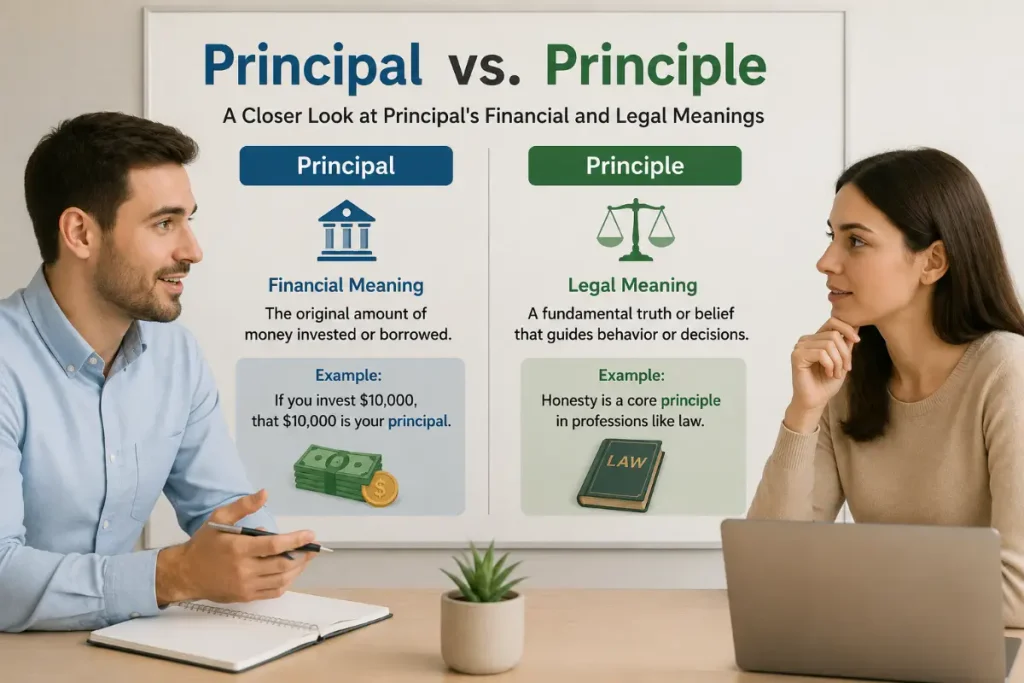
A Closer Look at Principal’s Financial and Legal Meanings
Because “principal” carries so many distinct meanings depending on the field, it’s worth separating them out clearly, since confusing these senses with each other (not just with “principle”) is its own small source of errors.
In banking and loans, principal refers to the original amount borrowed or invested, separate from interest. If you take out a $20,000 loan, that $20,000 is the principal — the interest is calculated on top of it, and your monthly payments typically go toward both, though extra payments can often be directed specifically at reducing the principal faster.
In law and business, a “principal” is the main party in an agreement — the person who has ultimate authority or responsibility — as distinct from an “agent” who acts on the principal’s behalf. A real estate agent, for example, represents a principal (the buyer or seller) in a transaction.
In theater and performance, a “principal” is a lead performer, as opposed to someone in the ensemble or chorus — “she was cast as a principal dancer” refers to a featured, prominent role.
In education, principal refers specifically to the head administrator of a school, distinct from other leadership titles like superintendent (who oversees an entire district) or dean (more common at the college level).
Across every one of these specialized senses, the underlying thread connects back to the core meaning: principal always points to something or someone central, primary, or foundational to a specific role — which is exactly why it’s the “person” and “most important” word, while principle stays firmly in the territory of rules and beliefs.
Frequently Asked Questions
Why do principal and principle sound exactly the same if they mean different things?
They’re true homophones sharing a common Latin root (princeps/principium, both relating to “first” or “source”), but they developed into separate words with separate meanings over time — a common pattern in English, where words that once shared meaning drift apart while keeping a similar sound or spelling.
Is there an adjective form of “principle”?
Yes — “principled,” meaning guided by strong moral standards (“a principled leader,” “a principled decision”). This is a completely different word from “principal,” even though it’s built from “principle.”
Can “principal” ever refer to something other than a person or “most important”?
Yes — in finance, “principal” specifically refers to the original sum of money in a loan or investment, separate from interest or earnings. This is a distinct, specific meaning worth knowing if you deal with loans, mortgages, or investments.
Is “principals” or “principles” correct when talking about a company’s leadership team?
“Principals” — referring to the people who lead or own the firm, such as senior partners at a law or consulting firm. “Principles” would incorrectly suggest you’re talking about the firm’s beliefs or values instead of its leadership.
What’s the fastest way to catch this error before publishing something?
Search your document for every instance of “principal” and “principle,” and for each one, ask: does this refer to a person, “most important,” or a sum of money (principal)? Or does it refer to a rule, law, or belief (principle)? The pal/rule trick resolves nearly every case within seconds.
Practice Exercise
Fill in the blank with either “principal” or “principle.” Answers are listed right after — try each one before checking.
- The school ______ addressed the students at assembly.
- Honesty is one of her core ______s.
- The ______ reason for the delay was the weather.
- She refused to compromise her ______s.
- He paid extra toward the loan’s ______ each month.
- This is a fundamental ______ of physics.
- The firm’s senior ______ reviewed the contract personally.
- The company operates on the ______ of transparency.
- Our ______ concern is employee safety.
- He stood by his ______s despite the pressure.
- She met with the ______ about her son’s grades.
- The scientific ______ behind the experiment is well established.
- New York is one of the ______ cities in the country.
- The ______ on the mortgage decreased steadily.
- He made a ______d decision to walk away from the deal.
- The ______ of the school announced a new policy.
- This ______ has guided the company since its founding.
- The ______ ingredient in the dish is garlic.
- She acted purely on ______, not convenience.
- The ______ objected to the proposed schedule change.
Answer Key
- principal
- principles
- principal
- principles
- principal
- principle
- principal
- principle
- principal
- principles
- principal
- principle
- principal
- principal
- principled
- principal
- principle
- principal
- principle
- principal
If you got sixteen or more correct, the pal/rule trick has already become second nature. For any you missed, go back and ask: person or “most important” (principal), or rule and belief (principle)?
Before moving on, you may also want to read Among vs Between: 5 Common Mistakes to Avoid in 2026 for more helpful grammar tips.
The Bottom Line
Principal refers to a person in charge or something ranked most important — remember, the principal is your pal. Principle refers to a rule, law, or fundamental belief — it ends like “rule.” These two memory tricks together cover virtually every situation you’ll encounter with this genuinely tricky, identically-pronounced pair.
When it comes to Principal vs principle, the key is to focus on meaning rather than pronunciation. Once you remember that the principal can be your “pal,” while a principle is a rule or belief, choosing the right word becomes much easier. With these simple distinctions in mind, you can avoid one of English’s most common word-choice mistakes and use both confidently in everyday writing.