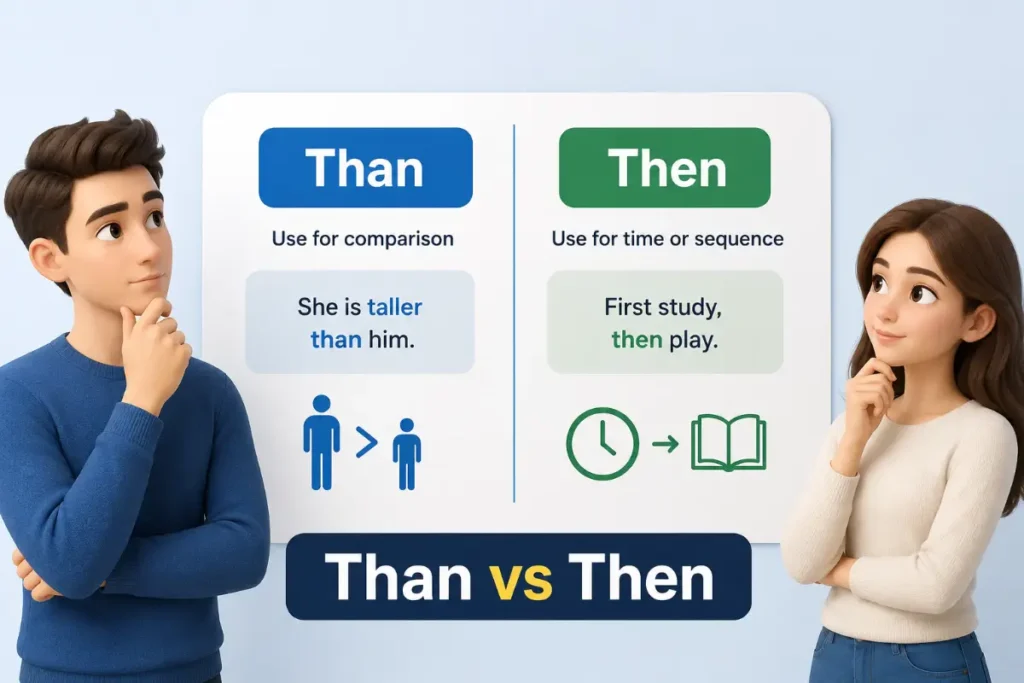
Than vs then look almost identical, differ by a single letter, and get swapped constantly — in texts, emails, even published articles that clearly went through an editor. The good news is that once you understand what each word is actually for, the confusion mostly disappears, because they don’t even do similar jobs.
Than is used for comparisons. Then is used for time and sequence. That’s the entire distinction, and it holds up in every situation you’re likely to run into.
You may also find Stationary vs Stationery: The Simple Trick That Never Fails helpful if you want to explore this topic further.
The Quick Answer
- Than = used when comparing two things
- She’s taller than her brother.
- Then = used to show time, sequence, or what comes next
- We ate dinner, then went for a walk.
The test: if you’re comparing two things, use than. If you’re talking about time — what happened next, what happened before, or a conditional result — use then.
Try it: “This restaurant is better ___ that one.” You’re comparing two restaurants, so it’s than.
Now try: “First we’ll eat, ___ we’ll head to the movie.” You’re describing a sequence of events, so it’s then.
Why These Two Get Mixed Up So Often
Part of the issue is pure visual similarity — “than” and “then” share three of their four letters, and the vowel sound that separates them is subtle in fast or casual speech. Many American English speakers pronounce the unstressed “a” in “than” so lightly that it sounds close to the “e” in “then,” especially in the middle of a sentence.
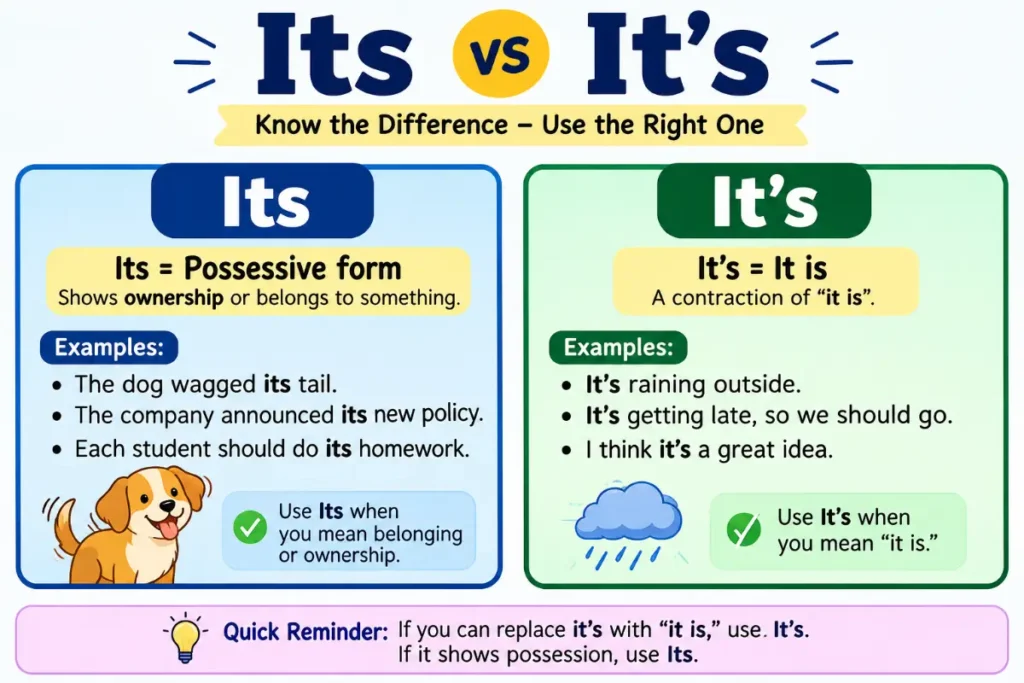
The other factor is that both words often show up in similar sentence positions — usually a few words after a verb, in the second half of a sentence. Your brain, moving fast, sometimes autocompletes based on that position rather than the actual meaning, the same way it does with its and it’s or other common pairs.
Unlike a lot of confusable word pairs, though, “than” and “then” don’t share any overlapping uses — there’s no exception where “than” can mean “next” or where “then” can be used to compare things. That makes this one of the more reliable rules once you’ve internalized it, since there’s nothing ambiguous to memorize beyond the one core distinction.
Than: Comparisons
“Than” shows up when you’re measuring one thing against another — bigger than, smaller than, better than, more than, less than, faster than, and so on.
Examples:
- This year’s sales were higher than last year’s.
- He’s more experienced than most of the team.
- I’d rather walk than wait for the bus.
- Nothing tastes better than a home-cooked meal.
- The test was easier than we expected.
A useful pattern to notice: “than” is almost always preceded by a comparative word — an “-er” ending (taller, faster, better) or a word like “more,” “less,” “rather,” or “other.” If you see one of those nearby, “than” is very likely the correct word.
Then: Time and Sequence
“Then” covers a few related jobs, all connected to time or order.
Showing what happens next:
- We finished dinner, then watched a movie.
- First mix the dry ingredients, then add the eggs.
Referring to a point in the past:
- Back then, things were different.
- I hadn’t met her yet at that point — this was before then.
Showing a conditional result (“if this, then that”):
- If it rains, then we’ll move the event indoors.
- If you finish early, then you can leave.
Notice that even in the conditional use, “then” is still fundamentally about sequence — it’s describing what happens after a condition is met, which is really just another form of “next.”
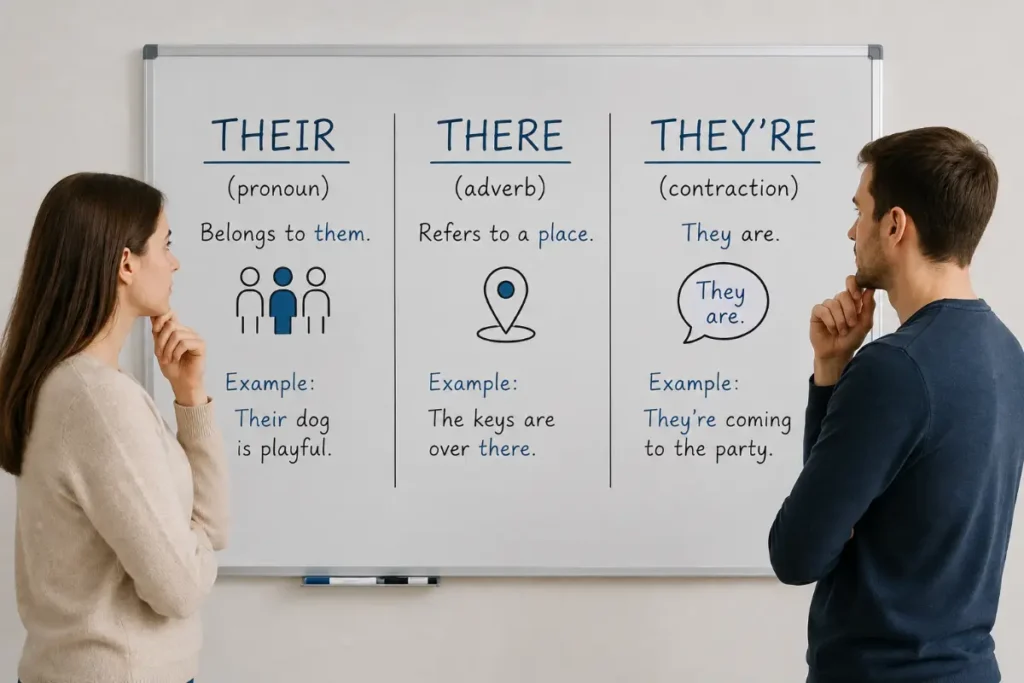
It’s a similar pattern to their, there, and they’re — three words that get treated as interchangeable because they sound alike, even though each one is doing a completely different job in the sentence.
The Fastest Way to Check Yourself
Here’s a quick mental test: ask yourself if the sentence is comparing two things. If yes, it’s “than.” If the sentence is about time, order, or what happens next, it’s “then.”
A simple memory trick that a lot of people use: “then” has an E, and so does “when” — both words relate to time. “Than” has an A, and so does “compare” — both relate to comparison. If you remember that “then” and “when” share a letter and a theme, the distinction becomes much easier to recall under pressure.
Another version of the same trick: read the sentence and ask “could I replace this word with ‘next’ or ‘after that’?” If yes, you need “then.” If replacing it with “next” makes the sentence nonsensical, you’re comparing two things, and you need “than.”
Than vs. Then: Side-by-Side Comparison
| Than | Then | |
|---|---|---|
| Type | Conjunction/preposition | Adverb |
| Used for | Comparisons | Time, sequence, or conditionals |
| Example | She runs faster than I do. | She finished, then left. |
| Often paired with | -er words, “more,” “less,” “rather” | “if,” “first,” “next,” “back” |
| Test | Comparing two things? | Describing time or order? |
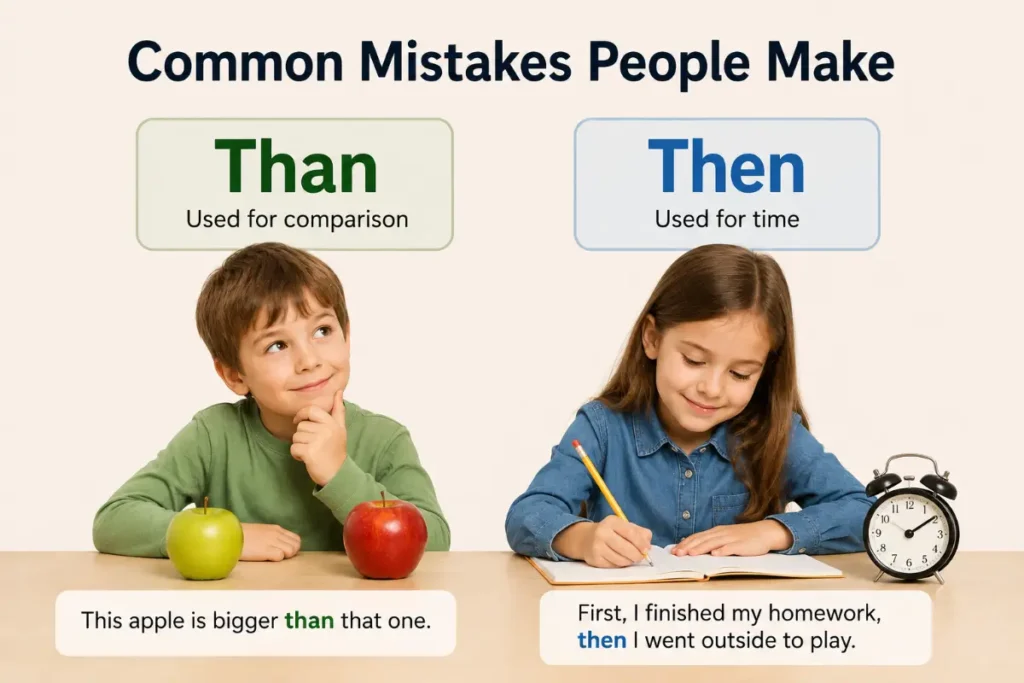
Common Mistakes People Make
Mistake 1: “I’d rather stay home then go out.” Should be “rather stay home than go out” — this is a comparison between two choices, not a sequence of events.
Mistake 2: “First we’ll finish the report, than send it to the client.” Should be “then send it” — this describes what happens next in a sequence, not a comparison.
Mistake 3: “If you’re not careful, than you’ll make the same mistake.” Should be “then you’ll make the same mistake” — this is a conditional result, which falls under “then,” not “than.”
Mistake 4: “She’s smarter then she lets on.” Should be “smarter than she lets on” — this is comparing her actual intelligence to what she shows, so it needs “than.”
Mistake 5: Losing track in long sentences. The error rate goes up noticeably in longer, more complex sentences, where the comparison or the sequence isn’t right next to the word in question. In sentences like “He finished the project faster, even than he had originally planned, then moved straight on to the next one,” it helps to mentally break the sentence into smaller chunks and check each “than/then” individually rather than relying on the overall flow to guide you.
More Examples to Lock It In
- The meeting ran longer than expected, so we grabbed lunch, then headed back.
- If sales are higher than last quarter, then we’ll consider expanding.
- She’d rather finish the project herself than delegate it, and then move on to the next task.
- Back then, remote work was rare, but now it’s more common than ever.
- He ran faster than anyone else on the team, then collapsed at the finish line.
- We reviewed the numbers, then realized the forecast was more optimistic than reality.
- If the flight is delayed, then we’ll rebook — better than waiting around at the gate.
- Nothing feels better than finishing a project early, then having the rest of the day free.
Practice Exercise
Fill in the blank with either “than” or “then.” Answers are listed right after — try each one before checking.
- This laptop is faster ______ my old one.
- We finished the meeting, ______ grabbed coffee.
- If the store is closed, ______ we’ll try again tomorrow.
- She’s more organized ______ anyone else on the team.
- First proofread the draft, ______ send it out.
- He’d rather cook at home ______ eat out.
- Back ______, nobody had heard of the company.
- The results were better ______ expected.
- Mix the batter, ______ let it rest for ten minutes.
- Nothing matters more ______ getting this right.
- If you finish early, ______ you can head home.
- This year’s turnout was larger ______ last year’s.
- We toured the venue, ______ signed the contract.
- I’d rather wait ______ rush the decision.
- The workshop starts at nine, ______ breaks for lunch at noon.
- Her second attempt was smoother ______ her first.
- If the numbers hold up, ______ we’ll move forward.
- Nothing feels worse ______ missing a deadline.
- We packed the car, ______ hit the road.
- The new plan is more efficient ______ the old one.
Answer Key
- than
- then
- then
- than
- then
- than
- then
- than
- then
- than
- then
- than
- then
- than
- then
- than
- then
- than
- then
- than
If most of these came easily, the comparison-versus-sequence test has already become automatic. For any you missed, ask yourself again: was that sentence measuring two things against each other, or describing what happens next?
What the Style Guides Say
Merriam-Webster defines “than” as a conjunction and preposition used in comparisons, and “then” as an adverb tied to time, sequence, or consequence — a distinction that holds across every major English-language dictionary, not just one. The AP Stylebook and Chicago Manual of Style both treat the two as entirely separate words with no overlapping usage, and Purdue OWL lists than/then confusion as one of the recurring error patterns instructors flag in student papers, often alongside its/it’s and their/there/they’re.
Because this distinction is consistent across every authoritative English reference — with no regional variation, no style-guide disagreement, and no accepted exceptions — it’s one of the more reliable rules to commit to memory permanently rather than needing to look up case by case.
For another useful perspective, check out Accept vs Except: The Two Sounds That Cause Nonstop Confusion.
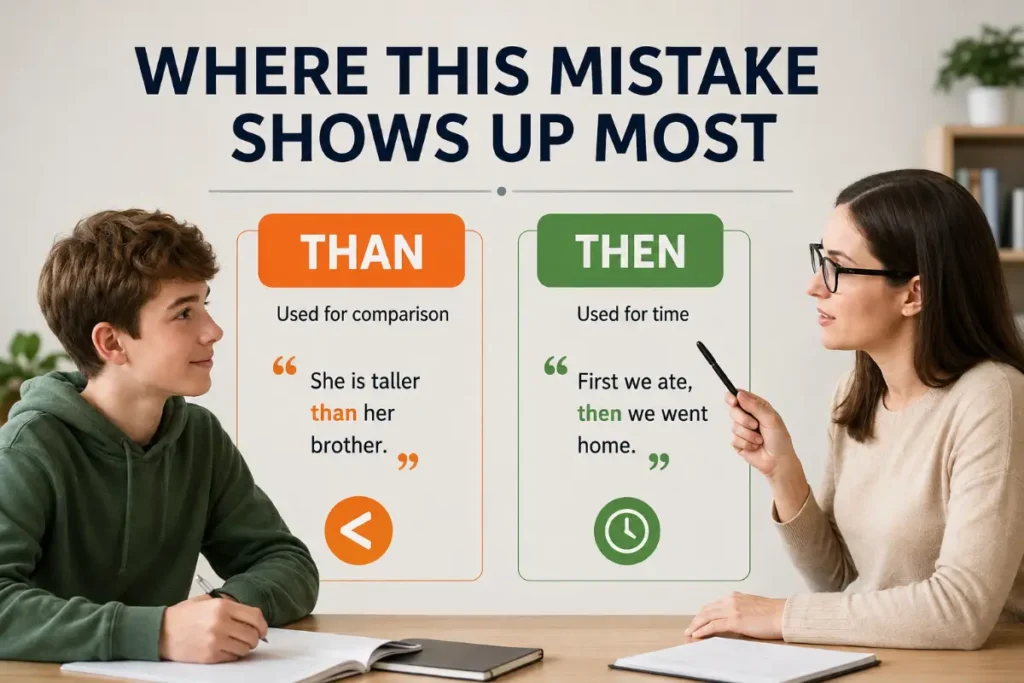
Where This Mistake Shows Up Most
Business and financial writing. Comparisons are constant in this world — quarter-over-quarter growth, performance versus targets, one product against another — which means “than” appears in nearly every report, deck, and email. A single slip (“revenue was higher then projected”) can slow a reader down mid-sentence in exactly the kind of document where clarity matters most.
Recipe and instructional content. “Then” carries the entire structure of step-by-step writing. “Whisk the eggs, then fold in the flour” only works if the sequence word is correct — swap in “than” here and the sentence becomes grammatically broken rather than just slightly off.
Persuasive and opinion writing. Comparative claims are the backbone of a lot of argumentative writing — “this approach works better than that one,” “the risks outweigh than the benefits” (note: that example is actually wrong; it should be “outweigh the benefits,” a different but related trap where “than” gets inserted where it doesn’t belong at all). Getting comparisons exactly right matters here because the whole point of the sentence is the comparison itself.
Casual texting and chat. Because both words are short and common, they’re also two of the most frequently mistyped words on mobile keyboards, especially since they sit close together in meaning within a sentence’s rhythm even though they mean completely different things.
A Closer Look at Why English Split These Two Words
Than and then actually share a common ancestor — in Old and Middle English, they were essentially the same word, used for both comparison and sequence, spelled in overlapping ways depending on dialect and time period. Over centuries, English speakers gradually split the word into two distinct spellings tied to two distinct jobs, likely because comparison and sequence are different enough concepts that keeping them separate reduced ambiguity in writing.
That shared history is actually part of why the confusion persists today — the words aren’t just visually similar by coincidence, they’re historically related, which means the instinct to treat them as interchangeable isn’t entirely baseless, even though modern standard English treats the distinction as firm and non-negotiable.
Understanding that history doesn’t change how you should use the words today, but it does explain why this particular pair feels stickier than some other homophone confusions — you’re not fighting an arbitrary rule, you’re untangling a genuine linguistic overlap that took English hundreds of years to fully resolve.
Than and Then in Different Writing Contexts
In casual writing, this mix-up rarely causes real confusion since context usually makes the intended meaning clear, but it’s still one of the errors readers notice, especially in longer or more formal messages.
In professional and academic writing, comparisons are everywhere — performance reviews, research papers, marketing copy, financial reports — which means “than” shows up constantly, and getting it wrong in a data-heavy sentence (“Q3 revenue was higher then Q2”) can actually make numbers-focused writing harder to parse quickly.
In instructional and how-to content, “then” is the backbone of any sequence of steps (“first do this, then do that”), so a mix-up here can genuinely confuse the order of instructions, not just look like a typo.
In published and edited content, this error is one of the clearer signals of insufficient proofreading, since spell-check won’t catch it — both words are spelled correctly, just used in the wrong spot.
Frequently Asked Questions
Is “rather than” always correct, or is it sometimes “rather then”?
It’s always “rather than.” This phrase is inherently a comparison — you’re weighing one option against another — so “than” is the only correct choice here, regardless of context.
What about “more than” versus “more then”?
Always “more than.” Whenever you’re quantifying a comparison — more than, less than, fewer than — “than” is correct, since you’re measuring one amount against another.
Is “and then” always correct?
Yes, “and then” is a standard way to connect sequential actions (“We ate, and then we left”). Since this is describing time and sequence, “then” is correct here.
Does this rule ever change based on region or dialect?
No — the than/then distinction is consistent across American, British, and other English dialects. Pronunciation differences exist, but the grammatical rule itself doesn’t shift.
What’s the single fastest way to catch this error before publishing?
Search your document for every instance of “than” and “then,” and for each one, ask whether the sentence is comparing two things (than) or describing time and sequence (then). Because both are correctly spelled real words, spell-check typically won’t flag a wrong-but-valid choice, so this quick manual scan remains the most reliable check.
Do grammar checkers reliably catch than/then errors?
Better than plain spell-check, but not perfectly. Context-aware grammar tools have improved at flagging suspicious usage, especially in clearly comparative sentences, but they still miss cases in longer or more complex sentences where the comparison or sequence isn’t immediately obvious from surrounding words. A quick manual check on anything important is still worth the extra minute.
Does it matter which one I use in casual speech, since they sound different when spoken?
Not really — in speech, “than” and “then” are usually distinguishable enough that listeners rarely notice a mix-up, and slips of the tongue get self-corrected constantly without anyone commenting. This is really a written-language problem, which is exactly why proofreading catches nearly all of it.
Before moving on, you may also want to read Discreet vs Discrete: 7 Easy Tricks to Never Mix Them Up (2026) for more helpful grammar tips.
The Key Takeaway
Than is for comparisons — bigger than, better than, more than. Then is for time — what happens next, what happened before, or what follows a condition. The two never overlap in meaning, which makes this one of the cleaner rules to lock in permanently: once you ask “am I comparing, or am I talking about time?”, the right word follows automatically.