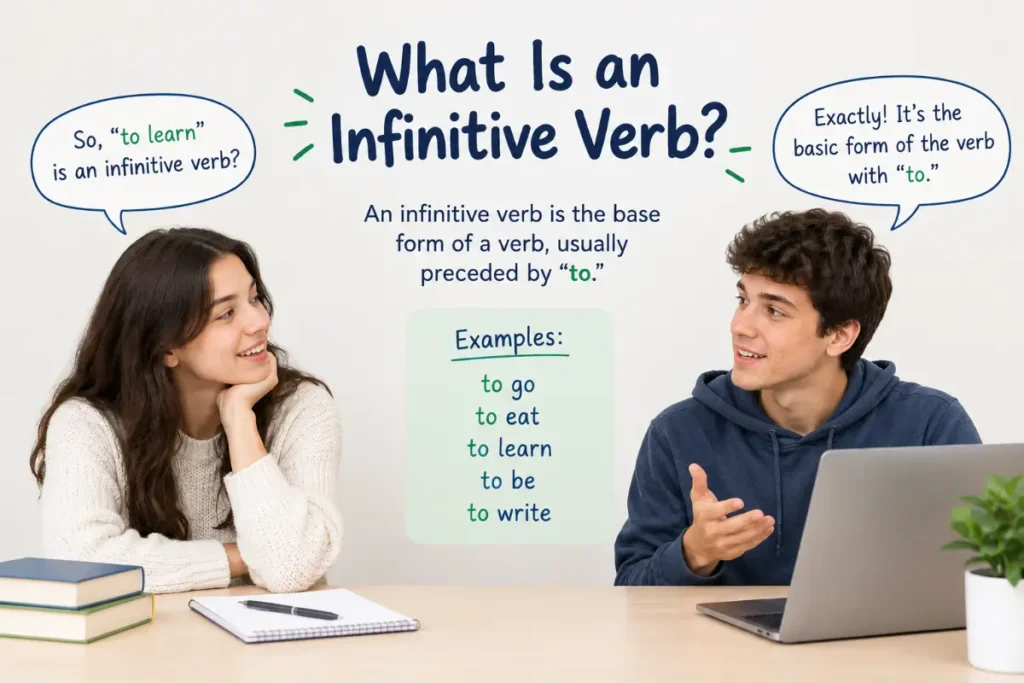
Here’s the plain answer to what is an infinitive verb: it’s the word to followed by the basic form of a verb, as in to wait, to go, or to fly. It looks like a verb and carries a verb’s meaning, but it doesn’t work as the main verb of a sentence. Instead, it acts as a noun, an adjective, or an adverb.
That split personality is what makes infinitives worth understanding. In “To forgive takes courage,” the infinitive is the subject. In “She has a report to submit,” it describes the report. In “He saved money to buy a car,” it explains why. This guide covers what an infinitive is made of, the five jobs it can do, how to tell it apart from a plain “to” before a noun, which verbs want an infinitive after them, and the single comma rule that applies.
You may also find An Adverb? 25 Easy Examples to Understand It (2026) helpful if you want to explore this topic further.
What Is an Infinitive Verb? Definition and Examples
An infinitive verb is the base form of a verb, usually preceded by the word to. Common examples include to eat, to read, to learn, and to play. Infinitives express actions or states without acting as the main verb of a sentence.
Here are a few examples:
- To read helps you learn new things.
- I want to travel this summer.
- She needs a book to study for her exam.
- He exercises daily to stay healthy.
In each sentence, the infinitive serves a different purpose. It can act as a noun, describe a noun, or explain why someone does something. This flexibility makes infinitives useful in everyday speaking and writing.
Although people commonly use the term infinitive verb, an infinitive is technically a verb form called a verbal. Unlike a main verb, it does not show tense or agree with the subject on its own. For example, in the sentence “She wants to swim,” the main verb is wants, while to swim is the infinitive.
Remember this simple rule: An infinitive usually follows the pattern to + base verb. However, some sentences use a bare infinitive without to, as in “She can swim.”
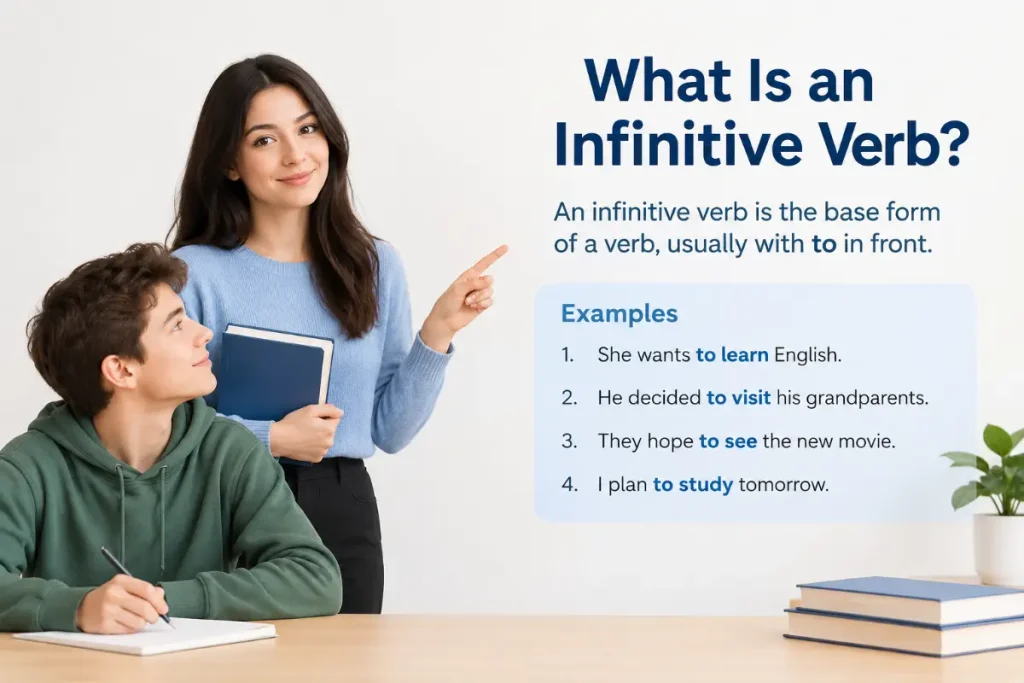
10 Examples of Infinitive Verbs in Sentences
The easiest way to understand infinitives is to see how they work in everyday sentences. In the examples below, the infinitives are shown in bold.
- To learn a new language takes time.
- I hope to visit New York next year.
- She wants to become a doctor.
- He went to the store to buy some milk.
- We need a quiet place to study.
- They decided to leave early.
- My dream is to own a house.
- She has a lot of homework to finish.
- He promised to help his friend.
- To forgive someone can be difficult.
Notice that each infinitive begins with to followed by the base form of a verb. However, the infinitives do different jobs. Some act as nouns, some describe nouns, and others explain the purpose of an action.
For example, to buy explains why he went to the store, while to study describes the kind of place we need. Recognizing these differences will help you identify infinitives and use them correctly in your own writing.
What Is the Difference Between an Infinitive and a Gerund?
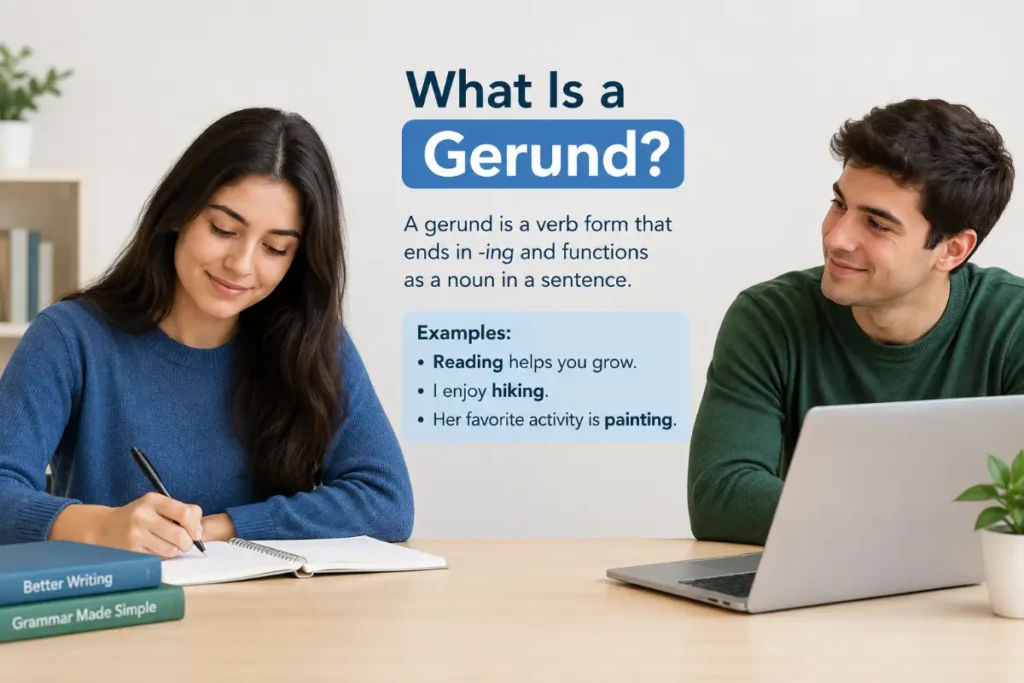
An infinitive uses the base form of a verb, usually with to, while a gerund uses the -ing form of a verb and functions as a noun.
Here is a simple comparison:
| Infinitive | Gerund |
|---|---|
| To swim is good exercise. | Swimming is good exercise. |
| She wants to dance. | She enjoys dancing. |
| He decided to study. | He finished studying. |
| They plan to travel. | They avoid traveling. |
Both forms can refer to actions, but they do not always work interchangeably. Some verbs, such as want, hope, and decide, are commonly followed by infinitives. Others, such as enjoy, avoid, and finish, are followed by gerunds.
Compare these sentences:
- Correct: She hopes to win the competition.
- Correct: She enjoys winning competitions.
- Incorrect: She enjoys to win competitions.
The best way to learn these patterns is to study which verb forms naturally follow common verbs. For more examples, see our guide to what is a gerund.
What an Infinitive Is Made Of
Purdue OWL defines an infinitive as a verbal consisting of the word to plus a verb in its simplest stem form, functioning as a noun, adjective, or adverb. A “verbal” is a word built from a verb that expresses an action or a state of being but doesn’t serve as the sentence’s main verb.
That’s why the label “infinitive verb,” though common, is slightly loose. The infinitive is based on a verb, but a sentence still needs its own finite verb to be complete.
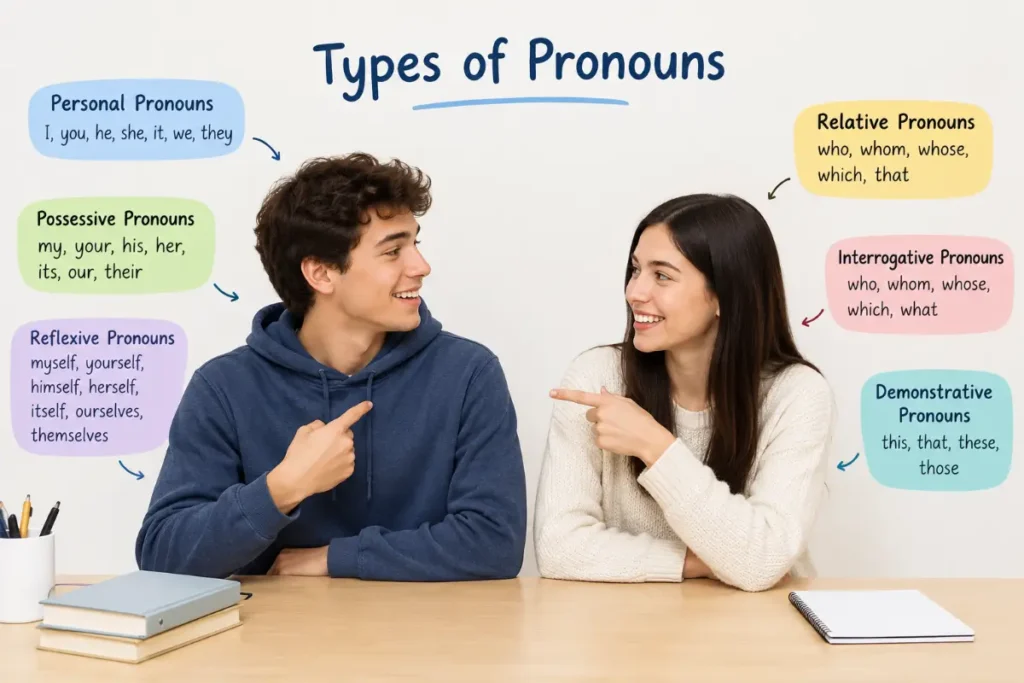
For another useful perspective, check out Types of Pronouns: 9 Essential Types With Easy Examples (2026).
- To wait seemed foolish. (“seemed” is the main verb; “to wait” is the infinitive)
- Everyone wanted to go. (“wanted” is the main verb; “to go” is the infinitive)
Five Jobs an Infinitive Can Do
Purdue OWL lists five functions. Each one is easier to see in a sentence.
Subject. The infinitive is what the sentence is about.
- To forgive takes courage.
Direct object. The infinitive receives the action of the main verb.
- She wants to travel.
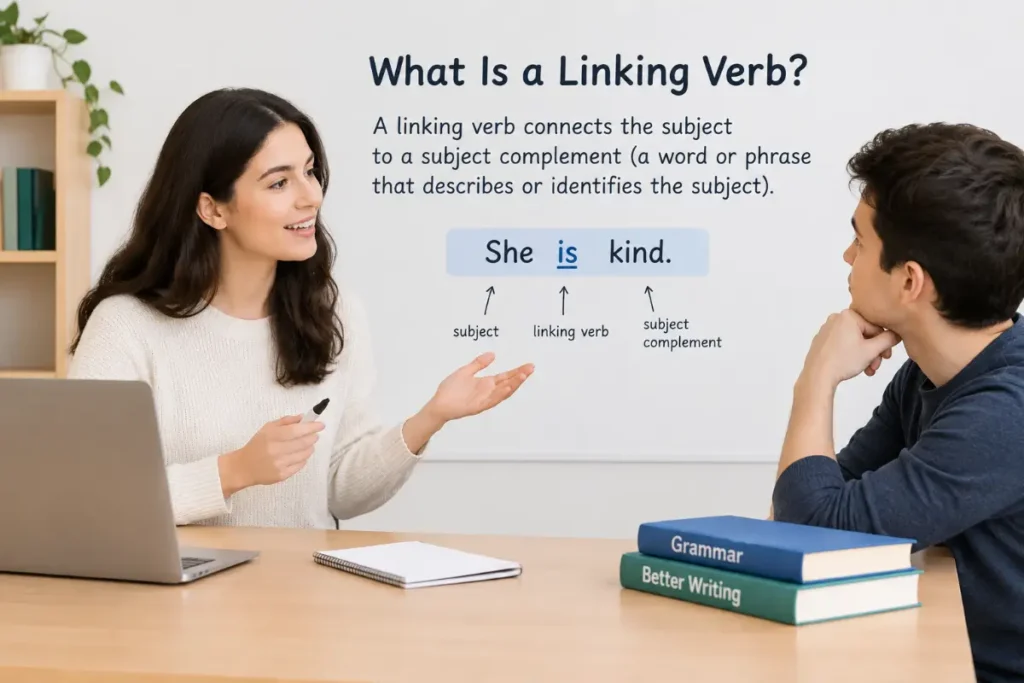
Subject complement. The infinitive follows a linking verb and renames the subject.
- His goal is to finish the marathon.
Adjective. The infinitive describes a noun, usually the one right before it.
- We need a place to sleep.
Adverb. The infinitive explains why, or for what purpose, something happens.
- He saved money to buy a car.
Deciding which job an infinitive is doing can be the hard part, even though finding it is easy. A useful trick is to ask what question the infinitive answers. If it answers “what?” it’s acting as a noun. It’s an adjective if it answers “which one?”. If it answers “why?” it’s an adverb.
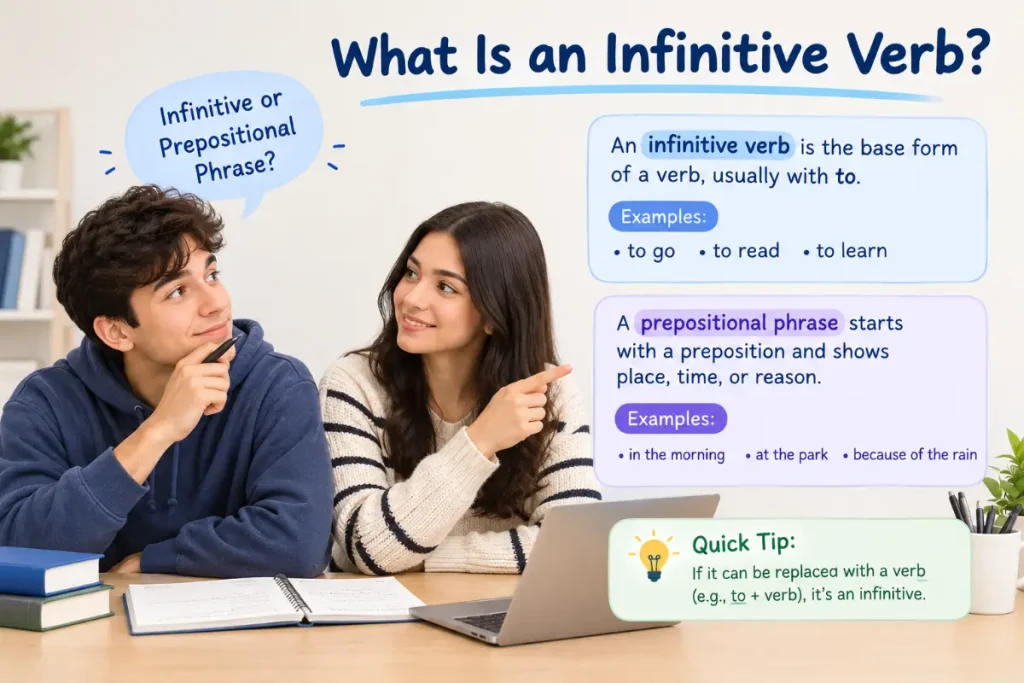
Infinitive or Prepositional Phrase?
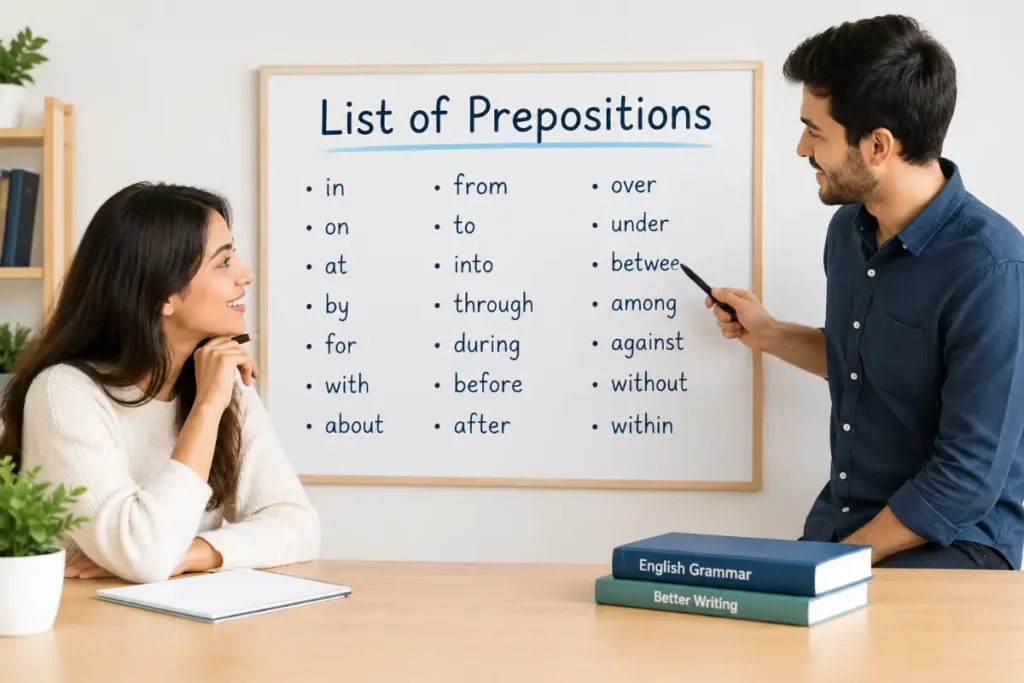
Not every to starts an infinitive. Purdue OWL warns against confusing an infinitive with a prepositional phrase that begins with to, which is to followed by a noun or pronoun rather than a verb.
| Infinitives (to + verb) | Prepositional phrases (to + noun or pronoun) |
|---|---|
| to fly | to him |
| to draw | to the committee |
| to become | to my house |
| to stand | to the mountains |
| to belong | to this address |
The test takes two seconds: look at the word right after to. A verb means infinitive. A noun, pronoun, or the start of a noun phrase means prepositional phrase.
- She wants to leave. (infinitive: “leave” is a verb)
- She walked to school. (prepositional phrase: “school” is a noun)
Infinitive Phrases and Their “Actors”
An infinitive can gather objects, modifiers, and even a doer, forming an infinitive phrase that works as a single unit.
- We intended to leave early. (“to leave early” is the direct object of “intended”)
- I have a paper to write before class. (“to write before class” describes “paper”)
- Phil agreed to give me a ride. (“to give me a ride” is the direct object of “agreed”)
Sometimes a noun or pronoun sits between the main verb and the infinitive, naming who will do the action. Purdue OWL calls this the actor of the infinitive phrase.
- They asked me to bring some food.
- Everyone wanted Carol to be the captain.
When the actor is a pronoun, it takes the objective case: me, him, her, us, them. That’s why “They asked I to bring food” is wrong, and “They asked me to bring food” is right.
Verbs That Take an Infinitive
Many verbs are followed by an infinitive, and Purdue OWL sorts them by whether they need an actor between the verb and the infinitive.
| Without an actor | With an actor | Either way |
|---|---|---|
| agree, begin, continue, decide | advise, allow, convince, remind | ask, expect, like, want |
| fail, hesitate, hope, intend | encourage, force, hire, teach | need |
| learn, offer, plan, prefer | instruct, invite, permit, tell | |
| promise, refuse, remember, try | order, appoint, implore |
- Most students plan to study. (no actor)
- He reminded me to buy milk. (actor “me” required)
- I asked to see the records. / I asked him to show me the records. (works both ways)
Notice what happens if you break the pattern. “She promised him to return” sounds off because “promise” works without an actor, while “He reminded to buy milk” is incomplete because “remind” needs one.
Infinitive vs. Gerund
Both forms can follow a main verb, but verbs tend to prefer one or the other. Hope, promise, agree, and decide take infinitives. Enjoy, avoid, finish, and consider take gerunds, the -ing form covered in our guide to what is a gerund.
- She hopes to travel. (not “hopes traveling”)
- She enjoys traveling. (not “enjoys to travel”)
The meaning usually stays the same whichever form a verb takes, so this is mostly a matter of memorizing which verbs pair with which form.
The Bare Infinitive: When “To” Disappears
After modal verbs such as can, will, must, and should, the same verb form appears without to. Some grammar guides call this the bare infinitive.
- She can swim. (not “can to swim”)
- You must leave now.
- Let him go.
- She made them laugh.
If a verb in your sentence follows can, must, or let, drop the to.
Other Infinitive Forms
The basic infinitive can be expanded to show time, ongoing action, or passive voice.
- to write (simple)
- to have written (perfect: finished before the main action)
- to be writing (progressive: in progress)
- to be written (passive)
Examples: She seems to have finished, He appears to be working, The letter is to be signed by Friday.
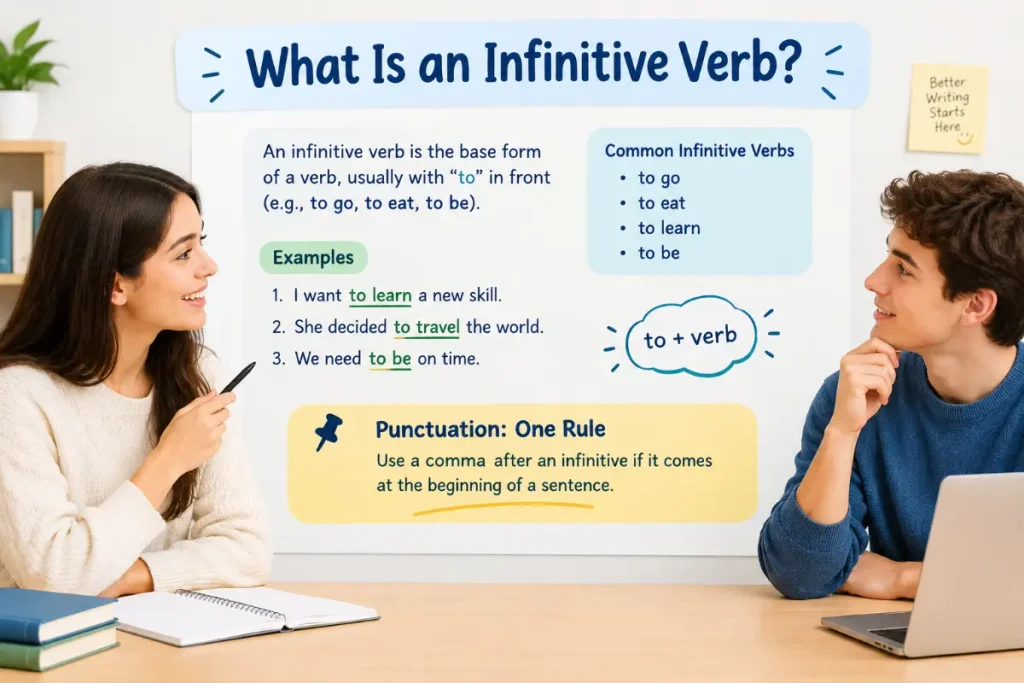
Punctuation: One Rule
Purdue OWL gives a short punctuation rule: an infinitive phrase needs a comma only when it’s used as an adverb at the beginning of a sentence.
- To buy a basket of flowers, John had to spend his last dollar. (comma after the opening adverb phrase)
- John had to spend his last dollar to buy a basket of flowers. (no comma when it comes last)
- To improve your writing, consider your purpose and audience.
Infinitive phrases that work as subjects, objects, or adjectives take no comma. For the broader pattern behind this, see our guide to when to use a comma after an introductory phrase.
What About Split Infinitives?
A split infinitive puts a word, usually an adverb, between to and the verb: to boldly go. Purdue OWL notes that many readers accept a single adverb in that spot but advises avoiding the split in formal writing, which is a conservative stance. Major dictionaries take a more relaxed view, tracing the “rule” to nineteenth-century Latin-based thinking rather than English grammar. Our full guide to the split infinitive rule covers both positions, so you can decide based on your audience.
Quick Reference Table
| Job | Example | Question It Answers |
|---|---|---|
| Subject | To forgive takes courage. | What takes courage? |
| Direct object | She wants to travel. | Wants what? |
| Subject complement | His goal is to finish. | What is his goal? |
| Adjective | We need a place to sleep. | Which place? |
| Adverb | He saved money to buy a car. | Why did he save? |
Common Mistakes People Make
- Mistake 1: Confusing an infinitive with a prepositional phrase, such as treating “to school” as if it contained a verb.
- Mistake 2: Using a subject pronoun as the actor, as in “They asked I to bring food” instead of “me.”
- Mistake 3: Using a gerund after a verb that wants an infinitive, such as “I hope seeing you soon.”
- Mistake 4: Adding “to” after a modal verb, as in “She can to swim.”
- Mistake 5: Putting a comma after an infinitive phrase that is a subject or object, as in “To forgive, takes courage.”
Practice Exercise
For each sentence, name the infinitive (or write “none” if “to” starts a prepositional phrase) and its job. Answers are listed right after, so try each one before checking.
- To wait seemed foolish.
- Everyone wanted to go.
- His ambition is to fly.
- He lacked the strength to resist.
- We must study to learn.
- She gave the book to him.
- I have a paper to write before class.
- They asked me to bring some food.
- We drove to the mountains.
- To improve your writing, read widely.
- She promised to return.
- He decided to leave early.
- The teacher told us to be quiet.
- She walked to school.
- I need a pen to write with.
- He works hard to support his family.
- Our goal is to finish by Friday.
- To see is to believe.
- They hesitated to answer.
- She sent a letter to the committee.
Answer Key
- to wait: subject
- to go: direct object
- to fly: subject complement
- to resist: adjective (describes “strength”)
- to learn: adverb (purpose)
- none: “to him” is a prepositional phrase
- to write before class: adjective (describes “paper”)
- to bring some food: direct object of “asked,” with the actor “me”
- none: “to the mountains” is a prepositional phrase
- to improve your writing: adverb (opens the sentence, so a comma follows)
- to return: direct object
- to leave early: direct object
- to be quiet: direct object of “told,” with the actor “us”
- none: “to school” is a prepositional phrase
- to write with: adjective (describes “pen”)
- to support his family: adverb (purpose)
- to finish by Friday: subject complement
- to see: subject; to believe: subject complement
- to answer: direct object
- none: “to the committee” is a prepositional phrase
Frequently Asked Questions
Is an infinitive a verb?
An infinitive is based on a verb, but it’s technically a verbal, a form that acts as a noun, adjective, or adverb rather than as the main verb of a sentence.
Does an infinitive always include “to”?
Usually yes, as in “to run.” After modal verbs like can, must, and should, and after verbs like let and make, the same form appears without “to,” often called the bare infinitive.
How do I tell an infinitive from a prepositional phrase beginning with “to”?
Check the word after “to.” If it’s a verb (“to leave”), it’s an infinitive. If it’s a noun or pronoun (“to school,” “to him”), it’s a prepositional phrase.
Do infinitive phrases need commas?
Only when the phrase acts as an adverb at the start of a sentence, as in “To improve your writing, read widely.” In other positions, no comma is needed.
Why do I say “I want him to go” and not “I want he to go”?
The word between the verb and the infinitive is the actor of the infinitive phrase, and a pronoun in that position takes the objective case: “him,” not “he.”
Before moving on, you may also want to read A Linking Verb? Easy Guide And 15+ Examples (2026) for more helpful grammar tips.
Final Thoughts
Knowing what is an infinitive verb gives you a small, reliable toolkit: it’s to plus a verb’s base form, and it works as a noun, an adjective, or an adverb. Look at what follows to to separate infinitives from prepositional phrases, and ask what question the infinitive answers to name its job.
The details worth keeping are the ones that cause real errors: pronoun actors take the objective case, some verbs need an infinitive while others prefer a gerund, modal verbs drop the to, and only an opening adverb phrase needs a comma. Once those habits are in place, infinitives become one of the more flexible and predictable parts of English grammar.