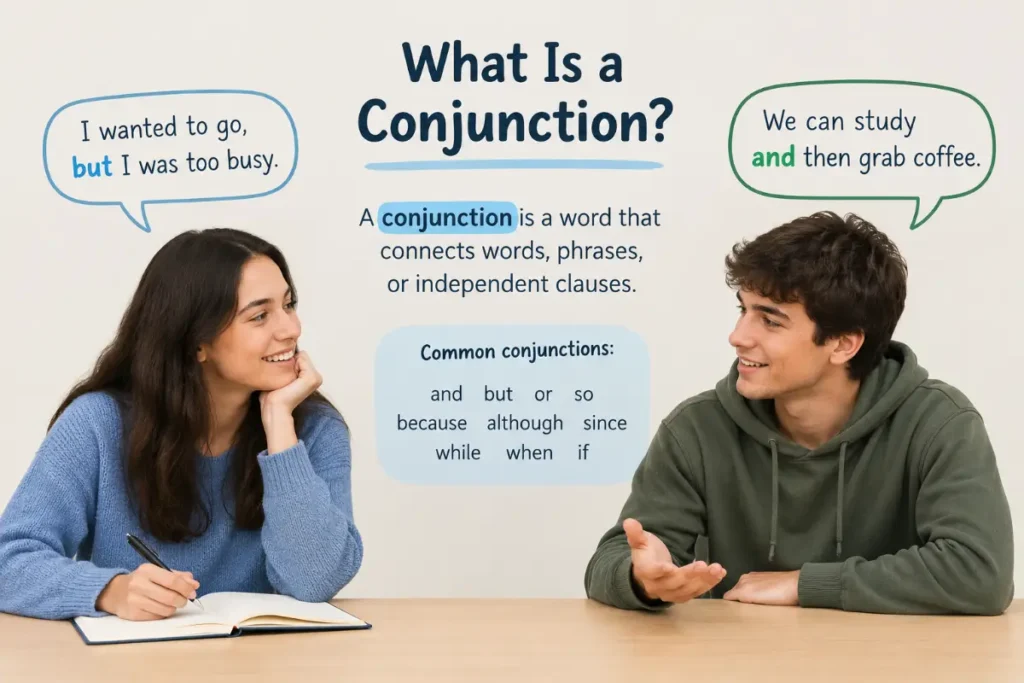
The short answer to what is a conjunction is that it’s a word whose entire job is connecting other parts of a sentence together, whether that’s two words, two phrases, or two full clauses. Purdue OWL describes conjunctions as words that join two words, phrases, or clauses together, giving English a way to combine simple ideas into more complex, connected ones.
This guide focuses on identifying conjunctions and understanding what makes a word count as one, rather than the punctuation rules that go with them, which our companion guide on how to use conjunctions correctly already covers in depth.
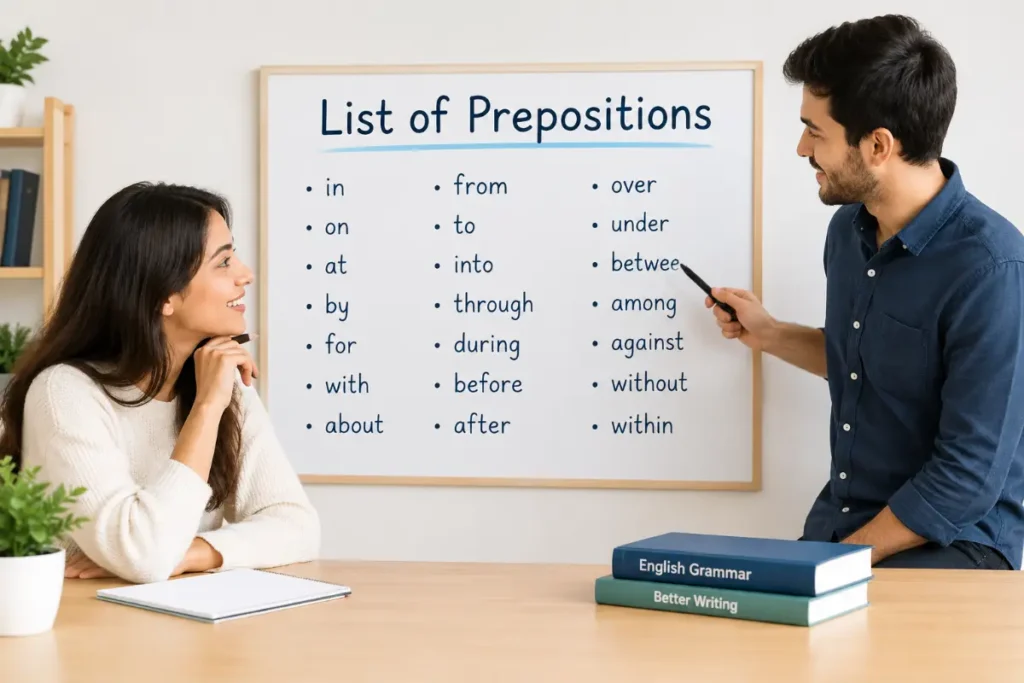
You may also find List of Prepositions: 100+ Words You Need to Know (2026) helpful if you want to explore this topic further.
What Makes a Word a Conjunction
A conjunction’s defining feature is that it has no real meaning of its own in isolation; its entire function is relational. Unlike a noun (“dog”) or a verb (“run”), which name a thing or an action, a word like “and” or “because” only makes sense in relation to the two things it’s connecting.
- She likes tea and coffee. (“and” links two nouns)
- He left because he was tired. (“because” links two clauses, showing a cause-and-effect relationship)
- Would you like soup or salad? (“or” links two alternatives)
Remove the conjunction from any of these, and you’re left with either two disconnected fragments or a sentence that no longer makes grammatical sense, which is the clearest sign the word was doing real structural work.
Three Types of Conjunctions, Briefly
English conjunctions fall into three families, based on what kind of connection they create.
Coordinating conjunctions join elements of equal grammatical weight: for, and, nor, but, or, yet, so.
- She was tired, but she kept working.
Subordinating conjunctions join a dependent clause to an independent one, showing a relationship like cause, time, or contrast: because, although, since, when, while, unless.
- Although it rained, we still went outside.
Correlative conjunctions work in matched pairs: both…and, either…or, neither…nor, not only…but also.
- She is both talented and hardworking.
For the complete punctuation rules attached to each of these three types, including the comma placement that changes based on word order, see our how to use conjunctions correctly guide.
A Fourth Category Worth Knowing: Conjunctive Adverbs
Words like however, therefore, moreover, consequently, and meanwhile function very similarly to conjunctions, connecting two ideas logically, but they’re technically classified as adverbs rather than true conjunctions. The distinction matters because they follow a different punctuation pattern (a semicolon before, a comma after) when joining two independent clauses.
- The report was late; however, the client remained patient.
Even though conjunctive adverbs aren’t part of the traditional conjunction category, they’re worth recognizing as functional cousins, since they do essentially the same connecting job in a sentence.
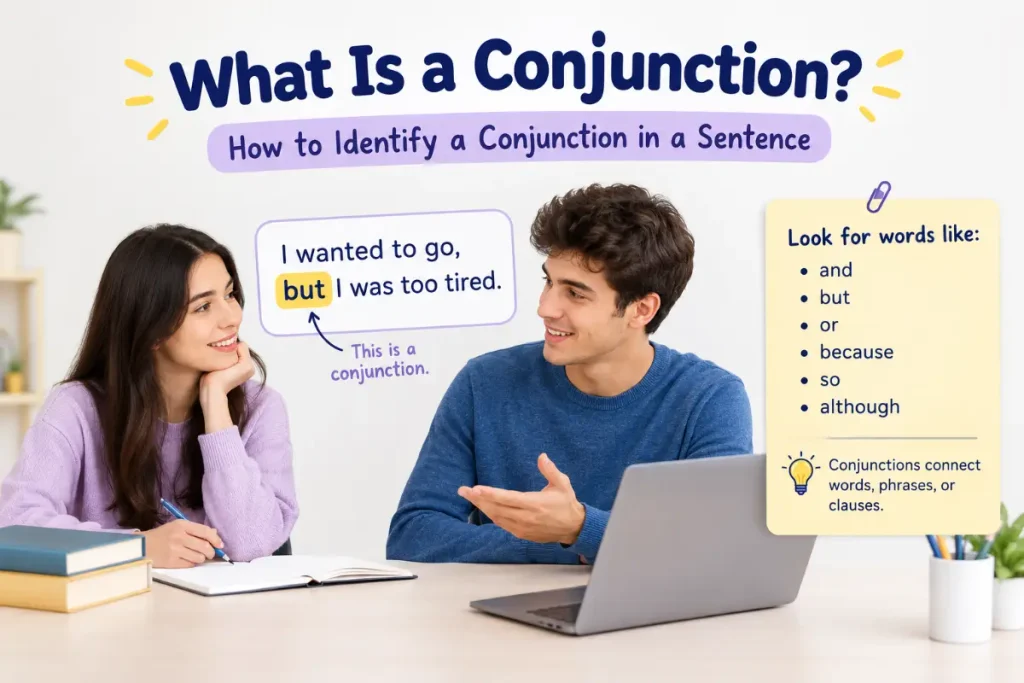
How to Identify a Conjunction in a Sentence
Step 1: Look for a word that links two elements rather than describing or naming something on its own.
Step 2: Check if removing the word breaks the connection between the two parts of the sentence, leaving either a fragment or a run-on.
Step 3: Ask what kind of connection it creates — equal weight (coordinating), unequal weight with one clause depending on the other (subordinating), or a matched pair (correlative).
- The cake looked delicious, so we ordered a slice. — “so” links two independent clauses of a cause-and-effect relationship, identifying it as a coordinating conjunction.
- We ordered dessert because the cake looked delicious. — “because” links a dependent clause to an independent one, identifying it as a subordinating conjunction.
Conjunctions vs. Prepositions: A Common Mix-Up
Several words, including “since,” “after,” “before,” and “until,” can function as either a conjunction or a preposition, depending on what follows them. This is worth knowing because it affects how the word is classified in that specific sentence.
- I haven’t seen her since Monday. (“since” is a preposition here, followed by just a noun)
- I haven’t seen her since she moved away. (“since” is a conjunction here, followed by a full clause with its own subject and verb)
The test is simple: if a complete clause (subject plus verb) follows the word, it’s functioning as a conjunction. If only a noun or noun phrase follows, it’s functioning as a preposition. Our list of prepositions covers this overlapping category in more detail.
Conjunctions vs. Relative Pronouns
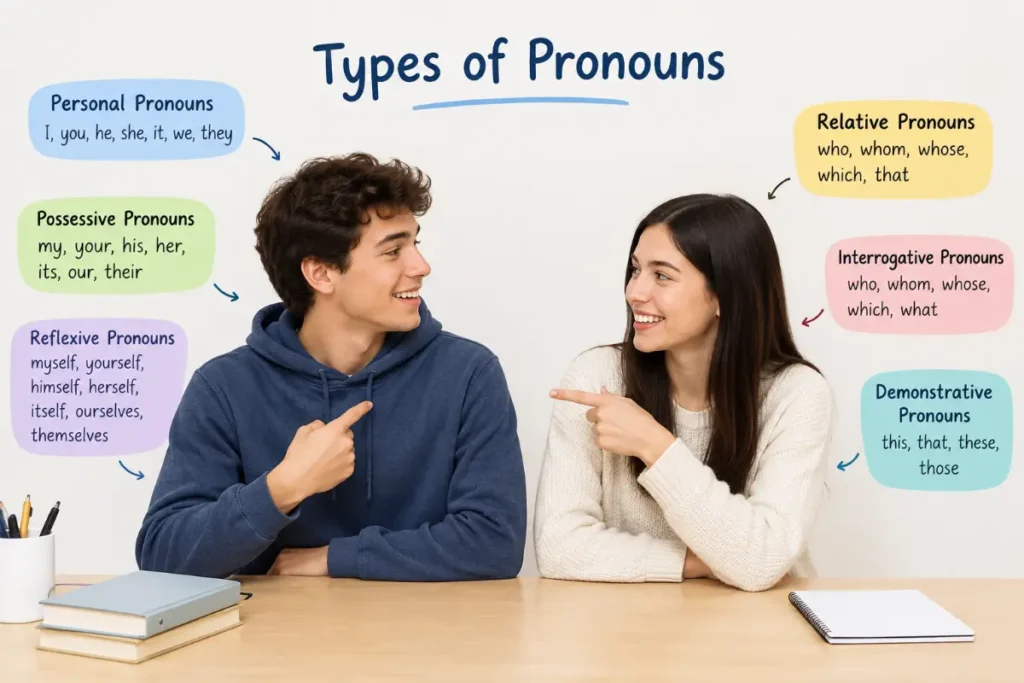
Another common point of confusion: words like “who,” “which,” and “that” can introduce a clause the way a conjunction does, but they’re technically relative pronouns, not conjunctions, because they also play a grammatical role (subject or object) within that clause itself. Our guide to types of pronouns covers relative pronouns as their own distinct category.
What Is a Conjunction? Definition and Examples
A conjunction is a word that connects two or more words, phrases, or clauses so they work together in a sentence. Think of conjunctions as grammatical bridges: they show how one part of a sentence relates to another.
For example:
- Mia and Jake went to the store. — and connects two nouns.
- We can watch a movie or play a game. — or connects two phrases.
- I stayed home because I was sick. — because connects two clauses.
- Although it was raining, we went for a walk. — although connects a dependent clause to an independent clause.
Conjunctions can show several types of relationships, including:
- Addition: She bought apples and oranges.
- Choice: You can have tea or coffee.
- Contrast: He was tired, but he kept working.
- Cause: We stayed inside because it was raining.
- Time: Call me when you arrive.
- Condition: We will go if the weather improves.
Without conjunctions, related ideas can sound disconnected:
- I was tired. I finished my work. I went to bed.
A conjunction makes the relationship clearer:
- I was tired, but I finished my work before I went to bed.
Here, but shows contrast, while before shows a time relationship.
Keep in mind that not every word that connects ideas is technically a conjunction. Words such as however and therefore are conjunctive adverbs, while who, which, and that can function as relative pronouns. The grammatical role of the word in a particular sentence determines its classification.
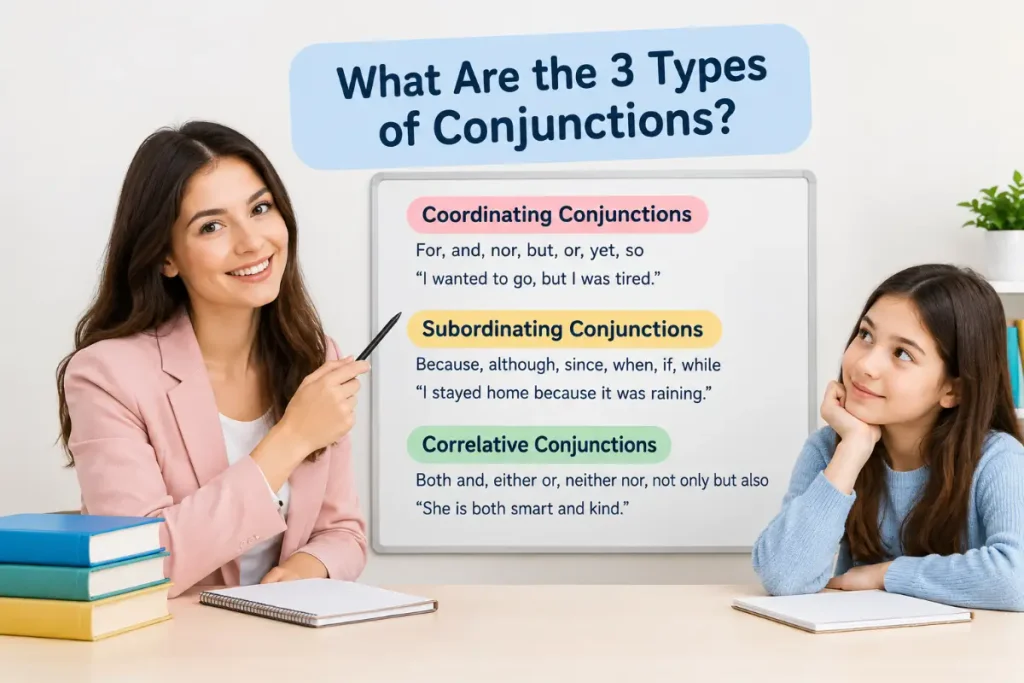
What Are the 3 Types of Conjunctions?
English has three main types of conjunctions: coordinating, subordinating, and correlative conjunctions. Each type creates a different kind of connection.
1. Coordinating Conjunctions
Coordinating conjunctions connect elements that have equal grammatical importance. The seven coordinating conjunctions are commonly remembered with FANBOYS:
- For
- And
- Nor
- But
- Or
- Yet
- So
Examples:
- She bought apples and oranges.
- I wanted to go, but I was too tired.
- You can call me or send a message.
- He studied hard, so he passed the test.
Coordinating conjunctions can connect:
- Words: tea and coffee
- Phrases: in the morning or at night
- Independent clauses: I was tired, but I kept working.
2. Subordinating Conjunctions
Subordinating conjunctions connect a dependent clause to an independent clause. They can show relationships such as cause, time, condition, contrast, or purpose.
Common subordinating conjunctions include:
- because
- although
- since
- when
- while
- if
- unless
- before
- after
- until
Examples:
- We stayed inside because it was raining.
- Although she was nervous, she gave the presentation.
- Call me when you arrive.
- We won’t leave until everyone is ready.
- Unless something changes, the event will continue.
The key difference is that the subordinating conjunction makes one clause dependent on the other. For example, because it was raining does not normally express a complete thought by itself, while We stayed inside can stand alone.
3. Correlative Conjunctions
Correlative conjunctions work in matched pairs. They connect two parts of a sentence and usually create a balanced grammatical structure.
Common pairs include:
- both…and
- either…or
- neither…nor
- not only…but also
- whether…or
Examples:
- She likes both tea and coffee.
- You can either stay here or come with us.
- Neither the manager nor the employees knew about the change.
- He is not only smart but also hardworking.
- Whether you agree or disagree, the decision has been made.
When using correlative conjunctions, try to keep the connected elements grammatically parallel. For example, She likes both swimming and running is balanced because both elements are gerunds.
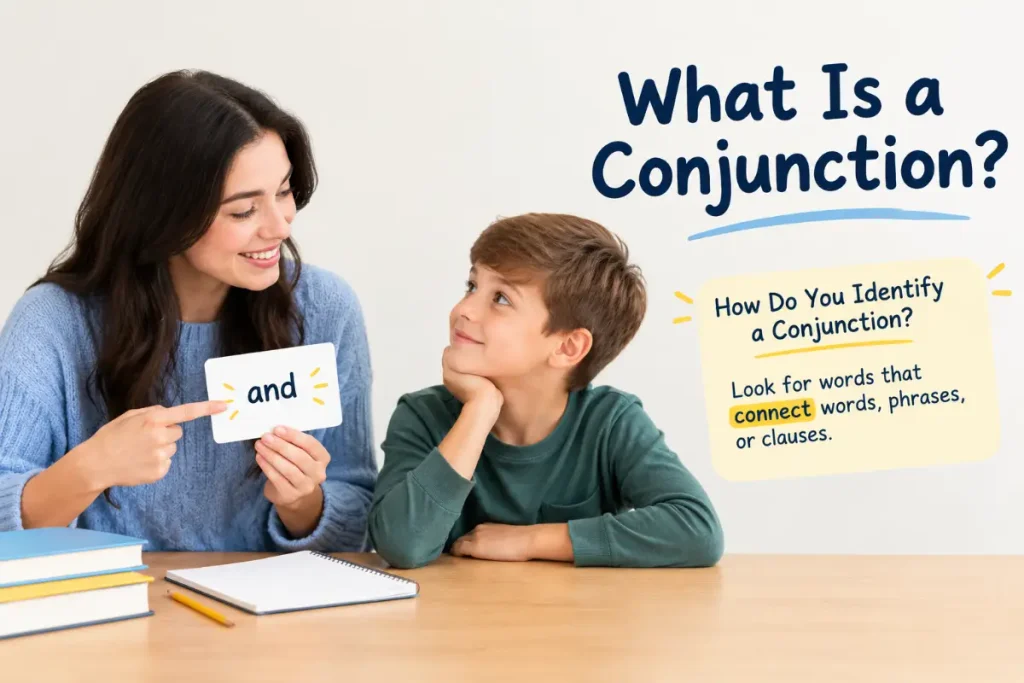
How Do You Identify a Conjunction?
The quickest way to identify a conjunction is to look at what the word connects and what relationship it creates.
Use these three steps:
- Find the connecting word. Look for a word that links two words, phrases, or clauses.
- Check what it connects. Decide whether it joins equal elements or connects a dependent clause to an independent clause.
- Look for a matched pair. If you see both…and, either…or, or another paired structure, you’re likely dealing with a correlative conjunction.
Use these examples to identify the type:
- She likes tea and coffee.
- and connects two nouns.
- It is a coordinating conjunction.
- We left early because traffic was heavy.
- because introduces a dependent clause.
- It is a subordinating conjunction.
- She wanted to stay, but she had to leave.
- but connects two independent clauses and shows contrast.
- It is a coordinating conjunction.
- Although it was late, they continued talking.
- although introduces a dependent clause.
- It is a subordinating conjunction.
- He is both talented and hardworking.
- both…and connects two descriptions.
- It is a correlative conjunction.
A final check can help with words that change grammatical categories. For example, since is a preposition when followed by a noun or noun phrase, as in since Monday, but it is a conjunction when followed by a complete clause, as in since she moved away.
So, when you’re unsure whether a word is a conjunction, don’t rely only on memorization. Look at what follows the word and examine the grammatical job it performs in the sentence.
Quick Reference Table
| Type | Example Words | Sample Sentence |
|---|---|---|
| Coordinating | and, but, or, so, yet | She was tired, but she kept going. |
| Subordinating | because, although, when, since | We left because it was late. |
| Correlative | either…or, both…and | He wants either tea or coffee. |
| Conjunctive adverb (functions similarly) | however, therefore, moreover | It rained; however, we stayed. |
Common Mistakes People Make
Mistake 1: Assuming every connecting-feeling word is a true conjunction, when words like “however” are technically conjunctive adverbs with their own punctuation rules.
Mistake 2: Misclassifying a preposition as a conjunction, or vice versa, without checking whether a full clause or just a noun phrase follows the word.
For another useful perspective, check out List of Coordinating Conjunctions: 7 FANBOYS Explained (2026).
Mistake 3: Overlooking correlative conjunctions as a distinct category, treating “either…or” as two unrelated coordinating conjunctions rather than one matched pair.
Mistake 4: Confusing relative pronouns like “who” and “which” with conjunctions, missing the fact that they also serve a grammatical role within their own clause.
Mistake 5: Assuming a sentence needs a conjunction every time two ideas are related, when sometimes a semicolon or period serves the connection better without one at all.
Practice Exercise
Identify the conjunction in each sentence and name its type: coordinating, subordinating, or correlative. Answers are listed right after, so try each one before checking.
- She wanted to stay, but she had to leave.
- Although it was late, they kept talking.
- He likes both hiking and camping.
- I’ll call you when I arrive.
- Neither the manager nor the staff were informed.
- We left early because traffic was heavy.
- She studied hard, so she passed the exam.
- Either you apologize, or the friendship ends.
- Since she moved away, we rarely talk.
- The movie was long, yet it felt too short.
- Whether you agree or not, we’re proceeding.
- I’ll wait here until you return.
- He’s not only talented but also humble.
- They canceled the trip because of the weather.
- She smiled and waved at the crowd.
- While I understand your point, I disagree.
- We can go now, or we can wait.
- Unless something changes, we’ll proceed as planned.
- He finished the race, for he refused to give up.
- I like coffee, nor do I dislike tea.
Answer Key
- but — coordinating
- Although — subordinating
- both…and — correlative
- when — subordinating
- neither…nor — correlative
- because — subordinating
- so — coordinating
- either…or — correlative
- Since — subordinating
- yet — coordinating
- whether…or — correlative
- until — subordinating
- not only…but also — correlative
- because — subordinating
- and — coordinating
- While — subordinating
- or — coordinating
- Unless — subordinating
- for — coordinating
- nor — coordinating
Frequently Asked Questions
Are conjunctive adverbs like “however” technically conjunctions?
No. They’re classified as adverbs, even though they perform a similar connecting function between ideas. The key practical difference is punctuation: conjunctive adverbs need a semicolon before them when joining two independent clauses, while true conjunctions don’t.
How many coordinating conjunctions are there?
Exactly seven: for, and, nor, but, or, yet, so, commonly remembered with the acronym FANBOYS.
Can the same word be a conjunction in one sentence and a preposition in another?
Yes. Words like “since,” “after,” and “before” function as prepositions when followed by just a noun, and as conjunctions when followed by a full clause with its own subject and verb.
Is “that” ever a conjunction?
Yes, in certain uses. In a sentence like “She said that she was tired,” “that” is functioning as a subordinating conjunction introducing a noun clause, distinct from its more common role as a relative pronoun in sentences like “the book that I read.”
What’s the fastest way to check if a word is a conjunction?
Confirm it’s connecting two words, phrases, or clauses rather than naming or describing something on its own, then check whether removing it breaks that connection, leaving a fragment or an incomplete thought.
Before moving on, you may also want to read An Adverb? 25 Easy Examples to Understand It (2026) for more helpful grammar tips.
Wrapping Up
Understanding what is a conjunction starts with recognizing its one job: linking parts of a sentence together, whether that’s two equal elements, a dependent clause to an independent one, or a matched pair working in tandem. The three core types, coordinating, subordinating, and correlative, cover the vast majority of conjunctions you’ll encounter.
The trickier skill is telling conjunctions apart from their close relatives, conjunctive adverbs, prepositions, and relative pronouns, since several words can shift categories entirely depending on what follows them in a given sentence. Checking what comes next is almost always the fastest way to settle the question.