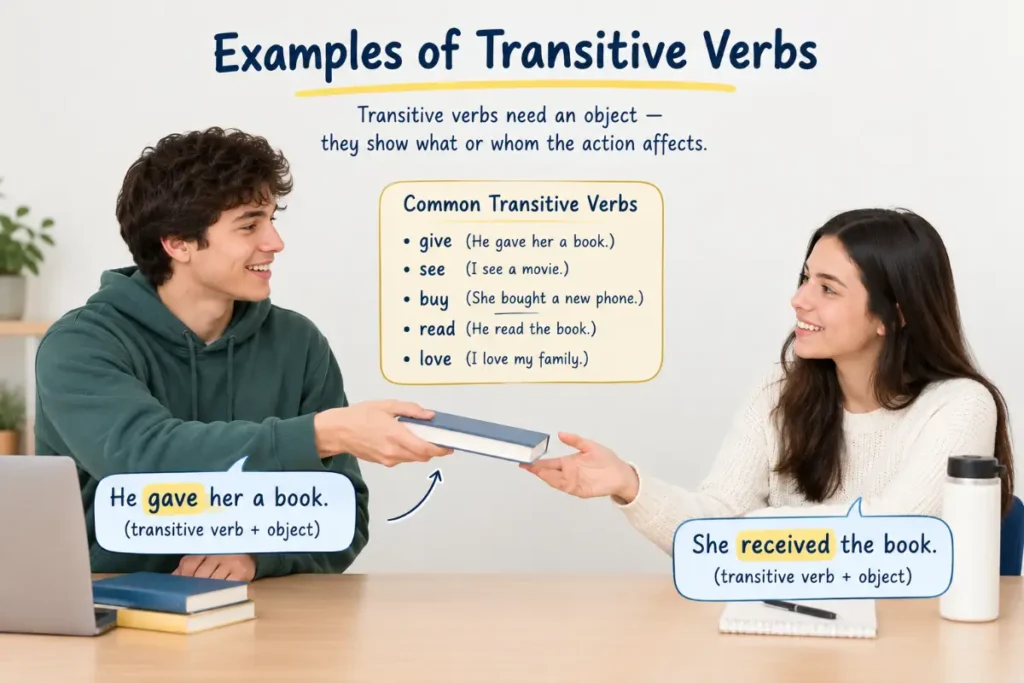
Looking at real examples of transitive verbs side by side with their intransitive counterparts is the fastest way to understand this distinction, because the test behind it is genuinely simple: does the verb need something to receive its action? If you can ask “what?” or “whom?” right after the verb and get a real answer, you’re looking at a transitive verb.
- The girl kicked the ball. (kicked what? the ball — transitive)
- The baby cried. (cried what? nothing — intransitive)
This guide works through clear examples of transitive verbs, shows the verbs that genuinely swing both ways depending on the sentence, and covers the passive-voice test that catches the cases where the “what?” question alone isn’t quite enough.
You may also find A Gerund? The -ing Word That Works as a Noun (2026) helpful if you want to explore this topic further.
The Core Definition
The SIU Writing Center’s handout on transitive and intransitive verbs defines it directly: a transitive verb is followed by a noun or noun phrase acting as a direct object. To find out if a verb has a direct object, first identify the subject and the verb, then ask what or whom receives the action.
- She baked a cake. Subject: she. Verb: baked. Baked what? A cake. “Cake” is the direct object, making “baked” transitive.
Everyday Examples of Transitive Verbs
- He ate the sandwich. (ate what? the sandwich)
- She wrote a letter. (wrote what? a letter)
- They built a house. (built what? a house)
- I saw the movie. (saw what? the movie)
- He opened the door. (opened what? the door)
- She borrowed my pen. (borrowed what? my pen)
- We painted the fence. (painted what? the fence)
- He fixed the engine. (fixed what? the engine)
In every one of these, removing the direct object leaves an incomplete-feeling sentence. “He ate” on its own is grammatically fine as an intransitive statement, but “He ate the sandwich” and plain “He ate” carry genuinely different information, which is exactly the clue that “eat” can swing both ways depending on context.

Verbs That Are Always Transitive
Some verbs simply can’t function without a direct object; the sentence falls apart without one.
- Henry bought [something]. (“Henry bought” alone doesn’t work as a complete thought)
- She brought [something].
- He needs [something].
- They made [something].
Try saying “Henry bought” and stopping — the sentence feels obviously unfinished, which is the clearest sign a verb belongs in this always-transitive category.
Verbs That Are Always Intransitive
On the other end, some common verbs never take a direct object at all, because the action doesn’t pass over to anything else.
- The baby cried.
- The sun shines.
- The train arrived.
- She laughed.
- He sneezed.
- They slept.
You can’t “cry something” or “arrive something” in standard English — these verbs are complete on their own, describing an action the subject performs without transferring it anywhere.
The Verbs That Go Both Ways
This is the category that causes the most confusion, since the exact same verb can be transitive in one sentence and intransitive in the next, depending entirely on whether an object follows it.
- She ran the marathon. (ran what? the marathon — transitive)
- She ran every morning. (ran what? nothing — intransitive)
- A crowd shouted at me from across the street. (shouted what, or at whom? me — transitive)
- A crowd shouted from across the street. (shouted what? nothing — intransitive)
- He’s playing basketball. (playing what? basketball — transitive)
- The kids are playing outside. (playing what? nothing — intransitive)
Other common verbs in this flexible category: eat, read, write, sing, drive, grow, continue, and win. The verb’s meaning doesn’t necessarily change between the two uses, just whether an object happens to follow it in that particular sentence.
The Passive Voice Test
For trickier cases, there’s a second reliable check worth knowing: if a sentence can be converted into passive voice, the original verb was transitive. Intransitive verbs can never be made passive, since there’s no object available to become the new subject.
- The chef prepared the meal. → The meal was prepared by the chef. (works — “prepared” is transitive)
- The train arrived. → Arrived was… (nonsense) — this conversion fails, confirming “arrived” is intransitive
This test is especially useful for distinguishing genuinely tricky cases, and it connects directly to the mechanics covered in our guide to active vs passive voice examples, since passive voice is only grammatically possible with a transitive verb in the first place.
Direct Object vs. Indirect Object
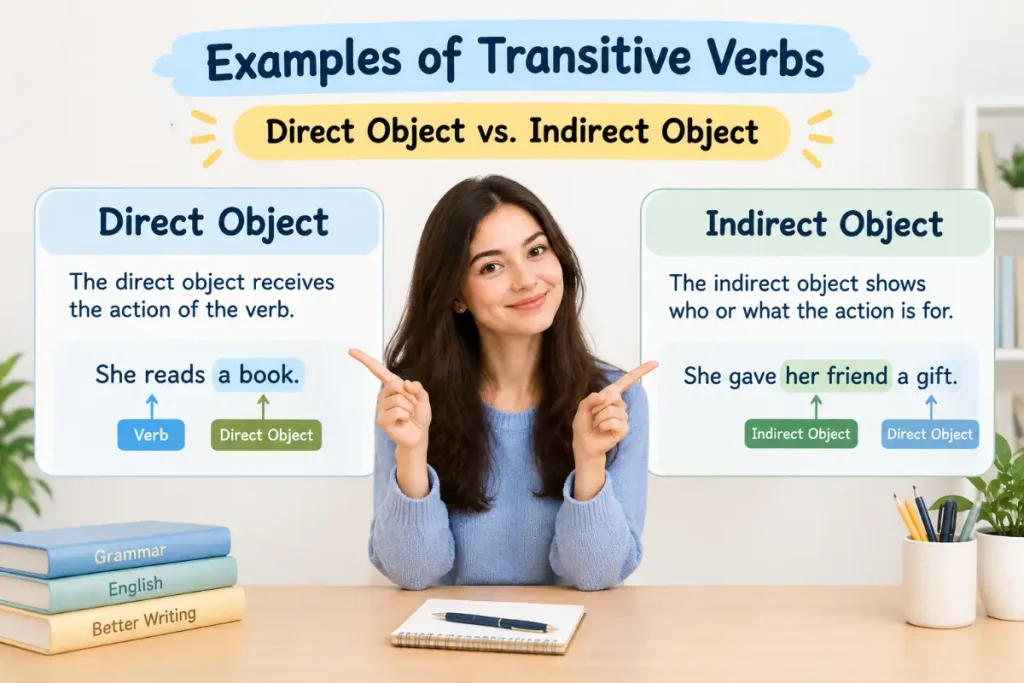
Once you’ve confirmed a verb is transitive, it’s worth knowing that some transitive verbs take two objects: a direct object (what’s being given, sent, or done) and an indirect object (who receives it).
- She gave her sister a gift. (“gift” is the direct object; “sister” is the indirect object, receiving the gift)
- He sent me a letter. (“letter” is direct; “me” is indirect)
Verbs that regularly take both are sometimes called ditransitive, but they still fall under the broader transitive category, since they do require at least one direct object to complete their meaning.
Examples of Transitive Verbs in Everyday Sentences
The easiest way to recognize a transitive verb is to see it doing its job in a normal sentence. A transitive verb passes its action to a direct object—the person, place, thing, or idea that receives the action. Ask “what?” or “whom?” after the verb, and the answer should point you straight to the object.
Here are some clear examples of transitive verbs:
- Maria washed the dishes. (washed what? the dishes)
- James kicked the ball. (kicked what? the ball)
- We watched the game. (watched what? the game)
- She answered the question. (answered what? the question)
- The teacher explained the lesson. (explained what? the lesson)
- He carried the boxes upstairs. (carried what? the boxes)
- They planted flowers in the garden. (planted what? flowers)
- I finished my homework. (finished what? my homework)
- The dog chased the squirrel. (chased whom? the squirrel)
- She opened the window. (opened what? the window)
Notice the pattern: the verb is followed by something that receives the action. In “She opened the window,” for example, opened is the transitive verb and the window is its direct object.
The same verb can sometimes appear without an object, so always judge the verb by how it functions in the specific sentence. “She opened the window” is transitive, while “The window opened” is intransitive. That small difference is why looking at the whole sentence matters.
Transitive vs. Intransitive Verbs: Easy Examples
The difference between transitive and intransitive verbs becomes much easier when you put the two side by side. A transitive verb takes a direct object, while an intransitive verb does not.
Compare these examples:
| Transitive | Intransitive |
|---|---|
| She read the book. | She read quietly. |
| He opened the door. | The door opened. |
| They played the game. | The children played outside. |
| We watched the movie. | We watched quietly. |
| She sang a song. | She sang beautifully. |
| He ran the marathon. | He ran yesterday. |
| They grew tomatoes. | The plants grew quickly. |
| I cooked dinner. | I cooked all afternoon. |
The fastest way to check the difference is to ask what? or whom? after the verb.
Take “They played the game.” Played what? The game. Because the game receives the action, played is transitive.
Now look at “The children played outside.” Played what? There is no direct object. Outside tells us where they played, not what they played, so played is intransitive in this sentence.
Some verbs can work in both ways, including read, play, sing, cook, run, grow, and eat. That means you cannot simply memorize a verb as “transitive” or “intransitive.” You need to check how it is being used in the sentence.
How to Identify a Transitive Verb
You don’t need to memorize a long list of transitive verbs to identify one. In most sentences, a simple “what?” or “whom?” test will do the job.
Start by finding the verb, then ask what or whom receives its action.
Example:
The boy kicked the ball.
- Subject: the boy
- Verb: kicked
- Kicked what? the ball
- Direct object: the ball
Because the ball receives the action of kicked, the verb is transitive.
Try another:
Sarah bought a new laptop.
- Verb: bought
- Bought what? a new laptop
- Direct object: a new laptop
So bought is transitive.
If nothing answers the “what?” or “whom?” question, the verb may be intransitive:
The baby slept peacefully.
- Verb: slept
- Slept what? Nothing.
- Direct object: None.
Therefore, slept is intransitive.
One detail can make this test confusing: a noun after a preposition is not automatically a direct object. In “She walked to the store,” store is the object of the preposition to, not a direct object of walked. The verb remains intransitive.
For another useful perspective, check out Complete List of Relative Pronouns (2026 Guide).
For especially tricky sentences, use the passive voice test as a second check. If the sentence can naturally become passive, the original verb is transitive:
The chef cooked the meal.
→ The meal was cooked by the chef.
Because the conversion works, cooked is transitive. An intransitive sentence such as “The baby slept” cannot be turned into a normal passive construction because there is no direct object to move into the subject position.
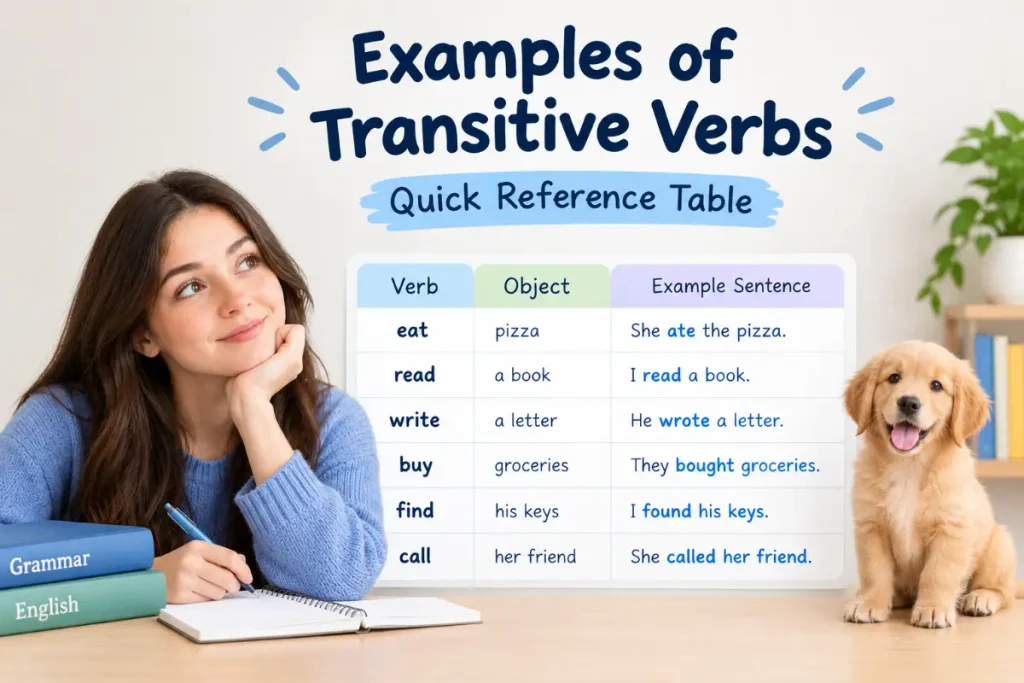
Quick Reference Table
| Verb | Transitive Example | Intransitive Example |
|---|---|---|
| eat | She ate the apple. | She ate quickly. |
| run | He ran the race. | He ran yesterday. |
| grow | They grow tomatoes. | The tomatoes grow fast. |
| sing | She sang a song. | She sang beautifully. |
| read | He read the book. | He read all night. |
| cry | (always intransitive) | The baby cried. |
| buy | (always transitive) | (incomplete without an object) |
Common Mistakes People Make
- Mistake 1: Assuming a verb is always transitive or always intransitive without checking the specific sentence, when many common verbs genuinely swing both ways.
- Mistake 2: Trying to use an always-intransitive verb with a direct object, as in “she arrived the airport” instead of “she arrived at the airport,” which requires a preposition instead of a direct object.
- Mistake 3: Leaving out a required direct object after an always-transitive verb, producing an incomplete-sounding sentence like “He brought” with no object named.
- Mistake 4: Confusing a prepositional phrase for a direct object. In “she arrived at the station,” “station” is the object of the preposition “at,” not a direct object of “arrived,” which is why the verb is still intransitive here.
- Mistake 5: Forgetting that only transitive verbs can form passive voice sentences, and attempting to passivize an intransitive verb, which always produces a broken sentence.
Practice Exercise
Decide whether the verb in each sentence is transitive or intransitive. Answers are listed right after, so try each one before checking.
- She closed the window.
- The flowers bloomed early this year.
- He plays the guitar every evening.
- The children laughed loudly.
- They watched the sunset.
- The ice melted quickly.
- She teaches math at the school.
- The dog barked all night.
- He fixed the broken chair.
- The baby slept peacefully.
- We visited our grandparents.
- The leaves fell from the tree.
- She sang at the concert.
- He borrowed my car.
- The train departed on time.
- They built a treehouse.
- The student studied for hours.
- She wrote a novel last year.
- The crowd cheered loudly.
- He delivered the package.
Answer Key
- Transitive (closed what? the window)
- Intransitive
- Transitive (plays what? the guitar)
- Intransitive
- Transitive (watched what? the sunset)
- Intransitive
- Transitive (teaches what? math)
- Intransitive
- Transitive (fixed what? the broken chair)
- Intransitive
- Transitive (visited whom? our grandparents)
- Intransitive
- Intransitive (no direct object; “at the concert” is a prepositional phrase)
- Transitive (borrowed what? my car)
- Intransitive
- Transitive (built what? a treehouse)
- Intransitive
- Transitive (wrote what? a novel)
- Intransitive
- Transitive (delivered what? the package)
Frequently Asked Questions
Can the same verb be both transitive and intransitive in different sentences?
Yes, and this is extremely common. Verbs like eat, run, read, and sing can take a direct object in one sentence and appear without one in the next, with the meaning staying essentially the same either way.
Is a verb automatically intransitive if it’s followed by a prepositional phrase instead of a noun?
Generally yes. “She arrived at the station” is intransitive because “station” is the object of the preposition “at,” not a direct object of “arrived.” The verb itself still takes no direct object.
How can I tell if a tricky verb is transitive without guessing?
Ask “what?” or “whom?” directly after the verb. If a noun answers that question naturally, the verb is transitive in that sentence. You can also try converting the sentence to passive voice; if that works, the verb was transitive.
What’s a ditransitive verb, and is it a separate category?
A ditransitive verb takes both a direct and an indirect object, like “give” in “she gave him a gift.” It’s technically a subcategory of transitive verbs rather than a wholly separate type, since it still requires at least one direct object.
What’s the fastest way to check whether a verb is transitive in a specific sentence?
Ask what or whom receives the action right after the verb. If there’s a clear answer, it’s transitive. If the sentence feels complete without one, or if what follows is only a prepositional phrase, it’s intransitive.
Before moving on, you may also want to read Types of Adjectives with Examples: 8 Types Explained (2026) for more helpful grammar tips.
Wrapping Up
Working through real examples of transitive verbs alongside their intransitive counterparts makes the core test click fast: ask “what?” or “whom?” right after the verb, and if a direct object answers that question, the verb is transitive. Verbs that always need an object, always refuse one, or swing both ways depending on context all follow this same simple check.
The passive voice test is worth keeping in your back pocket for the trickier cases, since only a transitive verb can be flipped into passive voice at all, giving you a reliable second opinion whenever the “what?” question alone leaves you unsure.