The fastest way to answer what is an adverb example is to look at one in context: in “He waved wildly to get her attention,” the word “wildly” is the adverb, and it’s telling you how he waved. Purdue OWL defines adverbs as words that modify, or further describe, verbs — and while nouns answer the questions “who” and “what,” adverbs answer “how,” “when,” “why,” and “where.”
Most people learn adverbs as “the -ly words,” which is a decent starting shortcut but genuinely misleading, since plenty of common adverbs skip the -ly ending entirely, and plenty of -ly words are actually adjectives. This guide works through real examples organized by the four questions adverbs answer, then covers the modifier mix-up that causes most adverb-related mistakes.
You may also find A Gerund? The -ing Word That Works as a Noun (2026) helpful if you want to explore this topic further.
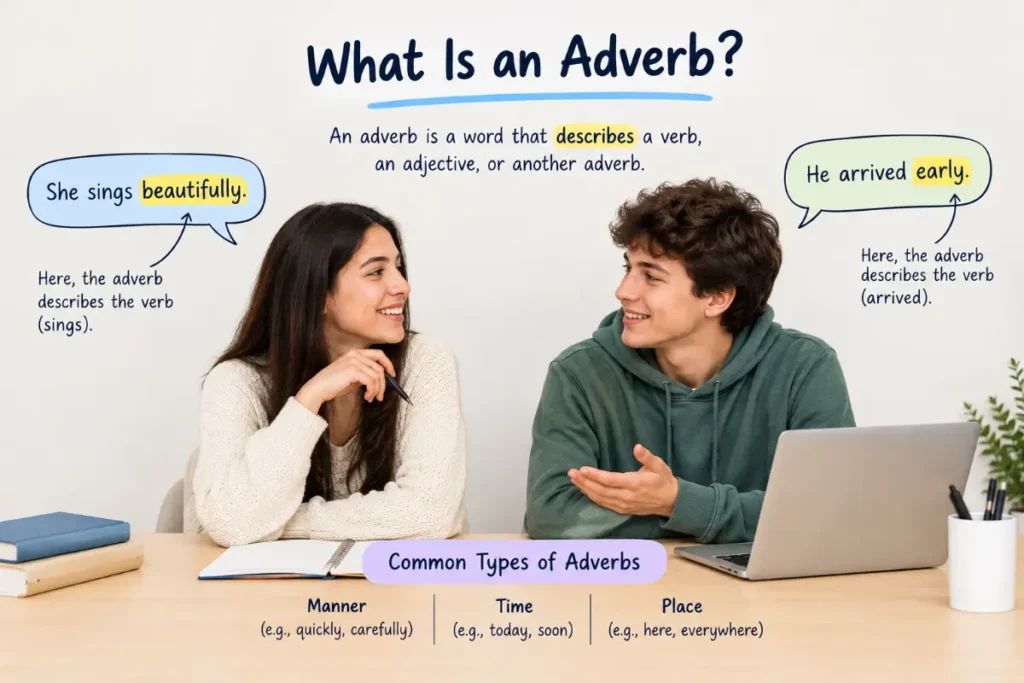
What Is an Adverb? Simple Definition
An adverb is a word that gives more information about a verb, adjective, another adverb, or sometimes an entire sentence. It can tell you how, when, where, or to what degree something happens.
For example:
- She spoke quietly. → tells how she spoke.
- We arrived yesterday. → tells when we arrived.
- Come inside. → tells where to come.
- The movie was extremely funny. → tells to what degree it was funny.
So, if you’re wondering what is an adverb example, start by looking at what the word modifies. In “She ran quickly,” quickly is an adverb because it describes how she ran. In “The test was extremely difficult,” extremely is also an adverb, but this time it modifies the adjective difficult.
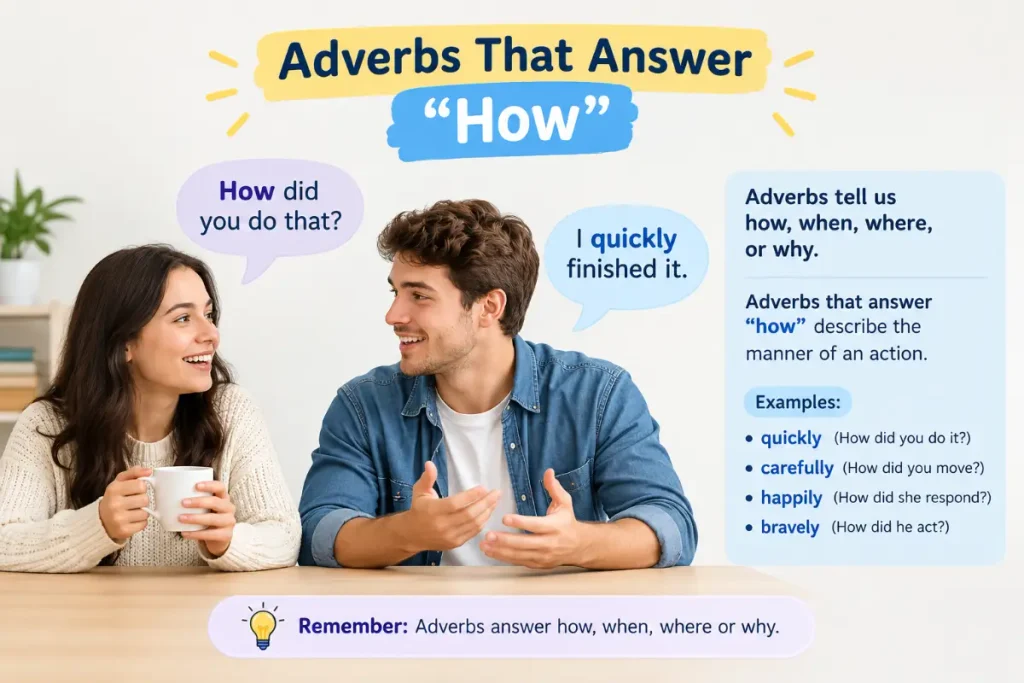
Adverbs That Answer “How”
This is the largest and most familiar category, describing the manner in which an action happens.
- She sang beautifully.
- He waved wildly to get her attention.
- They worked quickly to finish on time.
- The dog barked loudly all night.
Adverbs That Answer “When”
These place an action in time.
- We’ll leave tomorrow.
- She already finished the report.
- He rarely eats breakfast.
- They arrived early for the show.
Adverbs That Answer “Where”
These describe location or direction.
- Please sit here.
- The cat went outside.
- She looked everywhere for her keys.
- He walked away without a word.
Adverbs That Answer “Why” or “To What Degree”
A smaller category, but one that shows up constantly, especially the degree adverbs that intensify or soften another word.
- The shirt he wore to the party was extremely bright. (Purdue OWL’s own example, showing “extremely” modifying the adjective “bright”)
- She was somewhat disappointed with the results.
- He is too tired to continue.
- I completely agree with your plan.
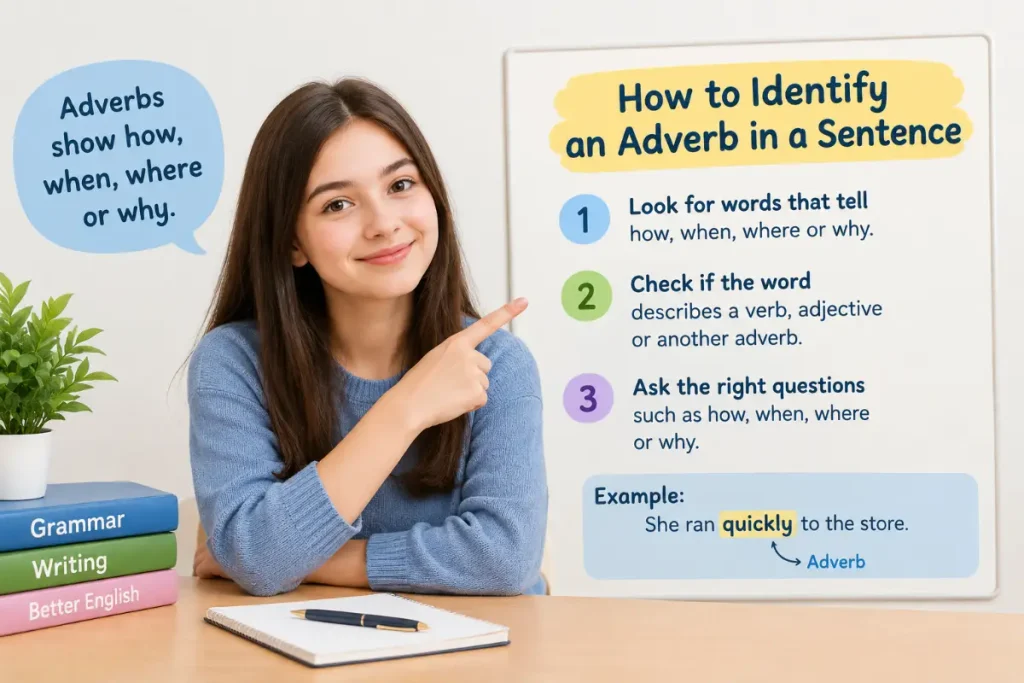
How to Identify an Adverb in a Sentence
The easiest way to identify an adverb is to find the word that gives extra information about an action, description, or another modifier. Then ask what question it answers.
Try this simple method:
- Find the verb, adjective, or adverb being described.
- Look for a word that adds information about it.
- Ask how, when, where, or to what degree.
- Check what the word actually modifies rather than relying on its ending.
For example, in “Marcus finished the assignment quickly,” the verb is finished. The word quickly tells us how Marcus finished it, so quickly is the adverb.
In “The coffee is very hot,” very is the adverb because it modifies the adjective hot.
In “She ran incredibly fast,” there are two adverbs. Fast describes how she ran, while incredibly modifies the adverb fast.
This approach is more reliable than simply looking for words ending in -ly, because many adverbs do not use that ending.
Adverbs Can Modify More Than Just Verbs
This is the detail that separates adverbs from adjectives most clearly: adverbs can also modify adjectives and even other adverbs, not just verbs.
- Priya was extremely happy. (the adverb “extremely” modifies the adjective “happy,” which itself modifies the proper noun “Priya”)
- She finished the race incredibly quickly. (the adverb “incredibly” modifies the other adverb “quickly”)
Adjectives can’t do this — they’re restricted to modifying nouns and pronouns only, which is the core distinction Purdue OWL’s adjective-versus-adverb guide returns to repeatedly.
The Sense-Verb Exception That Causes Most Errors
Here’s where adverbs and adjectives get genuinely confused in everyday writing. Purdue OWL states the rule directly: “an adjective always follows a sense verb or a verb of appearance — feel, taste, smell, sound, look, appear, and seem — when it modifies the noun before the verb.” In other words, after these specific verbs, you usually want an adjective, not an adverb, because the word is describing the subject, not the action of sensing.
- The ocean air smells fresh. (adjective “fresh” describes the air, not the manner of smelling)
- I feel bad about what happened. (adjective “bad” describes your state, not how well you perform the act of feeling)
Purdue OWL’s own example makes the contrast unmistakable: “The dog smells badly” means the dog is bad at smelling things, as though its nose doesn’t work, while “The dog smells bad” means the dog needs a bath. Swapping “bad” for “badly” in that sentence genuinely changes the meaning, not just the formality. This exact issue is what fuels the long-running “I feel good” debate too, which our guide to good vs well covers in full, and it connects directly to the broader concept in our guide to what is a linking verb, since sense verbs are linking verbs when they’re being modified this way.
Adverbs That Don’t End in -ly
Since the -ly shortcut genuinely misleads people, here’s a list of common adverbs that skip it entirely: fast, hard, early, late, often, never, always, soon, well, far, straight, high, low, near.
- She drives fast.
- He works hard.
- The train arrives soon.
- They never complain.
-ly Words That Are Actually Adjectives
Going the other direction, several common -ly words are adjectives, not adverbs, because they describe nouns rather than actions.
- a friendly dog, a lovely garden, a lonely road, a costly mistake, an elderly man
If you try to use one of these as though it were an adverb (“he smiled friendly”), the sentence breaks down, which is a useful clue that -ly alone never guarantees a word is an adverb.
Quick Reference Table
| Question Answered | Example Adverb | Sample Sentence |
|---|---|---|
| How | quickly | She finished quickly. |
| When | already | He already left. |
| Where | outside | The cat went outside. |
| Degree | extremely | It was extremely bright. |
| No -ly | often | They often visit. |
| After a sense verb | bad (adjective, not adverb) | I feel bad. |
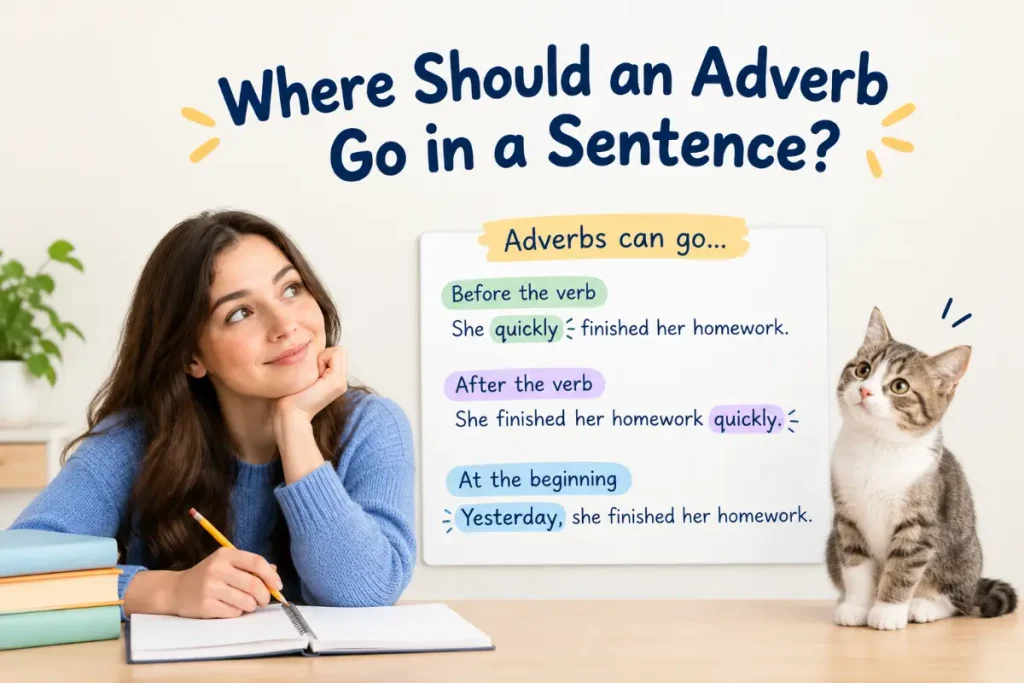
Where Should an Adverb Go in a Sentence?
Adverb placement depends on what the adverb modifies and the type of adverb you’re using. Many adverbs can move within a sentence, but moving one too far from the word it describes can make the meaning unclear.
For example:
- She quickly finished the report.
- She finished the report quickly.
Both sentences clearly show that quickly describes the action of finishing.
With frequency adverbs such as always, often, usually, rarely, and never, placement is more specific:
- She always checks her email.
- They often eat lunch together.
- He has never visited New York.
When an adverb modifies an adjective or another adverb, it normally appears directly before that word:
- The test was extremely difficult.
- She ran incredibly quickly.
The main goal is clarity. Place the adverb close enough to the word it modifies that readers do not have to guess what you mean.
Common Mistakes People Make
Mistake 1: Using an adverb after a sense verb when an adjective is needed, as in “she looks nicely” instead of “she looks nice.”
Mistake 2: Assuming any word ending in -ly must be an adverb, overlooking adjectives like “friendly” and “lovely.”
Mistake 3: Using an adjective to modify a verb, as in “he ran quick” instead of “he ran quickly.”
For another useful perspective, check out List of Prepositions: 100+ Words You Need to Know (2026).
Mistake 4: Placing an adverb so far from the word it modifies that the sentence becomes ambiguous, a problem covered in more depth in our guide to what is a misplaced modifier example.
Mistake 5: Double-modifying with redundant adverbs, such as “completely finished entirely,” when one degree adverb would do the job.
Practice Exercise
Identify the adverb in each sentence and name which question it answers: how, when, where, or degree. Answers are listed right after, so try each one before checking.
- She sang beautifully at the concert.
- We’ll meet tomorrow.
- He looked everywhere for his wallet.
- The soup was extremely spicy.
- They rarely argue.
- Please come here.
- She drives too fast.
- He finished the race early.
- The music played softly.
- I completely understand.
- They left yesterday.
- The children played outside.
- He answered the question correctly.
- She is somewhat nervous about the interview.
- We often visit our grandparents.
- He walked away quietly.
- The test was incredibly difficult.
- She arrived late to the meeting.
- He spoke confidently during the presentation.
- The cat hid underneath the bed.
Answer Key
- beautifully — how
- tomorrow — when
- everywhere — where
- extremely — degree
- rarely — when (frequency)
- here — where
- too (modifying “fast”) — degree
- early — when
- softly — how
- completely — degree
- yesterday — when
- outside — where
- correctly — how
- somewhat — degree
- often — when (frequency)
- quietly — how
- incredibly — degree
- late — when
- confidently — how
- underneath — where
Frequently Asked Questions
Do all adverbs end in -ly?
No. Common adverbs like fast, hard, soon, often, never, and well don’t end in -ly, while some -ly words, like friendly and lovely, are actually adjectives rather than adverbs.
Why does “I feel bad” use an adjective instead of an adverb?
Because “feel” is functioning as a linking verb here, connecting the subject to a description of its state rather than describing an action being performed. Adjectives, not adverbs, follow linking and sense verbs when they describe the subject.
Can an adverb modify a whole sentence rather than just one word?
Yes. Words like “fortunately,” “honestly,” and “surprisingly” at the start of a sentence often modify the entire statement rather than a single verb, adjective, or adverb, expressing the speaker’s attitude toward what follows.
How is an adverb different from an adjective in terms of what it can modify?
Adjectives modify only nouns and pronouns. Adverbs have a wider range, modifying verbs, adjectives, and other adverbs, which is why the same descriptive idea sometimes needs two different word forms depending on what it’s attached to.
What’s the fastest way to check if a word is functioning as an adverb?
Ask what it’s modifying. If it’s describing a verb, an adjective, or another adverb, and answering how, when, where, or to what degree, it’s an adverb. If it’s describing a noun or pronoun directly, it’s an adjective instead.
Before moving on, you may also want to read Types of Pronouns: 9 Essential Types With Easy Examples (2026) for more helpful grammar tips.
Wrapping Up
Working through a real what is an adverb example across all four categories, how, when, where, and degree, shows that adverbs do far more than just add -ly to the end of a word. They modify verbs, adjectives, and other adverbs, and knowing which of those three they’re attached to in a given sentence is what actually determines whether an adverb or an adjective belongs there.
The sense-verb exception is worth remembering longest, since it’s the single rule that resolves the most common real-world mix-ups, from “I feel bad” to “the soup tastes great,” where an adjective is doing the job many writers instinctively try to hand to an adverb instead.