Wondering How to Use Commas in a List without second-guessing every sentence? Whether you’re listing people, places, ideas, or everyday items, a few simple comma rules can keep your writing clear, natural, and easy to read.
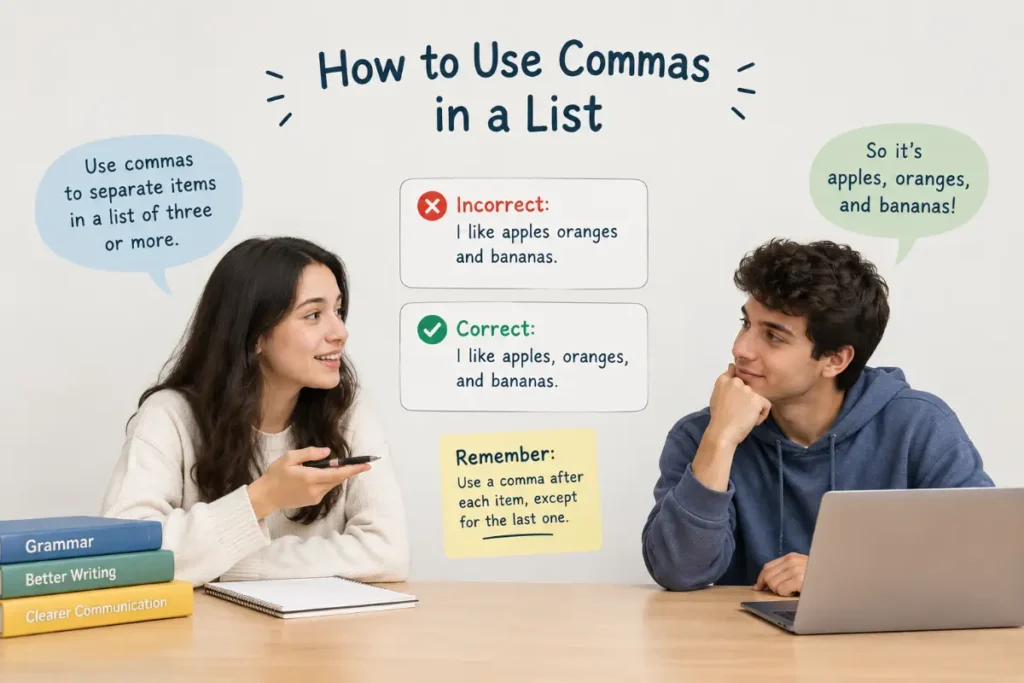
If you’ve ever paused mid-sentence wondering exact usage of commas in a list, the good news is that the core rule is refreshingly simple, even if one specific comma within it has sparked decades of debate among writers and editors. Purdue OWL states the basic principle plainly: use commas to separate three or more words, phrases, or clauses written in a series.
You may also find Use Whomever Correctly: 10 Simple Rules (2026) helpful if you want to explore this topic further.
The Quick Answer
- You will need to order cement bags, lumber, nails, nuts, bolts, screws, and glue.
- The employer was looking for a smart, outgoing, and passionate candidate.
- She traveled to Paris, visited the Louvre, and returned home exhausted.
Each item in a list of three or more gets separated by a comma, including — in most modern style guides — the comma right before the final “and” or “or.”
The Core Rule: Separating Three or More Items
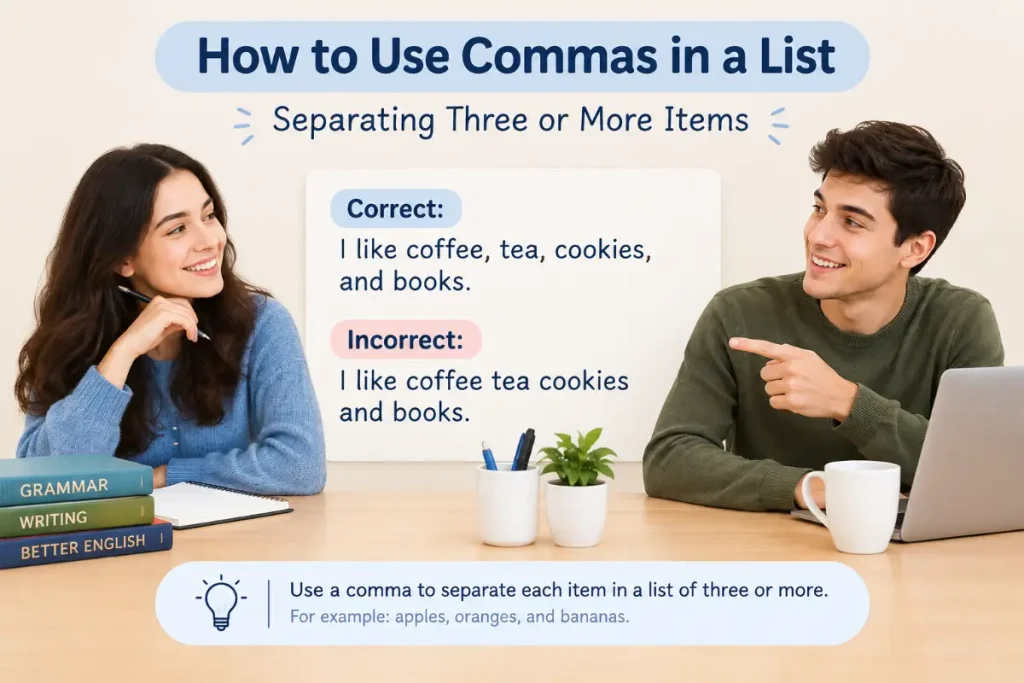
Whenever you’re listing three or more words, phrases, or short clauses in a row, commas go between each item to keep the list clear and easy to read.
- We packed sandwiches, chips, and drinks. (words)
- She likes hiking in the mountains, swimming in the lake, and reading by the fire. (phrases)
- He arrived late, apologized briefly, and sat down quietly. (short clauses)
Without commas, a list like this would blur together into a confusing run of words with no clear boundaries between items.
The Oxford Comma: The One Genuinely Debated Part of This Rule
This is the comma right before the final “and” or “or” in a list — also called the serial comma. Both of these are grammatically acceptable:
- Red, white, and blue. (with the Oxford comma)
- Red, white and blue. (without it)
Chicago Manual of Style and MLA recommend using it consistently. AP Stylebook generally omits it, except when leaving it out would create genuine ambiguity. Neither position is objectively “more correct” — it’s a matter of house style, though using it consistently tends to prevent more confusion than it causes. For a deeper look at exactly when this comma changes meaning, see our comma before and rule and our gallery of Oxford comma examples.
Commas With Coordinate Adjectives
A related but distinct case: when two or more adjectives describe the same noun equally, and their order could be swapped without changing the meaning, they’re separated by commas.
- The employer was looking for a smart, outgoing, and passionate candidate.
- I drive a slow, ugly, old car. (also correct reordered: an ugly, old, slow car)
Purdue OWL specifically distinguishes this from adjectives whose order can’t be swapped, which don’t take a comma between them: She lives in a big green house — not a green big house — because these adjectives build on each other in a fixed order rather than functioning as an equal, interchangeable list.
The quick test: if you can insert “and” between the adjectives and it still sounds natural (“smart and outgoing and passionate”), they’re coordinate adjectives and need commas. If inserting “and” sounds off (“big and green house” feels slightly wrong), skip the comma.
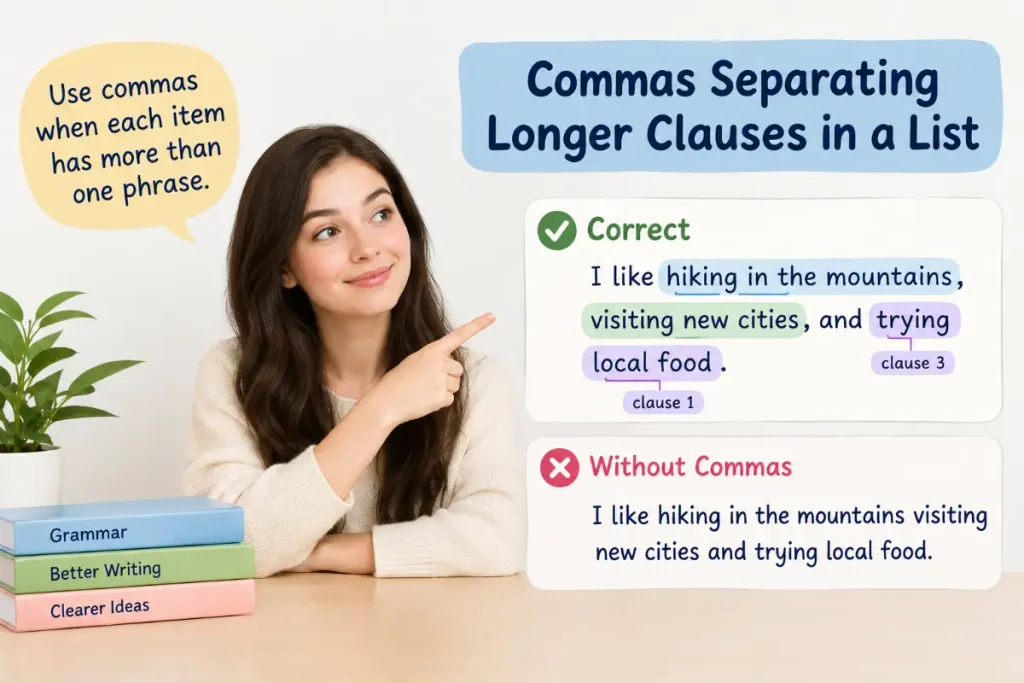
Commas Separating Longer Clauses in a List
When list items are longer, full clauses rather than single words, commas still separate them, though semicolons take over if any of those clauses already contain internal commas.
- He wanted to travel, she wanted to save money, and neither one would compromise.
Compare this to a complex list where semicolons are needed instead:
- The panel included Maria Chen, a software engineer; David Osei, a project manager; and Priya Nair, a designer.
The Fastest Way to Check Yourself
Step 1: Do you have three or more items — words, phrases, or clauses — in a series? Separate each one with a comma.
Step 2: Are the final two items connected by “and” or “or”? Decide whether you’re using the Oxford comma, and apply that choice consistently throughout your writing.
Step 3: Do any of your list items already contain commas within themselves? Switch to semicolons to separate the items clearly.
Step 4: Are you listing adjectives? Check whether they’re coordinate (equal, swappable, take commas) or cumulative (fixed order, no commas).
How to Use Commas in a List: Quick Reference
| Situation | Rule | Example |
|---|---|---|
| Simple list of 3+ items | Comma between each | apples, oranges, and pears |
| Oxford comma before “and”/”or” | Optional, but recommended for clarity | red, white, and blue |
| Coordinate adjectives | Comma between each | a bright, cheerful room |
| Cumulative adjectives (fixed order) | No comma | three small wooden chairs |
| List items with internal commas | Use semicolons instead | Lyon, France; Rome, Italy |
Common Mistakes People Make
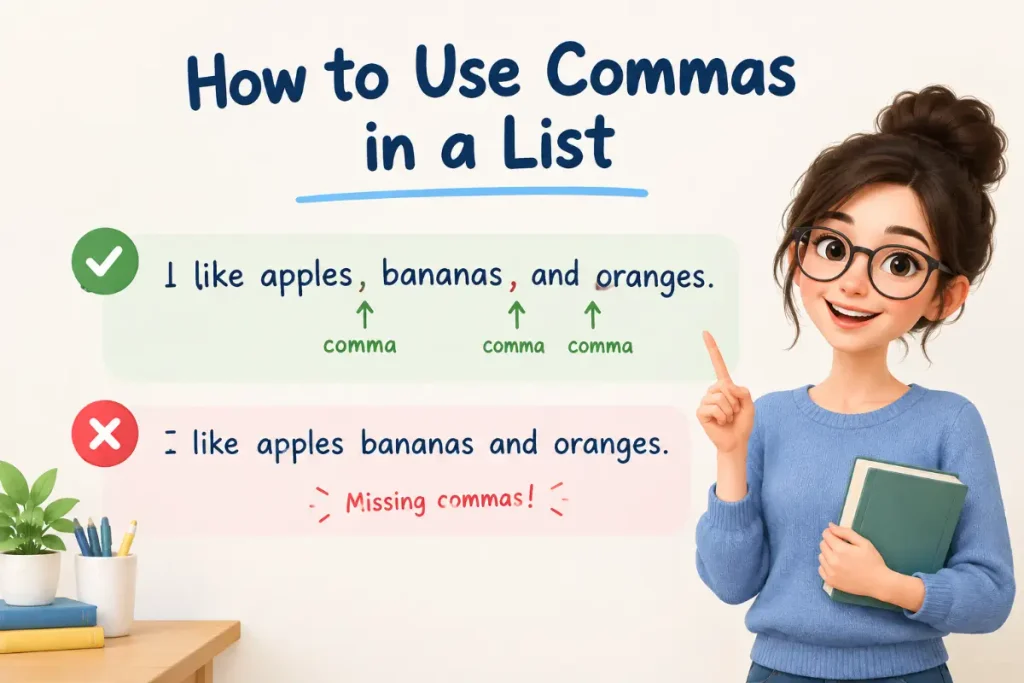
Mistake 1: “I bought apples oranges and pears.” Missing commas entirely — this should be “I bought apples, oranges, and pears.”
Mistake 2: “She lives in a green, big house.” The adjectives here are cumulative, not coordinate — “big green house” is the natural, fixed order, and no comma belongs between them.
Mistake 3: “The team included a designer, a writer, an editor a manager.” Missing the comma (and often the conjunction) before the final item: “a designer, a writer, an editor, and a manager.”
For another useful perspective, check out A Dangling Modifier? Learn It in 9 Easy Steps (2026 Guide).
Mistake 4: Using commas instead of semicolons in a complex list. “We visited Lyon, France, Rome, Italy, and Bern, Switzerland” becomes genuinely hard to parse — semicolons are needed here: “Lyon, France; Rome, Italy; and Bern, Switzerland.”
Mistake 5: Inconsistent Oxford comma use within the same document. Using it in one list and skipping it in another, without any stylistic reason, looks unpolished — pick a convention and stick with it.
More Examples to Lock It In
- He ordered a burger, fries, and a milkshake.
- The recipe calls for flour, sugar, eggs, and butter.
- She’s organized, dependable, and easy to work with.
- They visited the museum, walked along the river, and had dinner at a small café.
- The bright, cheerful, spacious apartment was exactly what they wanted.
Frequently Asked Questions
Is the Oxford comma required by any strict grammar rule?
No — it’s a style choice rather than a fixed grammar rule. Different style guides genuinely disagree, though using it consistently tends to prevent the kind of ambiguity covered in our Oxford comma examples guide.
How can I tell if adjectives in a list are coordinate or cumulative?
Try inserting “and” between them. If it sounds natural, they’re coordinate and need commas. If it sounds awkward, they’re cumulative and shouldn’t be separated by commas.
What if my list contains just two items?
Two items connected by “and” or “or” typically don’t need a comma at all: “coffee and tea,” not “coffee, and tea” — the comma-separated list rule applies specifically to three or more items.
Do numbers in a list follow the same comma rules as words?
Yes — numbers, like words, are separated by commas when listed in a series: “The scores were 12, 15, and 18.” The same Oxford comma question applies here too.
What’s the fastest way to catch list-comma errors before publishing something?
Count your list items. If there are three or more, check for a comma between each one, decide on your Oxford comma convention and apply it consistently, and switch to semicolons if any item already contains its own internal comma.
Practice Exercise
Add commas where needed in each sentence. Answers are listed right after — try each one before checking.
- We bought apples oranges bananas and grapes.
- She packed a notebook pens pencils and a ruler.
- The garden was quiet peaceful and beautifully maintained.
- He ordered pizza salad soup and iced tea.
- My favorite colors are blue green and purple.
- We visited Paris Rome Madrid and Lisbon.
- The old wooden table stood in the corner.
- She is smart creative patient and hardworking.
- Please bring your passport wallet phone and keys.
- The movie was funny exciting and surprisingly emotional.
- He bought a large leather travel bag.
- Our team needs focus patience communication and teamwork.
- She enjoys reading hiking cooking and photography.
- The children were tired hungry and ready for bed.
- We need fresh ripe tomatoes for the recipe.
- They packed shirts jeans socks and jackets.
- The restaurant served spicy flavorful and aromatic dishes.
- I saw Sarah Michael James and Olivia at the event.
- He drove through a long narrow winding road.
- The presentation was clear concise informative and engaging.
Answer Key
- We bought apples, oranges, bananas, and grapes.
- She packed a notebook, pens, pencils, and a ruler.
- The garden was quiet, peaceful, and beautifully maintained.
- He ordered pizza, salad, soup, and iced tea.
- My favorite colors are blue, green, and purple.
- We visited Paris, Rome, Madrid, and Lisbon.
- He bought a large leather travel bag. (Cumulative adjectives, so no commas are needed.)
- She is smart, creative, patient, and hardworking.
- Please bring your passport, wallet, phone, and keys.
- The movie was funny, exciting, and surprisingly emotional.
- He bought a large leather travel bag. (Cumulative adjectives, so no commas are needed.)
- Our team needs focus, patience, communication, and teamwork.
- She enjoys reading, hiking, cooking, and photography.
- The children were tired, hungry, and ready for bed.
- We need fresh, ripe tomatoes for the recipe. (Coordinate adjectives, so a comma is appropriate.)
- They packed shirts, jeans, socks, and jackets.
- The restaurant served spicy, flavorful, and aromatic dishes.
- I saw Sarah, Michael, James, and Olivia at the event.
- He drove through a long, narrow, winding road.
- The presentation was clear, concise, informative, and engaging.
If you got 18 or more correct, you’re handling list commas with confidence. If a few tripped you up, focus especially on the difference between items in a list, coordinate adjectives, and cumulative adjectives.ndle on how to use commas in a list, including knowing when adjectives don’t need one at all.
Commas in Lists Across Different Writing Contexts
- In academic and formal writing, the Oxford comma is close to universal, since clarity is prioritized over the space-saving concerns that shaped older newspaper conventions.
- In journalism, AP style’s general omission of the Oxford comma reflects its print-space origins, though most newsrooms still add it back in whenever a sentence would otherwise be genuinely ambiguous.
- In technical writing and documentation, comma-separated lists often appear alongside bullet points or numbered lists for longer series — when a list grows past four or five items, breaking it into a vertical list is usually clearer than cramming everything into one comma-separated sentence.
- In creative writing, longer descriptive lists sometimes deliberately skip strict comma rules for stylistic rhythm and effect, though this is a conscious choice made by experienced writers rather than a general exception to the rule.
Before moving on, you may also want to read Use Semicolons in a Sentence: The Easy 2026 Guide for more helpful grammar tips.
The Bottom Line
Once you understand how to use commas in a list, the mechanics become almost automatic: separate three or more items with commas, decide on your Oxford comma convention and stay consistent, and switch to semicolons the moment any list item contains its own internal comma. The rule itself is simple — it’s just that one small, debated comma that tends to get all the attention.
With these simple rules in place, how to use commas becomes much easier to apply in everyday writing. The goal isn’t to add commas everywhere, but to use them where they make each item clear and prevent confusion. Once you get comfortable spotting list items and coordinate adjectives, you’ll be able to punctuate your sentences naturally and confidently.