These two words are perfect homophones—they sound exactly the same when spoken—but they mean completely different things and fit different contexts. Stationary vs stationery can be tricky, but one simple memory trick can help you remember the difference for good.
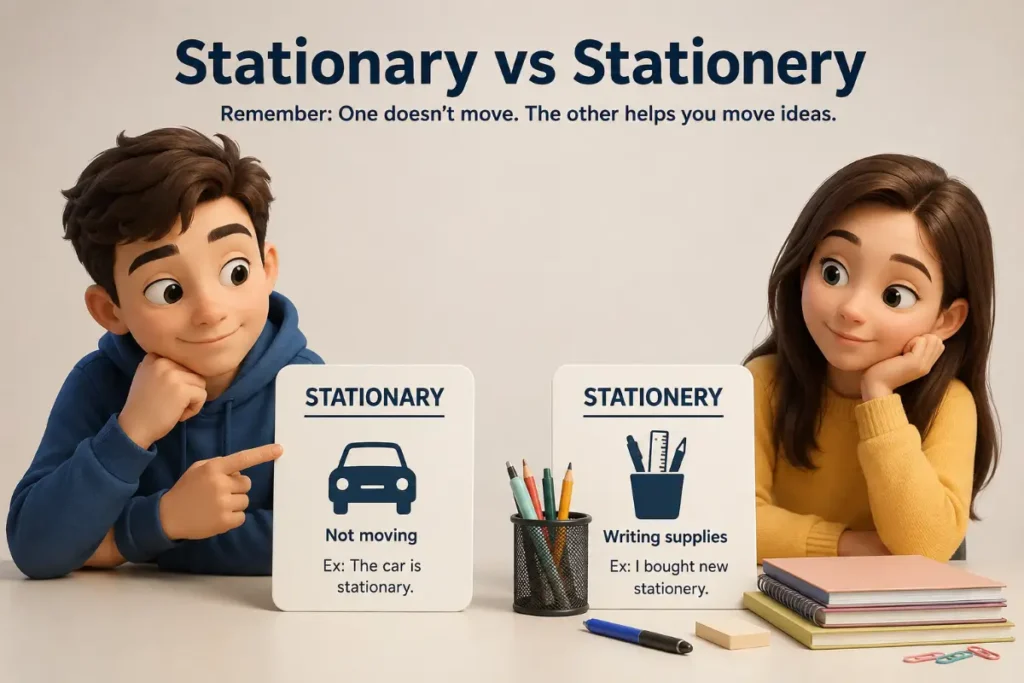
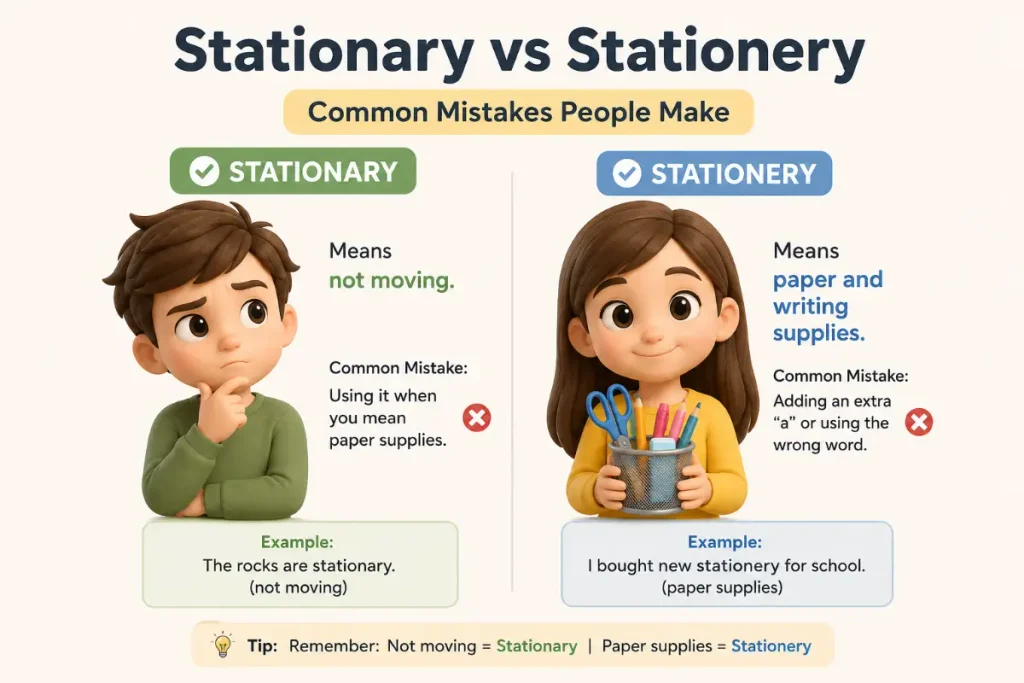
Stationary (with an A) means not moving, staying in place. Stationery (with an E) means paper and writing materials. Same sound, completely different words.
You may also find Lie vs Lay vs Laid: 20 Examples That Make It Easy (2026 Guide) helpful if you want to explore this topic further.
The Quick Answer
- Stationary (with an A) = not moving, fixed in place
- The car remained stationary at the red light.
- Stationery (with an E) = paper, envelopes, and writing materials
- She bought new stationery for writing thank-you notes.
The test: are you describing something that isn’t moving? Use stationary. Are you talking about paper, envelopes, or writing supplies? Use stationery.
Try it: “The bike at the gym is ___.” Is this about movement, or paper? Movement — it’s a fixed exercise bike. So it’s stationary: “The bike at the gym is stationary.”
Now try: “I need to buy some ___ for the wedding invitations.” Movement, or paper? Paper — you’re writing invitations. So it’s stationery: “I need to buy some stationery for the wedding invitations.”
The Trick That Makes This Permanent
Merriam-Webster points to what’s genuinely one of the most effective memory tricks for any commonly confused word pair: stationery and paper both contain the letters “ER.” Stationary, meanwhile, shares its ending with words like “stay” — think of the A in stationary as matching the A in “stay put.”
Put simply: paper has an E, stationery has an E — match the E’s. That’s the entire trick, and it works every single time, since it’s based on an actual shared letter pattern rather than an arbitrary association you have to memorize separately.
Stationary: Not Moving
Stationary is an adjective describing something fixed, immobile, or unchanging in position.
Examples:
- The truck stayed stationary while workers unloaded it.
- She rides a stationary bike every morning.
- The clouds seemed stationary against the still afternoon sky.
- Prices have remained largely stationary this quarter.
- The target on the range was stationary, unlike the moving ones.
Notice that stationary doesn’t only apply to physical objects — it can also describe something unchanging in a more abstract sense, like prices, conditions, or a situation that isn’t shifting. “The situation remained stationary for weeks” works just as well as describing a physically motionless object.

Stationery: Paper and Writing Materials
Stationery is a noun referring to paper, envelopes, pens, and related writing or office supplies — especially the kind used for formal letters and correspondence.
Examples:
- She wrote the thank-you note on elegant stationery.
- The office ordered new stationery with the updated logo.
- He collects vintage stationery from local shops.
- The wedding invitations were printed on custom stationery.
- I keep a drawer full of stationery for handwritten letters.
Stationery is typically treated as an uncountable noun — you don’t say “three stationeries,” you say “some stationery” or “a set of stationery,” the same way you’d handle “furniture” or “equipment.”
Where the Words Actually Come From
Understanding the origin makes the distinction stick even better. Both words trace back to the same root — “stationarius,” a Latin-derived term originally describing something fixed in place, like a permanent shop location, as opposed to a traveling merchant who moved from place to place.
Here’s the interesting split: a “stationer” originally referred to a bookseller who had a fixed, permanent shop — a “stationary” business — rather than a traveling peddler. Over time, “stationer” narrowed to specifically mean someone who sold paper, pens, and office goods from that fixed location. The goods themselves eventually took on the name “stationery,” directly borrowed from the seller’s title. Meanwhile, “stationary” kept its original, more general meaning of simply “not moving.”
So in a real sense, stationery (the paper) is named after the fact that it was originally sold from a stationary (fixed) location — the two words are historically connected, even though they’ve since split into entirely separate meanings in modern English.
The Fastest Way to Check Yourself
Step 1: Am I describing something that isn’t moving? If yes, it’s stationary, with an A.
Step 2: Am I talking about paper, envelopes, or writing supplies? If yes, it’s stationery, with an E.
Step 3: If genuinely stuck, use the paper/stationery E-match trick. Both words share the letters “ER” — paper, letter, stationery. If you’re writing on it, it has that E.
Another version some people find sticks better: “stationAry” has an A, like “stAy” — if it’s staying put, it’s stationary. “stationEry” has an E, like “lEtter” — if you write letters on it, it’s stationery.
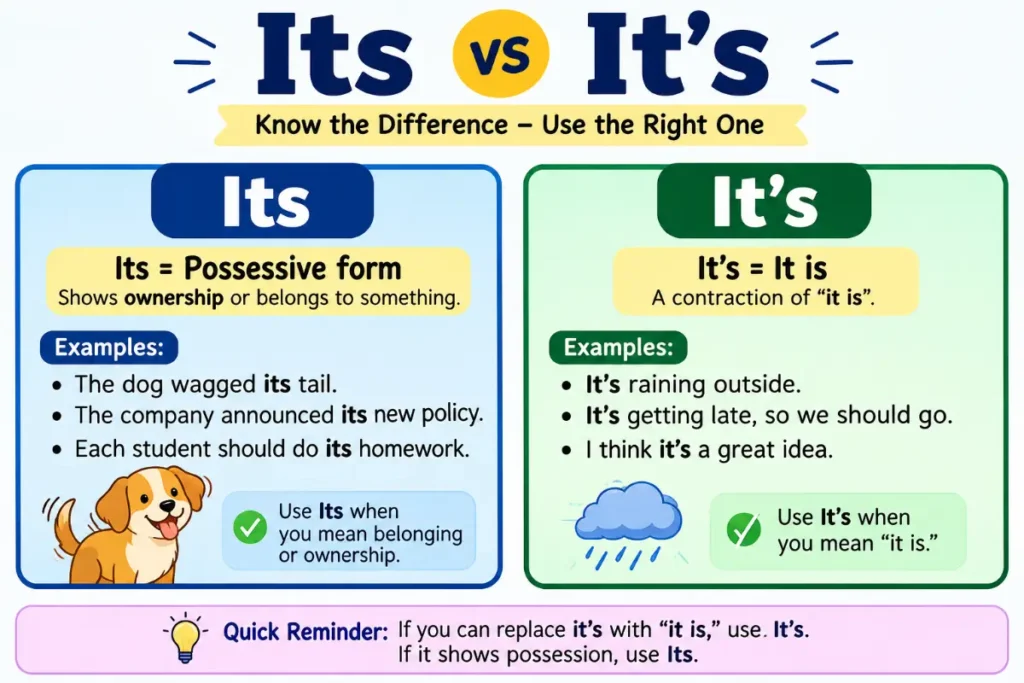
This is a similar kind of true-homophone situation to its and it’s — words that sound completely identical but do entirely different jobs, which is exactly why a solid letter-based memory trick works better here than trying to reason through grammar rules.
Stationary vs. Stationery: Side-by-Side Comparison
| Stationary | Stationery | |
|---|---|---|
| Part of speech | Adjective | Noun |
| Meaning | Not moving, fixed in place | Paper and writing materials |
| Memory trick | Shares “A” with “stay” | Shares “ER” with “paper” and “letter” |
| Example | a stationary vehicle | personalized stationery |
| Countable? | N/A (adjective) | Uncountable, like “furniture” |
| Common contexts | Exercise equipment, vehicles, prices, conditions | Letters, invitations, office supplies |
Common Mistakes People Make
Mistake 1: “I bought new stationary for the office.” Should be “stationery” — this refers to paper and writing supplies, not something that isn’t moving.
Mistake 2: “The stationery bike at the gym is broken.” Should be “stationary bike” — this describes a piece of equipment that stays in place, not paper.
Mistake 3: “The economy has remained relatively stationery this year.” Should be “stationary” — this is describing an unchanging economic condition, an abstract but still “not moving” sense of the word, not paper.
Mistake 4: “The company’s stationary features the new logo.” Should be “stationery” — letterhead, business cards, and branded paper goods all fall under this word.
Mistake 5: Relying on spell-check to catch it. Since both words are correctly spelled on their own, spell-check will not flag a wrong-but-valid choice here. This is exactly the kind of error that slips into published, professional writing unnoticed, especially in business communications and invitations, where getting it wrong can look distinctly unprofessional.
For another useful perspective, check out Continual vs Continuous: 20 Examples That Make It Clear (2026).
More Examples to Lock It In
- She kept the car stationary at the curb while she ran inside to grab her monogrammed stationery.
- The company invested in new stationery for client letters, even as its physical office location remained stationary for the tenth year running.
- He set up a stationary camera to film the event, then later wrote thank-you notes to the crew on custom stationery.
- The stationary bike in the corner of the room sat next to a desk covered in unused stationery.
- Weather patterns can remain stationary for days, which meteorologists sometimes describe using language borrowed from the same root as your favorite stationery brand.
What the Style Guides Say
Merriam-Webster directly recommends the paper/stationery “ER” memory trick as the most effective way to keep these two straight, noting that it’s one of the most commonly requested mnemonics among readers trying to sort out confusable word pairs. The AP Stylebook and Chicago Manual of Style both treat this as a standard, non-negotiable spelling distinction with no flexibility or regional variation — unlike some of the more debated pairs covered elsewhere on this site, there’s no usage controversy here at all, just a straightforward spelling to memorize.
Because this pair is a true homophone (identical pronunciation, unrelated modern meanings) rather than a genuinely debated grammar point, every major English-language authority treats it the same way, with the shared trick being the most efficient path to getting it right consistently.
Stationary and Stationery in Different Writing Contexts
In business and office writing, “stationery” appears constantly — letterhead, company stationery, stationery orders — and getting it wrong on something like official letterhead or a client-facing document can look genuinely careless.
In fitness and product writing, “stationary” shows up regularly to describe equipment (stationary bikes, stationary rowers) that doesn’t move during use, distinguishing it from equipment you take outdoors.
In event planning and invitation design, “stationery” is an industry-standard term covering everything from save-the-dates to formal invitations, and it’s worth getting right since it’s a term clients and vendors use constantly in that specific professional context.
In scientific, weather, and economic writing, “stationary” describes unchanging conditions — a stationary weather front, a stationary market — extending the “not moving” meaning into more abstract, technical territory.
A Closer Look at “Stationary” in Specialized Fields
Beyond everyday descriptions of objects that aren’t moving, “stationary” carries some specific technical uses worth knowing, since it shows up in fields well beyond casual writing.
In meteorology, a “stationary front” refers to a boundary between two air masses that isn’t advancing in either direction, often leading to prolonged periods of the same weather conditions in one location — a direct, literal extension of “not moving” applied to large-scale weather systems.
In physics and engineering, “stationary” describes an object or system in equilibrium, with no net movement or change over time — a stationary wave, for instance, is one where the wave pattern doesn’t appear to travel, even though the medium itself is oscillating.
In statistics, a “stationary process” is one whose statistical properties (like mean and variance) don’t change over time, a concept widely used in time-series analysis and forecasting.
In astronomy, a “geostationary” satellite orbits the Earth at exactly the same rate the Earth rotates, meaning it appears fixed in the sky from any given point on the ground — the “stationary” here refers to its apparent position relative to an observer, even though the satellite itself is actually moving through space at high speed.
In every one of these specialized uses, “stationary” holds onto its core, simple meaning: not changing position, or not changing over time. That consistency is part of what makes the word reliable across such a wide range of technical fields.
Frequently Asked Questions
Why do these two words sound exactly the same if they mean different things?
They’re true homophones that share a common historical root — both ultimately trace back to a Latin-derived word for something fixed in place. Over time, “stationery” narrowed specifically to mean the paper goods sold by a “stationer” (originally a bookseller with a fixed shop location), while “stationary” kept the broader, original meaning of simply “not moving.”
Is “stationery” always uncountable, or can you say “stationeries”?
Stationery is treated as an uncountable noun in standard English, similar to “furniture” or “luggage” — you’d say “some stationery,” “a set of stationery,” or “the stationery drawer,” not “three stationeries.”
Does “stationary” ever apply to something other than physical objects?
Yes — it regularly describes abstract, unchanging conditions too, like a stationary economy, a stationary weather pattern, or stationary prices, extending the “not moving” meaning beyond literal physical objects.
What’s the single best trick for remembering which is which?
Match the E’s: “papEr” and “lEttEr” both contain E, and so does “stationEry” — the paper one. This is the trick Merriam-Webster itself recommends, and it works reliably because it’s based on an actual shared letter pattern, not an arbitrary rule.
What’s the fastest way to catch this error before publishing something?
Search your document for every instance of “stationary” and “stationery,” and for each one, ask whether you’re describing something that isn’t moving or something you write on. Since spell-check won’t flag a wrong-but-valid word here, this manual check is the most reliable method.
Practice Exercise
Fill in the blank with either “stationary” or “stationery.” Answers are listed right after — try each one before checking.
- She wrote the letter on beautiful ______.
- The car remained ______ at the intersection.
- He ordered custom ______ for the company.
- The exercise bike is completely ______.
- I need to buy more ______ for the invitations.
- Prices have stayed ______ for months.
- The store sells fine ______ and greeting cards.
- The weather system became ______ over the coast.
- She keeps a drawer of ______ for handwritten notes.
- The satellite remains ______ relative to the Earth.
- We printed the menu on elegant ______.
- The target was ______ during target practice.
- He collects antique ______ from estate sales.
- The bus stayed ______ while passengers boarded.
- The wedding ______ arrived a week before the event.
- The economy remained largely ______ this quarter.
- She monogrammed her new ______ with her initials.
- The camera was mounted on a ______ tripod.
- The office restocked its ______ supply closet.
- The boat stayed ______ despite the current.
Answer Key
- stationery
- stationary
- stationery
- stationary
- stationery
- stationary
- stationery
- stationary
- stationery
- stationary
- stationery
- stationary
- stationery
- stationary
- stationery
- stationary
- stationery
- stationary
- stationery
- stationary
If you got sixteen or more correct, the paper/stationery “ER” trick has already become second nature. For any you missed, go back and check whether the sentence is about movement or about paper.
Before moving on, you may also want to read Their vs There vs They’re: How to Finally Stop Mixing Them Up for more helpful grammar tips.
The Bottom Line
Stationary (with an A) means not moving. Stationery (with an E) means paper and writing materials. The most reliable way to remember which is which: paper and letter both contain “ER,” and so does stationery — match the E’s, and you’ll never mix these up again.
The difference between Stationary vs Stationery becomes much easier once you connect each word to its meaning. If something stays in one place, use stationary; if you’re talking about writing paper, envelopes, or office supplies, use stationery.