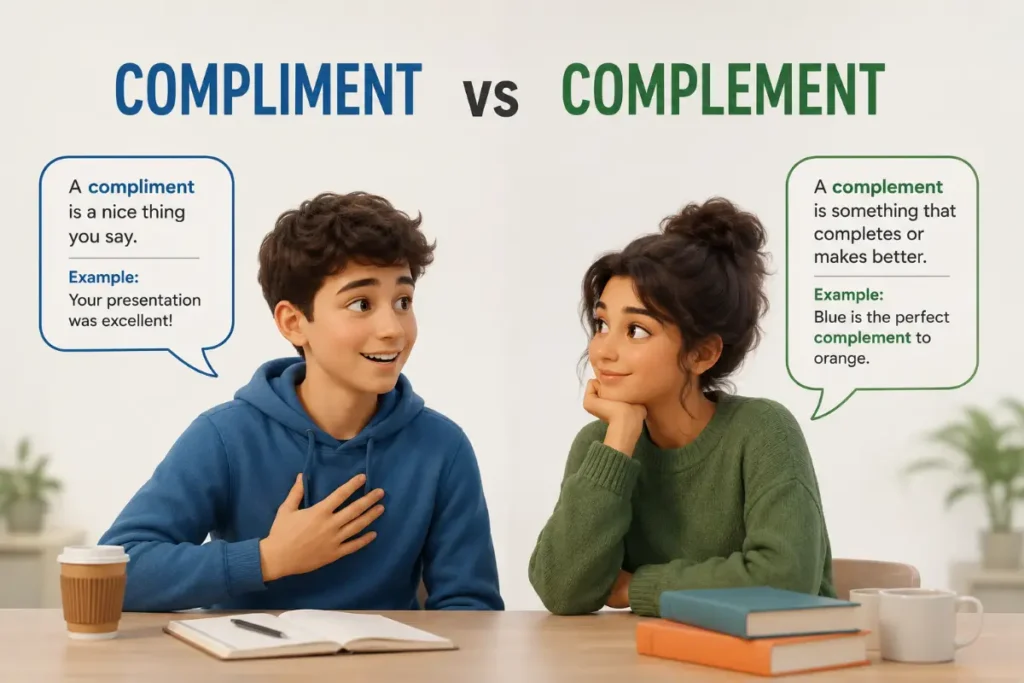
These two words are spelled almost identically, pronounced exactly the same way, and share a common ancestor in Latin — which is exactly why Compliment vs Complement gets mixed up so often, even in professional and published writing. The good news is that once you understand the small root-word connection between them, the distinction becomes much easier to remember permanently.
Compliment (with an I) is a kind or admiring remark. Complement (with an E) is something that completes or enhances something else. One letter, completely different meaning.
You may also find Adverse vs Averse: 5 Common Mistakes to Avoid (2026 Guide) helpful if you want to explore this topic further.
The Quick Answer
- Compliment (with an I) = a nice thing you say, praise, or admiration
- She gave me a lovely compliment on my presentation.
- Complement (with an E) = something that completes, enhances, or pairs well with something else
- The wine was a perfect complement to the meal.
The test: are you talking about praise or a kind remark? Use compliment. Are you talking about something that completes or enhances something else? Use complement.
Try it: “The scarf really ___ your outfit.” Is the scarf praising the outfit, or enhancing it? It’s enhancing it — so it’s complement: “The scarf really complements your outfit.”
Now try: “She paid me a lovely ___ on my cooking.” Is this praise or enhancement? Praise — so it’s compliment: “She paid me a lovely compliment on my cooking.”
Where the Confusion Actually Comes From
This isn’t a random spelling coincidence. Merriam-Webster traces both words back to the same Latin root, “complēre,” meaning “to complete.” Complement stayed close to that original meaning — it’s about completing or perfecting something. Compliment took a longer, more winding route through Italian and Spanish, eventually landing on a meaning tied to courtesy and admiring remarks, since paying someone a compliment was historically seen as a way of “completing” a polite social exchange.
That shared ancestry explains why the words look and sound so similar despite meaning completely different things today — and it’s actually a useful fact to hold onto, since remembering that “complement” connects to “complete” (both spelled with an E, both about wholeness) gives you a reliable anchor point whenever you’re unsure.
Compliment: Praise or Admiration
Compliment functions as both a noun (the praise itself) and a verb (the act of giving praise).
Examples:
- He complimented her on the presentation.
- Thank you for the compliment — that means a lot.
- She’s always quick to compliment her team’s hard work.
- “Compliments to the chef” is a classic way to praise a meal.
- I took it as a compliment when she said my writing was unusual.
Compliment can also appear as an adjective, “complimentary,” which has two related but distinct meanings: expressing praise (“a complimentary review”) or given for free as a courtesy (“complimentary breakfast,” “complimentary Wi-Fi”). Both senses trace back to the same idea of generosity and goodwill.
Complement: Completing or Enhancing
Complement functions as both a noun (the thing that completes) and a verb (the act of completing or enhancing).
Examples:
- The tie complements the suit perfectly.
- A full complement of staff was on hand for the event.
- This dessert is a wonderful complement to the meal.
- The two colors complement each other beautifully.
- We need a complement of tools to finish this job.
Complement also has specific technical meanings worth knowing: in grammar, a complement is a word or phrase that completes the meaning of a verb or clause (as in “they elected her mayor,” where “mayor” completes the sentence). In mathematics, complementary angles are two angles that add up to 90 degrees. In color theory, complementary colors sit opposite each other on the color wheel and enhance each other visually when paired.
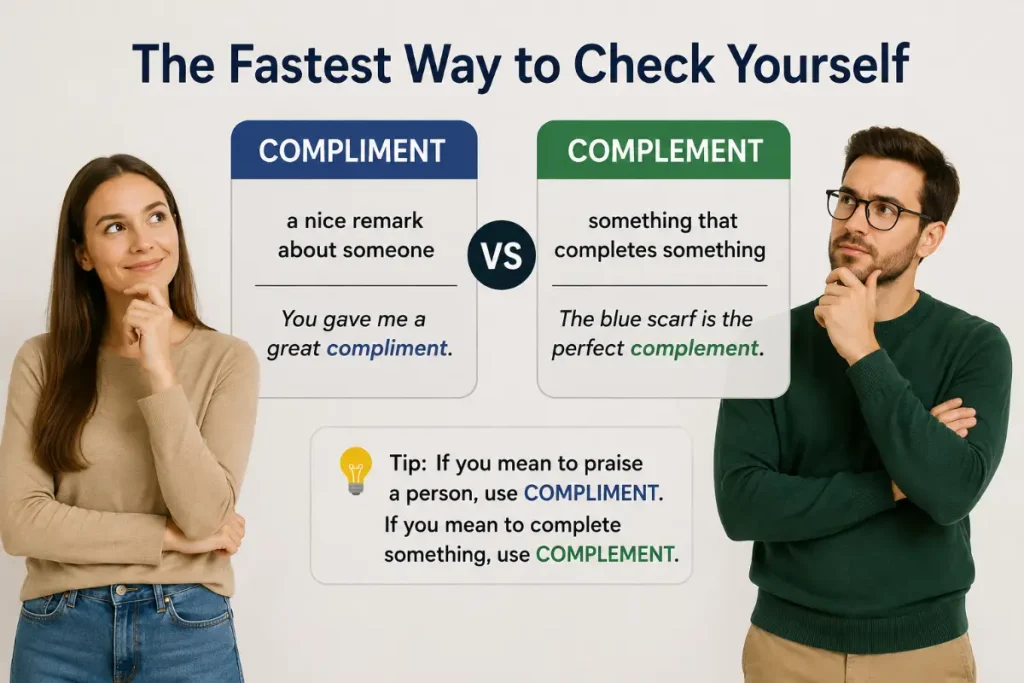
The Fastest Way to Check Yourself
Step 1: Are you talking about a kind remark or praise? If yes, it’s compliment, with an I.
Step 2: Are you talking about something completing, enhancing, or pairing well with something else? If yes, it’s complement, with an E.
The most reliable memory trick, and the one Merriam-Webster itself points to: complement shares its first six letters with complete, and both are spelled with an E. If you’re describing something that completes or rounds out something else, reach for the word that looks like “complete.” If you’re describing praise, you want the other spelling entirely.
Another version some writers use: “I like compliments” — both “I” and “like” and “compliments” all contain the letter I, reinforcing that compliment (with an I) is the one about being liked or praised.
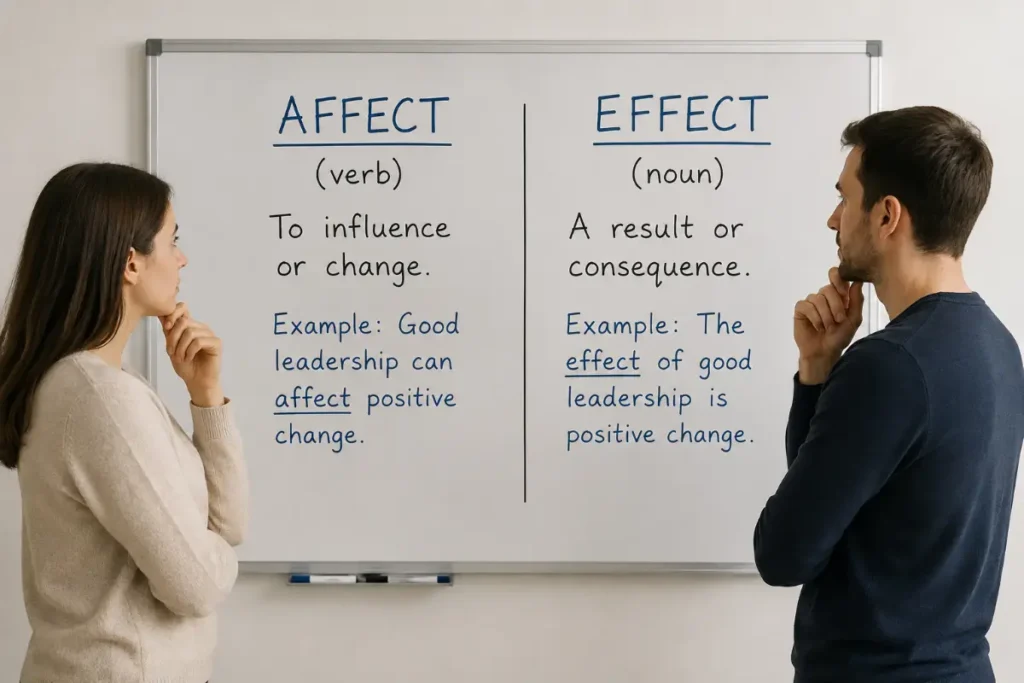
It’s a similar shared-root situation to affect and effect — two words that trace back to a common origin but drifted into completely separate meanings, which is exactly why a little etymology goes a long way toward locking the distinction in permanently.
Compliment vs. Complement: Side-by-Side Comparison
| Compliment | Complement | |
|---|---|---|
| Meaning | Praise or an admiring remark | Something that completes or enhances |
| Part of speech | Noun and verb | Noun and verb |
| Related word | Complimentary (praise, or free) | Complementary (completing, or paired) |
| Example | She complimented his speech. | The speech complemented the evening’s theme. |
| Root connection | From words meaning “courteous” | From Latin for “to complete” |
| Technical uses | None | Grammar, math, color theory |
Complimentary vs. Complementary: The Adjective Forms
Since these adjective forms show up constantly and carry their own point of confusion, they’re worth covering directly.
Complimentary means either “expressing praise” or “given free as a courtesy”:
- The reviewer was complimentary about the film’s cinematography.
- The hotel offers complimentary breakfast to all guests.
Complementary means “completing, enhancing, or pairing well together”:
- Red and green are complementary colors.
- The two departments have complementary skill sets.
- Complementary angles add up to 90 degrees.
Notice that “complimentary” meaning “free” is actually a metaphorical extension of the praise sense — offering something for free is, in a sense, a gesture of goodwill or a compliment to the recipient. That connection can help the “free” meaning feel less like a totally separate, unrelated definition to memorize.
Common Mistakes People Make
Mistake 1: “The colors really compliment each other in this room.” Should be “complement each other” — the colors are enhancing or pairing well with one another, not praising each other. This is one of the single most common versions of this error, especially in interior design and fashion writing.
Mistake 2: “Thank you for the complement on my work.” Should be “compliment” — this is praise being received, so it needs the I spelling.
Mistake 3: “We offer a complementary breakfast to all guests.” This one’s actually correct if the breakfast is meant to pair well with something else specifically, but almost always what’s intended is “complimentary breakfast” — meaning free. This mix-up shows up constantly in hospitality and marketing materials, sometimes changing the entire meaning of an offer.
Mistake 4: “She has a full compliment of tools for the job.” Should be “complement” — this refers to a complete set, not praise.
For another useful perspective, check out Loose vs Lose: The Missing-Letter Trick That Fixes This Forever (2026).
Mistake 5: Autocorrect making the swap silently. Because both words are correctly spelled on their own, spell-check won’t catch a wrong-but-valid choice here. This is one of the errors most likely to slip through unnoticed into published, professional writing.
More Examples to Lock It In
- She complimented the chef, who had created a menu with dishes that beautifully complemented each other.
- The complimentary wine tasting was a nice complement to the dinner reservation.
- He received several compliments on how well his tie complemented his suit.
- The team’s complementary skill sets meant everyone appreciated hearing genuine compliments about the final product.
- With a full complement of volunteers on hand, the event coordinator had nothing but compliments for the turnout.
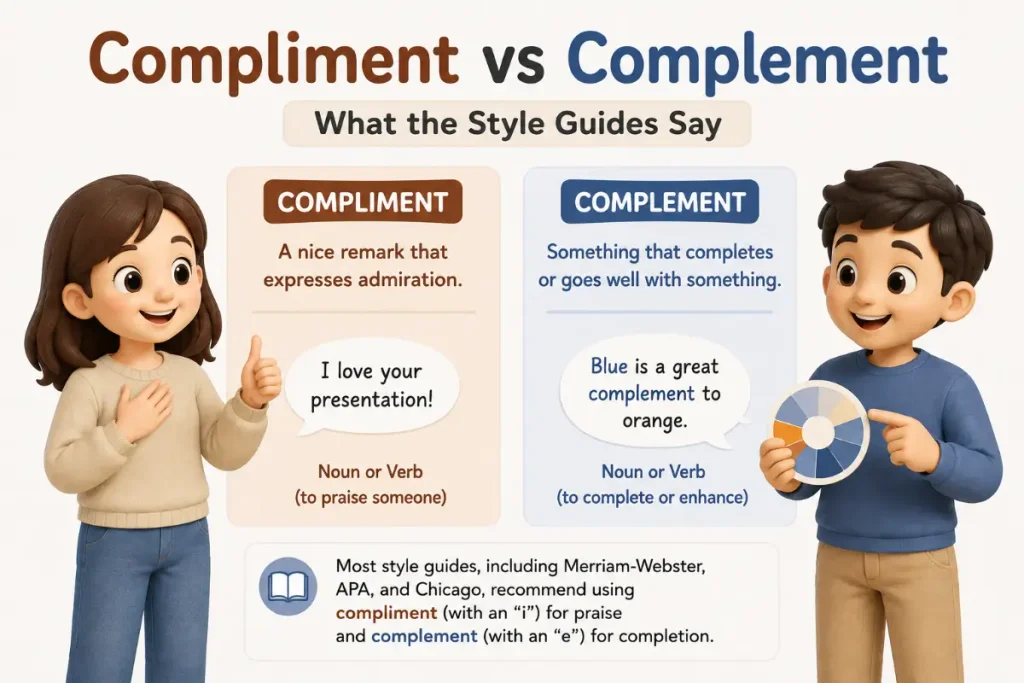
What the Style Guides Say
Merriam-Webster traces both words to the same Latin root and explicitly recommends anchoring “complement” to “complete” as the most reliable memory device, since both share the same first six letters and the same core meaning of wholeness. The AP Stylebook and Chicago Manual of Style both flag this pair as a commonly confused word set worth double-checking, particularly in hospitality, marketing, and design writing, where “complimentary” and “complementary” both appear frequently and carry genuinely different meanings that change what’s being offered or described.
Because the distinction here is purely about meaning (not a genuinely contested usage question, the way less/fewer or farther/further can be), every major English-language authority treats this the same way, with no real disagreement to navigate.
Compliment and Complement in Different Writing Contexts
- In hospitality and travel writing, “complimentary” (free) shows up constantly — complimentary breakfast, complimentary Wi-Fi, complimentary shuttle — and mixing this up with “complementary” can genuinely confuse a reader about whether something costs money.
- In interior design, fashion, and lifestyle writing, “complement” (pairing well, enhancing) is the workhorse word — colors that complement each other, accessories that complement an outfit — and this is the single most common place the compliment/complement error shows up in published content.
- In business and professional writing, both words appear regularly — complimenting a colleague’s work, describing complementary skill sets on a team — and getting the spelling right in each case is a small but noticeable marker of careful writing.
- In technical and academic writing, “complement” carries specific meanings in grammar, mathematics, and science, where precision matters and there’s no flexibility in which spelling is correct.
A Closer Look at the Technical Uses of “Complement”
Beyond everyday praise-versus-completion contexts, “complement” carries several precise technical meanings worth knowing, since they show up often enough in specialized writing to matter.
In grammar, a complement is a required word or phrase that completes the meaning of a verb, especially with linking verbs. “Happy” is a subject complement — without it, the sentence would feel incomplete in “she seems happy”. In “they named him captain,” “captain” is an object complement, completing the meaning of the verb “named.”
the complement of a set includes everything not in that set but within a larger defined universe — a concept used throughout probability and set theory in mathematics. Complementary angles, similarly, are two angles that together add up to exactly 90 degrees.
In biology and immunology, “complement” (often capitalized as “the complement system”) refers to a specific group of proteins in the immune system that work together to fight infection — a specialized use that has nothing to do with grammar or geometry, but still traces back to the same core idea of parts working together to complete a function.
In genetics, a “complementary” strand of DNA is one that pairs precisely with another strand according to base-pairing rules — another case where “complementary” describes two things that fit together to form a complete whole.
Across every one of these technical fields, the throughline is the same: complement, in any context, is about parts coming together to form something whole or complete — which is exactly the connection worth holding onto when deciding between the two spellings.
Frequently Asked Questions
Is “complimentary” always about being free, or can it mean something else?
It has two distinct meanings: expressing praise (“a complimentary review”) and given free as a courtesy (“complimentary parking”). Context usually makes clear which sense is intended, but it’s worth double-checking in marketing copy specifically, since confusing this with “complementary” changes whether something costs money.
What’s a “complement” in grammar, specifically?
A grammatical complement is a word or phrase needed to complete the meaning of a verb or clause — for example, “beautiful” in “I thought the music beautiful,” or “mayor” in “they elected her mayor.” Without the complement, the sentence would feel incomplete.
Are complementary colors and complimentary colors different things?
Only “complementary colors” is correct — this refers to colors positioned opposite each other on the color wheel that enhance one another visually. “Complimentary colors” is a common misspelling that doesn’t have an established meaning of its own.
Why do these two words look so similar if they mean completely different things?
They share the same ultimate Latin root, “complēre” (to complete), but took different paths into English — complement stayed close to that original meaning, while compliment developed a specific meaning around courtesy and praise as it passed through Italian and Spanish before entering English.
What’s the fastest way to catch this error before publishing something?
Search your document for every instance of “compliment,” “complement,” and their adjective forms, then ask: is this about praise, or about something completing or enhancing something else? Since spell-check won’t catch a wrong-but-valid word, this manual check is the most reliable method.
Practice Exercise
Fill in the blank with either “compliment” or “complement” (or their adjective forms). Answers are listed right after — try each one before checking.
- She gave him a genuine ______ on his speech.
- The scarf really ______s the dress.
- The hotel offers a ______ breakfast to guests.
- He has a full ______ of tools in his garage.
- I always ______ my coworkers on good work.
- Red and green are ______ colors.
- Thank you for the kind ______s on my presentation.
- The wine ______ed the meal beautifully.
- Their skill sets are genuinely ______.
- She was ______ed on her quick thinking during the crisis.
- The team needs a full ______ of players to compete.
- His ______ review praised every aspect of the film.
- This side dish is the perfect ______ to the main course.
- She blushed at the unexpected ______.
- The accessories ______ the outfit nicely.
- We received several ______s after the event.
- The two departments work well because their goals are ______.
- The airline offers ______ snacks on long flights.
- He always knows how to pay a sincere ______.
- The new logo ______s the brand’s overall design.
Answer Key
- compliment
- complement
- complimentary
- complement
- compliment
- complementary
- compliments
- complemented
- complementary
- complimented
- complement
- complimentary
- complement
- compliment
- complement
- compliments
- complementary
- complimentary
- compliment
- complements
If you got sixteen or more correct, the “complement connects to complete” trick has already become second nature. For any you missed, go back and ask whether the sentence is about praise or about something rounding out something else.
Before moving on, you may also want to read Peak vs Peek vs Pique: 7 Key Differences Explained (2026 Guide) for more helpful grammar tips.
The Bottom Line
Compliment (with an I) is praise or an admiring remark. Complement (with an E) is something that completes or enhances something else. The fastest way to keep them straight: complement shares its spelling pattern with complete, and both share the same core idea of wholeness. Compliment is about being kind; complement is about being complete.
A simple way to remember Compliment vs Complement is to think about what each word does. You compliment someone when you praise them, while something complements another thing when it adds to or improves it. Once you connect “complement” with “complete,” the difference becomes much easier to remember.