These examples of intransitive verbs share one trait: the action stops with the subject. In “The train arrived,” nothing receives the action. You can’t ask “arrived what?” and get an answer, which is exactly what makes “arrive” intransitive.
Our guide to examples of transitive verbs covered the other side of this distinction. This guide stays on the intransitive side: twenty clear examples sorted by what they describe, plus the phrasal verbs, look-alike pairs, and prepositional patterns that make intransitive verbs trickier than they first appear.
You may also find Complete List of Relative Pronouns (2026 Guide) helpful if you want to explore this topic further.
The One-Question Test
Ask “what?” or “whom?” right after the verb. If nothing answers, the verb is intransitive.
- The baby slept. (slept what? nothing, so intransitive)
- The baby ate cereal. (ate what? cereal, so transitive)
A second check is the passive voice test. Only transitive verbs can be turned into passive sentences, so “The train arrived” can’t become “The train was arrived.”
20 Examples of Intransitive Verbs, Sorted by Type
Verbs of Motion and Movement
- arrive — The guests arrived early.
- depart — The flight departs at noon.
- fall — Leaves fall in October.
- rise — The sun rises in the east.
- vanish — The magician’s coin vanished.
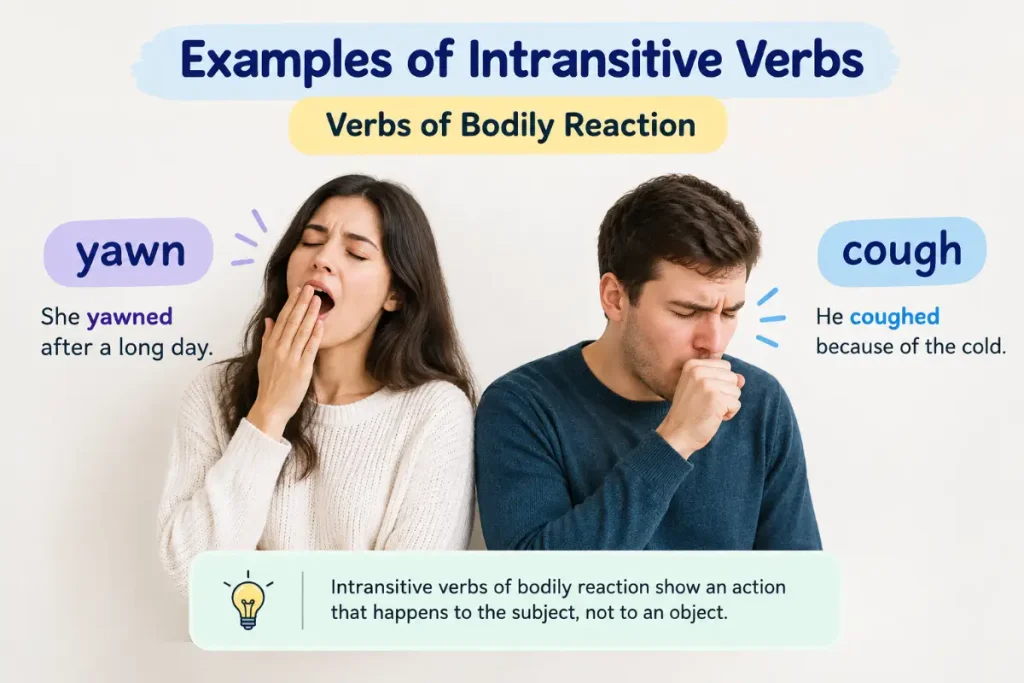
Verbs of Bodily Reaction
- sneeze — She sneezed twice.
- cough — He coughed all night.
- laugh — The audience laughed.
- cry — The baby cried.
- sleep — They slept soundly.
- faint — He fainted in the heat.
Verbs of Existence and Occurrence
- exist — Dinosaurs no longer exist.
- persist — The cough persisted for weeks.
- linger — The smell lingered in the hallway.
- occur — The accident occurred at dawn.
- happen — Strange things happen here.
Verbs of Natural Events
- bloom — The roses bloomed in May.
- wilt — The flowers wilted without water.
- sparkle — The lake sparkled in the sun.
- erupt — The volcano erupted overnight.
In every sentence above, the verb is complete without anything receiving its action.
10 More Examples of Intransitive Verbs in Everyday Sentences
Intransitive verbs appear in everyday conversations, stories, news reports, and academic writing. They describe actions or events that don’t require a direct object to complete their meaning. Here are 10 additional examples of intransitive verbs in sentences to help you recognize how they work in context.
- Dance: The couple danced until midnight.
- Smile: The little girl smiled at her teacher.
- Shout: Someone shouted from across the street.
- Travel: My parents travel frequently for work.
- Disappear: The rainbow disappeared after the rain.
- Sleep: The exhausted hikers slept under the stars.
- Apologize: He apologized for arriving late.
- Compete: Several athletes competed in the final.
- Recover: She recovered quickly after the long journey.
- Wait: We waited patiently outside the theater.
Notice that some sentences contain additional details. In “The little girl smiled at her teacher,” the phrase “at her teacher” identifies the target of the smile, but “her teacher” is the object of the preposition “at,” not a direct object of “smiled.”
Similarly, “He apologized for arriving late” includes a prepositional phrase that explains the reason for the apology. The verb “apologized” does not take a direct object.
These examples show that an intransitive verb can appear with adverbs, prepositional phrases, and other sentence elements while remaining intransitive.
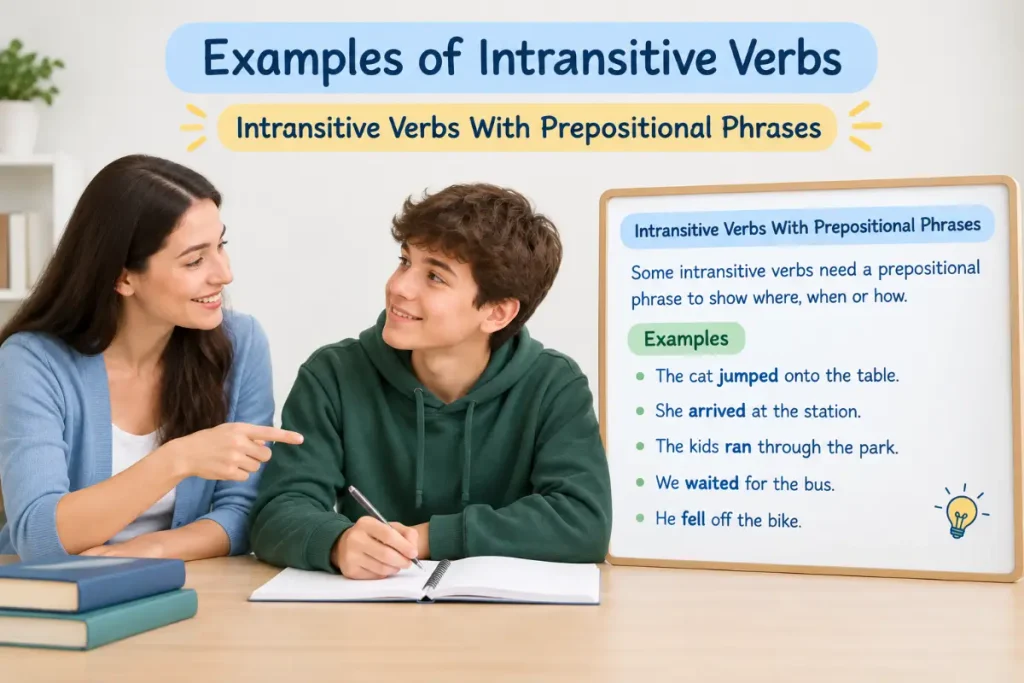
Intransitive Verbs With Prepositional Phrases
Many intransitive verbs are followed by a prepositional phrase that adds detail, which can make them look transitive. The noun inside the phrase is the object of the preposition, not a direct object of the verb.
- She arrived at the station. (“station” belongs to “at,” so “arrived” is still intransitive)
- He listened to the radio.
- They waited for the bus.
- The cat slept on the couch.
If the sentence would still be complete without the prepositional phrase, the verb is intransitive.
Intransitive Phrasal Verbs
Phrasal verbs combine a verb with a particle like up, down, or out, and many of them are intransitive. Purdue OWL’s list of intransitive phrasal verbs includes dozens, such as:
- calm down — Please calm down.
- catch on — The idea finally caught on.
- give up — He refused to give up.
- grow up — Children grow up quickly.
- show up — She showed up late.
- take off — The plane took off at six.
- wake up — I wake up at seven.
- work out — Everything worked out fine.
None of these takes a direct object. Compare them with transitive phrasal verbs like “turn off the light,” where an object is required.
Look-Alike Pairs: Intransitive vs. Transitive
Three common pairs of verbs differ only in whether they take an object, and mixing them up is a classic error.
| Intransitive (no object) | Transitive (needs an object) |
|---|---|
| lie — He lies on the sofa. | lay — He lays the book on the table. |
| sit — She sits on the bench. | set — She sets the cup on the bench. |
| rise — The sun rises. | raise — They raise the flag. |
The lie/lay pair is the trickiest because the past tense of “lie” is “lay,” a collision explained in our guide to lay vs lie.
Verbs That Go Both Ways
Some verbs are intransitive in one sentence and transitive in the next, depending on whether an object follows.
- The glass broke. (intransitive)
- He broke the glass. (transitive)
- We ate quickly. (intransitive)
- We ate dinner. (transitive)
Eat, read, write, run, grow, and break are all in this flexible group, so always check the specific sentence rather than assuming a verb’s category.
Can the Same Verb Be Transitive and Intransitive?
Yes. Many English verbs can function as either transitive or intransitive verbs, depending on how they’re used in a particular sentence. The key is to examine whether the verb takes a direct object in that sentence rather than assuming every use of the word follows the same pattern.
Consider these examples:
| Verb | Intransitive example | Transitive example |
|---|---|---|
| Break | The branch broke. | The wind broke the branch. |
| Change | The weather changed. | She changed her plans. |
| Cook | My father cooks every evening. | My father cooks dinner every evening. |
| Drive | She drives carefully. | She drives a delivery truck. |
| Grow | The children grow quickly. | Farmers grow vegetables. |
| Read | He reads before bed. | He reads mystery novels. |
| Sing | The audience sang loudly. | The singer sang a ballad. |
| Write | She writes every morning. | She writes short stories. |
In each intransitive example, the sentence is complete without a direct object. In the transitive example, a noun or noun phrase receives the action of the verb.
For instance, “She writes every morning” tells us what she does, but it doesn’t specify what she writes. In “She writes short stories,” the phrase “short stories” is the direct object.
Remember: A verb’s classification can change from sentence to sentence. Always examine how the verb functions in context instead of memorizing it as permanently transitive or intransitive.
Quick Reference Table
| Type | Examples | Sample Sentence |
|---|---|---|
| Motion | arrive, depart, fall, rise | The train arrived. |
| Bodily reaction | sneeze, cough, laugh, faint | She sneezed. |
| Existence | exist, persist, linger, occur | The smell lingered. |
| Natural events | bloom, wilt, sparkle, erupt | The volcano erupted. |
| Phrasal | calm down, grow up, show up | He showed up late. |
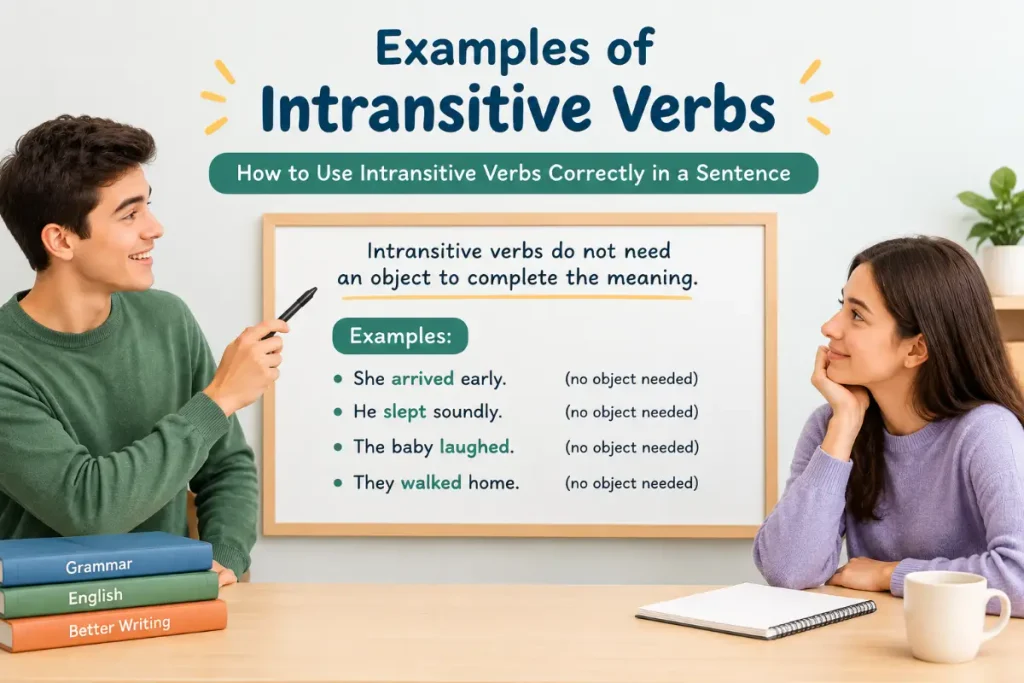
How to Use Intransitive Verbs Correctly in a Sentence
Using intransitive verbs correctly becomes easier when you understand what can follow them and what cannot. Although these verbs don’t take direct objects, they can still appear with adverbs, prepositional phrases, and other expressions that add meaning.
Follow these practical guidelines to avoid common grammatical errors.
1. Don’t add a direct object when the verb doesn’t allow one.
Incorrect: She arrived the airport at noon.
Correct: She arrived at the airport at noon.
The verb “arrived” is intransitive in this construction. The preposition “at” connects it to the location.
2. Use adverbs to describe how an action happens.
Correct: The children laughed loudly.
Here, “loudly” describes how the children laughed. It is an adverb, not a direct object.
For another useful perspective, check out List of Subordinating Conjunctions: 50+ Words With Examples (2026).
3. Recognize objects of prepositions.
Correct: He listened to the announcement.
“Announcement” is the object of the preposition “to.” It is not a direct object of “listened.”
4. Check verbs that can function in both ways.
Compare these sentences:
- The door opened. — Intransitive
- She opened the door. — Transitive
The verb “opened” functions differently in these two sentences because only the second sentence has a direct object.
5. Don’t force an intransitive verb into passive voice.
Incorrect: The accident was happened yesterday.
Correct: The accident happened yesterday.
The verb “happened” doesn’t take a direct object in this sentence, so it cannot form a standard passive construction.
Once you understand these patterns, you can identify intransitive verbs more confidently, construct clearer sentences, and avoid confusing direct objects with other sentence elements.
Common Mistakes People Make
- Mistake 1: Adding a direct object to an intransitive verb, as in “she arrived the airport.” The correct form uses a preposition: “she arrived at the airport.”
- Mistake 2: Mixing up lie and lay, or sit and set, so that a transitive verb is used without an object or an intransitive verb is given one.
- Mistake 3: Treating a prepositional phrase as a direct object and calling the verb transitive.
- Mistake 4: Assuming every verb has a fixed category when many can be either.
- Mistake 5: Trying to turn an intransitive verb into passive voice, which always produces a broken sentence.
Practice Exercise
Label the verb in each sentence as transitive (T) or intransitive (I). Answers are listed right after, so try each one before checking.
- The train arrived at noon.
- She opened the window.
- The baby slept soundly.
- He lay on the sofa.
- She laid the book on the table.
- We waited for the bus.
- The sun rises in the east.
- They raised the flag.
- The glass broke.
- He broke the glass.
- She sat on the bench.
- She set the cup on the bench.
- The flowers wilted.
- We ate dinner at six.
- We ate quickly.
- The volcano erupted.
- She wrote a novel.
- She wrote all night.
- He listened to the radio.
- The crowd cheered loudly.
Answer Key
- I
- T (opened what? the window)
- I
- I
- T (laid what? the book)
- I (for the bus is a prepositional phrase)
- I
- T (raised what? the flag)
- I
- T (broke what? the glass)
- I
- T (set what? the cup)
- I
- T (ate what? dinner)
- I
- I
- T (wrote what? a novel)
- I
- I (to the radio is a prepositional phrase)
- I
Frequently Asked Questions
Can an intransitive verb have an object?
Not a direct object. It can be followed by a prepositional phrase, whose noun is the object of the preposition rather than of the verb.
How can I tell an intransitive verb from a linking verb?
Both lack direct objects, but a linking verb connects the subject to a word that describes or renames it (“The soup tastes salty”), while an intransitive verb simply completes the action (“The baby slept”).
Why can’t intransitive verbs be passive?
Passive voice turns the object of an active sentence into the subject. With no object to promote, the conversion has nothing to work with, so “The train was arrived” fails.
Are phrasal verbs always intransitive?
No. Some phrasal verbs take objects (“turn off the light”), while others don’t (“wake up”). Purdue OWL separates them into intransitive, separable, and inseparable lists for exactly this reason.
What’s the fastest way to check whether a verb is intransitive?
Ask “what?” or “whom?” after the verb. If no noun answers, and the sentence is complete without anything receiving the action, it’s intransitive.
Before moving on, you may also want to read An Adverb? 25 Easy Examples to Understand It (2026) for more helpful grammar tips.
Final Thoughts
These examples of intransitive verbs show the pattern clearly: the action begins and ends with the subject, whether it’s a train arriving, a baby sleeping, or a volcano erupting. The “what?” test and the passive voice test both confirm it, and a following prepositional phrase never changes the verb’s category.
The real traps are the verbs that switch sides, like break and eat, and the look-alike pairs lie/lay, sit/set, and rise/raise. Check each sentence on its own terms, and the distinction stops being a guessing game.