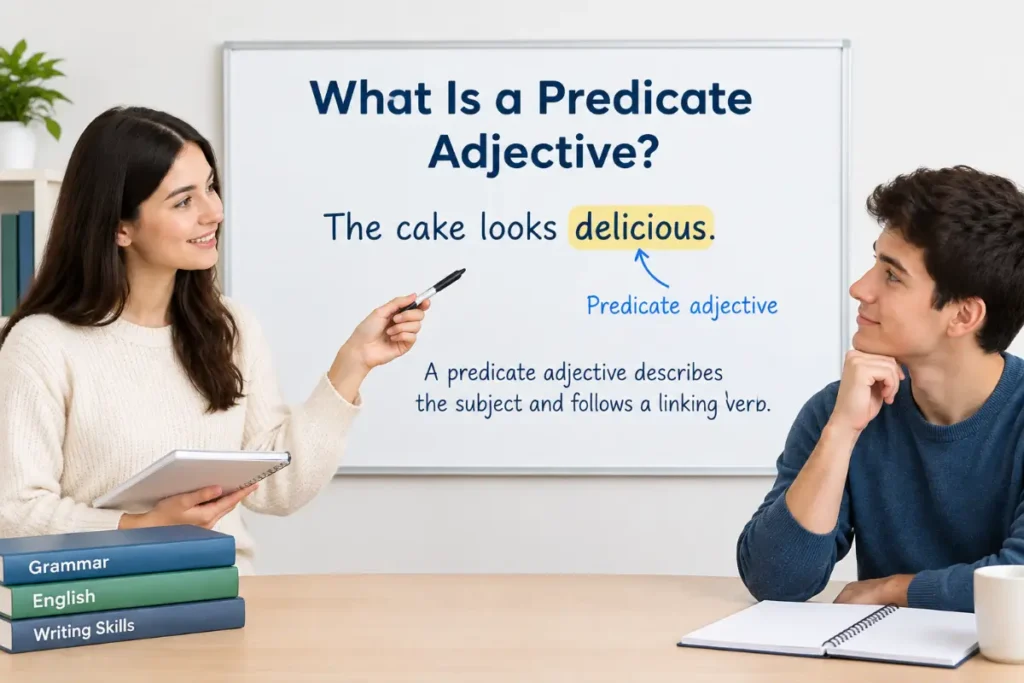
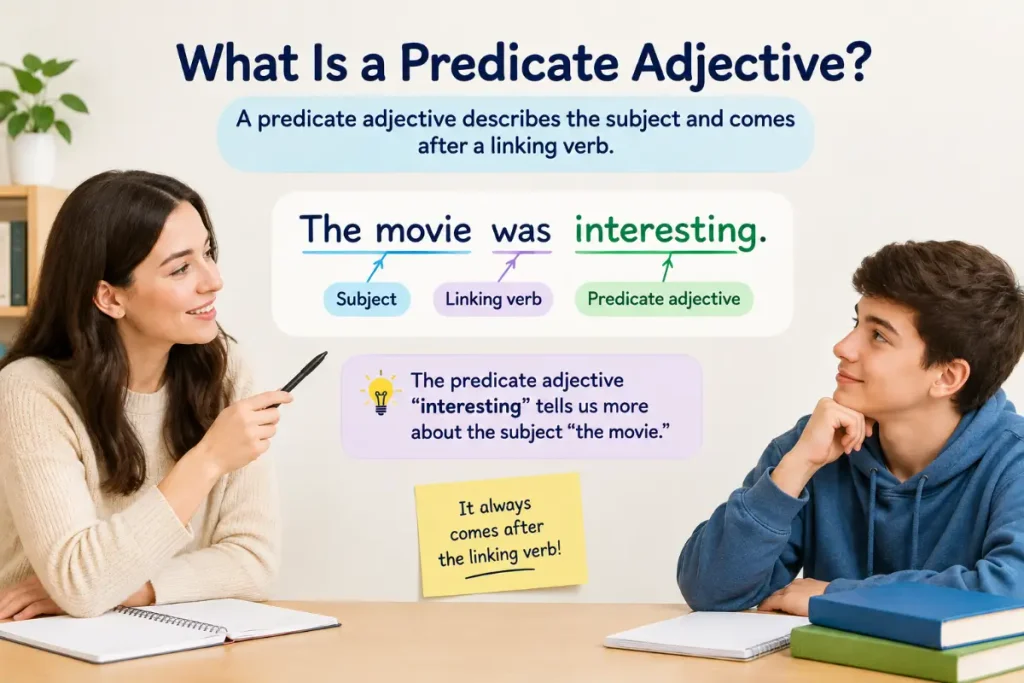
Here’s the plain answer to what is a predicate adjective: it’s an adjective that comes after a linking verb and describes the subject of the sentence. In “The soup tastes delicious,” the word “delicious” is the predicate adjective, because it follows the linking verb “tastes” and tells you something about the soup.
The pattern is simple enough to memorize as a formula, but the details are where people slip: which verbs count as linking verbs, how a predicate adjective differs from a predicate noun, and why the word after “smells” or “feels” is usually an adjective rather than an adverb. This guide takes those one at a time, with examples that show the difference.
You may also find An Adverb? 25 Easy Examples to Understand It (2026) helpful if you want to explore this topic further.
Predicate Adjective Examples in Different Types of Sentences
A predicate adjective describes the subject after a linking verb, but it can appear in many kinds of sentences. Recognizing it in statements, questions, and sentences with compound adjectives makes the concept easier to understand.
Simple statements:
- The weather feels pleasant.
- Her explanation was clear.
- The children seem excited.
Questions:
- Is the coffee hot?
- Why does he look upset?
- Are the instructions clear?
Sentences with two predicate adjectives:
- The room was quiet and comfortable.
- The puppy looks small but healthy.
- The instructions seemed confusing and incomplete.
In each example, the predicate adjective describes the subject rather than an action. In “The coffee is hot,” for instance, “hot” describes the coffee, while “is” connects the subject to that description.
Remember that a predicate adjective doesn’t have to be a single word. Two or more adjectives can describe the same subject, and they can still function as predicate adjectives when they follow a linking verb.
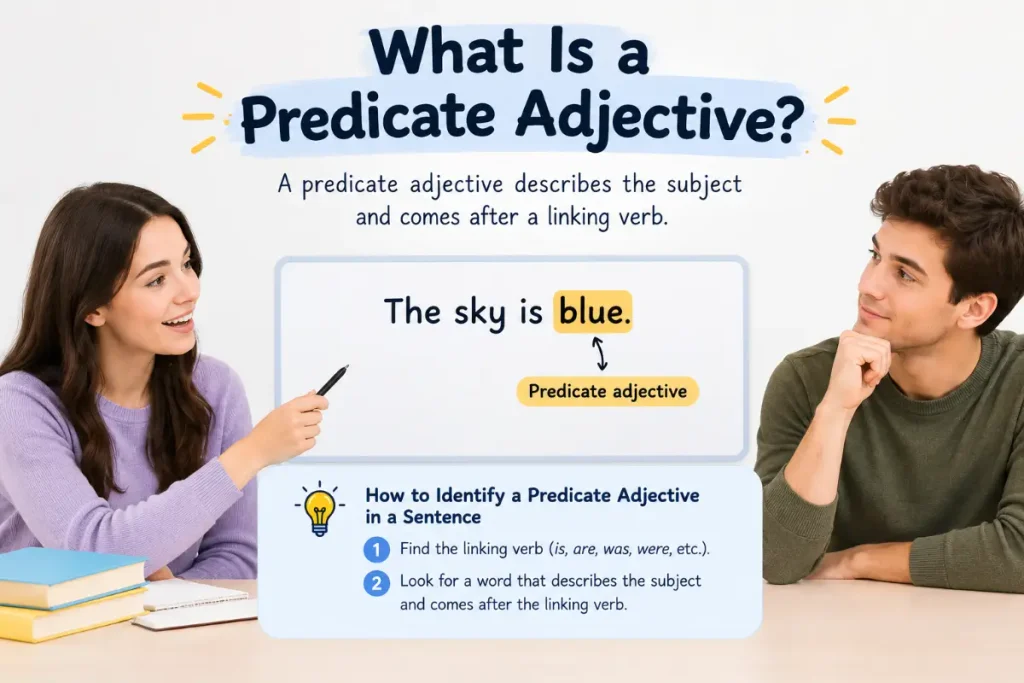
How to Identify a Predicate Adjective in a Sentence
Finding a predicate adjective becomes easier when you follow a simple process. Instead of looking for any adjective in the sentence, focus on the relationship between the subject, the verb, and the word that describes the subject.
Step 1: Identify the subject. Ask who or what the sentence is about.
Step 2: Find the verb. Check whether it acts as a linking verb, such as “is,” “seems,” “feels,” “looks,” or “became.”
Step 3: Look for a description of the subject. If an adjective follows the linking verb and describes the subject, it is a predicate adjective.
For example:
The exhausted runner seemed relieved.
- Subject: “The exhausted runner”
- Linking verb: “seemed”
- Predicate adjective: “relieved”
Notice that “exhausted” is also an adjective, but it appears before the noun “runner” and describes that noun directly. “Relieved,” on the other hand, follows the linking verb and describes the subject through the predicate.
Try another example:
The flowers grew beautiful and fragrant.
The subject is “The flowers,” the linking verb is “grew,” and “beautiful and fragrant” describes the subject. Both adjectives function as predicate adjectives.
One final check can help: ask whether the adjective describes the subject or an object. In “She painted the door red,” the word “red” describes the object “door,” not the subject “she.” It is therefore not a predicate adjective.
Predicate Adjective vs. Object Complement: What’s the Difference?
A predicate adjective and an object complement can both describe something in a sentence, but they refer to different parts of the sentence. A predicate adjective describes the subject and follows a linking verb. An object complement describes or identifies the direct object and typically follows an action verb.
Compare these examples:
Example 1: The soup tastes delicious.
- Subject: “The soup”
- Linking verb: “tastes”
- Predicate adjective: “delicious”
The adjective “delicious” describes the subject, “the soup.” It is a predicate adjective.
Example 2: The chef made the soup delicious.
- Subject: “The chef”
- Action verb: “made”
- Direct object: “the soup”
- Object complement: “delicious”
Here, “delicious” describes the direct object, “the soup,” rather than the subject, “the chef.” It functions as an object complement, not a predicate adjective.
Here is another comparison:
| Sentence | Word or phrase | Function |
|---|---|---|
| The sky became dark. | dark | Predicate adjective |
| The storm turned the sky dark. | dark | Object complement |
| The baby seems sleepy. | sleepy | Predicate adjective |
| The noise made the baby sleepy. | sleepy | Object complement |
The easiest way to distinguish them is to identify what the adjective describes. If it describes the subject after a linking verb, it is a predicate adjective. If it describes the direct object after an action verb, it is an object complement.
This distinction is useful because the position of an adjective alone does not determine its grammatical function. You must also consider the verb and the word the adjective describes.
The Formula
A predicate adjective always sits in the same slot: subject, then linking verb, then adjective.
- The sky became dark. (sky + became + dark)
- My brother is tall. (brother + is + tall)
- Your idea sounds reasonable. (idea + sounds + reasonable)
Daily Writing Tips explains the logic: the word “complement” comes from the verb “to complete,” and a predicate adjective completes the meaning of a linking verb by describing the subject. Without it, a sentence like “The sky became” would feel unfinished.

Which Verbs Can Introduce One
Three groups of verbs lead into a predicate adjective.
Forms of “be.” Am, is, are, was, were, been, and being. Daily Writing Tips notes that “to be” is the most common linking verb.
For another useful perspective, check out A Linking Verb? Easy Guide And 15+ Examples (2026).
- The children were restless.
State-change verbs. Become, grow, turn, remain, and stay.
- She grew impatient.
- The leaves turned brown.
Sense and appearance verbs. Look, feel, taste, smell, sound, seem, and appear.
- He looks nervous.
- In certain light, the fish appears transparent.
Many of these verbs also have an action meaning, so the swap test from our guide to what is a linking verb is worth keeping handy: if you can replace the verb with “is” and the sentence still makes sense, the verb is linking.
Predicate Adjective vs. Attributive Adjective
The same adjective can do its job in two different positions.
- The tall man left. (attributive: before the noun it describes)
- The man is tall. (predicate: after a linking verb)
Some adjectives only work in the predicate position. Words like asleep, afraid, alive, and alone sound natural after a linking verb (“The baby is asleep”) but awkward before a noun (“the asleep baby”).
Predicate Adjective vs. Predicate Nominative
Both are subject complements that follow a linking verb, but they do different work. Daily Writing Tips puts it simply: a predicate adjective describes the subject, while a predicate nominative is a noun or pronoun that renames it.
- She is brilliant. (predicate adjective: describes her)
- She is a genius. (predicate nominative: renames her)
The quick check: if the word describes a quality, it’s an adjective. If it names who or what the subject is, it’s a noun.
Adjective, Not Adverb
After a linking verb, you need an adjective because the word describes the subject, not the action. An adverb can’t complete a linking verb.
- The fish smells bad. (the fish needs attention)
- The fish smells badly. (the fish has a poor sense of smell)
The second sentence is grammatical but means something very different, which is why the adjective-or-adverb choice isn’t just a formality here. Our guide to what is an adverb example covers the adverb side of this distinction.
Predicate Adjective Phrases and Pairs
A predicate adjective can be a single word, a pair, or a longer phrase.
- The room was bright and cheerful. (two adjectives joined by “and”)
- She seems very tired after the trip. (an adjective phrase)
- The team was proud of its progress. (an adjective plus its complement)
When two adjectives are joined by “and,” no comma is needed. When there are three or more, they follow the usual series comma rule.
Where It Fits in the Sentence
A predicate adjective is part of the predicate, the half of the sentence that isn’t the subject. If you want the full picture of how subjects, verbs, and complements fit together, see our guide to what is a predicate in a sentence.
Quick Reference Table
| Sentence | Linking Verb | Predicate Adjective |
|---|---|---|
| The soup tastes delicious. | tastes | delicious |
| She seems exhausted. | seems | exhausted |
| The sky became dark. | became | dark |
| The room felt cold. | felt | cold |
| The answer is obvious. | is | obvious |
| They remained calm. | remained | calm |
Common Mistakes People Make
Mistake 1: Using an adverb after a sense verb, as in “she looks nicely” instead of “she looks nice.”
Mistake 2: Confusing a predicate adjective with a predicate nominative. “She is a genius” has a noun after the verb, not an adjective.
Mistake 3: Calling any adjective after a verb a predicate adjective. In “He painted the wall red,” the word “red” describes the wall (the object), not the subject, so it isn’t a predicate adjective.
Mistake 4: Assuming a sense verb is always linking. In “She tasted the soup carefully,” “tasted” is an action verb and “carefully” is an adverb.
Mistake 5: Putting a comma between the linking verb and the adjective, as in “The soup tastes, delicious.”
Practice Exercise
Write the predicate adjective in each sentence, or write “none” if there isn’t one. Answers are listed right after, so try each one before checking.
- The soup tastes delicious.
- She seems exhausted.
- The sky became dark.
- Your idea sounds reasonable.
- The children were restless.
- He looks nervous.
- The room felt cold.
- My brother is tall.
- The milk smells sour.
- They remained calm.
- The fabric feels soft and smooth.
- She grew impatient.
- The test was difficult.
- The leaves turned brown.
- He appears confident.
- The answer is obvious.
- The cake looks delicious.
- She tasted the soup carefully.
- He is a teacher.
- The meeting was long but productive.
Answer Key
- delicious
- exhausted
- dark
- reasonable
- restless
- nervous
- cold
- tall
- sour
- calm
- soft and smooth
- impatient
- difficult
- brown
- confident
- obvious
- delicious
- none (“tasted” is an action verb; “carefully” is an adverb)
- none (“teacher” is a predicate nominative)
- long but productive
Frequently Asked Questions
What’s the difference between a predicate adjective and a subject complement?
A subject complement is the broader category: any word or phrase after a linking verb that describes or renames the subject. A predicate adjective is the adjective version, and a predicate nominative is the noun version.
Can a predicate adjective come before the verb?
Not in the usual sense. A predicate adjective follows a linking verb. An adjective that comes before the noun it describes is an attributive adjective, even if it’s the same word.
Is a participle ever a predicate adjective?
Yes. In “The movie was boring” and “She was tired,” the words “boring” and “tired” come from verbs but work as adjectives after the linking verb.
Why do we say “I feel bad” instead of “I feel badly”?
“Feel” is acting as a linking verb here, and linking verbs take adjectives. Usage guides are not unanimous about “feel badly,” but “feel bad” is the standard, safe choice for describing your state.
What’s the fastest way to find a predicate adjective?
Find the linking verb first, then look at what follows. If it’s an adjective describing the subject, you’ve found it. If it’s a noun renaming the subject, it’s a predicate nominative instead.
Before moving on, you may also want to read List of Prepositions: 100+ Words You Need to Know (2026) for more helpful grammar tips.
The Takeaway
Knowing what is a predicate adjective comes down to one pattern: a subject, a linking verb, and an adjective that describes that subject. The verb can be a form of “be,” a state-change verb like “become,” or a sense verb like “taste,” and the word that follows is an adjective, never an adverb.
Keep the swap test and the noun-versus-adjective check in mind, and you’ll catch the common errors: “looks nicely,” confusing complements with objects, and treating action verbs as linking ones. It’s a small concept that quietly explains a lot of everyday grammar choices.